 GRI Institute
How geopolitical turmoil and cautious capital are reshaping European real estate
Exclusive senior insights from GRI Women Leading European Real Estate - Summer Edition on macro shocks, debt market trends, and conviction-driven deployment
September 30, 2026Real Estate
Written by:Rory Hickman
Executive Summary
European commercial real estate is undergoing a structural recalibration, as persistent macro volatility and changing interest rate expectations drive institutional focus towards income durability, operational efficiency, and fundamental asset performance.
This report reveals the biggest talking points and survey results from the latest edition of our Women Leading European Real Estate 2026 roundtable discussion as part of Europe GRI 2026 - Summer Edition, featuring the industry’s most senior female leaders debating macro resilience and capital allocation strategies.
With global real estate markets facing prolonged execution cycles and shifting capital requirements, we examine how top decision-makers are navigating geopolitical risk, assessing alternative credit expansion, and positioning capital across thematic sectors to secure long-term regional growth.
► Learn more about the GRI Institute’s Women Leading Real Estate Committee - Europe Chapter here
► These discussions continue at GRI Commercial RE & Data Centres Europe 2026 and GRI Credit & Debt Opportunities 2026
This report reveals the biggest talking points and survey results from the latest edition of our Women Leading European Real Estate 2026 roundtable discussion as part of Europe GRI 2026 - Summer Edition, featuring the industry’s most senior female leaders debating macro resilience and capital allocation strategies.
With global real estate markets facing prolonged execution cycles and shifting capital requirements, we examine how top decision-makers are navigating geopolitical risk, assessing alternative credit expansion, and positioning capital across thematic sectors to secure long-term regional growth.
► Learn more about the GRI Institute’s Women Leading Real Estate Committee - Europe Chapter here
► These discussions continue at GRI Commercial RE & Data Centres Europe 2026 and GRI Credit & Debt Opportunities 2026
Key Takeaways
- Persistent geopolitical instability and elevated benchmark interest rates are driving private real estate investors to maintain a highly cautious and defensive posture.
- Institutional capital is consolidating around operationally backed, demographically supported asset classes including living, logistics, and digital infrastructure.
- Long-term performance across European markets will ultimately depend on hands-on asset management, disciplined cost control, and strong property-level fundamentals.
► Navigating European Real Estate Today

(GRI Institute)
Macroeconomic and Geopolitical Catalysts
The European real estate market is navigating a complex web of geopolitical shocks in late 2026, including continuing Middle Eastern conflicts, global shipping disruptions, rapidly shifting tariff policies, and the ongoing Russo-Ukrainian War.These overlapping events have fundamentally altered the macroeconomic landscape, driving up inflation and prompting immediate interest rate adjustments.
Industry experts identify the fallout from the unresolved 2026 Iran War as the most acute disruptor, as the resulting energy price surges directly pushed government ten-year yields up by 45 to 65 basis points.
While core inflation in Europe appears relatively contained, rising energy costs remain a persistent headwind that directly compresses cap rates and debt yields.
Alternatively, some market participants argue that the broader interest rate environment itself, rather than isolated geopolitical events, is the primary driver of market pullbacks. In this view, capital is not entirely frozen but is naturally flowing away from real estate as investors continually re-evaluate yield versus risk.
Furthermore, there is a pronounced disconnect in how different markets process these macroeconomic shocks. Public equity markets reprice rapidly, often recovering within weeks, whereas private real estate valuation cycles operate on a quarterly lag.
This structural delay fosters a wait-and-see approach, causing private market investors to pause significant capital deployment until market stability returns.
Cross-Border Capital Shifts and Strategies
Despite the sheer scale and liquidity of the US market, the EMEA region continues to capture a dominant share of global cross-border real estate investment. Recent data indicates that Europe secures the highest volume of international capital per capita, with funds concentrating in larger, highly liquid destination markets.A significant driver of this trend is the strategic reallocation of Asian institutional capital. Historically focused heavily on the US, these investors are increasingly targeting European core assets to secure predictable, guaranteed income generation in an uncertain environment.
Concurrently, high currency hedging costs have bifurcated risk strategies across the Atlantic. International investors are maintaining core asset allocations within Europe but are moving further up the risk curve into value-add strategies when deploying capital in the US to achieve their required return premiums.
Beyond broader regional shifts, localised supply chain restructuring has drastically impacted Central Europe. Trade routes connecting Asia to European markets are being heavily diverted through countries such as Poland, Germany, and the Netherlands.
The restoration of overland rail links and the rapid expansion of regional port capacities have absorbed massive amounts of industrial space. Logistics vacancy rates in these transport corridors have consequently compressed toward 5%, driving rental rates in key border logistics hubs up by as much as 50% over recent years.

(GRI Institute)
Sector-Specific Dynamics and Trends
The European debt market has experienced a structural transformation, with non-bank lending expanding from less than 1% prior to the 2008 financial crisis to approximately 40% to 50% today.This massive growth is indirectly supported by traditional banking institutions, which are partnering with alternative lenders to achieve better regulatory capital outcomes.
As traditional lenders retrench from office and retail exposure, alternative credit funds are selectively filling the liquidity gap, targeting prime assets backed by well-capitalised sponsors.
The concurrent retreat of regional banking entities in the US has created a highly competitive, lucrative back-leverage market for private credit vehicles.
The living and residential sector remains a primary target for institutional capital globally, evidenced by an 86 billion USD influx and a 109% year-to-date surge in Asian residential investment. Southern European markets, including Spain and Italy, alongside the Netherlands, are experiencing intense demand for purpose-built accommodations.
However, the sector faces severe macroeconomic headwinds. Assets acquired during the 2021 pricing peak, underwritten at compressed cap rates of around 3%, are now struggling against ten-year benchmark yields exceeding 5%.
Furthermore, new development viability is challenged by European residential construction costs that currently sit 43% to 48% higher than 2015 levels.
To navigate these pressures, investors are increasingly discriminating between granular sub-sectors, shifting focus toward niche operational assets such as student housing, senior living, and single-family rentals.
Digital infrastructure has emerged as a critical, albeit complex, frontier for real estate capital. Data centre development is heavily constrained by massive power requirements, rapidly shifting national and EU regulations, grid capacity limitations, and an increase in local community levies.
Consequently, the sector is dominated by a select group of highly capitalised institutional developers focused on pre-leased hyperscale facilities backed by robust corporate guarantees.
A fundamental debate is currently underway regarding the strict classification of these assets. Many industry leaders argue that data centres must be underwritten, regulated, and financed strictly as digital infrastructure rather than traditional real estate to properly account for their unique operational profiles and obsolescence timelines.

(GRI Institute)
Portfolio Management and Operational Execution
In an era of elevated geopolitical and financial volatility, industry consensus dictates that attempting to time private market cycles is an inherently flawed strategy. Instead, long-term portfolio resilience depends heavily on operational excellence and the rigorous extraction of net operating income (NOI).Fund managers capable of driving asset-level alpha through active management will increasingly differentiate themselves from those relying on passive beta growth.
While macroeconomic shocks inevitably cause transaction pauses, these periods of dislocation present unique opportunities. Debt funds, for example, have successfully leveraged market hesitation to acquire discounted syndicated loan positions from traditional banks looking to offload exposure.
Ultimately, despite the fragmented geopolitical environment, the primary driver of successful real estate investment remains a strict adherence to underlying property fundamentals.
► Real Estate Leader Barometer Results
Predicted Geopolitical Shock Impacts
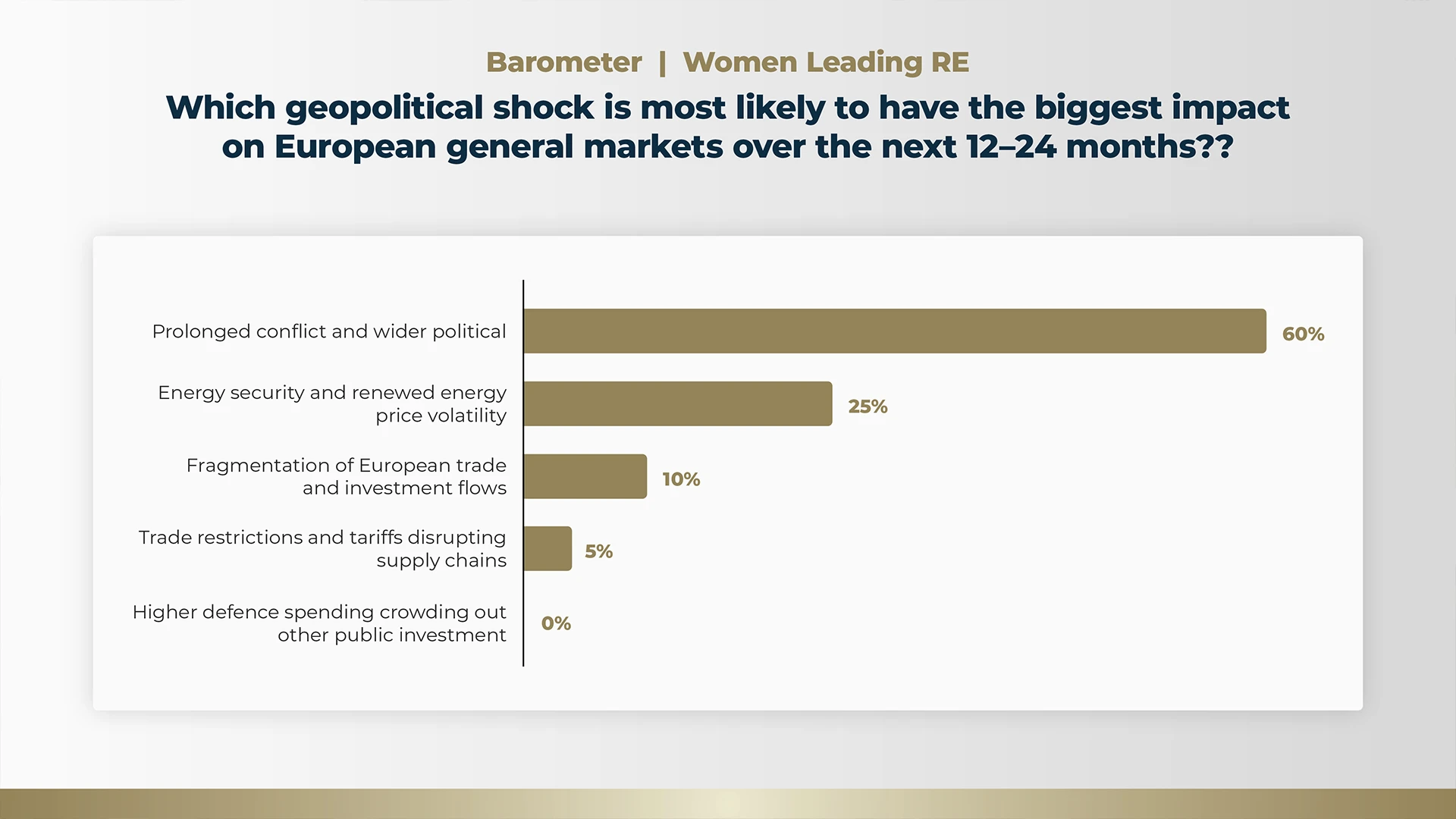
The survey results reveal an overwhelming consensus among market participants, with 60% identifying prolonged conflict and wider political instability as the most critical threat to European markets over the next 12 to 24 months.
Energy security and energy price volatility formed the second largest concern at 25%, while trade fragmentation, supply chain tariff disruptions, and defence spending crowding out public investment registered lower anxieties at 10%, 5%, and 0% respectively.
Leaders characterised these findings as a clear warning, noting that industry sentiment is far more deeply shaped by broader political turmoil than by isolated trade policy friction.
In terms of strategic decision-making, this pronounced focus on systemic geopolitical disruption implies that institutional investors and lenders will maintain a defensive posture, prioritising liquidity, stress-testing portfolios against energy price spikes, and demanding higher risk premiums before committing long-term capital.
Geopolitical Fragmentation vs European Investment
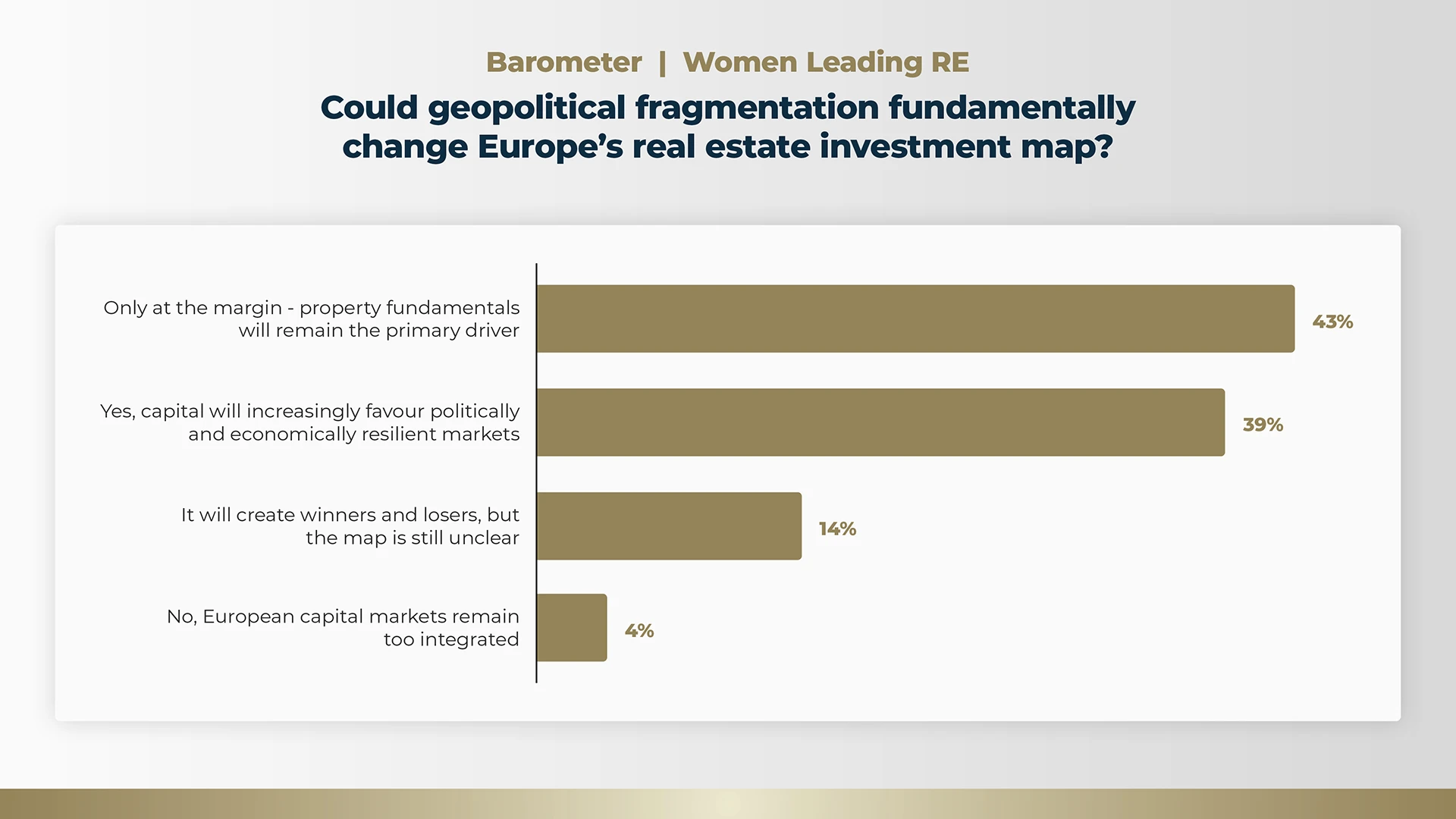
When evaluating the long-term geography of capital flows, sentiment remains closely split between traditional micro-level underwriting and macro risk mitigation.
A plurality of respondents (43%) contend that geopolitical fragmentation will alter the investment map only at the margin, affirming that property-level fundamentals remain the primary driver of real estate allocation.
Nevertheless, a significant 39% subset foresees a structural shift toward politically and economically resilient markets, reflecting a growing flight to safety among global institutional LPs.
A further 14% acknowledge that fragmentation will inevitably create regional winners and losers even if the final topography remains unclear, while just 4% view European capital integration as robust enough to resist these pressures.
These dynamics mirror the broader panel consensus that, while geopolitical shocks prompt strategic pauses and subtle geographic pivots, future investment decisions will ultimately prioritise asset-level cash flow generation, strong tenancy, and localised operational strengths over speculative geographic shifts.
Operational Impacts of Geopolitical Risk
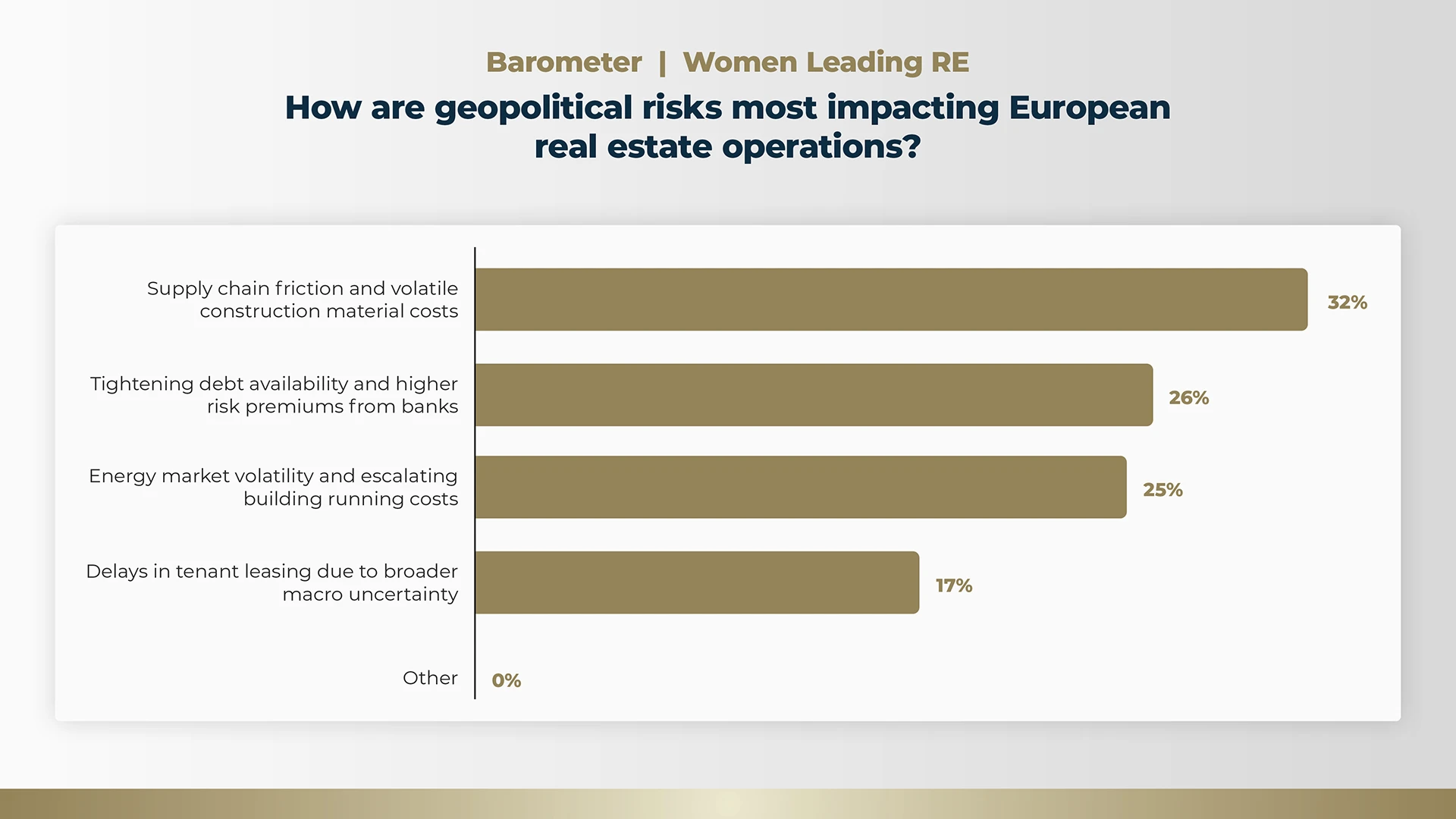
On an operational level, tangible supply chain frictions and erratic construction material costs represent the single greatest day-to-day headache for real estate managers, capturing 32% of responses.
This acute execution pressure is compounded by a dual squeeze on financial and property-level performance, with 26% of market participants pointing to tightened bank debt availability alongside elevated risk premiums, and 25% highlighting energy market volatility and escalating building operating expenses.
Broader macroeconomic uncertainty also continues to hamper leasing momentum, with 17% citing protracted tenant decision-making timelines.
These results illustrate how geopolitical turmoil directly filters down to asset-level cash flows, eroding net operating margins and undermining development viability.
Moving forward, capital deployment decisions will heavily favour assets with locked-in construction costs, energy-efficient operational profiles, and secure, pre-leased cash flows that insulate sponsors from unpredictable build-out delays and refinancing bottlenecks.
Current Conviction-Driven Capital Deployment
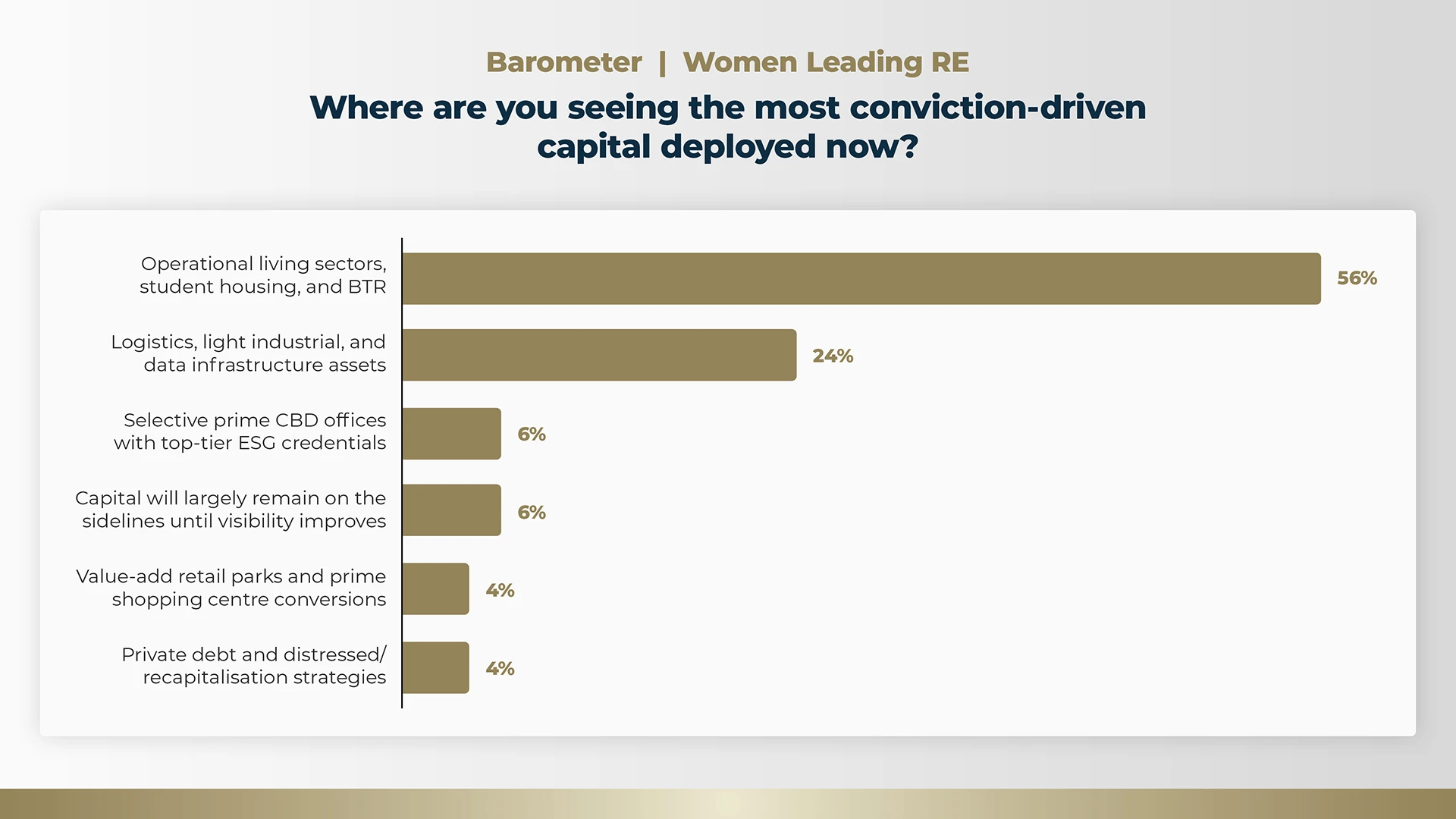
When tracking conviction-driven capital deployment, current survey results demonstrate an even deeper consolidation around structural thematic strategies than observed earlier in the year.
Operational living sectors, student housing (PBSA), and build-to-rent (BTR) capture a commanding 56% majority of institutional conviction, while logistics, light industrial, and data infrastructure assets account for 24%.
Selective prime CBD offices with top-tier ESG credentials and capital remaining on the sidelines represent just 6% each, with value-add retail parks and private debt or distressed recapitalisation strategies trailing at 4% apiece.
Comparing these figures against those from the Barometer conducted during the GRI Women Leading European Real Estate - Winter Edition gathering in February reveals significant shifts in investor sentiment and deployment decisions.
At the beginning of the year, the living sector attracted 53% of conviction, logistics and infrastructure stood at 20%, niche alternatives held 13%, and opportunistic debt or recapitalisations captured 13%.
The step-up in living and logistics over the course of 2026 underscores how persistent macroeconomic uncertainty has solidified capital commitment around demographically backed, cash-flow-resilient asset classes.
Conversely, the notable contraction in opportunistic debt and recapitalisation strategies from 13% down to 4% suggests that, despite widespread discussion surrounding a global refinancing wall, actual investor appetite has migrated away from speculative distress plays toward defensive, operationally backed yield.
This evolution confirms that future capital allocation will remain tightly focused on structural demand drivers, with institutional investors choosing to deploy actively into beds, sheds, and digital infrastructure rather than holding excess cash or taking outsized cyclical risks.
► Conclusion
Looking ahead, the European real estate landscape is entering a phase of heightened strategic discipline, where persistent geopolitical volatility, elevated benchmark interest rates, and operational cost pressures will continue to enforce a rigorous flight to safety.Rather than pausing allocation indefinitely or chasing speculative cyclical distress, institutional capital is decisively consolidating around demographically backed, operationally resilient asset classes that offer dependable cash flow generation.
While global LPs continuously refine their cross-border strategies and adapt to evolving supply chain trade hubs, the industry's ultimate trajectory will not be dictated by speculative market timing or geopolitical fragmentation, but by hands-on asset management, disciplined cost control, robust NOI extraction, and a fundamental return to property-level strength.
► Join us to continue these discussions at upcoming GRI Institute Europe gatherings, including GRI Commercial RE & Data Centres Europe 2026 and GRI Credit & Debt Opportunities 2026.
These insights and GRI Barometer results were collected during the GRI Institute’s Women Leading European RE 2026 - Summer Edition roundtable discussion, moderated by Audrey Klein (Spencer House Partners) and with participation from Eugenie Dadachpour (GID), Irene Ryan (Starwood Capital Group), and Nioki Doggett (M&G Investments).
► Enquire about joining the GRI Institute’s Women Leading Real Estate Committee here