 GRI Institute
REwired through AI: Europe GRI C-Circle Private Discussion and Barometer Insights
How leading real estate decision-makers are leveraging cutting-edge automation to eliminate friction, cut overheads, and future-proof portfolios
September 18, 2026Real Estate
Written by:Rory Hickman
Executive Summary
Last week’s GRI C-Circle Private Discussion on AI, co-hosted by McKinsey & Company during Europe GRI 2026 - Summer Edition, gave European real estate’s most senior decision-makers the opportunity for a closed-door debate on the realities of how artificial intelligence is impacting the industry.
What emerged was a clear consensus: AI is no longer a distant productivity gimmick, but a transformative force driving sharp market dispersion across the built environment.
As autonomous multi-agent systems move beyond simple digital assistants, the gap between tech-enabled prime assets and lagging secondary stock is widening, while internal operations undergo a quiet revolution.
From underwriting and portfolio asset management to physical power constraints, industry leaders are shifting focus from speculative hype to hard operational realities - prioritising cost efficiency, eliminating transaction friction, and tackling the organisational bottlenecks required to scale enterprise capabilities.
Ahead of further GRI Institute gatherings to address the impacts of AI on European real estate, including GRI Commercial RE & Data Centres Europe 2026, we examine the core themes from the debate alongside exclusive insights from our C-Circle Barometer survey.
► Apply for the chance to join the C-Circle at GRI Global Real Estate Forum 2027
What emerged was a clear consensus: AI is no longer a distant productivity gimmick, but a transformative force driving sharp market dispersion across the built environment.
As autonomous multi-agent systems move beyond simple digital assistants, the gap between tech-enabled prime assets and lagging secondary stock is widening, while internal operations undergo a quiet revolution.
From underwriting and portfolio asset management to physical power constraints, industry leaders are shifting focus from speculative hype to hard operational realities - prioritising cost efficiency, eliminating transaction friction, and tackling the organisational bottlenecks required to scale enterprise capabilities.
Ahead of further GRI Institute gatherings to address the impacts of AI on European real estate, including GRI Commercial RE & Data Centres Europe 2026, we examine the core themes from the debate alongside exclusive insights from our C-Circle Barometer survey.
► Apply for the chance to join the C-Circle at GRI Global Real Estate Forum 2027
Key Takeaways
- Rapid AI adoption is driving pronounced market dispersion across asset classes, sharply separating prime, tech-enabled properties from secondary commodity stock.
- Real estate executives overwhelmingly prioritise near-term operational cost reduction and data-dense portfolio asset management to eliminate underwriting friction.
- Successful enterprise integration requires executive-led change management and structured value mapping rather than simply acquiring standalone technology.
► Navigating the AI Frontier
The pace of artificial intelligence (AI) adoption is unfolding at a velocity unprecedented in modern economic history, penetrating individual workflows at double the speed of mobile technology and quadruple the speed of the early internet.While previous technological waves offered incremental productivity improvements through static automation, the rapid transition from large language models to autonomous multi-agent systems is fundamentally altering what is operationally achievable in the built environment.
Rather than acting as simple digital assistants or isolated chatbots, multi-agent frameworks are now deployed to execute complex, rule-based workflows, coordinate multi-layered team tasks, and conduct continuous quality assurance.
For institutional real estate leaders, waiting on the sidelines is no longer a viable risk-mitigation strategy.
Given the exponential trajectory of technical capability, the gap between early adopters and late entrants threatens to become unbridgeable, making flexibility and structured implementation an immediate strategic priority.

(GRI Institute)
► Sectoral Disruption and Asset Class Dispersion
The impact of AI across real estate asset classes is best understood not as a uniform demand shock, but as a story of pronounced market dispersion. Across sectors, technological capability is reshaping tenant needs, operational requirements, and underlying asset performance in highly nuanced ways.Data Centres
Data centres represent the most direct operational beneficiary of the intelligence boom, driven by immense global compute requirements. However, the sector faces physical realities, as power grid connections in major global cities encounter five-to-ten-year lead times.This creates a structural mismatch between daily growth in algorithmic processing demand and the physical timeline required to bring high-power digital infrastructure online.
Offices
In the office sector, AI is accelerating a sharp polarisation between secondary assets and prime, highly sustainable space. While task-based and administrative knowledge roles are increasingly automated, reducing baseline headcount demand in commodity office space, the war for top-tier talent continues to intensify.High-quality, energy-efficient offices in central business districts are maintaining robust rental growth, as corporate occupiers prioritise premium collaborative environments to retain skilled workforces.
Retail
Counter-intuitively, physical retail stores have demonstrated unexpected resilience. Rather than displacing physical storefronts, AI is reinforcing retail performance by enhancing customer discovery, refining supply chain precision, and facilitating store conversion into hybrid fulfilment nodes.Top-performing regional shopping centres and dominant retail parks continue to capture robust footfall, serving as essential social gathering hubs.
Hospitality
In the hospitality industry, productivity gains and experience-driven consumer preferences are channelling discretionary spend toward premium leisure assets, provided operators leverage AI platforms to streamline guest engagement and back-end property management.Logistics and Living
Although seemingly an odd pairing, the industrial logistics and living sectors are both witnessing AI acting primarily as an operational catalyst.Autonomous inventory routing, robotic warehouse management, and intelligent last-mile distribution are elevating requirements for building power capacity, floor load tolerances, and technical specifications.
Meanwhile, residential sectors remain structurally insulated by fundamental demographic demand, benefiting from operational software that streamlines tenant management, leasing workflows, and maintenance scheduling.

(GRI Institute)
► Operational Rewiring and Underwriting Friction
Beyond macro asset dynamics, AI is reshaping internal real estate operations across the entire investment lifecycle. The deployment of autonomous agents is transforming traditional underwriting, deal sourcing, and portfolio oversight.By processing vast arrays of structured and unstructured market data, multi-agent systems can filter hundreds of deal opportunities simultaneously, generate investment memoranda, and run thousands of complex portfolio scenarios in real time.
This dramatic reduction in operational friction drastically lowers transaction costs and accelerates underwriting timelines. Consequently, smaller deal sizes that were historically unviable due to high administrative overheads can now be underwritten efficiently. However, this acceleration requires rigorous governance.
Automated systems lack contextual nuances, moral judgement, and the ability to interpret unstated stakeholder motives. Algorithmic outputs must be continuously calibrated by experienced investment professionals to prevent compounded analytical errors and ensure strategic alignment.
► C-Circle AI Barometer Results
To capture senior decision-makers' perspectives on AI in real estate, a comprehensive barometer survey was conducted, focusing on primary value drivers, high-potential operational domains, and internal organisational gaps.AI Value Driver Impacts
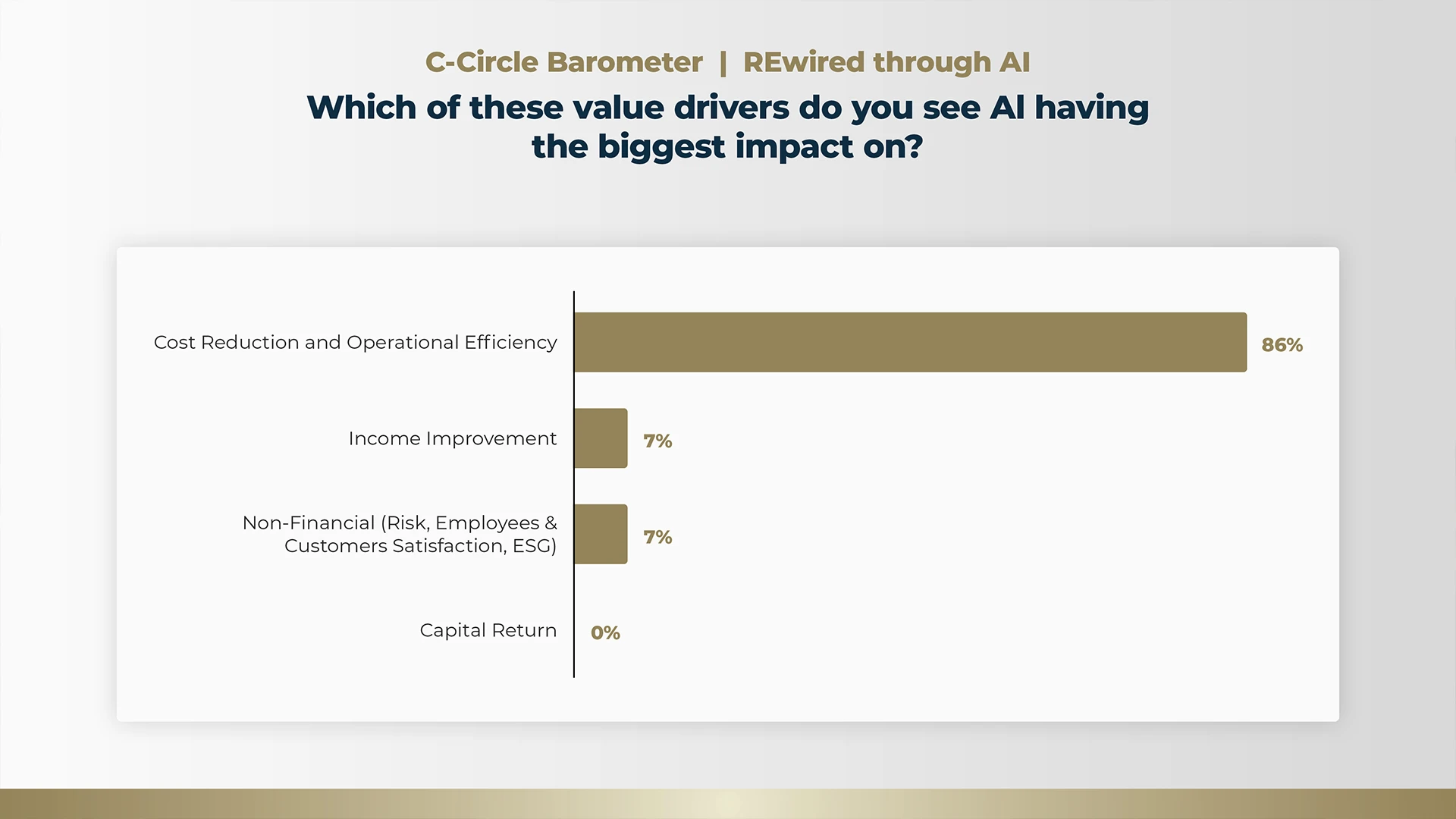
The first survey metric examined which core value drivers real estate executives expect AI to impact most significantly, revealing that 86% of respondents view “Cost Reduction and Operational Efficiency” as the single biggest value driver.
In contrast, Income Improvement captured 7%, “Non-Financial drivers (encompassing Risk, Employees and Customers Satisfaction, and ESG)” represented 7%, and “Capital Return” registered 0%.
These results reflect an industry-wide prioritisation of near-term efficiency gains. In the current macroeconomic climate, reducing operational friction and streamlining administrative workflows provide immediate, measurable financial returns.
This operational cost reduction serves as a crucial self-funding mechanism, generating savings that can subsequently finance broader strategic investments in intelligence capabilities, predictive leasing tools, and asset optimisation platforms.
C-Circle AI Excitement
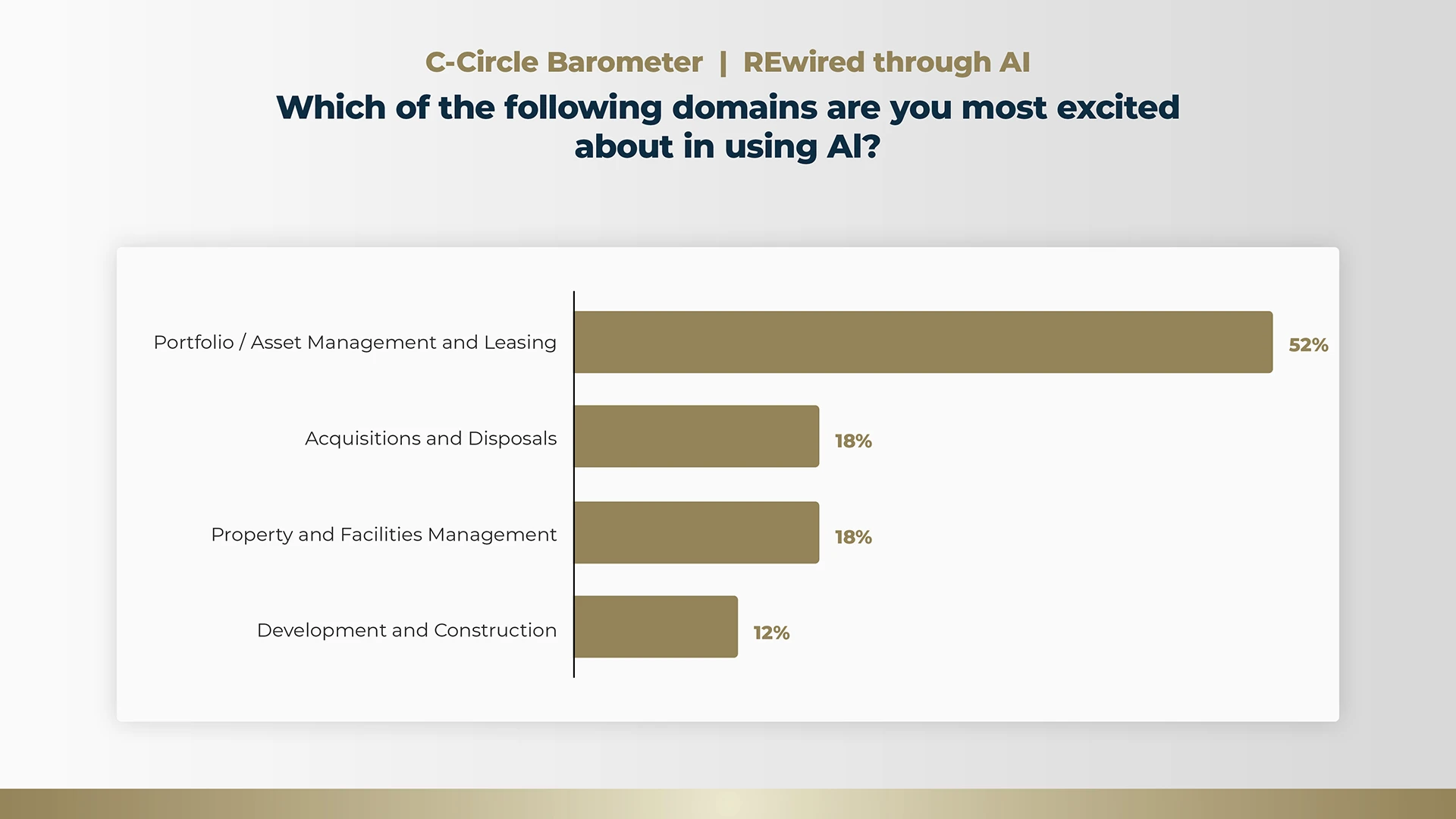
The second survey metric evaluated which operational domains across the real estate value chain excite senior leaders most regarding AI integration.
“Portfolio/Asset Management and Leasing” emerged as the dominant area of interest, selected by 52% of respondents. “Acquisitions and Disposals” gathered 18% of votes, “Property and Facilities Management” accounted for 18%, and “Development and Construction” captured 12%.
The overwhelming focus on portfolio and asset management highlights where decision-makers see the highest concentration of recurring data and operational friction.
Asset management involves continuous lease analysis, tenant communications, rent collection tracking, and cash flow forecasting. Applying multi-agent processing to these data-dense workflows yields immediate improvements in retention and rental yield optimisation.
While acquisitions and facility management present clear efficiency benefits, asset management remains the core operational engine for driving fund performance.
Company AI Gap Concerns
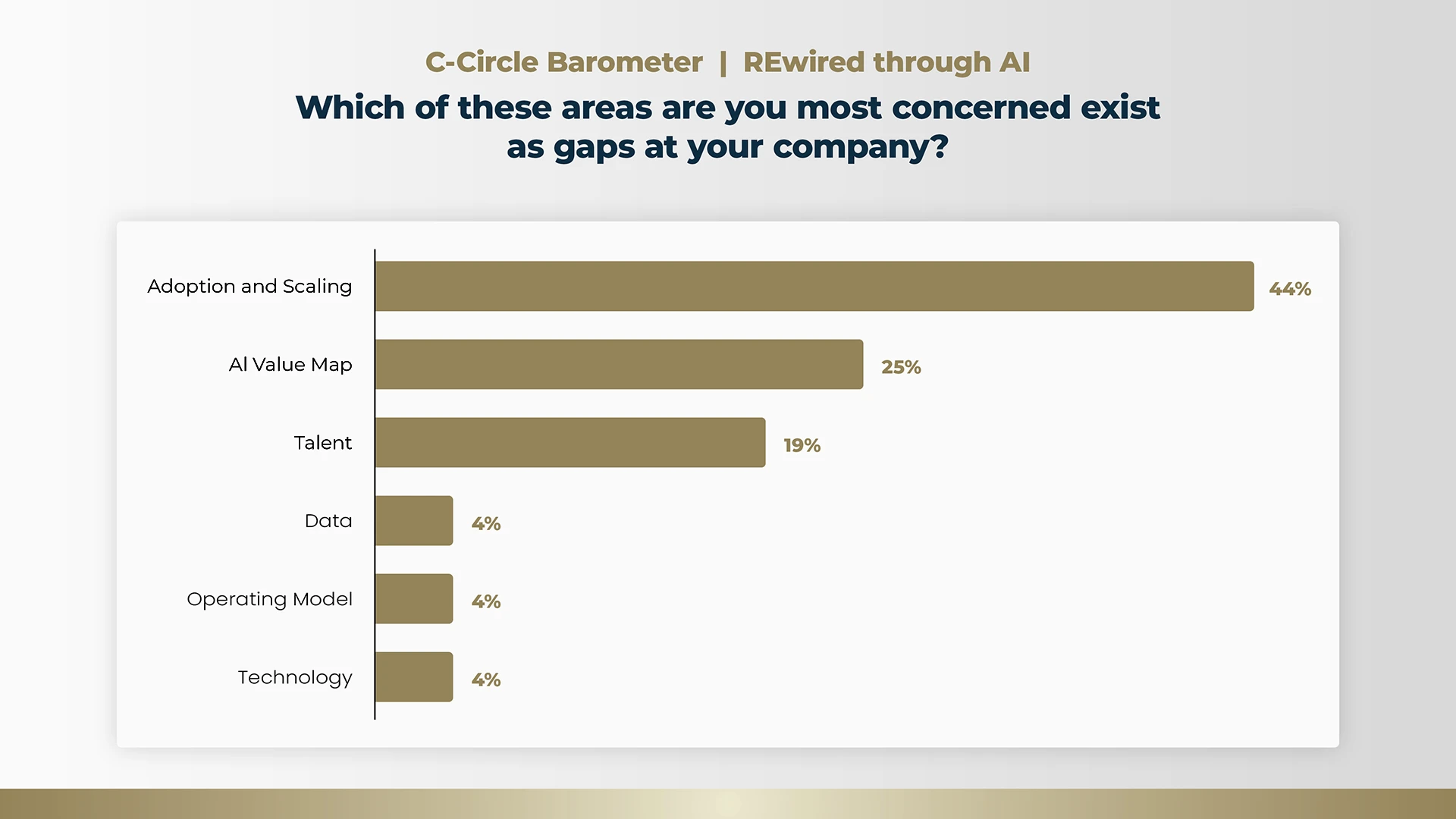
The final survey metric identified the internal organisational gaps that senior leaders are most concerned about within their respective companies.
“Adoption and Scaling” was identified as the primary concern by 44% of respondents, followed by “AI Value Map” at 25%, and “Talent” at 19%. In contrast, “Data”, “Operating Model”, and “Technology” were viewed as far less pressing bottlenecks, each capturing just 4% of responses.
The findings illustrate that the primary barrier to transformation is not technological availability or raw data access, but organisational change management. Real estate firms frequently struggle to scale successfully from localised pilots to enterprise-wide integration.
Without a structured value roadmap that explicitly connects AI tools to bottom-line performance, and without targeted talent development, organisations risk deploying fragmented technology that fails to deliver sustained institutional value.
► Conclusion
To capture meaningful financial value from AI, real estate firms must move beyond fragmented pilot schemes and establish structured, enterprise-wide capabilities. Successful execution requires clear alignment across strategy, talent, technology, and governance.Executive leadership must directly spearhead adoption rather than delegating responsibility deep within the organisation. Rather than scattering resources across dozens of isolated initiatives, top-performing firms concentrate efforts on one to four high-value operational domains.
Achieving sustained impact going forward depends on robust change management, explicit value mapping, and an organisational culture that permits controlled experimentation and iterative learning.
► Join us for GRI Commercial RE & Data Centres Europe 2026 on 17th November in London
These insights and GRI Barometer results were collected during the GRI Institute’s C-Circle AI Private Discussion - Europe GRI 2026 Summer Edition, co-hosted by McKinsey & Company and moderated by Ben Dimson (McKinsey).