 GRI Institute
GRI Living Assets Europe 2026 Barometer Results: Repricing friction drives capital towards operational living
Exclusive GRI Barometer insights on how residential market leaders are tackling capex inflation, regulatory complexity, debt constraints, and valuation gaps
August 20, 2026Real Estate
Written by:Rory Hickman
Executive Summary
At the recent GRI Living Assets Europe 2026 conference in London, industry leaders addressed a residential market undergoing structural recalibration.
With elevated borrowing costs, construction inflation, and regulatory friction stalling traditional core development, institutional capital is rapidly pivoting towards operational intensity, asset repurposing, and targeted recapitalisations.
Exclusive GRI Barometer findings from the gathering highlight a growing emphasis on flexible living formats, opportunistic acquisitions of repriced stock, and agile regional execution, where tech integration and hands-on management serve as the primary engines for driving operational alpha.
Ahead of dedicated discussions on the living sector at the upcoming Europe GRI 2026 Summer Edition - Incorporating GRI Hospitality summit in Paris on 9th-10th September, this survey captures key investor sentiment regarding capital flows, subsector viability, and regional opportunities defining the next investment cycle.
► Access the full GRI Living Assets Europe 2026 Spotlight report here
With elevated borrowing costs, construction inflation, and regulatory friction stalling traditional core development, institutional capital is rapidly pivoting towards operational intensity, asset repurposing, and targeted recapitalisations.
Exclusive GRI Barometer findings from the gathering highlight a growing emphasis on flexible living formats, opportunistic acquisitions of repriced stock, and agile regional execution, where tech integration and hands-on management serve as the primary engines for driving operational alpha.
Ahead of dedicated discussions on the living sector at the upcoming Europe GRI 2026 Summer Edition - Incorporating GRI Hospitality summit in Paris on 9th-10th September, this survey captures key investor sentiment regarding capital flows, subsector viability, and regional opportunities defining the next investment cycle.
► Access the full GRI Living Assets Europe 2026 Spotlight report here
Key Takeaways
- High capex inflation, elevated financing costs, and regulatory friction are redirecting institutional capital away from ground-up development towards commercial retrofits and recapitalisations.
- Investors are prioritising flexible living formats and value-add repositioning strategies to drive operational alpha and protect cash-flow margins.
- Capital deployment is concentrating in dynamic markets like Spain and the UK that offer higher risk-adjusted returns and viable conversion opportunities.
► The Repricing of European Living
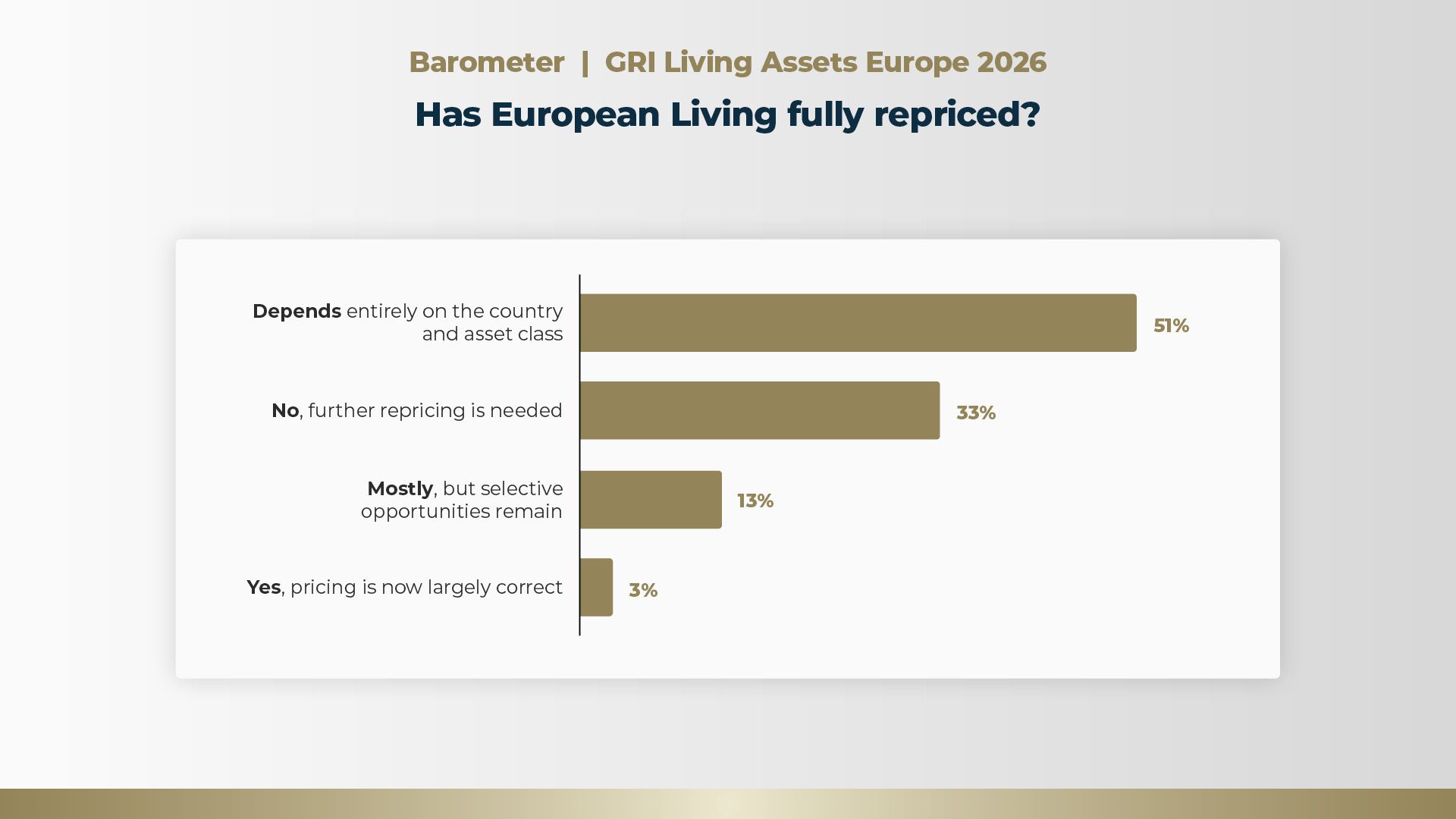
The results of the GRI Barometer reveal that European residential real estate pricing remains highly variable, with 51% of surveyed decision-makers stating that whether the market has fully repriced depends entirely on the specific country and asset class.
A further 33% believe that pricing has not reached bottom and that further repricing is necessary across the sector.
Conversely, a small minority view the market as recalibrated, with 13% noting that pricing has mostly adjusted bar selective opportunities, and only 3% taking the stance that asset pricing is now largely correct.
This sentiment underscores a fragmented investment landscape across Europe where local regulatory regimes, municipal interactions, and monetary environments dictate market recovery.
Although European living assets have repriced at a faster pace than real estate in the United States or Asia-Pacific, institutional core capital remains hesitant.
Regional dynamics highlight this divergence, as markets such as Spain demonstrate strong momentum across student and flexible living, Germany undergoes price stabilisation with attractive value-add prospects, and the UK faces pre-development delays stemming from complex planning processes, fire safety regulations, and political shifts.
As a result, subsector performance is increasingly city- and asset-specific rather than purely thematic.
The emphasis on further required repricing points to an ongoing gap between legacy book valuations and realistic market clearing prices.
Valuation indices frequently lag behind real-time transaction data, holding on to historic low-yield benchmarks while active market deals clear at wider cap rates or substantial discounts to replacement cost.
High borrowing costs, elevated construction expenses, and operational leakage continue to compress margins, driving capital away from core development and into recapitalisations, retrofits, and high-yielding operational living assets until valuations fully adjust.
► Living Capital Deployment Challenges
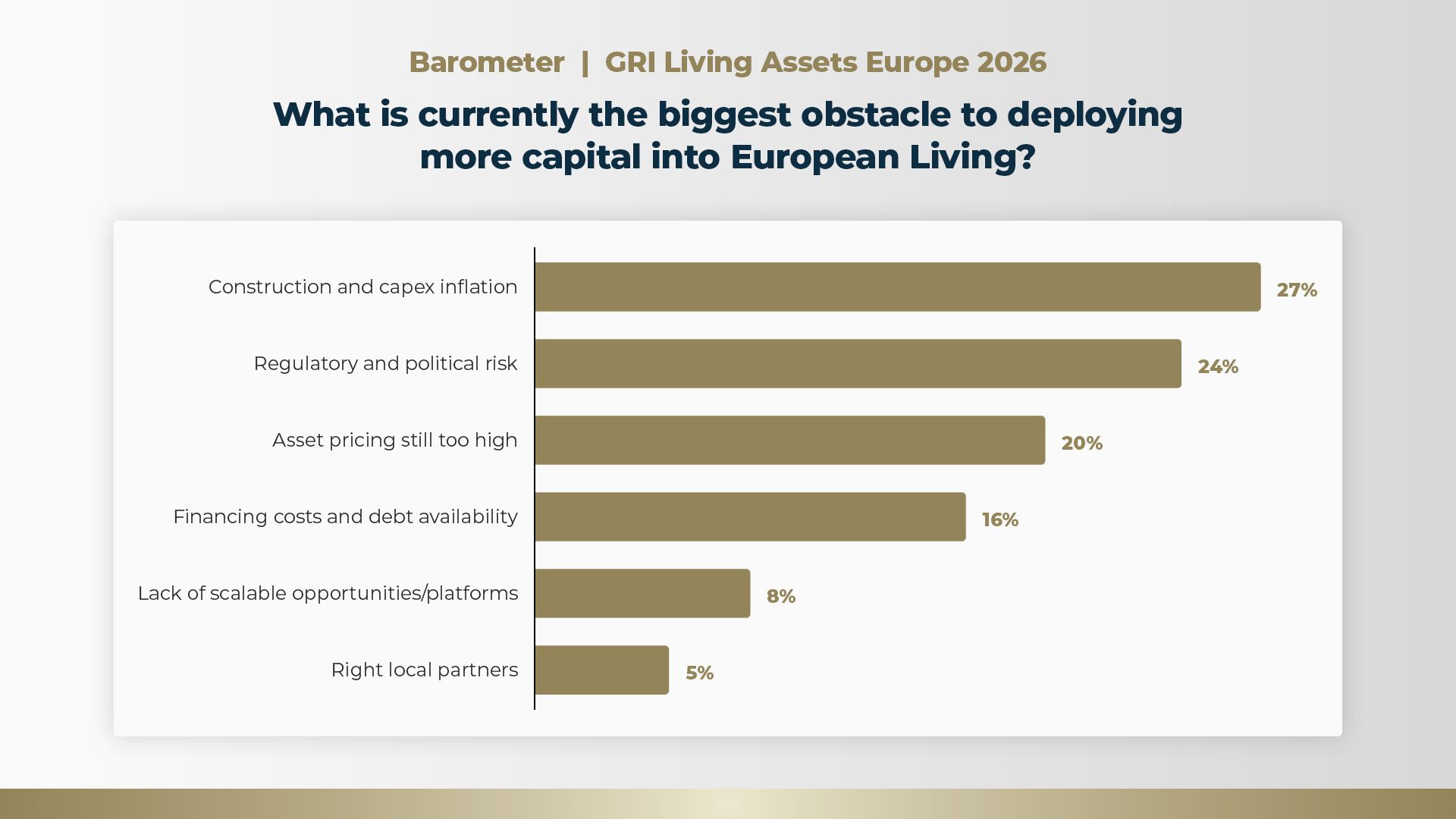
Development costs and legislative uncertainty present the main barriers to deploying capital across European housing, with 27% of industry leaders identifying construction and capex inflation as their single largest hurdle.
Regulatory and political risk follows closely at 24%, while asset pricing remaining too high accounts for 20% of responses.
Elevated financing costs and debt availability represent the primary impediment for 16% of respondents, whereas structural execution constraints, including a lack of scalable platforms (8%), and securing the right local partners (5%), account for the remainder.
The prominence of capex inflation highlights severe development headwinds stemming from volatile material expenses, contractor insolvencies, and soaring construction costs that reach GBP 300 to GBP 500 per square foot in primary markets like London.
Compounded by sticky land values, these cost pressures compress development margins to narrow spreads over borrowing costs, rendering traditional ground-up schemes unviable.
Concurrently, political friction and shifting regulatory regimes, including rent caps in continental Europe, discretionary planning systems, and mandatory safety updates under the UK Building Safety Act, introduce underwriting risks that extend timelines and inflate bridging costs.
These financial and operational frictions explain why transaction activity has shifted toward equity recapitalisations, commercial retrofits, and refinancings rather than direct asset purchases.
The fact that 20% of respondents view asset pricing as excessive reflects an ongoing bid-ask spread, as institutional owners resist writing down legacy book valuations to align with real-time market clearing yields.
Simultaneously, restrictive senior bank lending and high interest rates push sponsors toward private debt funds and flexible credit structures.
Ultimately, unlocking deployment requires building tech-enabled operational platforms, adopting standardised planning frameworks, and partnering with local specialists to navigate municipal relationships and share execution risk.
► The Future of Value Creation
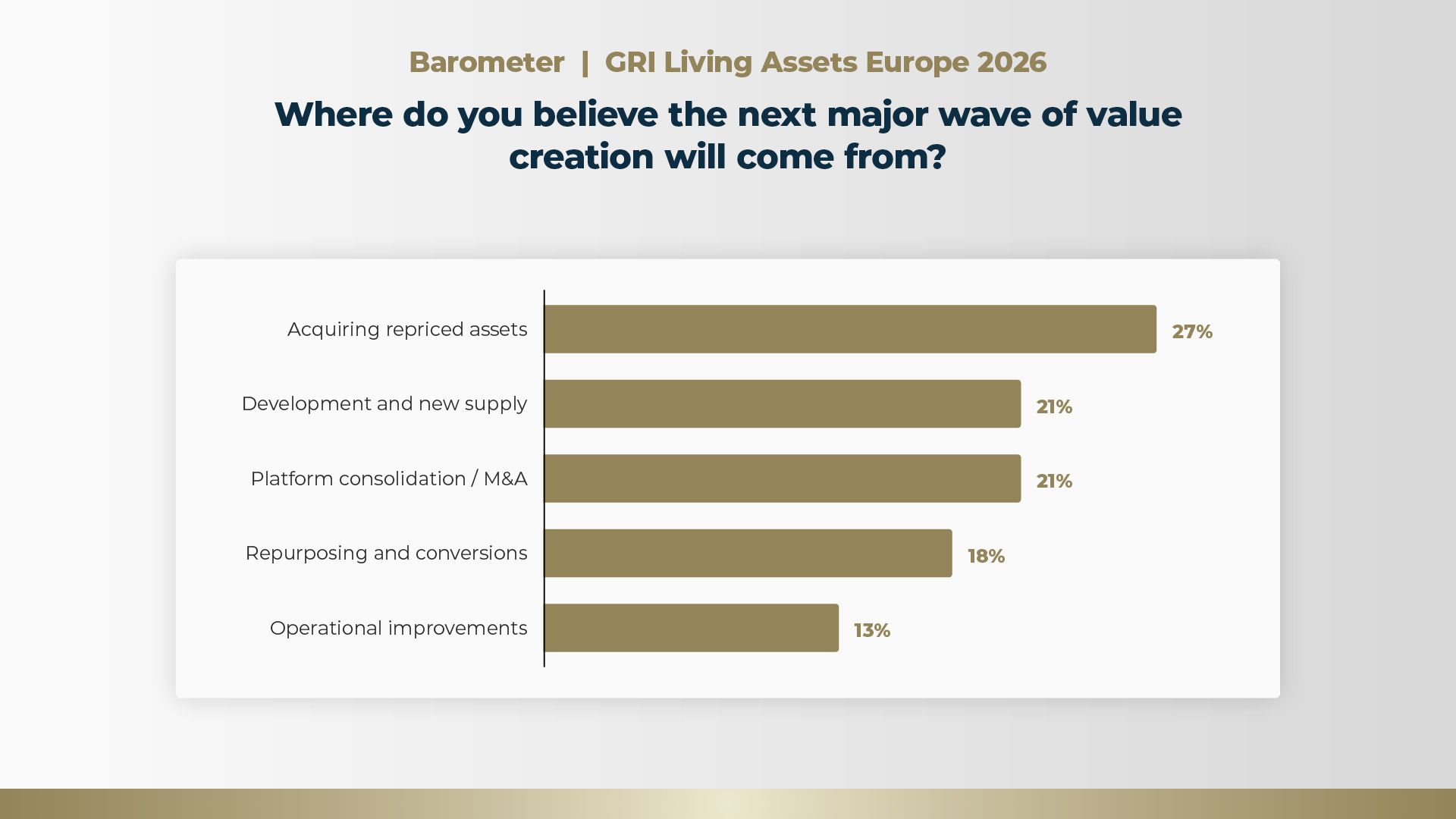
Senior industry leaders currently view discount asset hunting as the leading driver of market value, with 27% identifying the acquisition of repriced assets as the primary catalyst for future investment returns.
Generating new supply through ground-up development and pursuing platform consolidation or M&A tied for the second spot, each capturing 21% of the vote.
Meanwhile, adaptive reuse strategies via repurposing and conversions gathered 18% support, leaving hands-on operational improvements as the top catalyst for 13% of respondents.
The strong inclination toward opportunistic acquisitions highlights an environment where active market deals clear at notable discounts to replacement cost or wider capitalisation rates, outstripping historical valuation benchmarks.
Although ground-up development continues to face high borrowing costs and construction inflation, long-term demographic tailwinds across student, workforce, and senior sectors ensure that original supply creation remains vital for investors capable of navigating discretionary planning frameworks.
At the same time, the appetite for platform consolidation reflects an institutional drive to achieve operational scale, pool regional management expertise, and consolidate standardised operator platforms across fragmented European markets.
Commercial retrofits and asset conversions offer a pragmatic route to unlock capital, driven by an expanding pipeline of obsolete office stock resulting from shifting tenant demands and corporate restructuring.
Converting vacant commercial properties into residential or hospitality formats allows investors to bypass inflated contractor pricing and secure well-located urban inventory, despite physical constraints and initial technical review costs.
Finally, while operational improvements accounted for a smaller proportion of responses, driving operational alpha through tech-enabled data platforms, automated workflows, and lean cost structures remains essential to protect net operating income against wage inflation and maintain resilient occupancy levels.
► Residential Returns
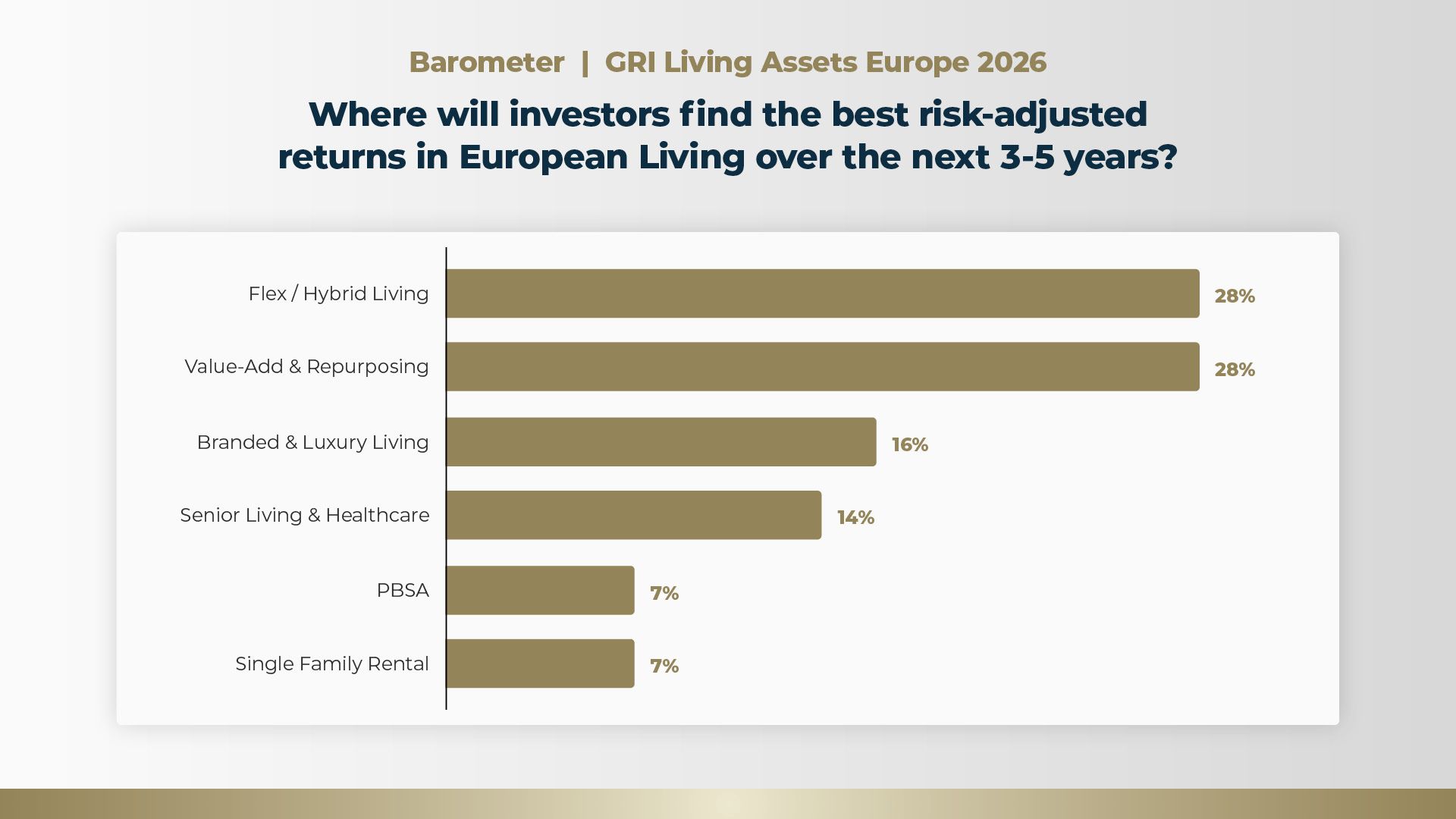
Flexible living formats and adaptive repositioning strategies lead investor expectations for risk-adjusted performance over the next three to five years, with Flex/Hybrid Living and Value-Add & Repurposing jointly capturing the top spot at 28% each.
Branded & Luxury Living garnered 16% of the survey vote, closely followed by Senior Living & Healthcare at 14%. More traditional living subsectors attracted limited conviction for top-tier returns, as PBSA and Single Family Rental tied at 7% apiece.
This strong preference for flexible models and repositioning strategies reflects an industry-wide pivot toward operational efficiency and capital protection in an environment of elevated borrowing costs.
Flexible and hybrid models deliver robust cash-flow margins exceeding 60% and sustained occupancy above 90% by utilising tech-enabled platforms, automated guest support, and lean operational structures.
Meanwhile, value-add retrofits and conversions enable capital deployment that avoids inflated ground-up construction pricing, unlocking stranded commercial inventory at compelling discounts to replacement cost.
Subsectors such as branded residences and senior housing highlight the ongoing demand for niche, downside-protected strategies.
Branded schemes achieve substantial pricing premiums, benefit from high proportions of cash buyers, and demonstrate strong downturn resilience, while senior living capitalises on long-duration demographic tailwinds.
Conversely, the modest ranking for PBSA and single-family rentals suggests that despite underlying structural demand, tighter initial yields and tenant affordability limits constrain their capacity to generate outsized risk-adjusted returns relative to higher-yielding, operational living models.
► Top Living Investment Markets
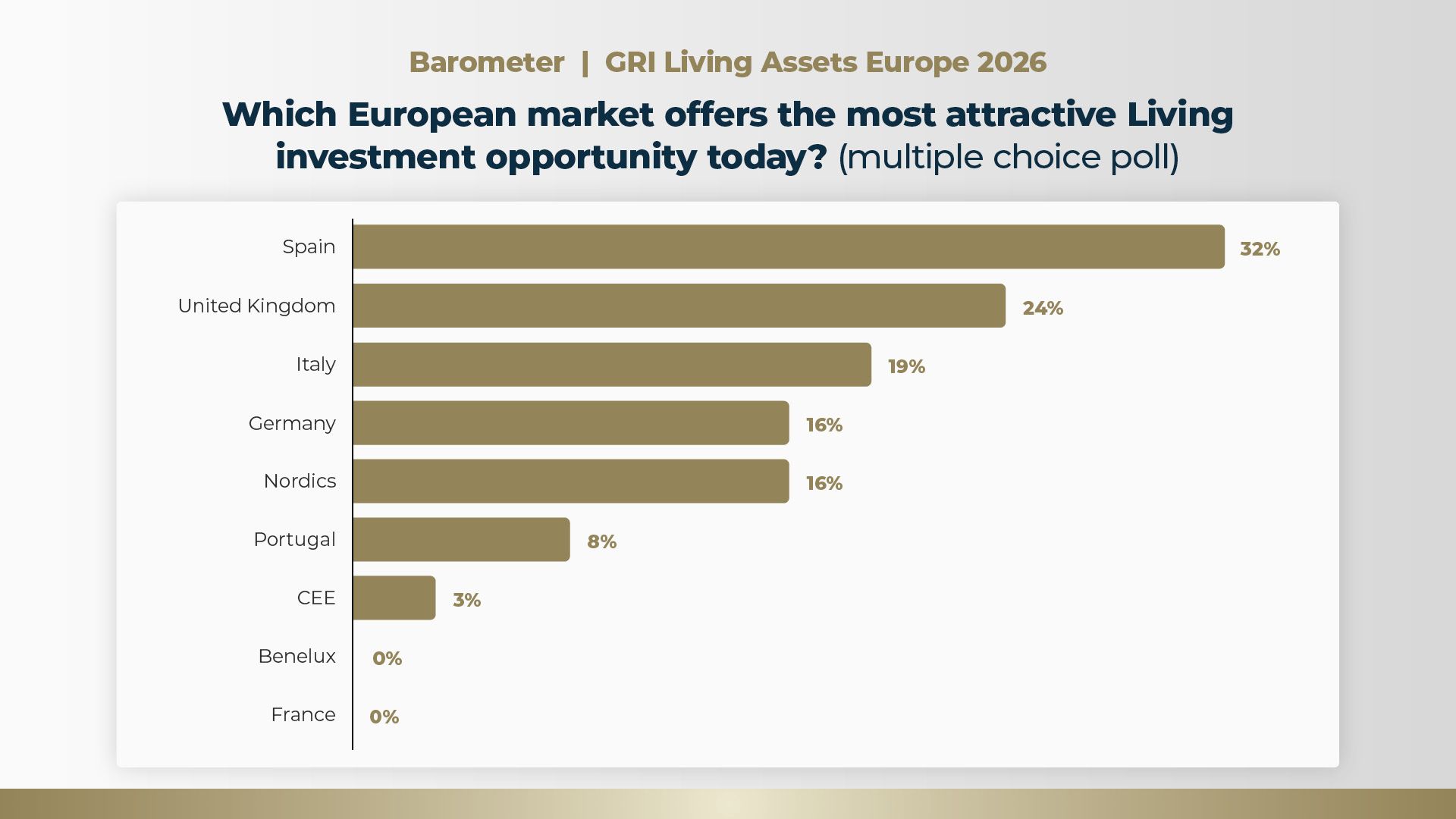
Southern European hubs and the United Kingdom lead international capital preferences for housing deployment, with Spain standing out as the most attractive target market at 32% of survey responses.
Spain's market leadership is driven by strong momentum across student accommodation, flexible living formats, and active refinancing opportunities across Southern Europe, alongside relatively lower conversion expenses compared to primary Northern cities.
The UK followed in second position with 24%, retaining strong investor appeal due to higher potential risk-adjusted returns, even as sponsors navigate complex planning procedures, building safety mandates, and sticky land values that inflate pre-development expenses.
Italy placed in third with 19%, another Southern European country that is increasingly attracting capital through active acquisition pipelines, credit recapitalisations, and an expanding concentration of lifestyle and branded residential developments.
Central and Northern European regions captured more modest attention, with Germany and the Nordics sharing 16% of the vote each, while Portugal recorded 8% and CEE registered 3%.
Mature Northern markets face a mix of structural debt conditions and regulatory constraints that moderate capital allocation. Although Germany offers a deep market undergoing price stabilisation with clear value-add potential and supportive debt financing, high construction costs and ongoing debates surrounding rent regulation continue to compress margins.
In the Nordics, distinct underwriting hurdles such as local rent controls, unit-sizing constraints, and dominant relationship-banking models restrict widespread deployment, despite pockets of renewed transaction activity in deregulated markets such as Denmark.
The absence of interest in France and Benelux among these leaders emphasises continued investor hesitation towards regions with tighter initial yield spreads and rigid regulatory frameworks that limit operational upside.
► Conclusion
Taken alongside the insights shared during discussions at GRI Living Assets Europe 2026, these findings signal a structural shift in European housing, ending reliance on passive yield compression.Outperformance will depend on operational alpha, adaptive repurposing, and tech platforms capable of protecting margins against capex inflation and regulatory friction. Institutional capital is bypassing core assets in favour of flexible living, repriced stock, and platform consolidation.
Ultimately, the next cycle will favour operators who pair disciplined pricing with local execution to build scalable, resilient platforms, while regionally, this accelerates a strategic pivot towards agile markets, particularly in Southern Europe, offering accretive yields and viable conversion dynamics.
This survey was conducted among the senior industry leaders attending GRI Living Assets Europe 2026.
► Don’t miss the chance to continue the discussion at Europe GRI 2026 Summer Edition - Incorporating GRI Hospitality.
► Check out all upcoming GRI Institute Europe gatherings here.