 GRI Institute
Europe GRI 2026 Summer Edition Barometer: Industry leader investment outlooks for 2027 revealed
Exclusive survey findings reveal how senior European real estate decision-makers are adapting portfolio mechanics, risk management, and capital strategies
September 15, 2026Real Estate
Written by:Rory Hickman
Executive Summary
Building on the expansionary momentum identified in our last survey in February, the latest GRI Barometer from Europe GRI 2026 - Summer Edition reveals a real estate market maturing into a phase of tactical execution and structural adaptation.
While growth remains the primary corporate stance, optimism has moderated as construction cost inflation, high interest rates, and global geopolitical shocks re-emerge as top operational challenges.
In response, the region’s most senior investors are rejecting financial leverage in favour of joint-venture risk-sharing, geographic diversification, and longer-duration, income-focused strategies.
Hospitality has leaped to become the most preferred asset class, while Madrid and London retain their uncontested leadership positions alongside surging Italian momentum and sustained CEE growth.
The outlook for the coming 12 months points to a mature, execution-driven landscape where performance will depend on active asset management, collateral quality, and operational excellence.
► Take part in the next survey - join us at Europe GRI 2027 - Winter Edition in London
While growth remains the primary corporate stance, optimism has moderated as construction cost inflation, high interest rates, and global geopolitical shocks re-emerge as top operational challenges.
In response, the region’s most senior investors are rejecting financial leverage in favour of joint-venture risk-sharing, geographic diversification, and longer-duration, income-focused strategies.
Hospitality has leaped to become the most preferred asset class, while Madrid and London retain their uncontested leadership positions alongside surging Italian momentum and sustained CEE growth.
The outlook for the coming 12 months points to a mature, execution-driven landscape where performance will depend on active asset management, collateral quality, and operational excellence.
► Take part in the next survey - join us at Europe GRI 2027 - Winter Edition in London
Key Takeaways
- Corporate growth is being delivered through active portfolio adaptation, risk-sharing JVs, and strict balance-sheet discipline rather than financial leverage.
- Capital is concentrating in operational asset classes while reallocating geographically toward resilient Southern European and CEE gateways.
- Development cost inflation, elevated interest rates, and global geopolitical shocks have re-emerged as the primary operational friction points disrupting deal execution.
► Top Cities
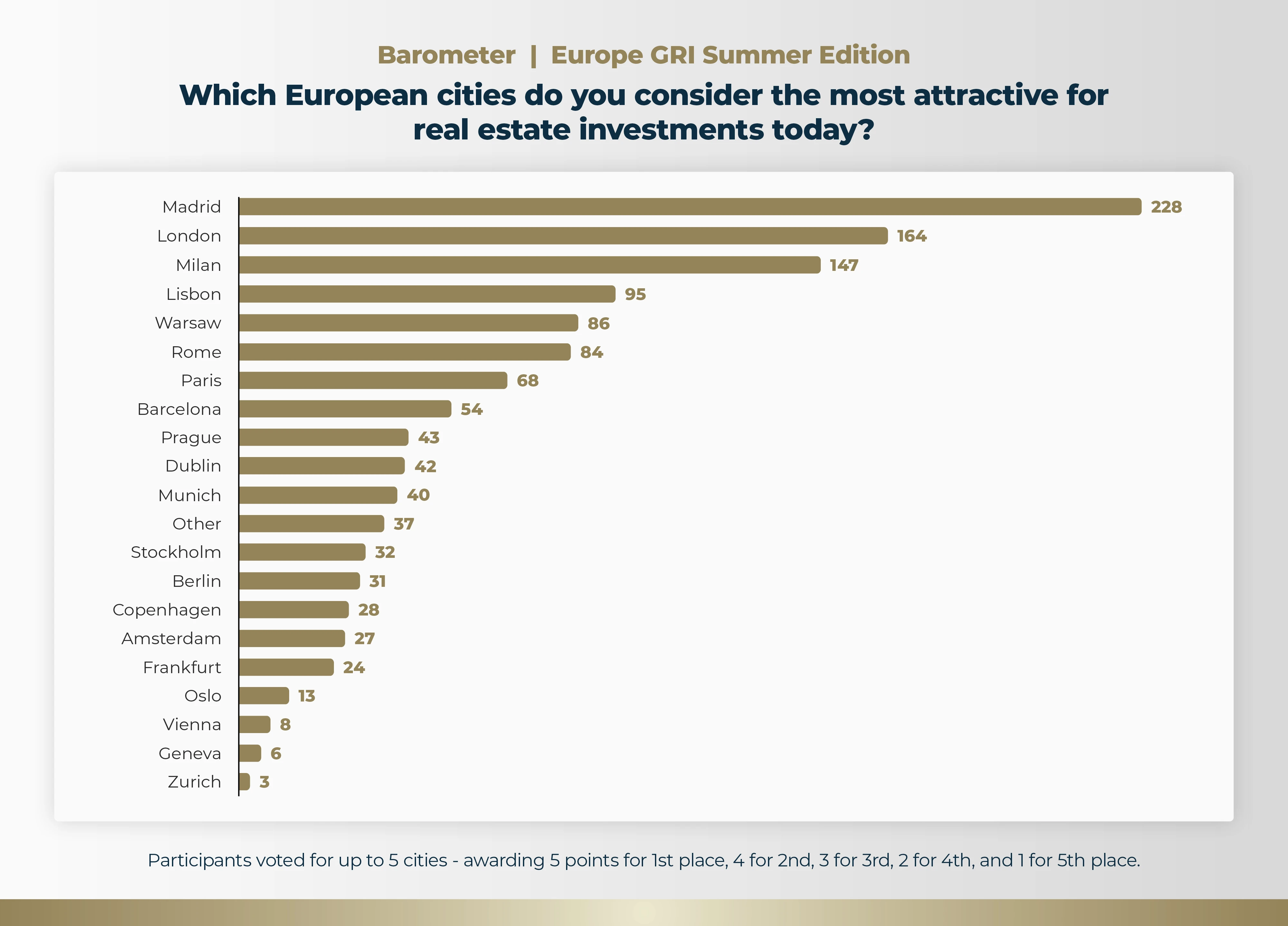
The GRI Institute’s latest Barometer survey assessed cities across Europe, capturing the evolving preferences of senior real estate leaders.
Although the results indicate a high degree of continuity at the very top of the rankings, with Madrid and London firmly holding the leading two positions, notable shifts have redefined the broader market landscape.
These movements are highlighted by a surge in Italian sentiment, sustained momentum in Central and Eastern Europe (CEE), and further softening across core Western European and German hubs.
Madrid and London - Uncontested leaders
Madrid and London firmly anchored the top of the rankings, repeating their first and second place finishes for the third consecutive survey cycle.Madrid retained its undisputed leadership position, benefiting from Spain's resilient macroeconomic growth, strong structural tailwinds, and sustained investor confidence across Southern Europe.
London remained immovable in second place, underpinned by its deep market liquidity, transparency, and institutional stability amidst broader global economic volatility.
Milan and Rome - Italian momentum surges
Italian destinations recorded the most striking upward trajectory in the latest survey. Milan climbed into third place, displacing Lisbon to enter the top three for the first time across recent cycles.Rome experienced an even sharper surge, breaking into sixth place after rising to twelfth place earlier in the year and sitting outside the top ten late last year. Italian real estate continues to attract heightened international capital, particularly across hospitality, luxury residential, and operational strategies.
Lisbon, Paris, and Barcelona - Gradual cooling in core hubs
Conversely, several long-standing core markets experienced a gradual moderation in relative momentum. Lisbon dropped to fourth place, pulling back after holding third place in early 2026 and sharing second place late last year.Paris continued its step-by-step downward movement, falling to seventh place after slipping to sixth place in early 2026 and fifth place late last year. Sentiment in France remains tempered by political uncertainty, low transaction volumes, and constrained liquidity outside prime assets.
Barcelona similarly moved to eighth place, down from seventh place previously and sixth place late last year, although long-term gateway fundamentals in Spain remain supportive.
Warsaw and Prague - CEE maintains its ascent
CEE continued to demonstrate sustained upward mobility. Warsaw held firm in fifth place, consolidating the major gains made earlier in the year when it rose from seventh place to displace Paris from the top five.Solid Polish GDP growth, tight office supply, and resilient residential demand continue to bolster landlord confidence.
Prague also broke into the top ten for the first time, advancing to ninth place after finishing eleventh earlier in the year and remaining outside the top ten late last year.
German markets - Persistent structural headwinds
German cities continue to face challenging relative sentiment compared to their historical standing. Berlin experienced a sharp drop, falling out of the top tier to fourteenth place after holding eighth place in previous surveys.Frankfurt continued its steady decline, landing in seventeenth place after slipping to sixteenth place earlier in the year and tenth place late last year.
Munich recorded a modest recovery to eleventh place after receiving no top votes in the previous survey, though it remains below its former ninth place standing late last year.
Refinancing gaps, buyer-seller price disconnects, and risk-averse lending conditions continue to constrain German transaction activity.
Dublin and secondary hubs - Completing the rankings
Dublin rounded out the top ten in tenth place, demonstrating steady stability on the threshold after entering the top ten in the previous survey.Further down the table, Nordic gateways showed modest gains or stability, with Stockholm moving to thirteenth place and Copenhagen ascending to fifteenth place from seventeenth place previously.
Amsterdam recorded a notable recovery, climbing to sixteenth place after languishing near the bottom in twenty-first place earlier in the year.
The latest cycle also saw new entries from secondary and alpine markets, with Oslo entering in eighteenth place, followed by Vienna, Geneva, and Zurich taking the remaining bottom spots.
Conversely, regional hubs such as Manchester, Athens, Brussels, Luxembourg, Budapest, and Helsinki dropped out of the primary rankings entirely after making appearances in early 2026.
Finally, the "Other city" category held a prominent position in twelfth place, reinforcing a persistent underlying trend where investors selectively explore secondary and niche alternatives beyond traditional core markets.
► Sector Preferences
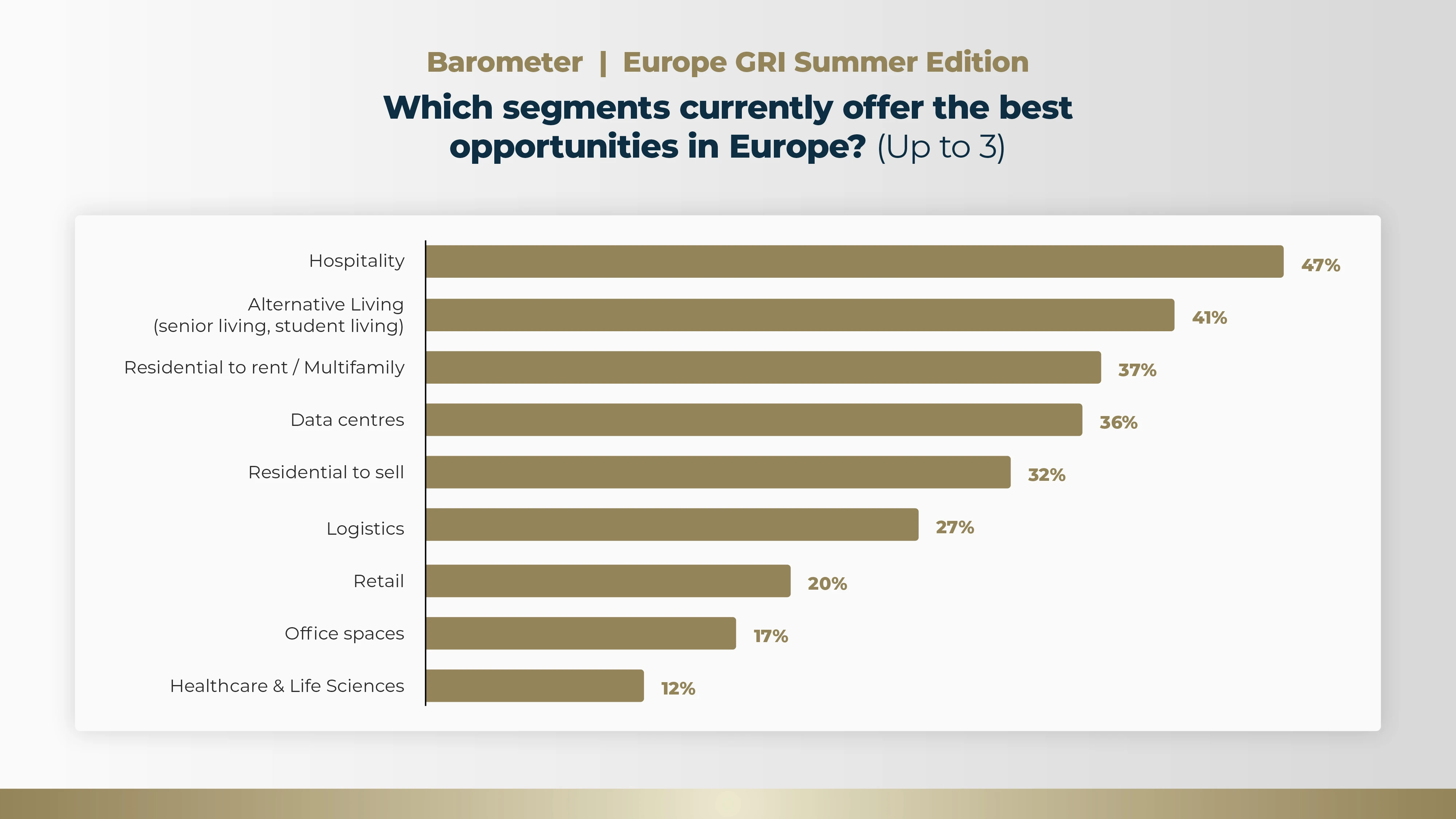
In addition to geographic preferences, the latest edition of the Barometer once again examined which asset classes investors consider to offer the most compelling opportunities today.
The results point to a dynamic market where operational resilience, megatrend-driven demand, and structural adaptation are reshaping investor priorities amidst stagflationary headwinds and elevated financing costs.
Hospitality - Surging to the top spot
Hospitality real estate experienced a major upward movement, leaping to become the single most preferred asset class in Europe in our latest survey.After holding a mid-tier position late last year in fourth place and slipping slightly to fifth place in early 2026, the sector has surged to first place. Once viewed as a niche play, hospitality has transitioned into a mainstream institutional asset class.
Investors are aggressively targeting the sector to hedge against economic volatility through dynamic room pricing, inflation-linked cash flows, and hybrid operational models that integrate luxury branded residences and serviced apartments.
Alternative Living - Unwavering core conviction
Alternative living assets (including senior living and student living) maintained an exceptionally stable second place ranking across all three survey cycles.Capital is aggressively targeting scalable operational platforms in counter-cyclical, demographic-focused niches like purpose-built student accommodation (PBSA), senior living, single-family housing, and flexible co-living formats.
Widespread undersupply, demographic ageing, and growing student populations continue to make alternative residential formats a cornerstone of defensive growth strategies.
Residential - Market dominance split by operational model
The European residential sector continues its foundational dominance, though its top-spot ranking was distributed as the latest survey bifurcated build-to-rent (BTR) and build-to-sell (BTS) strategies. BTR and multifamily secured third place, while residential to sell ranked fifth.Stubbornly high construction costs, persistent inflation, and expanding rent controls have triggered a BTR viability crisis in Northern and Western Europe, driving equity sponsors toward liquid BTS frameworks in Southern and Eastern Europe, or value-add office-to-residential conversions.
Data Centres - Rebounding digital conviction
Data centres held firm in fourth place, rebounding in sentiment after a brief dip in early 2026 from its third place ranking in late 2025. The sector has fundamentally transitioned from being demand-constrained to execution-constrained.Rapid AI diffusion, automated training models, and soaring rack densities have driven an intense race for power infrastructure, pushing developers upstream to secure grid availability, build independent micro-grids, or migrate toward Tier-2 markets and sovereign cloud platforms.
Logistics - Cooling following an early-year peak
Logistics and warehousing retreated to sixth place, pulling back after reaching a top-three position in early 2026 and fifth place late last year.Although institutional capital maintains a cautious transaction pace, a 30% surge in construction costs has created a powerful defensive moat for existing stock trading below replacement value.
With completions hitting multi-year lows, occupier demand remains anchored by industrial nearshoring, expanding defence sectors, and high-voltage power upgrades for automation and fleet electrification.
Retail - Constant, polarised baseline
Retail maintained its position in seventh place, holding the exact same rank across all three survey periods. The sector demonstrates profound operational resilience through sharp polarisation.Defensive, necessity-driven formats like out-of-town retail parks and prime luxury corridors consistently outperform secondary shopping centres. Furthermore, AI integration is boosting tenant affordability by streamlining conversions, reducing apparel returns, and optimising inventory.
Offices - Returning to bottom-tier caution
Office spaces fell back to eighth place, relinquishing the brief sentiment uptick recorded in early 2026 when it climbed to sixth place, returning to its late-2025 position near the bottom of investor preferences.The sector is defined by a critical 90/10 split, where prime, ESG-compliant CBD assets in gateways like Paris, Madrid, and Lisbon command strong rents and low vacancy, while legacy stock faces severe refinancing freezes, non-core vacancy spikes, and structural obsolescence.
Healthcare & Life Sciences - Dedicated niche play
Separated into a standalone category in the latest survey, healthcare and life sciences real estate occupied ninth place.While long-term demographic trends provide clear demand tailwinds, high operational complexity, specialised technical requirements, and disciplined capital allocation keep investment concentrated in targeted niche opportunities.
► Key Challenges
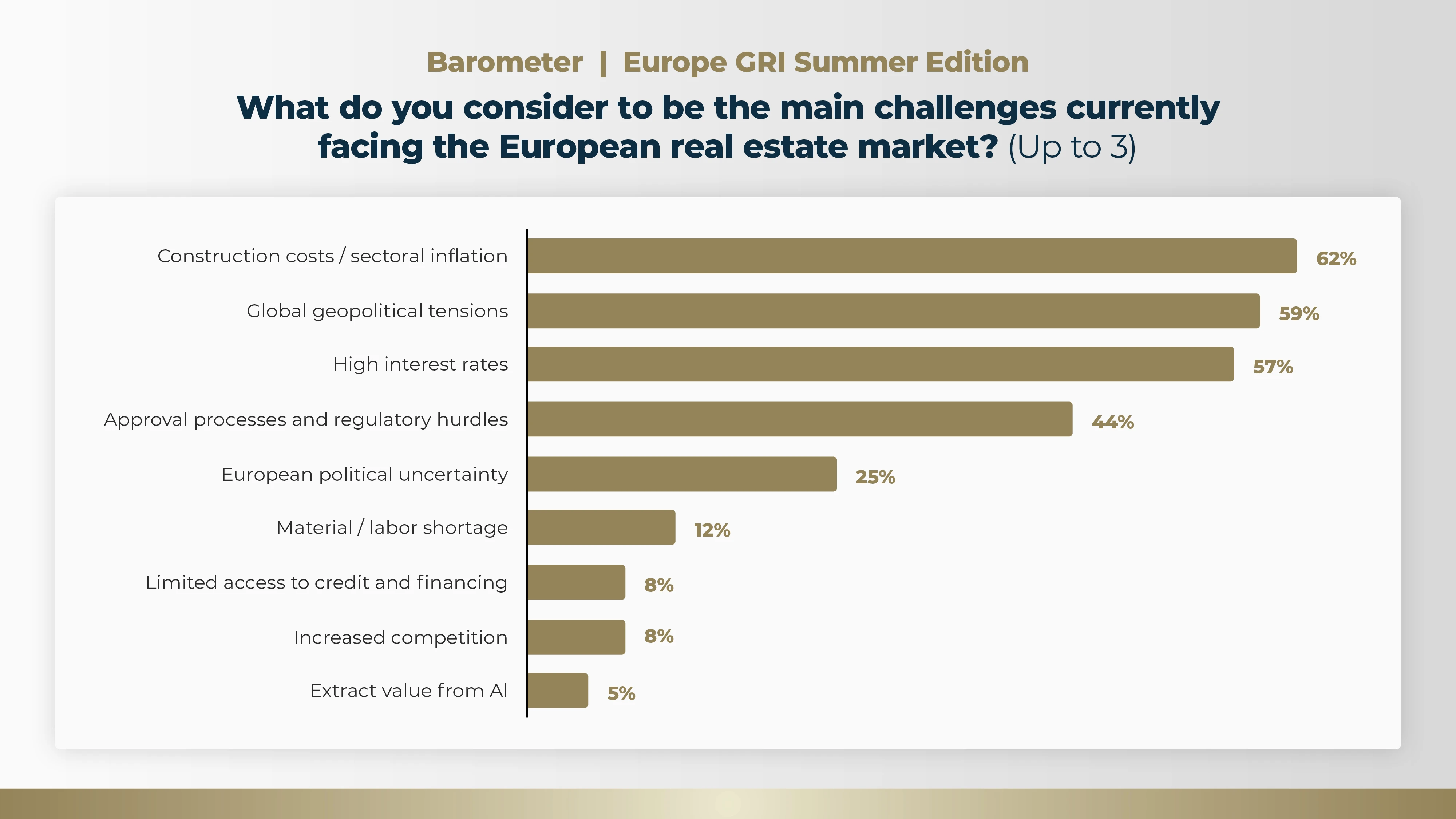
When evaluating the main operational and macro friction points facing European real estate, the latest Barometer reveals a decisive shift back toward development cost control, interest rate burdens, and external geopolitical shocks.
Construction Costs and Inflation - Returning to the top spot
Construction costs and sectoral inflation surged to first place, rising from third place in early 2026 and second place late last year.Compounding material prices, persistent wage growth, and fresh energy price shocks have re-established development viability and cost containment as the primary operational threat across European property markets.
Geopolitical Tensions and Political Uncertainty - Macro volatility bifurcates
Having topped the overall rankings in early 2026 as a combined category, macro-political instability was split into separate international and domestic variables in the latest survey.Global geopolitical tensions took second place, driven by the ongoing Russia-Ukraine war, the Middle East conflicts, and increasing trade disruptions, while European political uncertainty landed in fifth place.
This division illustrates how investors now differentiate between acute international shocks and regional policy shifts.
High Interest Rates vs Credit Access - A stark financial divergence
Separating debt cost from capital availability revealed a clear market divide. High interest rates jumped to third place, whereas limited access to credit and financing dropped into a tie for seventh place alongside increased competition, with both capturing 8% of the vote.This shift indicates that while bank and alternative debt liquidity has stabilised, the absolute cost of leverage remains a severe hurdle for underwriting deal structures, structuring transactions, and refinancing legacy debt.
Regulatory Hurdles and Approval Processes - Overshadowed by acute shocks
Approval processes and regulatory hurdles slipped to fourth place, continuing a gradual downward trend from second place in early 2026 and first place in late 2025.While permitting delays, planning backlogs, and expanding rent regulations remain a chronic baseline friction point, their relative urgency has been eclipsed by immediate macroeconomic and interest rate pressures.
Labour Constraints, Competition, and AI Integration - Secondary operational headwinds
Combined material and labour shortages held firm in sixth place, aligning with its sixth place standing for labour difficulties in early 2026 and seventh place for material shortages late last year. Increased competition occupied seventh place alongside credit access.Finally, extracting value from AI entered the rankings for the first time in ninth place, highlighting the emergence of digital transformation and technology adoption as a strategic operational consideration.
► Strategic Outlook
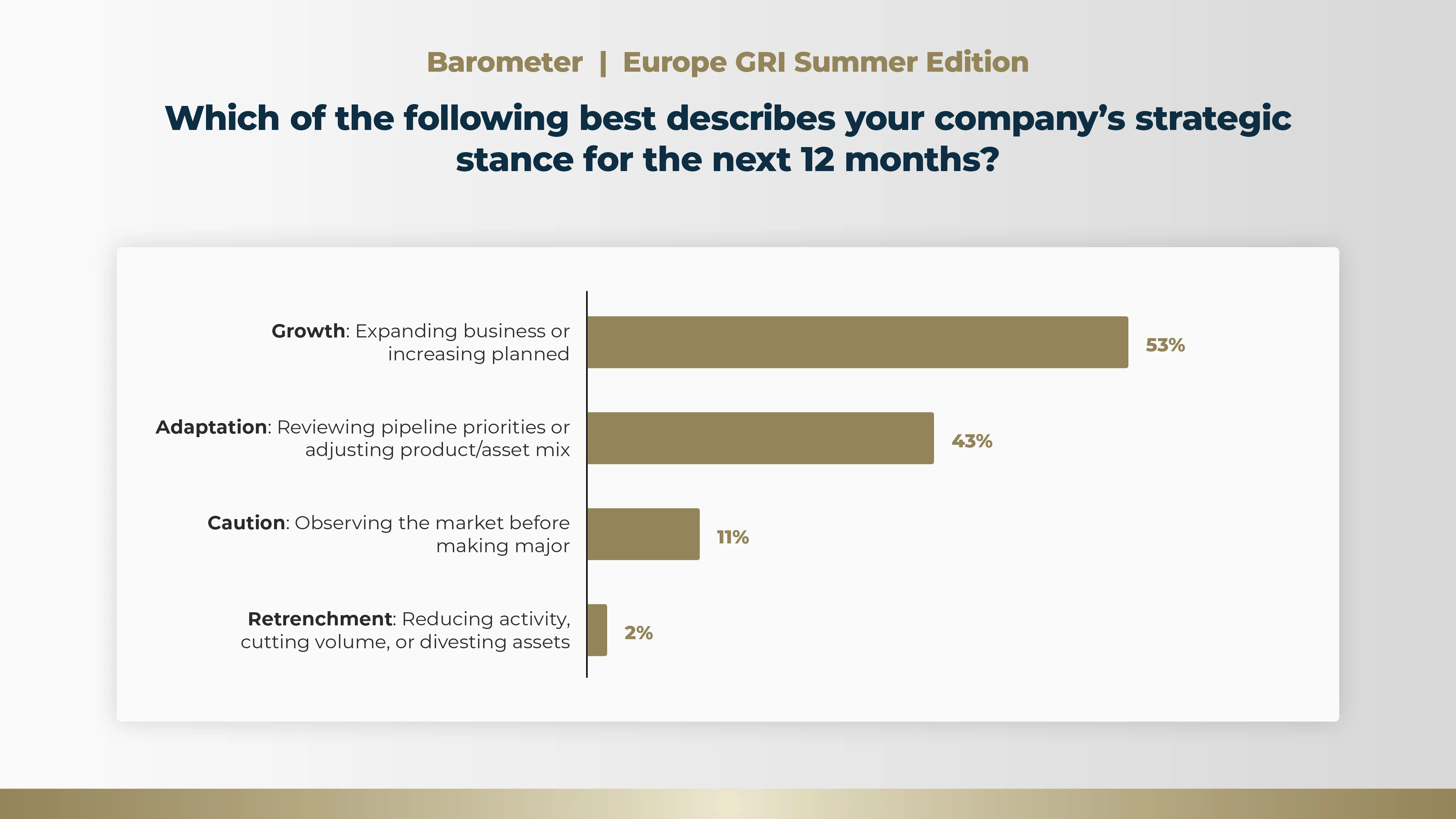
Growth - Sustained dominance despite a mid-cycle cooling
Growth remains the leading strategic direction for European real estate firms, even as expansionary sentiment moderated from its early-2026 high.After cresting in early 2026 amid initial monetary stabilisation, growth appetite experienced a measured pullback in the second half of the year.
Nevertheless, expansion remains the primary corporate stance across all three survey cycles, demonstrating that market participants continue to prioritise active capital deployment and business expansion over passive retreat.
Adaptation - Active restructuring and mix adjustments gain momentum
Adaptation maintained its second-place position, recording a continuous upward trajectory across 2026.As persistent inflation, elevated debt costs, and renewed geopolitical volatility complicated traditional ground-up development, companies increasingly shifted toward active asset management and pipeline realignment.
Rather than freezing operations, firms are rebalancing asset mixes, pivoting toward build-to-sell frameworks or alternative living formats, and executing value-add conversions to protect underwriting margins.
Caution - Macro uncertainty fuels wait-and-see hesitation
Caution held third place, marking a notable resurgence late in the year after hitting a cycle low in early 2026.Market hesitation effectively dissolved during the early-2026 expansionary peak but re-emerged as escalating Middle East tensions, stagflationary pressures, and sticky interest rates forced a growing segment of decision-makers to adopt an observational posture before committing fresh capital.
Retrenchment - Defensive contraction remains negligible
Retrenchment consistently anchored the bottom of the rankings in fourth place. Outright defensive contraction remains virtually non-existent compared to late 2025, when a notable share of market participants considered scaling back planned investments.This confirms that despite resurfacing macroeconomic headwinds, European property firms prefer active portfolio adaptation and risk-sharing over divesting assets or freezing operational activity.
► Portfolio Strategies
In previous editions of the Barometer - including those conducted at Europe GRI 2025 and Europe GRI 2026 - Winter Edition, our analysis focused on high-level corporate sentiment and broad strategic direction, tracking the market's overarching appetite for growth versus caution.
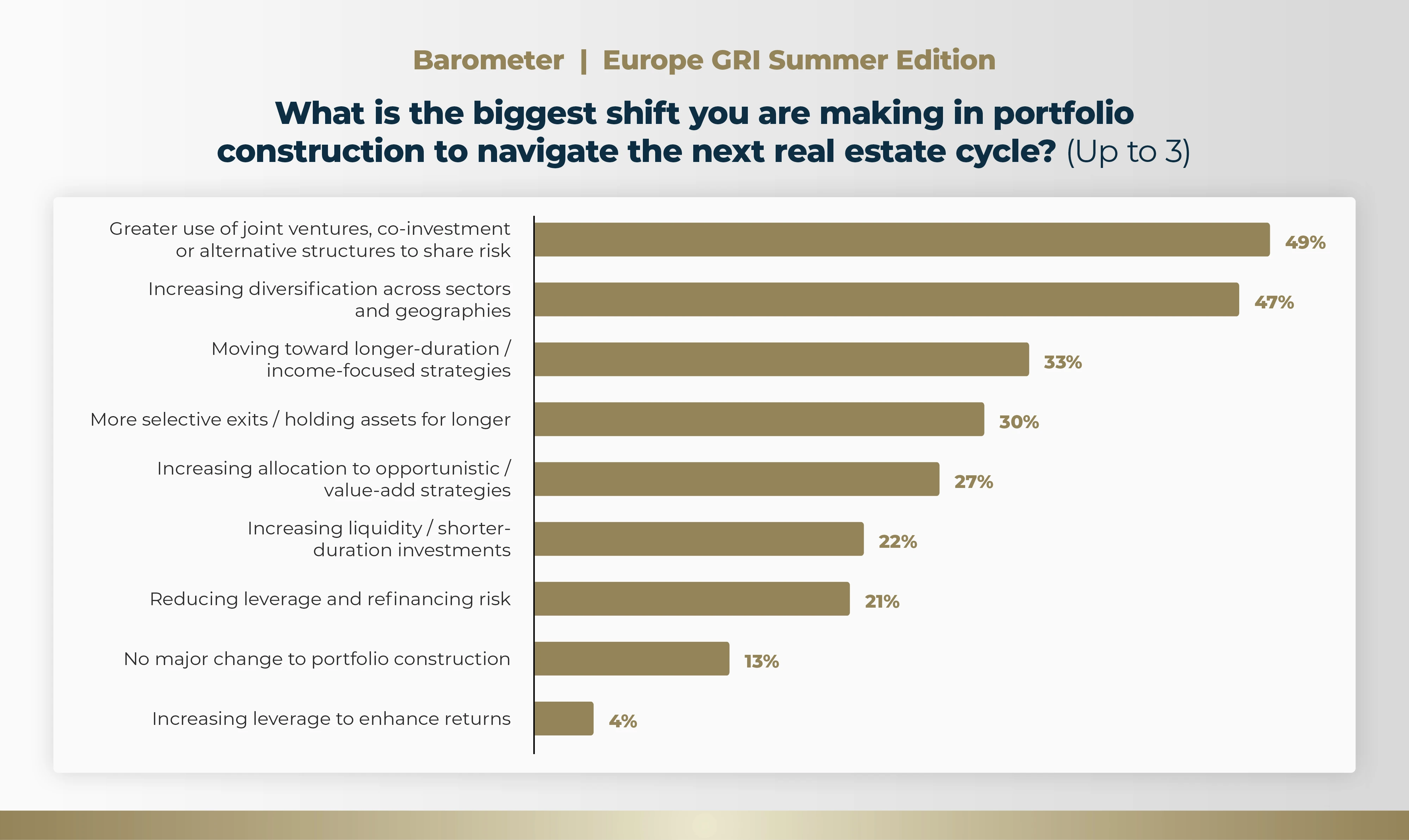
With the market now transitioning into an expansionary phase defined by structural adaptation, the H2 2026 survey introduces a more granular metric: Portfolio Shifts.Rather than asking whether companies are expanding, this dataset establishes a new benchmark for how firms execute those strategies at the asset and balance-sheet level, measuring specific tactical levers such as risk-sharing, diversification, asset duration, and leverage.
Risk-Sharing and Geographic Diversification
“Greater use of joint ventures, co-investment, or alternative structures to share risk” emerged as the single most dominant portfolio shift in first place, followed closely by “increasing diversification across sectors and geographies” in second place.These findings illustrate how firms are delivering the expansionary appetite established in earlier 2026 surveys.
Investors are moving away from equity-heavy, single-asset ground-up developments, which have largely stalled across Western Europe due to elevated construction costs and tight credit.
Instead, they are pooling capital through JVs, club deals, and operational partnerships to share risk while reallocating into resilient Southern European gateways, CEE hubs, and operational asset classes like living, hospitality, and data centres.
Duration, Income, and Exit Selectivity
“Moving toward longer-duration/income-focused strategies” secured third place, while “more selective exits/holding assets for longer” ranked fourth.Faced with high risk-free sovereign yields, extended transaction timelines, and illiquidity in non-core secondary markets, investors are moving away from rapid trading or speculative flipping.
Capital deployment is overwhelmingly focused on securing stable, inflation-linked cash flows, while portfolio managers exercise patience by extending holding periods and executing active asset management rather than accepting deep pricing discounts on disposals.
Opportunistic Realignment and Balance-Sheet Discipline
“Increasing allocation to opportunistic/value-add strategies” captured fifth place, reflecting widespread capital deployment toward office-to-residential or office-to-hotel conversions, brownfield industrial upgrades, and recapitalisations of stressed capital stacks.Concurrently, “reducing leverage and refinancing risk” ranked seventh, whereas “increasing leverage to enhance returns” finished dead last in ninth place.
This stark contrast underscores that in an environment of elevated interest rates and strict lender underwriting, financial engineering has been completely rejected as a return driver, with sponsors choosing conservative debt structures and equity risk-sharing instead.
Tactical Liquidity and Structural Baseline
“Increasing liquidity/shorter-duration investments” placed sixth, capturing a segment of capital seeking flexibility amid geopolitical volatility and potential interest rate adjustments.Meanwhile, “no major change to portfolio construction” occupied eighth place, demonstrating that the vast majority of European real estate organisations have actively adjusted their operational, asset, and financing frameworks to navigate the current cycle.
► Conclusions
The survey results signal a structural reset in European real estate, where passive capital growth and financial leverage have been replaced by operational value creation and balance-sheet discipline.Moving forward, performance will depend not on timing market cycles, but on active asset management, collateral quality, and securing resilient, inflation-hedged cash flows.
While expansionary appetite remains the primary corporate stance, firms are executing growth through a far more risk-mitigated lens.
By embedding joint ventures, geographic diversification, and operational flexibility into core strategies, market participants are positioning themselves to navigate external macro volatility while capturing value across an increasingly selective European landscape.
► Make your voice heard in the next survey by joining us in London on 24th February for Europe GRI 2027 - Winter Edition
This survey was conducted among the senior industry leaders who participated in Europe GRI 2026 - Summer Edition.
► Check out all upcoming GRI Institute Europe gatherings here