 GRI Institute
Portugal GRI 2026 Barometer Results: Robust cross-border capital meets execution friction
Exclusive GRI survey insights reveal how market leaders are overcoming administrative bottlenecks through flexible underwriting, conversions, and BTS platforms
August 12, 2026Real Estate
Written by:Rory Hickman
Executive Summary
At the recent Portugal GRI 2026 conference in Lisbon, senior real estate leaders examined a market caught between exceptional cross-border demand and severe delivery friction.
Driven by safe-haven macroeconomics, competitive property pricing, and resilient tourism performance, Portugal remains a primary target for international capital, even as municipal licensing delays and 40% tender inflation restrict new supply.
To navigate these execution bottlenecks, investors are rapidly shifting toward risk-mitigated asset playbooks. Exclusive barometer survey results reveal a clear pivot toward upper-tier Build-to-Sell residential, suburban mixed-use hubs, and regional eco-tourism concepts, where operational agility and flexible underwriting are critical to protect yields.
Ahead of the Iberia - From Recovery to Maturity panel at Europe GRI 2026 - Summer Edition in Paris on 9th-10th September, where industry leaders will gather to continue the conversation, this barometer outlines the core survey findings and strategic shifts shaping the market.
► Read the full Portugal GRI 2026 Spotlight report for more insights
Driven by safe-haven macroeconomics, competitive property pricing, and resilient tourism performance, Portugal remains a primary target for international capital, even as municipal licensing delays and 40% tender inflation restrict new supply.
To navigate these execution bottlenecks, investors are rapidly shifting toward risk-mitigated asset playbooks. Exclusive barometer survey results reveal a clear pivot toward upper-tier Build-to-Sell residential, suburban mixed-use hubs, and regional eco-tourism concepts, where operational agility and flexible underwriting are critical to protect yields.
Ahead of the Iberia - From Recovery to Maturity panel at Europe GRI 2026 - Summer Edition in Paris on 9th-10th September, where industry leaders will gather to continue the conversation, this barometer outlines the core survey findings and strategic shifts shaping the market.
► Read the full Portugal GRI 2026 Spotlight report for more insights
Key Takeaways
- High cross-border investor demand remains heavily restricted by municipal licensing delays, deep-seated bureaucratic hurdles, and conservative bank financing criteria.
- Acute shortages of skilled labour and tender inflation are forcing living and hospitality operators towards public-private partnerships and digital automation.
- A sharp flight to quality across commercial sectors has triggered severe prime office deficits, rapid data centre expansion, and a rental surge in primary logistics corridors.
► Cross-Border Capital Catalysts
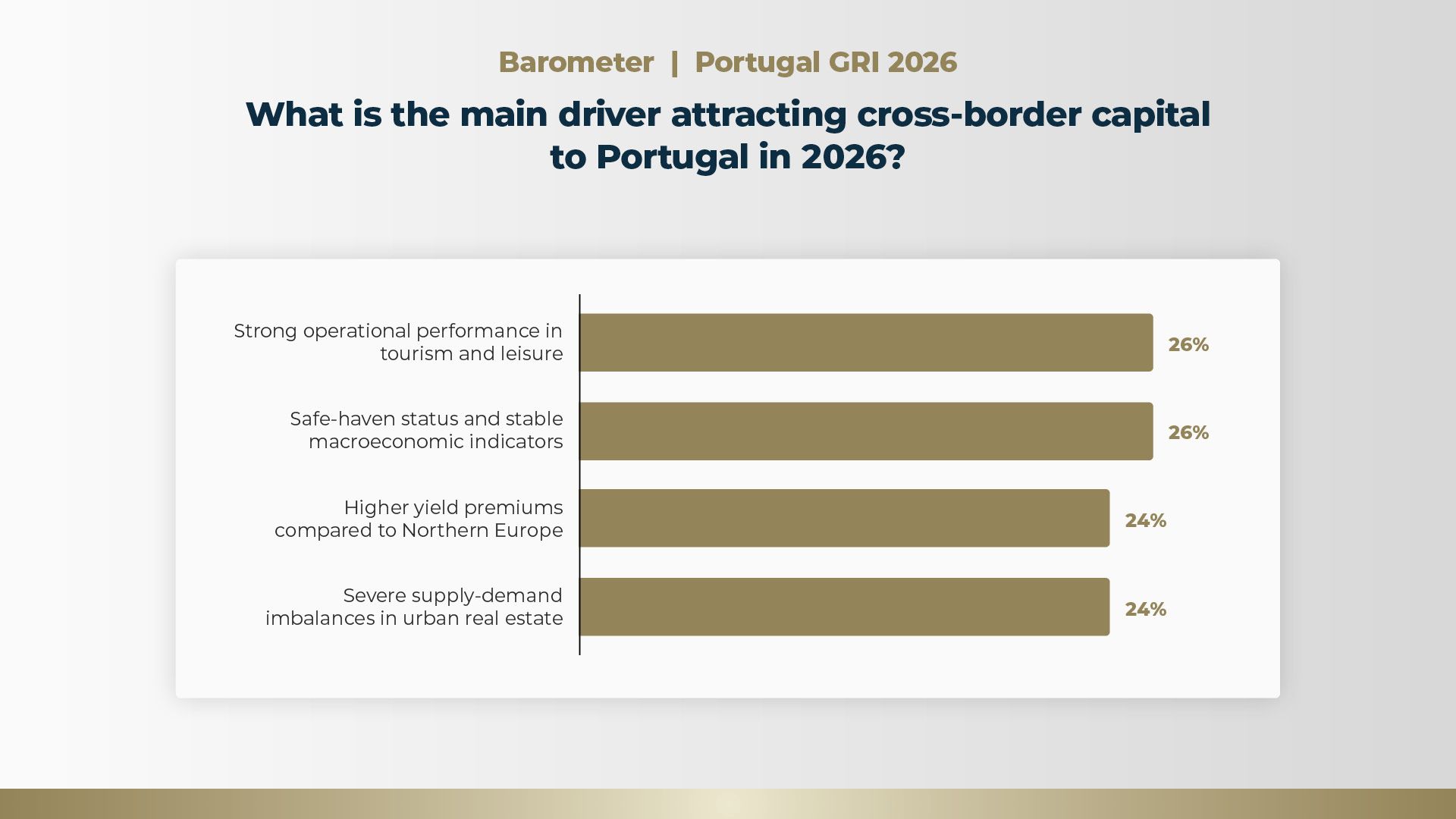
The results of our latest industry leader survey at Portugal GRI 2026 reveal a remarkably balanced set of drivers attracting cross-border capital into the country’s real estate sector.
Leading the responses, strong operational performance in tourism and leisure, along with the country's safe-haven status and stable macroeconomic indicators, each captured 26% of the sentiment.
Meanwhile, higher yield premiums compared to Northern Europe and severe supply-demand imbalances in urban real estate followed closely behind, each securing 24% of the votes.
This tight distribution highlights that international investors are drawn to a combination of operational performance, financial returns, and structural macroeconomic stability rather than relying on a single catalyst.
This balanced perspective reflects broader market dynamics across the Portuguese investment landscape. Property pricing remains relatively low compared to neighbouring Spain, while a stable economy and safe-haven status provide defensive security.
Furthermore, severe municipal licensing delays and bureaucratic hurdles have restricted new supply influx, insulating incumbent asset owners and allowing them to capture significant rental uplifts and capital appreciation through refurbishments.
The influx of cross-border capital is further reinforced by wealthy US consumers seeking currency diversification, stable geopolitical hedges, and second homes abroad.
Strong operational performance in tourism and leisure also underpins investor confidence, with sector revenues per available room expanding significantly faster than inflation since 2019.
Consequently, international investors view Portugal as a multifaceted market offering both defensive preservation and strong growth potential across commercial and residential sectors.
► Stock Shortage Strategies
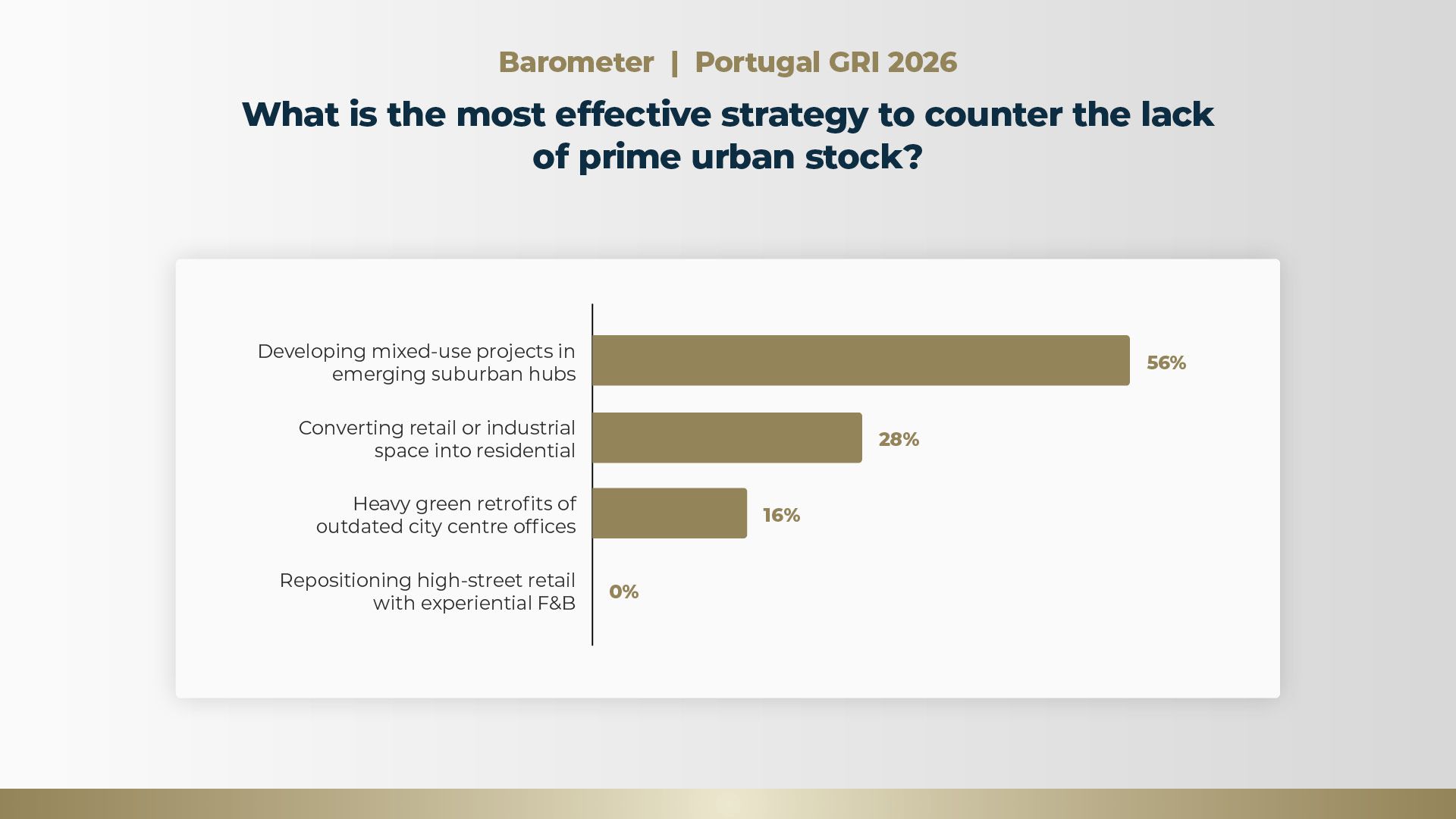
When polled on the most effective strategy to counter the acute shortage of prime urban stock, a clear majority of 56% of senior real estate leaders identified developing mixed-use projects in emerging suburban hubs as the primary solution.
Asset conversion strategies also garnered notable support, with 28% favouring the conversion of retail or industrial space into residential units.
Heavy green retrofits of outdated city centre offices secured 16% of the vote, whereas repositioning high-street retail with experiential food and beverage recorded 0%, underscoring a decisive pivot away from purely retail-led urban interventions.
The strong endorsement of suburban mixed-use developments stems from the severe friction associated with pure city centre schemes.
Urban developments face protracted municipal licensing procedures and planning constraints that can stretch for years, prompting institutional funds to target emerging suburban hubs.
In these suburban nodes, large-scale mixed-use projects generate continuous consumer traffic, combine immediate build-to-sell (BTS) revenue with stable income-producing assets, and effectively bypass tight urban footprint restrictions.
At the same time, conversion and retrofit strategies address urgent structural demands across specific asset classes.
Converting industrial or retail space directly targets the severe deficit in residential supply, while green retrofits of city centre offices respond to an intense flight to quality among international corporate occupiers seeking carbon-neutral, ESG compliant facilities.
Conversely, the complete lack of interest in high-street retail repositioning demonstrates a mature environment where prime high-street yields have compressed below 4%, shifting investor priorities toward functional, large-scale urban expansion.
► Hospitality Value Creation
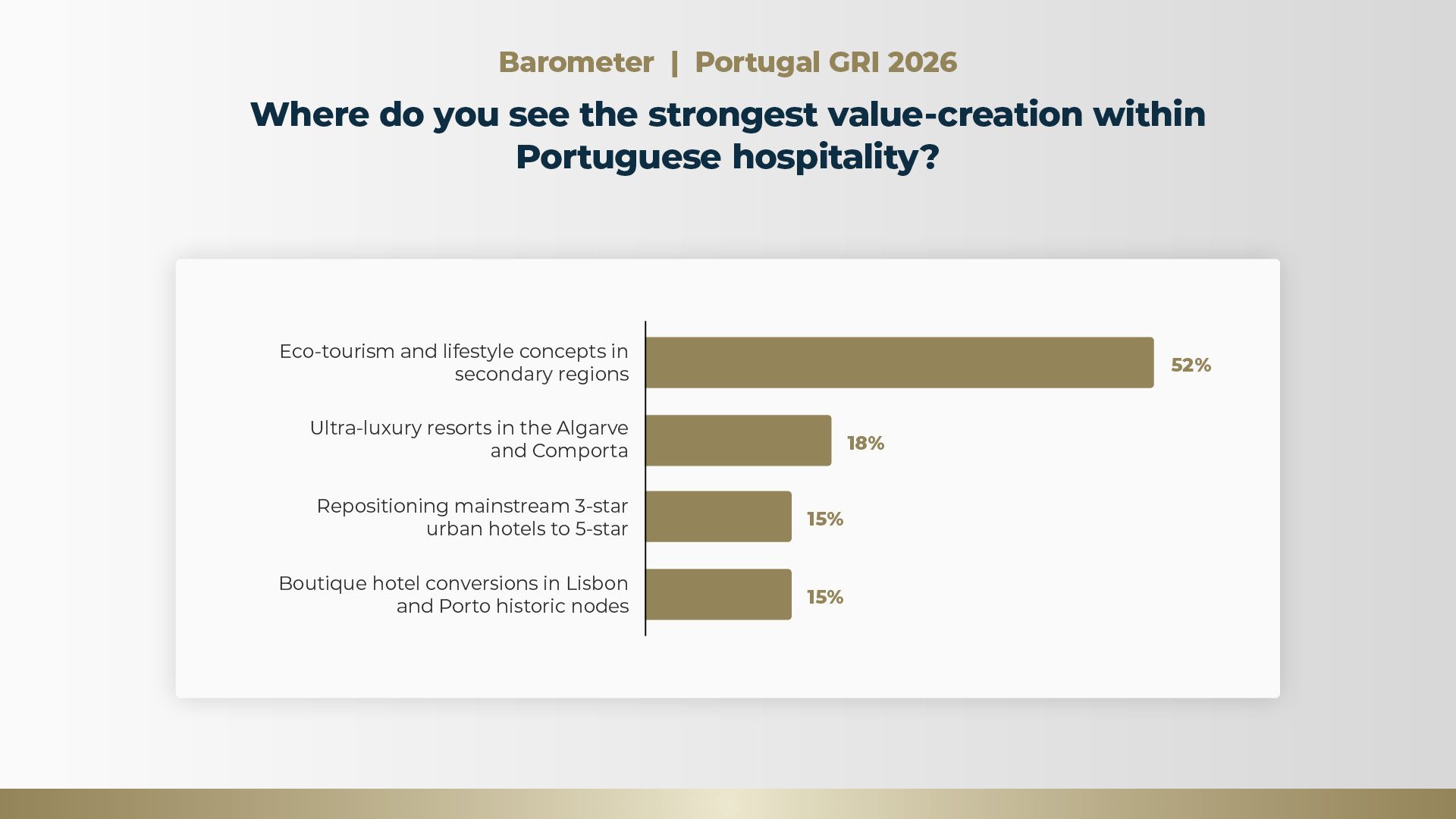
Survey results regarding hospitality value creation highlight a major strategic shift toward non-traditional leisure assets, with over half of respondents viewing eco-tourism and lifestyle concepts in secondary regions as offering the strongest value-creation opportunities.
In contrast, traditional luxury choices recorded significantly lower support, with ultra-luxury resorts in the Algarve and Comporta gathered 18% of votes, while repositioning mainstream 3-star urban hotels to 5-star and boutique hotel conversions in historic Lisbon and Porto nodes tied at 15% each.
This decisive preference for secondary regional lifestyle concepts matches evolving global travel habits and macroeconomic conditions.
Consumer tastes are moving away from uniform, traditional luxury toward experiential concepts, eco-tourism, and private, hidden resort zones, driven by a desire to avoid over-tourism in primary urban nodes.
Additionally, geopolitical instabilities in the Eastern Mediterranean have redirected European travellers toward Western Mediterranean destinations with safer reputations, bolstering demand for sustainable, earthbound regional holiday concepts reachable by car.
Conversely, traditional hotel models in primary hubs face tightening operational margins and heavy development barriers.
Standalone luxury hotel developments have become financially difficult to justify without integrated branded residences to de-risk capital stacks, while mid-scale urban hotels face rising labour costs and operational inflation unless they fully adopt streamlined, tech-enabled digital frameworks.
As a result, secondary market eco-lifestyle schemes offer superior growth trajectories and operational efficiency in an evolving hospitality market.
► Risk-Adjusted Residential Returns
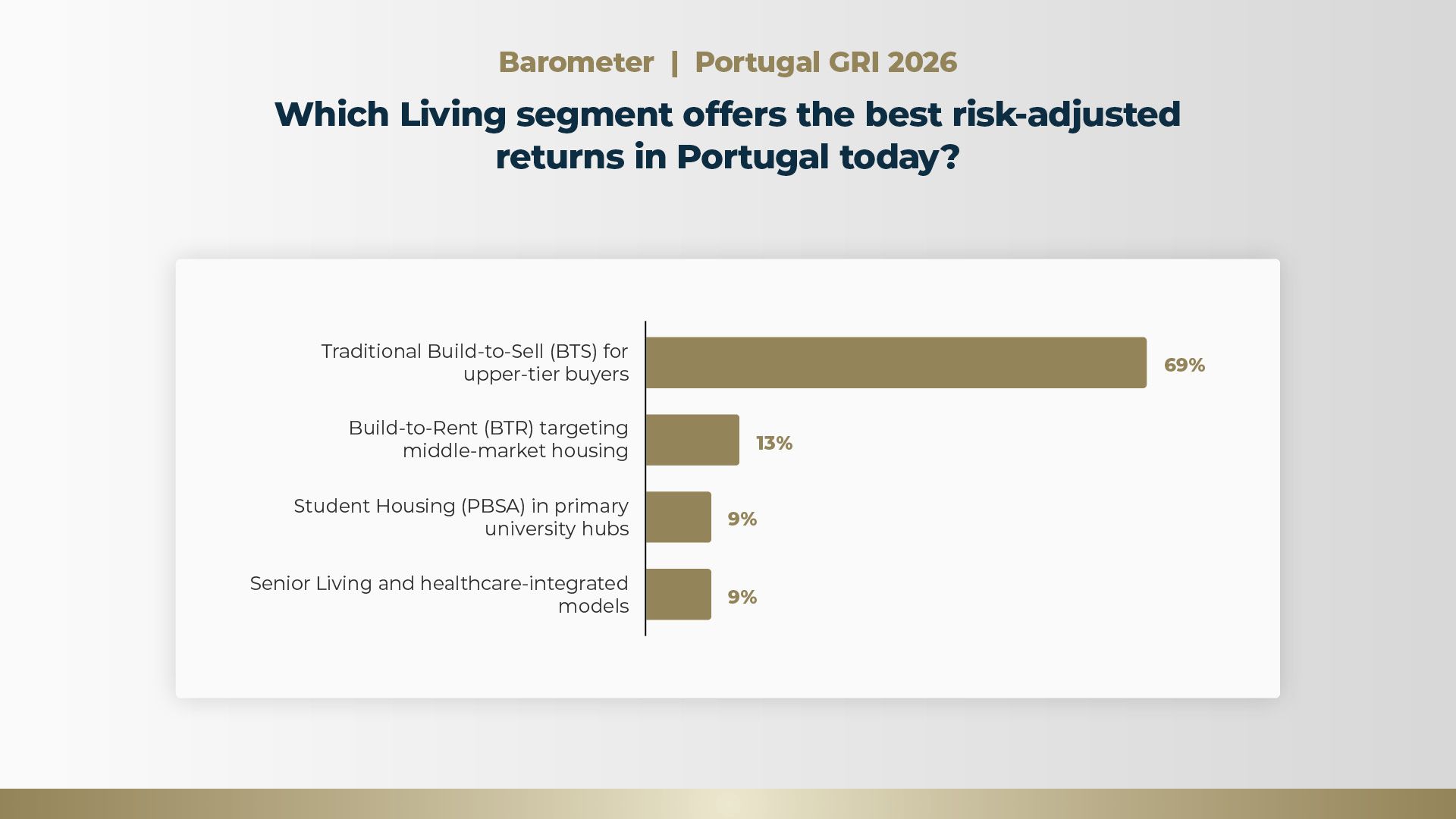
In assessing the living sector, an overwhelming 69% of industry leaders identified traditional BTS for upper-tier buyers as providing the best risk-adjusted returns in Portugal today.
Alternative residential asset classes lagged far behind, with build-to-rent (BTR) targeting middle-market housing capturing 13%, while purpose-built student accommodation (PBSA) in primary university hubs, and senior living models tied at 9% each.
The dominance of upper-tier BTS reflects specific execution advantages within the Portuguese market.
High-end residential schemes benefit from sustained demand among affluent domestic and international buyers, particularly US citizens, who display virtually no price sensitivity and enable rapid off-plan sales.
These early pre-sales generate crucial cash flow that mitigates significant execution risks, including 40% tender inflation, acute shortages of skilled construction labour, and municipal licensing timelines that frequently extend from two to four years.
By contrast, middle-market BTR and specialised institutional living platforms face notable administrative and regulatory obstacles.
BTR schemes are constrained by legacy municipal planning laws enforcing large minimum unit sizes averaging 110 to 120 square metres, shifting national guidelines, and a tightening mortgage environment for middle-class domestic buyers.
Although public-private partnerships are beginning to emerge to support middle-market housing, upper-tier BTS remains the most dependable, capital-efficient strategy for navigating current development constraints.
► Conclusion
The barometer survey results depict a Portuguese real estate market underpinned by strong fundamental demand and attractive yield potential, yet constrained by severe operational and administrative friction.Cross-border capital remains eager to deploy across the country, drawn by a safe-haven macroeconomic profile, strong tourism performance, competitive pricing, and acute supply shortages.
However, the market's ultimate upside is governed by the speed at which developers and investors can navigate deep-seated municipal licensing delays, construction labour deficits, and 40% tender inflation.
To capture value in this environment, capital deployment is actively reorganising around flexible and risk-mitigated asset strategies.
Real estate leaders are leaning into upper-tier BTS developments to secure early liquidity, expanding mixed-use platforms in emerging suburban hubs to circumvent urban space bottlenecks, and capturing regional travel demand through eco-tourism in secondary markets.
Going forward, long-term market success will belong to adaptable operators who can combine local operational expertise with innovative strategies, such as public-private partnerships and automated digital operations, to overcome supply constraints and deliver resilient returns.
► Check out more insights in our full Portugal GRI 2026 Spotlight report
This survey was conducted among the senior industry leaders attending Portugal GRI 2026.
► Check out all upcoming GRI Institute Europe gatherings here