 Adobe Stock
Strategic CRE Foresights Ahead of GRI Offices India 2026
Analysing record 31.3M sq ft of GCC leasing, an INR 500Bn retrofitting market, and the aggressive push toward 100M sq ft of flex space
March 19, 2026Real Estate
Written by:Jorge Aguinaga
Executive Summary
How will commercial portfolios remain defensible in the next market cycle? Ahead of GRI Offices India 2026, convening on April 9th in Bangalore, we explore the outlook for the sector as it undergoes a profound structural evolution.
As the industry gathers to shape the 2026-2030 operational playbook, it is clear that the narrative has definitively shifted from basic space acquisition to securing high-performance, AI-ready, and sustainable assets.
Driven by the rapid maturation of Global Capability Centres (GCCs) and a strict mandate for enterprise agility, the market is severely bifurcating. Premium, green-certified properties consistently command higher yields, while legacy assets require aggressive capital intervention to prevent obsolescence.
As the industry gathers to shape the 2026-2030 operational playbook, it is clear that the narrative has definitively shifted from basic space acquisition to securing high-performance, AI-ready, and sustainable assets.
Driven by the rapid maturation of Global Capability Centres (GCCs) and a strict mandate for enterprise agility, the market is severely bifurcating. Premium, green-certified properties consistently command higher yields, while legacy assets require aggressive capital intervention to prevent obsolescence.
Key Takeaways
- Flexible workspaces are now core portfolio strategies, with India's flex stock projected to surpass 100 million square feet by 2026 to ensure enterprise agility and rapid scaling.
- GCCs leased a record 31.3 million square feet in 2025, actively decentralising into emerging Tier 2 hubs to access untapped talent and optimise costs.
- Ageing legacy assets face severe obsolescence risk, unlocking a retrofitting investment potential exceeding INR 500 billion to meet strict modern ESG and AI-readiness standards.
The 2026 Office Playbook
Workspaces as AI Decision Hubs
The fundamental purpose of the commercial office is undergoing a profound structural shift from a static container for tasks to a high-value decision hub.As artificial intelligence compresses routine execution and reduces the time required for knowledge work, the strategic premium relocates toward physical settings that accelerate complex, human-centric decisions.
Consequently, corporate real estate portfolios are pivoting away from simple desk aggregation toward environments engineered to capture conversations, define actions, and compound organisational knowledge.
This evolution demands that properties be intrinsically designed to support AI workflows, mandating advanced acoustic management, high-capacity digital infrastructure, and spaces optimised for rapid collaboration.
Grade A Uptake and Flight to Quality
This paradigm shift is actively driving unprecedented market momentum, with Grade A space uptake reaching a record 71.5 million square feet across major Indian markets in 2025.Occupiers are ruthlessly prioritising a flight to quality, targeting premium assets that seamlessly integrate technological readiness with comprehensive wellness standards.
Assets lacking this foundational digital and infrastructural core are facing severe market fit risks, as generic floorplates struggle to accommodate the heterogeneous demands of the modern, AI-enabled enterprise.
Sustainability as a Strict Baseline
Intertwined with technological readiness is the absolute mandate for environmental sustainability, which has transitioned entirely from a compliance checklist to a strategic business imperative.In 2025, approximately 75% of all new Grade A office supply achieved green certification, reflecting a definitive developer commitment to climate-ready portfolios.
The occupier response has been equally decisive, with leasing in green-certified buildings exceeding 50 million square feet in both 2024 and 2025.
The financial metrics supporting this sustainable transition are indisputable. Green-certified buildings consistently command rental premiums of 15% to 20% while maintaining robust occupancy levels between 80% and 90%.
Properties that fail to integrate on-site renewable energy systems, water recycling frameworks, and advanced building management systems are being rapidly marginalised.
As corporations aggressively pursue their 2030 carbon neutrality targets, ESG compliance dictates long-term asset valuation and viability in the modern commercial landscape.
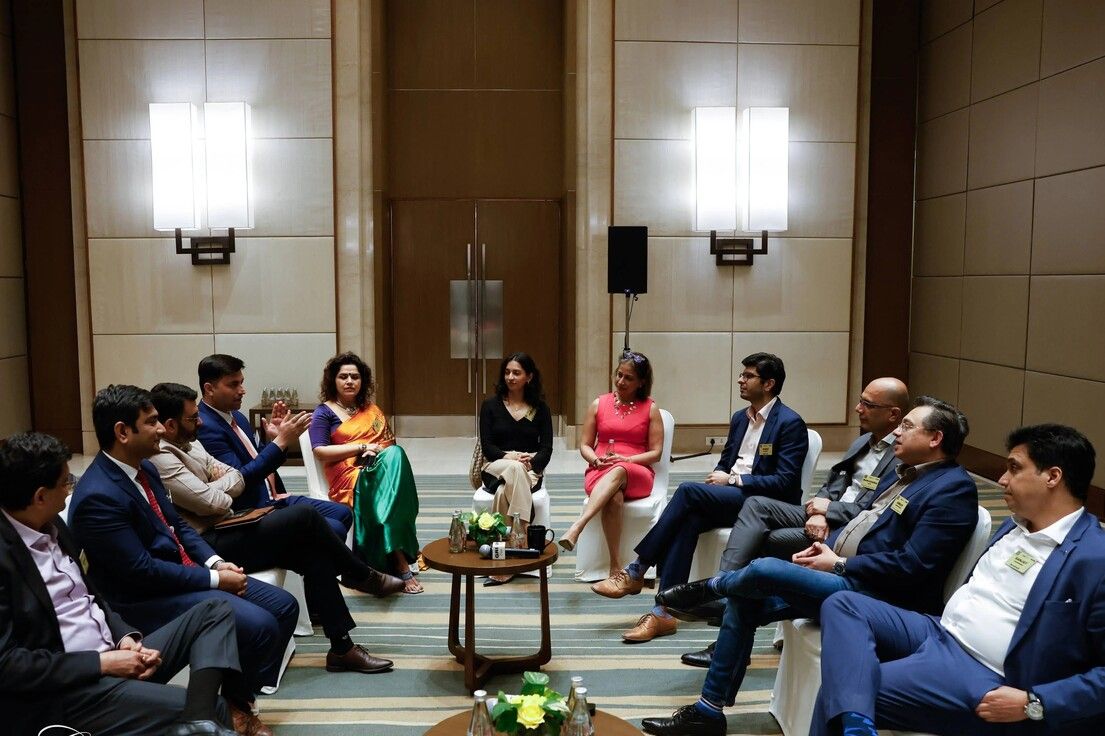
Following last year's GRI Offices & Global Capability Centres gathering, the upcoming 2026 edition is set to bring together the top decision-makers in India’s commercial real estate and GCC sectors. (GRI Institute)
Scaling Flexible Workspaces
Global Market Maturity and Agility
India has definitively emerged as the most advanced and mature flexible workspace ecosystem globally.Recent market intelligence from Cushman & Wakefield’s Global Trends in Flexible Office report awards India a perfect maturity score, outpacing established markets such as the United Kingdom, France, and the United States.
This extraordinary growth trajectory is characterised by a flexible workspace stock that reached 79.7 million square feet across the top eight cities by the second quarter of 2025 and is aggressively projected to surpass the 100 million square feet threshold by 2026.
Demand for these highly adaptable spaces has surged nearly sixfold since 2020, fundamentally transforming flexible offices from temporary, stopgap arrangements into core, indispensable components of long-term corporate real estate portfolios.
Consequently, flexible workspaces accounted for a substantial 18% of the total Grade A office space uptake in 2025, underscoring their critical role in facilitating enterprise agility, rapid scaling, and seamless market entry.
Managed Solutions and Emerging Hubs
The structural composition of this demand has shifted decisively towards fully managed, enterprise-grade solutions, which now command between 70% and 80% of the market share following the normalisation of hybrid work models.International enterprises are driving the vast majority of this absorption, representing 72% of flexible seat uptake in 2024, as they actively prioritise speed-to-market strategies and capital expenditure optimisation over traditional, rigid lease structures.
While metropolitan hubs like Bangalore continue to dominate with approximately 30% of the national flexible inventory, occupiers are increasingly decentralising their operational footprints by expanding into emerging Tier 2 cities such as Jaipur, Kochi, and Coimbatore.
This strategic geographic diversification enables corporations to tap into fresh, highly skilled talent pools while capitalising on fit-out costs that average a highly competitive USD 75 per square foot, providing a stark contrast to major global markets that frequently exceed the USD 150 per square foot mark.
Institutional Validation and Core Plus Flex
The flexible workspace sector is simultaneously experiencing robust institutional validation, heavily evidenced by the successful public listings of four major operators and a strong pipeline of anticipated initial public offerings (IPOs) that signal heightened market transparency, rigorous governance, and surging investor confidence.As the market undergoes inevitable consolidation over the next three to five years, leading operators are actively cementing their market share by offering sophisticated, brandable, and built-to-suit workspaces that seamlessly integrate digital concierge services alongside comprehensive environmental, social, and governance tracking dashboards.
This deep institutional maturation firmly solidifies the core and flex portfolio model as the definitive standard for modern occupiers, allowing them to continuously balance operational resilience and exceptional employee experiences without being encumbered by the limitations of conventional real estate commitments.
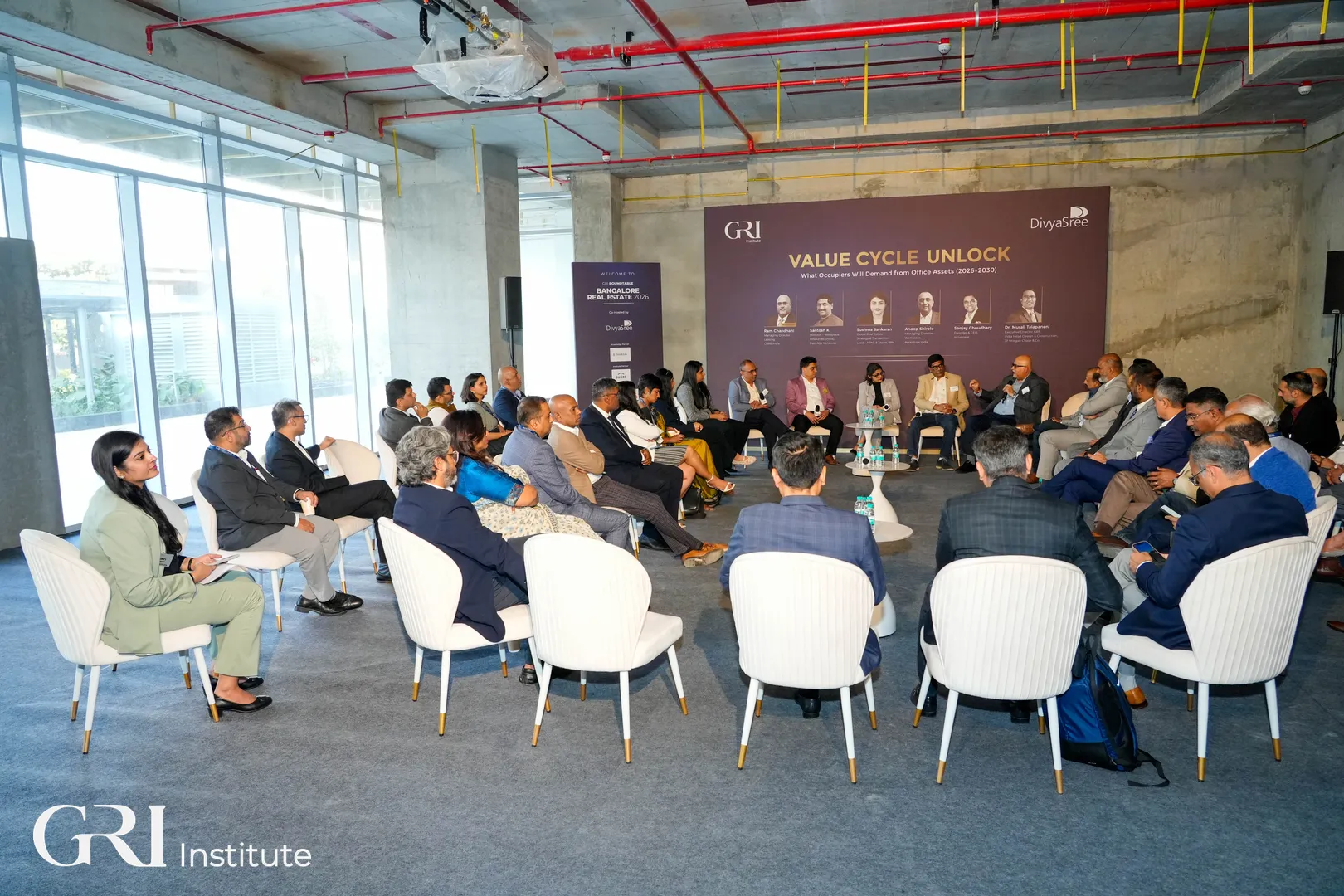
The Bangalore RE 2026 roundtable back in January convened industry leaders to discuss what will define high-performing office assets in the 2026-2030 cycle. (GRI Institute)
Grade A Pricing and Legacy Assets
The Surge of Domestic Capital
The commercial real estate investment landscape is currently undergoing a profound structural evolution as traditional foreign institutional dominance is rapidly supplanted by aggressive domestic capital participation encompassing robust family offices and local institutional funds."What we are seeing in India right now, the trend is that a lot of domestic capital, which till a few years ago was buying pieces of real estate directly, is getting institutionalised," notes Anshul Jain, Chief Executive for India, Southeast Asia, the Middle East, and Africa at Cushman & Wakefield during an exclusive GRI interview. "So far, what we saw in India was basically global institutional funds entering, but now we are seeing domestic funds getting on the ride".
Investors are fiercely pursuing premium core assets which consistently demonstrate the capacity to yield highly attractive pre-tax returns in the range of 18% to 20% over a standard investment horizon.
However, the inherently finite supply of these fully stabilised premium properties is actively compressing yields and strategically redirecting massive capital flows towards core-plus and value-add acquisition strategies.
This reallocation of capital is heavily supported by the profound institutionalisation of the market, which witnessed 141 million square feet of Grade A office stock successfully listed under Real Estate Investment Trusts (REITs) by the end of 2025, representing an unprecedented 17% market penetration.
The democratisation of commercial real estate ownership is further evidenced by a dramatic surge in IPOs, with real estate players collectively raising an astonishing INR 318 billion throughout 2024 and 2025 to fuel ongoing portfolio expansion.
Obsolescence and Structural Interventions
As new capital floods the market seeking premium returns, a severe pricing bifurcation is emerging that places older legacy assets at an existential disadvantage.Properties constructed over a decade ago, which encompass a staggering inventory exceeding 420 million square feet nationwide, currently face an imminent threat of obsolescence if they remain untouched.
The historical standard of merely executing cosmetic lobby refreshes is entirely insufficient to meet the sophisticated demands of the modern corporate occupier.
Asset survival now mandates deep, capital-intensive structural interventions that comprehensively upgrade mechanical, electrical, and plumbing systems while drastically enhancing indoor air quality to align with stringent environmental and wellness certifications.
Strategic Upgrades for Competitiveness
This urgent requirement to elevate ageing stock represents a monumental market opportunity.According to Colliers' 2026 India Office outlook, the retrofitting potential for buildings older than a decade confidently exceeds INR 500 billion, unlocking massive value for developers who execute comprehensive structural and technological enhancements
Developers and portfolio managers who successfully execute these comprehensive structural and technological enhancements are directly rewarded with superior market positioning and highly tangible financial returns.
Upgraded, green-certified properties consistently command substantial rental premiums ranging from 15% to 20% over their non-certified counterparts while simultaneously securing resilient occupancy levels between 80% and 90%.
Consequently, the strategic repositioning of legacy assets is no longer viewed merely as a defensive capital preservation tactic, but rather as an aggressive value creation mechanism essential for achieving the highest tiers of modern Grade A pricing and capturing elevated leasing velocity.

"At this point in time, you touch a real estate sector, the economics, the macro demographic dividends - everything is falling in the right direction," noted Anshul Jain (Cushman & Wakefield) during an exclusive GRI interview with Rodrigo Branchini, Partner & Managing Director APAC at the GRI Institute.
GCC Expansion and Infrastructure
Maturation of Global Capability Centres
Global Capability Centres have definitively transitioned from cost-focused outsourcing outposts into strategic engines of innovation and global product ownership.This profound functional maturation is fundamentally anchoring the commercial real estate sector, propelling leasing activity to an unprecedented record of 31.3 million square feet in 2025.
Capturing over 40% of total office leasing over the past decade, these sophisticated centres are aggressively expanding their operational footprints across the subcontinent.
The market influx remains remarkably robust, with over 200 new GCCs entering the Indian market within the last two years alone, collectively driving a mandate for highly scalable and technologically advanced workspaces.
As corporations deeply embed artificial intelligence and advanced analytics into their core operations, these centres now command extensive enterprise-grade facilities designed to support sophisticated global leadership roles rather than mere back-office processing.
Metropolitan Sector Ecosystems
The geographic distribution of this monumental expansion is characterised by highly sophisticated and sector-specific clustering.Data from JLL's India GCC Guide 2026 confirms Bangalore remains the undisputed leader, commanding a 34% to 39% market share through a dense network of over 900 operational units focused heavily on technology and engineering research.
Simultaneously, Hyderabad has aggressively consolidated its position as the premier healthcare and biotechnology destination, capturing 20% to 23% of the national market share while leveraging strong infrastructural investments and governmental policy incentives.
Other major urban centres are equally carving out distinct domain specialisations, with Chennai rapidly accelerating as a manufacturing and automotive powerhouse and Pune capturing 15% to 20% of the market through demonstrated excellence in the banking, financial services, and insurance sectors.
Tier 2 Frontiers and Decentralisation
While Tier 1 cities currently retain over 90% of all Global Capability Centre activity, a highly strategic decentralisation movement is currently unlocking vast new real estate corridors.Multinational enterprises are aggressively implementing integrated hub-and-spoke operational models, deploying high-value innovation functions in primary metropolises while establishing scaled operations across emerging Tier 2 destinations.
Secondary markets such as Jaipur, Kochi, Coimbatore, and Mysuru are rapidly transforming into highly sophisticated business hubs. This deliberate geographic diversification extends far beyond simple cost arbitrage, though it effectively yields immediate operational savings between 10% and 35%.
More critically, establishing strategic footholds in these modern infrastructure-led corridors provides direct access to massive, previously untapped talent reservoirs, fundamentally engineering long-term enterprise resilience and ensuring highly sustainable portfolio expansion for the future.
Shaping the Future at GRI Offices India 2026
As the market rapidly pivots towards artificial intelligence integration, flexible enterprise portfolios, and aggressive asset repositioning, navigating these complexities requires unparalleled market intelligence and collaborative foresight.To turn these macro insights into execution, we invite you to join the strategic dialogue at GRI Offices India 2026 on April 9th at the JW Marriott Hotel in Bangalore.
The gathering will feature closed-door discussions such as the "Creating the 2026-2027 Office Playbook" session, dedicated to building, retrofitting, and running defensible assets. This critical panel will be moderated by Anshul Jain (Cushman & Wakefield) and co-chaired by Amit Shetty (Embassy REIT), Ganesh Parameswaran (Google India), Kunal Mehra (Table Space), and Thirumal Govindraj (RMZ Corporation).
Explore the full GRI Offices India 2026 agenda HERE.