 GRI Institute
How Indian real estate is turning net-zero goals into net-value gains
How sustainability is evolving from a compliance cost into a core strategy for financial returns
November 11, 2025Real Estate
Written by:Jorge Aguinaga
Key Takeaways
- Failing to build for climate resilience is now a direct financial risk, evidenced by the recent INR 14,000 crore loss in Himachal Pradesh.
- A proactive net-zero strategy can drive significant ROI, as companies like Infosys are saving INR 9.50 crore annually while attracting green finance.
- The green building cost premium has collapsed to just 1-2%, an investment that typically pays for itself in only one to two years.
The new value proposition
For decades, sustainability in real estate was treated as a compliance issue or a simple marketing feature, but a fundamental shift is now underway. This traditional view is no longer just outdated; it represents a direct threat to the bottom line, prompting a new industry imperative that moves from net-zero to net-value.This new model, detailed by Dr. Mala Singh, Chairperson of the IGBC (CII) Mumbai Chapter, at a recent GRI Institute women's gathering in Mumbai, reframes decarbonisation not as a cost but as a core driver of business value, financial performance, and brand reputation.
The conversation detailed how climate risk is now intrinsically linked to financial risk, explaining how a proactive net-zero strategy is already unlocking tangible ROI, mitigating catastrophic losses, and attracting a new wave of green capital.
The discussion has evolved beyond simple compliance to focus on building a resilient and profitable future for green real estate
Why climate risk is financial risk
The urgency of this shift is underscored by the immense financial cost of inaction, as climate change has evolved from a distant threat into a present-day reality for India.Prestigious institutions are already predicting that 80% of the country's GDP could be affected by 2050 if global warming is allowed to reach 3°C. This is not a theoretical risk; it is already impacting regional economies and critical infrastructure.
The recent catastrophic events in Himachal Pradesh, where floods and landslides resulted in a declared loss of INR 14,000 crore, demonstrate the profound vulnerability of infrastructure to climate shocks and the immense cost of rebuilding.
Beyond sudden disasters, the growing threat of extreme heatwaves and urban heat island effects directly translates into productivity losses, disrupting both construction and daily operations. For investors and real estate leaders, these factors prove that analysing climate risk is now an essential component of any sound financial strategy.
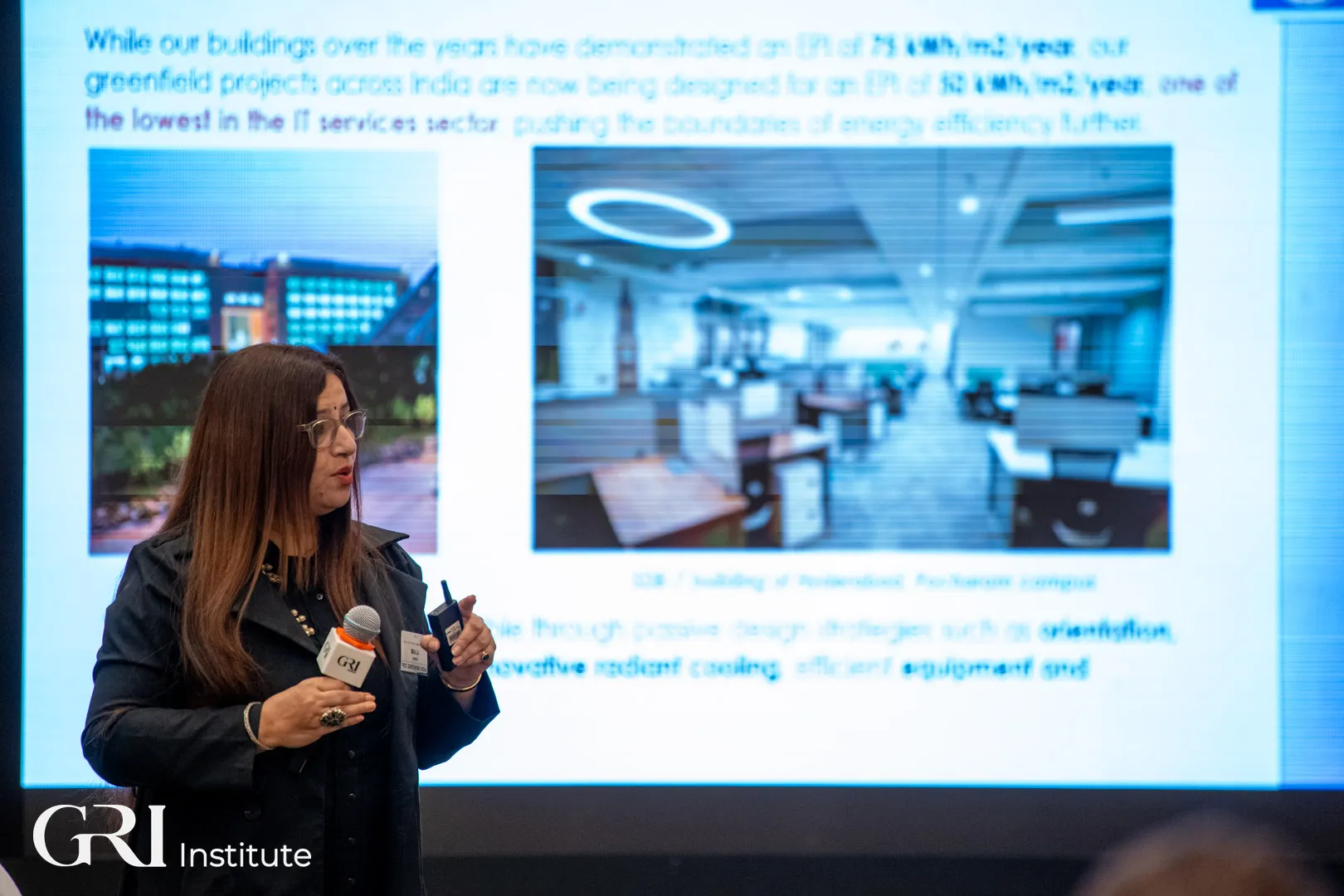
Dr. Mala Singh, speaking at the 'Path to Net Zero' gathering, noted that sustainability has decisively shifted from an onerous compliance cost to a core driver of net value. (GRI Institute)
From risk to tangible roi
The transition to net-value moves beyond defensive posturing; it is a proven strategy for unlocking significant financial gains and new investment opportunities.High-profile examples show where Indian corporations are already seeing massive returns. Infosys, for instance, is saving an estimated INR 9.50 crore per year in energy consumption alone by systematically reducing its Energy Performance Index (EPI) .
This strong performance is also attracting new sources of capital. Investors are actively seeking to fund credible, certified green projects, creating a clear financial advantage for developers who adopt these standards.
Major players are already capitalising on this trend, as seen in:
- Mindspace REIT's success in securing green finance from the International Finance Corporation (IFC).
- HDFC's agreement with the IFC to finance affordable and green housing projects in India.
- Brookfield's climate-positive model, which demonstrates how green energy partnerships can enhance profitability and business value.
Addressing the cost myth
Perhaps the most persistent objection to green building has been the perception of high initial costs, but recent data shows this is now a myth. When the first green building in India was certified in 2001, the additional cost for its green features was a significant 17%.Today, thanks to a market-driven process, mature green supply chains, and strong regulatory frameworks, that financial barrier has virtually disappeared.
For modern residential buildings, green design can actually save costs, while the premium for a high-platinum rating in a commercial building is hardly 1-2%.
More importantly, this minimal extra cost is not an unrecoverable expense but a high-return investment. With the resulting savings in energy and water, the payback period for this premium is often just one to two years.
This rapid ROI dismantles the cost objection, cementing the case for net-zero as a sound and profitable financial strategy.
The future is net-value
The path from net-zero to net-value has matured from a theoretical concept into a proven and urgent financial strategy. The real estate and infrastructure sectors are at a critical juncture where climate risk and financial risk are one and the same.The old perception of sustainability as a heavy cost has been replaced by the hard reality of its ROI.
For today's leaders, embracing green building, certified materials, and smart design goes beyond being a responsible choice to become the cornerstone of a resilient, competitive, and profitable business model.
These strategic insights were shared by Dr. Mala Singh, Chairperson & MD of PEC Greening India, during the "Path to Net-Zero: A Women's Gathering".
Access all takeaways and C-level insights in the exclusive India GRI 2025 Spotlight report.