 GRI Institute
The Rise of Geopolitical Real Estate: Securing the India-GCC Investment Corridor
How shifting trade alliances and advanced digital liquidity are transforming outbound Gulf capital allocations into Indian supply chains
February 24, 2026Real Estate
Written by:Jorge Aguinaga
Key Takeaways
- Global supply chain realignments and China plus one strategies are driving massive institutional investments into Indian logistics platforms.
- Indian data centre developments now require independent power infrastructure and are heavily supported by 20-year foreign tax exemptions.
- Abu Dhabi is pioneering billion-dollar tokenisation programmes to create secondary market exit liquidity for real estate investors.
The New Geopolitical Investment Baseline
As the global investment landscape rapidly fragments away from unified globalisation, geopolitical strategy has fundamentally superseded traditional macroeconomic indicators to become the primary driver of institutional capital allocation.By consciously adopting an independent stance rather than leaning exclusively toward any single global superpower, India has facilitated the creation of a robust new trade and investment corridor linking the subcontinent with the United Arab Emirates and Europe.
For cross-border capital allocators, navigating these geopolitical realities is no longer a peripheral exercise; it is the fundamental baseline for securing assets along these newly solidified economic pathways that serve as vital alternatives to legacy China-led routes.
Logistics and the Supply Chain Realignment
The Western world is actively disentangling its manufacturing dependencies after realising the systemic vulnerabilities of highly concentrated supply chains, rapidly accelerating a China plus one strategy that positions India as a critical beneficiary for widespread industrial expansion.Driven by a consumption-heavy domestic economy of 1.5 billion people alongside surging export-oriented production, the Indian warehousing sector is currently absorbing more than 50 million square feet of space year-on-year.
To capitalise on this massive industrial realignment, global institutional capital is flowing heavily into high-grade logistics platforms, highlighted by major entities such as Blackstone establishing themselves as the largest owners of warehouse infrastructure across the country.
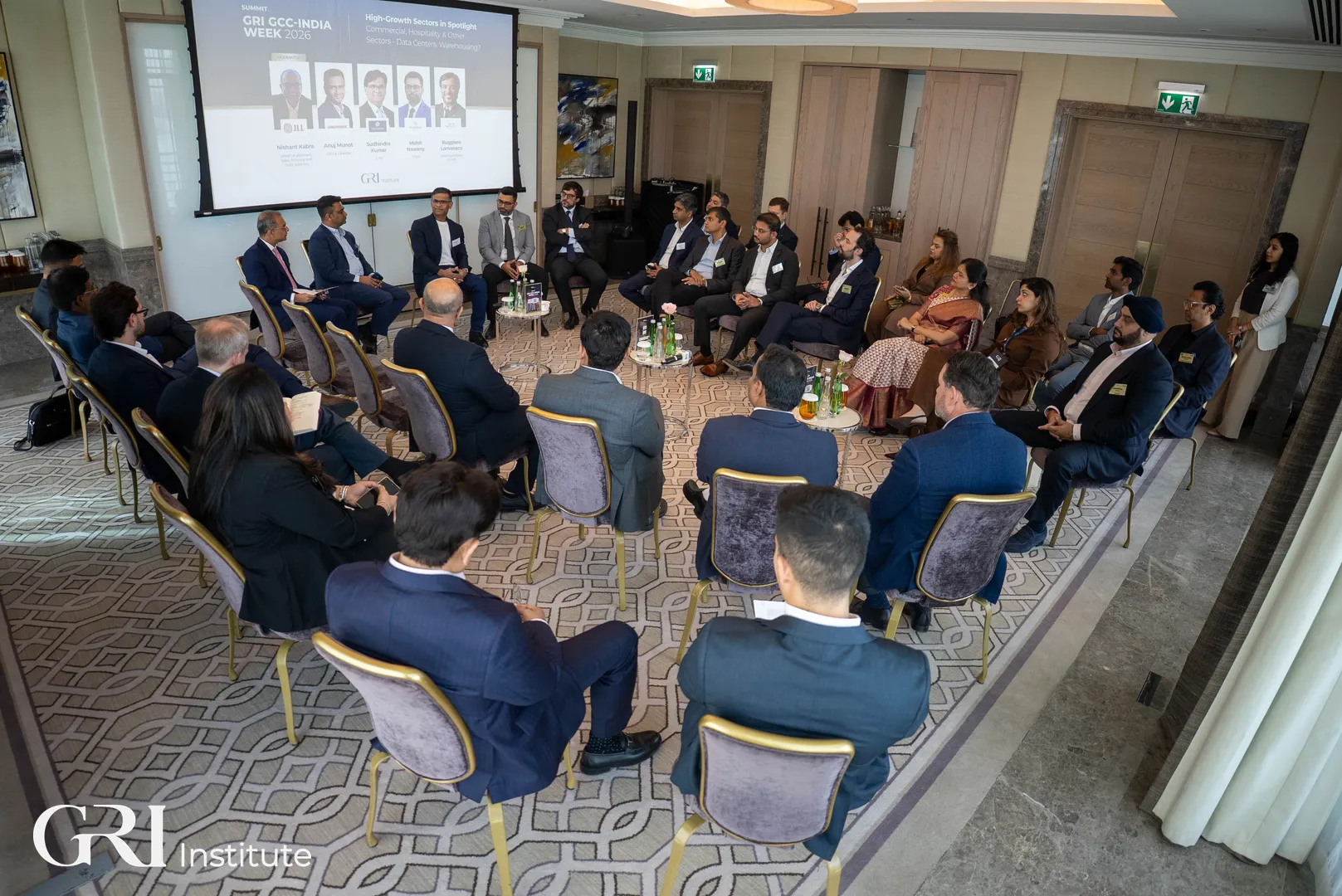
Global leaders convened in Abu Dhabi during the GRI GCC-India Week 2026 to assess strategic cross-border investments and institutional capital flows. (GRI Institute)
Redefining Data Centres as Sovereign Infrastructure
Because the next phase of global economic dominance will be dictated by the advancement of artificial intelligence (AI) and robotics, investing in data centres has evolved from a traditional real estate transaction into a complex, sovereign infrastructure deployment.The physical shell of the building is now entirely secondary to the critical challenge of securing stable, continuous power, as heavy data processing loads risk overwhelming existing municipal grids and causing systemic blackouts.
To maintain operational resilience, major operators are actively evaluating the integration of small modular nuclear reactors and large-scale renewable energy farms directly into their digital parks.
Foreign capital deployment in this highly specialised sector is currently being heavily incentivised by the Indian government, which has introduced a 20-year tax exemption for offshore investors to accelerate the development of digital infrastructure in a market already globally recognised for its deep IT literacy.
Advanced Asset Tokenisation and Exit Liquidity
As hard asset portfolios continue to expand across the region, sophisticated mechanisms for capital extraction are evolving to meet the demands of global investors seeking predictable and highly agile exit routes.Tokenisation is rapidly emerging as a highly credible financial instrument designed to create secondary market liquidity for historically illiquid real estate and large-scale development projects.
In Abu Dhabi, progressive regulatory frameworks are facilitating advanced digital ownership models that provide unprecedented market agility, perfectly illustrated by the launch of forward-sale tokenisation programmes valued at USD 1 billion within the Abu Dhabi Global Market (ADGM).
The institutionalisation of these digital assets arms global investors with the transparent valuations necessary to deploy long-term capital across the India-GCC corridor with absolute confidence.
Read more high-level industry insights in the full GRI GCC-India Week Summit Spotlight report.