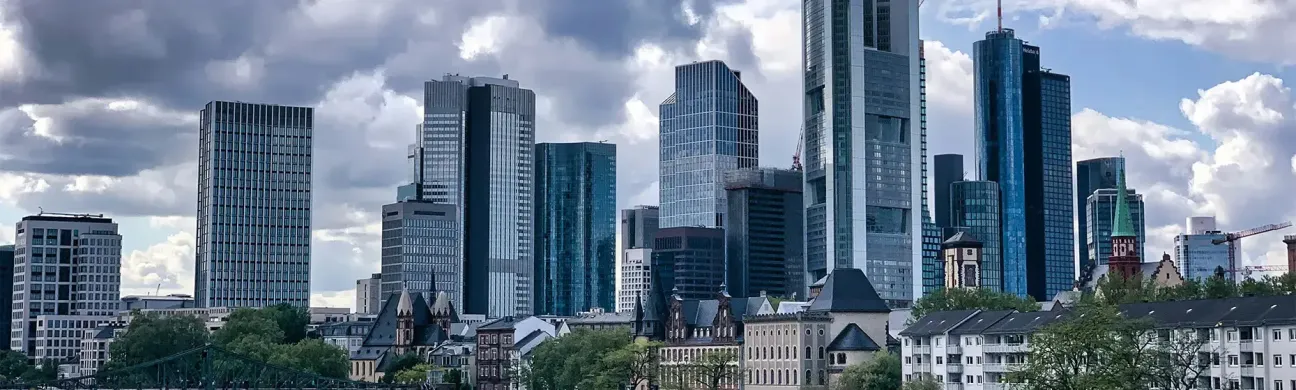
 Unsplash
Germany’s Commercial Real Estate Market Adapts to New Dynamics
GRI Institute analyses key trends, emerging opportunities and the shift towards income-oriented investment strategies
April 9, 2026Real Estate
Written by:Isabella Toledo
Executive Summary
Germany has long been considered a stronghold for real estate investment, and its market is now undergoing a significant transformation as traditional domestic investors retreat, creating space for alternative capital sources such as international players and private credit.
Despite challenges in the debt landscape and regulatory hurdles, experts agree that the current environment offers a prime entry point, as risk is being repriced and financing conditions are becoming more favourable.
Ahead of the GRI Institute’s Deutsche GRI 2026 conference in Frankfurt on 28th April, we explore the current trends and future outlook for a market where success increasingly relies on investors' ability to manage operational risks and pivot towards proactive, income-focused management strategies.
Despite challenges in the debt landscape and regulatory hurdles, experts agree that the current environment offers a prime entry point, as risk is being repriced and financing conditions are becoming more favourable.
Ahead of the GRI Institute’s Deutsche GRI 2026 conference in Frankfurt on 28th April, we explore the current trends and future outlook for a market where success increasingly relies on investors' ability to manage operational risks and pivot towards proactive, income-focused management strategies.
Key Takeaways
- The German real estate market is currently transitioning from a reliance on traditional domestic capital towards international players and private credit while experiencing a period of debt stagnation influenced by long-term fixed interest rates and conservative bank lending practices.
- Investors are increasingly prioritising a "flight to quality" across the logistics and office sectors, focusing on ESG-compliant prime assets in central business districts and resilient light industrial properties to drive stable, income-oriented returns.
- Despite administrative bottlenecks and a severe housing shortage that continues to support the case for new build developments and under-rented stock repurposing, the broader market is adapting through mixed-use retail transformations and the integration of "unified commerce".
► New horizons for real estate investment
Landscape & Liquidity
Historically regarded as a stronghold for real estate investment, the German real estate market is now adapting as traditional domestic investors retreat, creating space for alternative capital sources, particularly international players and private credit. This shift is opening opportunities for those who can navigate the new landscape.Although Germany remains one of Europe’s most liquid real estate markets, recent disruptions have led to a shift in focus towards other jurisdictions, reflecting investor fatigue in some segments.
However, industry leaders agree that this period presents a prime entry point for investors prepared to assess the evolving market, where risk is being repriced, and financing conditions are becoming more executable.
Positive Prospects
Despite these challenges, the long-term outlook for German real estate remains positive. The country continues to attract significant international capital, particularly in logistics and residential sectors, with large institutional transactions beginning to set new pricing benchmarks.As a result, the broader market is expected to see a return of sidelined equity. For investors who can navigate the complexities of local regulations, operational risks, and financing challenges, Germany continues to offer attractive opportunities, supported by a stable macroeconomic environment and ongoing demand for functional real estate assets.
► Germany’s conservative debt landscape
Bifurcated European Debt
The European real estate debt market is currently experiencing two distinct dynamics: while regions such as the United Kingdom, Spain, and Italy are seeing significant origination activity, Germany is in a period of relative stagnation.This slower pace can largely be attributed to the widespread use of long-term, fixed-rate financing in Germany, with many borrowers having locked in ten-year fixed interest rates, providing some stability against recent market volatility.
However, the full impact of refinancing pressures is expected to unfold gradually, leading to more measured adjustments in asset values compared to other global markets.
Germany’s conservative lending approach, characterised by cautious loan structures and a focus on lower leverage, continues to shape the market.
The country's stringent regulatory environment, while ensuring financial stability, influences banks to adopt a more cautious lending strategy, with an emphasis on stricter loan-to-value (LTV) ratios and slower adoption of more flexible debt structures.
Debt & Economic Future
The recovery in the debt market is progressing at a steady pace, with liquidity returning and banks again providing term sheets. However, many senior lenders are opting to extend existing financing rather than initiating restructurings, resulting in a more gradual recovery process with distressed opportunities handled privately rather than in the open market.Despite some concerns around Germany's economic outlook, value-add funds are increasingly redirecting equity into the country, viewing its price adjustments as an attractive opportunity compared to more stable neighbouring markets.
The market does present complexities, particularly regarding debt structures and regulatory risks. Instances of mezzanine lenders being impacted, along with German banks offering lower spreads than their international counterparts, highlight the importance of a focused strategy and a discerning approach, emphasising operational efficiency and a deep understanding of local income dynamics rather than broad market bets.
► Resilience in light industrial assets
Flight to Quality
Despite the broader European sector facing muted growth, the logistics market in Germany continues to offer significant opportunities, albeit with a more discerning approach. The market is increasingly characterised by a "flight to quality," with investors focusing on high-quality, well-located logistics spaces.A key shift in the sector is the growing preference for light industrial assets. These properties, particularly warehouses and distribution centres along major motorways such as the A1, A3, and A7, are being increasingly seen as resilient investments.
Unlike other sectors that are reliant on export-driven industries such as automotive or steel, light industrial assets are closely tied to the domestic economy, particularly in the context of e-commerce and logistics.
Speculative Slowdown
With regulatory barriers and high construction costs, speculative developments have slowed. Instead, there is a stronger emphasis on pre-let or build-to-suit projects, which offer greater stability and a lower-risk profile.This trend is particularly evident in urban logistics and last-mile distribution centres, where demand remains stable and less susceptible to broader economic cycles. The continued demand for smaller units in urban areas has also emerged as a key trend, as investors adapt to the evolving needs of occupiers seeking more flexible spaces.
This strategic shift is attracting a diverse range of investors, including Asian investors with established portfolios and Polish investment managers seeking joint venture opportunities. The smaller ticket sizes and high yields, often ranging between 9% and 10%, make this segment particularly appealing to family offices and specialised investment platforms.
Underwriting for Recovery
Underwriting standards for Germany’s industrial and logistics market reflect a more conservative yield profile compared to other European markets. Development yields in Germany are typically underwritten at approximately 100 basis points lower than the 7.5% to 8% range often seen in Southern European markets.This pricing differential underscores the market's perceived stability and its role as a core fixture in a diversified real estate portfolio. While capital markets remain selective, the stabilising macroeconomic conditions, including the trend of European inflation remaining below targets, have begun to foster a renewed sense of liquidity, supporting the market’s long-term recovery.
► Shifting strategies in the office sector
Office Stability
While the broader macroeconomic environment remains fragile, the office segment in Germany has shown signs of stabilisation, leading commercial real estate transaction volumes with EUR 5.7 billion in 2025, according to CBRE - a 15% increase over the previous year.However, this recovery is unfolding slowly, with total volumes still reaching only about one-third of the peak values recorded between 2019 and 2021. As yield compression no longer drives returns, the market is shifting towards an income-oriented performance model that demands a deep understanding of property quality and user requirements.
Just as seen in the logistics market, the most significant trend currently shaping the German office landscape is also the "flight to quality." Office space is increasingly viewed as a strategic tool for attracting and retaining talent, resulting in robust demand for premium, ESG-compliant premises in central business district (CBD) locations.
Companies are frequently downsizing their overall footprint while investing more heavily in high-quality, contemporary spaces that enhance productivity. This has driven prime rents upward in A-tier cities, with Munich approaching EUR 60 per square metre and Frankfurt exceeding EUR 50.
Prime vs. Secondary
Despite the demand for top-tier assets, the overall market faces significant headwinds. According to the ZIA German Property Federation, total space take-up in Germany’s largest office markets fell by 8% year-on-year in 2025. Vacancy rates have continued to rise, averaging 6.3% nationwide and reaching as high as 8.4% in prime locations.Cities such as Frankfurt and Düsseldorf have seen particularly high vacancy rates of 12% and 11.4%, respectively, primarily due to declining demand for older stock in decentralised or poorly connected locations. This surplus of secondary space is creating a market division, where non-prime assets require higher returns and significant capital expenditure to mitigate risks.
The scarcity of prime office space - compounded by a 24% decline in new construction completions - is creating opportunities for proactive asset management. A prominent strategy in response is the "brown-to-green" race, where older properties are acquired at a discount and refurbished to meet modern ESG standards.
Recalibrating Portfolios
The recent closure of a major open-ended office-focused fund further illustrates the ongoing recalibration within Germany’s commercial real estate sector.While flagship funds with diversified portfolios and significant liquidity buffers continue to operate effectively, the difficulties faced by this office-heavy vehicle underscore the importance of robust portfolio diversification and active asset management in a challenging transaction market.
Market participants are increasingly reassessing the role of traditional office investments within broader portfolios, factoring in hybrid work adoption, space rationalisation trends, potential job displacement from AI, and the evolving risk/return profile of office assets.
► Retail stability amid structural shifts
Consumer Caution
Germany’s retail real estate market is stabilising after a prolonged period of adjustment, shaped by evolving consumer behaviour, structural shifts, and the broader macroeconomic environment.In 2025, the sector generated approximately EUR 680 billion in sales, reflecting a nominal growth of 2.5%, according to the ZIA German Property Federation. However, this growth is tempered by a decoupling of purchasing power and actual spending, with consumer sentiment remaining cautious amid elevated savings rates and subdued demand for non-essential goods.
Against this backdrop, investment activity in the retail sector has stabilised at EUR 6.1 billion, a figure largely in line with previous years, though it signals a more discerning approach from global capital.
Retail as Infrastructure
Investors are increasingly favouring properties with "systemic relevance," such as grocery-anchored retail and established retail parks, increasingly viewed as infrastructure-like, valued for their resilient cash flows and essential nature, as opposed to traditional discretionary retail formats.This shift is particularly evident in the ongoing structural pressures on space requirements, with the non-food sector expected to shed approximately 10 million square metres of space by 2035 and rents in prime high-street locations remaining under pressure, with monthly rents in major cities averaging EUR 112.40 per square metre in 2025.
This has fostered the emergence of a "tenant's market," where credit-strong occupiers are increasingly leveraging bargaining power to tailor contract terms to their specific business models.
Unified Commerce
Alongside this, a significant trend reshaping the retail landscape is the transition from omni-channel strategies to "unified commerce." This next stage of retail integrates physical and digital platforms, using artificial intelligence and a single source of data to provide a seamless customer experience across all channels.Despite these innovations, high financing costs continue to influence deal structures and pricing expectations in the retail market. Properties with stable operating results and significant "trophy" potential remain highly desirable for international investors with strong liquidity.
These assets are being actively screened for value-add opportunities, but the cost and availability of debt remain central to deal flow, with liquidity and institutional credit support acting as key determinants for successful transactions.
Mixed-Use Momentum
As the market continues to stabilise, there is an increasing focus on the re-interpretation of existing retail stock through mixed-use concepts. Successful redevelopments are incorporating complementary functions, such as catering, health and wellness, and experience-oriented formats, to help balance footfall in the long term.Shopping centres in particular are now evaluated against new performance metrics, with investors increasingly focusing on properties with strong catchment dynamics, mixed-use activation, and proactive repositioning strategies.
Those assets that demonstrate stable occupancy, diversified tenant mixes, and experiential elements are held to a higher standard, reflecting growing scrutiny on income sustainability and long-term viability.
► Future outlook for Germany’s real estate sector
The German real estate market will be characterised by a gradual, income-oriented recovery that prioritises property quality and operational excellence over the speculative yield compression seen in previous cycles.While macroeconomic headwinds persist, the stabilisation of inflation and a moderate return to GDP growth, forecasted between 0.9% and 1.1%, are beginning to unlock sidelined equity - marking a shift from traditional domestic banks to a more diverse ecosystem of international investors and private credit.
With long-term interest rates expected to remain elevated, total returns are increasingly driven by rising rents and active asset management, rather than cheap financing, and transaction volumes for the year are projected to reach between EUR 35 billion and EUR 40 billion, according to CBRE.
► Don’t miss the chance for more expert insights at the GRI Institute’s Deutsche GRI 2026 conference in Frankfurt on 28th April, where senior decision-makers will engage in high-level discussions on inflation, dealflow and investment risks, share market-tested strategies, and build valuable partnerships to navigate the evolving German real estate landscape.