 Adobe Stock
Mixed-Use RE India: Beyond plain vanilla offices, toward living ecosystems
Developers pivot to value per employee metrics, replacing rigid offices with vibrant hubs designed for the modern workforce
January 30, 2026Real Estate
Written by:Jorge Aguinaga
Executive Summary
This report synthesises the strategic dialogues from the GRI Mixed-Use Roundtable 2026 held in Mumbai, where leading institutional investors and developers convened to address the structural evolution of the Indian property market. The discussion revealed that the industry has decisively moved beyond plain vanilla office structures toward integrated, hotel-inspired ecosystems designed to facilitate a seamless transition back to the workplace.
With physical retail demonstrating a 25% sales growth, the market is leveraging mixed-use synergy - specifically vertical stacking and airport city hubs - to drive a new value per employee index. As institutional capital continues to re-rate secondary assets, the primary challenge for the 2026 landscape lies in balancing radical operational agility with the non-negotiable demands for water positivity and inclusive, sustainable design.
With physical retail demonstrating a 25% sales growth, the market is leveraging mixed-use synergy - specifically vertical stacking and airport city hubs - to drive a new value per employee index. As institutional capital continues to re-rate secondary assets, the primary challenge for the 2026 landscape lies in balancing radical operational agility with the non-negotiable demands for water positivity and inclusive, sustainable design.
Key Takeaways
- Developers are replacing traditional rental metrics with a value per employee index, focusing on hotel-standard experiences to retain global talent.
- Institutional funds are transforming under-managed B-grade assets into high-performers, achieving 40-50% rental premiums through modernised management.
- Vertical stacking and airport city models are creating self-sustaining urban hubs where jungle boardrooms and concert arenas serve as the new "third places".
The human experience index and the hotelification of workspace
The Indian real estate landscape has reached a definitive turning point in 2026, transitioning from a volume-driven market to one defined by sophisticated, value-centric ecosystems that prioritise human experience over mere square footage.This paradigm shift is most evident in the hotelification of the commercial sector, where the rigid boundaries between work, play, and leisure have dissolved to accommodate a new generation of professionals who demand purpose and vibrancy from their physical environments.
Industry leaders now argue that the success of a modern development cannot be captured by traditional financial metrics alone, as the industry moves toward a value per employee index that accounts for the emotional and psychological well-being of the occupier.
This evolution is underpinned by a robust recovery in physical retail, which has defied previous digital disruption narratives by posting a 25% growth in sales over the last quarter, proving that well-curated physical spaces remain essential to the urban fabric.
Institutional capital and the strategic re-rating of Indian assets
The institutionalisation of the Indian market has accelerated with the influx of patient, international capital from global entities such as Fairfax, Blackstone, and Brookfield, who are bringing world-class management standards to the domestic landscape.These investors are moving beyond greenfield developments to identify "B-grade" or stressed assets in prime locations that suffer from poor management rather than fundamental locational flaws.
By infusing capital into these underperforming properties and enhancing their amenities - ranging from upgraded facades to integrated F&B precincts - institutional players are successfully re-rating these assets to achieve occupancy levels exceeding 90% and rental premiums of up to 50%.
This trend indicates a maturing market where the ability to transform and professionally manage an existing asset is becoming as valuable as the ability to construct a new one.
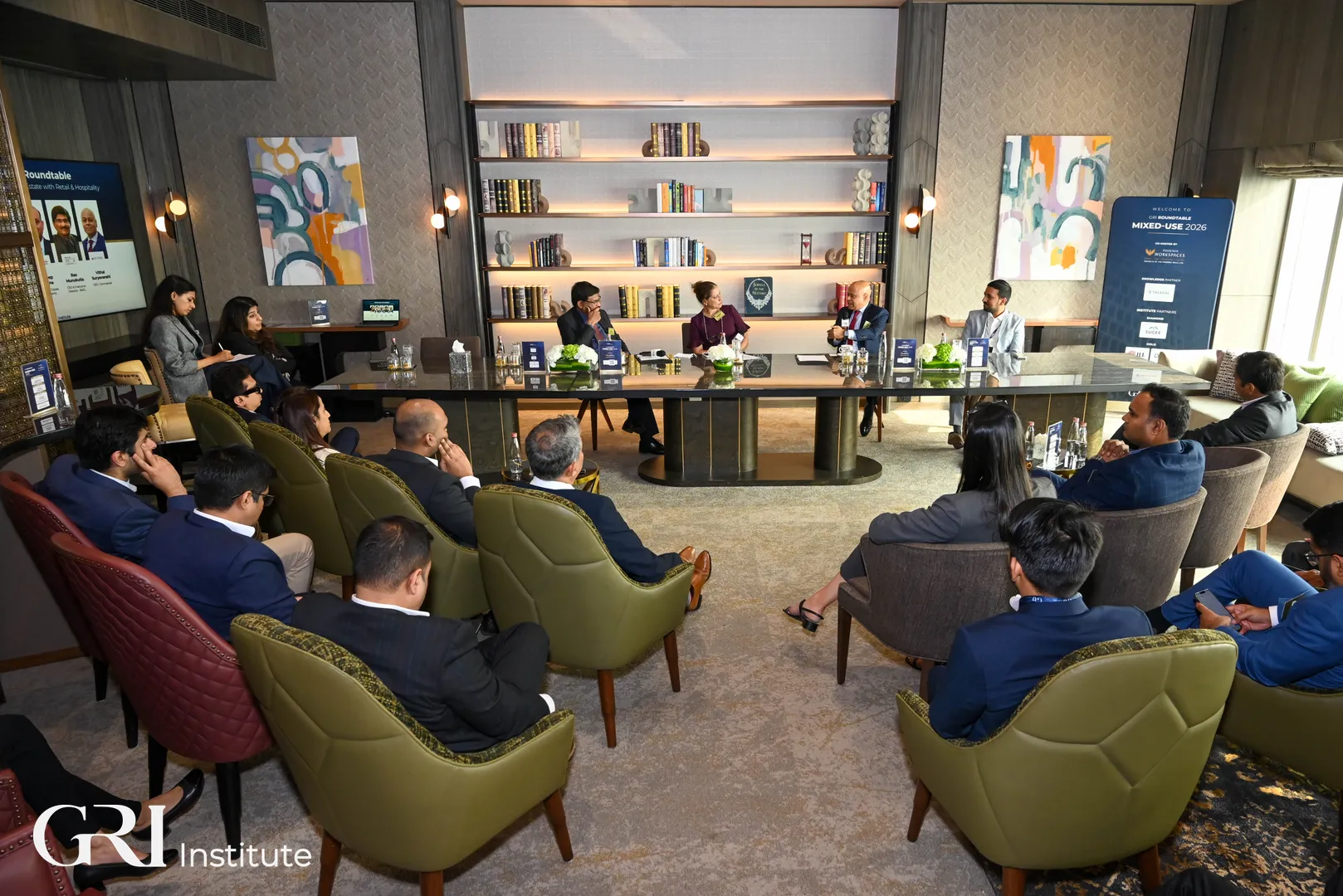
Value per employee is the new index. It doesn't matter if the employee is benefiting; work is only one part of why someone comes to the office. (GRI Institute)
Vertical stacking and the engineering of airport city hubs
In landlocked and high-density metros like Mumbai, the revolution is taking a vertical form, with developers engineering complex structures that stack luxury residences, international hotels, and Grade-A offices within a single, high-rise footprint.These vertical cities require meticulous planning to ensure that separate user bases - such as hotel guests and corporate tenants - benefit from shared prestige without compromising on security or operational exclusivity.
Simultaneously, the airport city model exemplified in Bangalore is redefining the urban periphery by creating massive five-hundred-acre hubs that integrate concert arenas and convention centres with sustainable business parks.
These aerotropolis developments are not merely transit points but are becoming "third places" where professionals can engage in jungle boardrooms or attend international music events, effectively creating a self-sustaining ecosystem that functions independently of the traditional central business district.
Future-proofing and sustainable innovation
As the industry looks toward the next decade, the focus has shifted from static future-proofing to operational agility, acknowledging that technological and economic landscapes can change within a three-to-five-year horizon.Developers are increasingly adopting modular construction methods that allow for the seamless reconfiguration of interior spaces, enabling a building to pivot between traditional office layouts and specialised requirements such as life sciences or research labs.
Sustainability has transitioned from a peripheral CSR initiative to a core commercial requirement, with multinational occupiers now refusing to consider facilities that do not meet stringent ESG benchmarks, including water positivity and carbon efficiency.
By integrating Artificial Super Intelligence (ASI) to optimise energy consumption and focusing on the physiological needs of a diverse workforce - such as nuanced climate control and inclusive wellness facilities - India is setting a new global standard for the next generation of mixed-use real estate.
Thank you to everyone who participated in the GRI Mixed-Use roundtable 2026.