 GRI Institute
How are family offices driving the institutionalisation of Indian real estate?
Industry leader insights into generational wealth shifts, portfolio financialisation, and new co-investment structures across key sectors in India
August 10, 2026Real Estate
Written by:Rory Hickman
Executive Summary
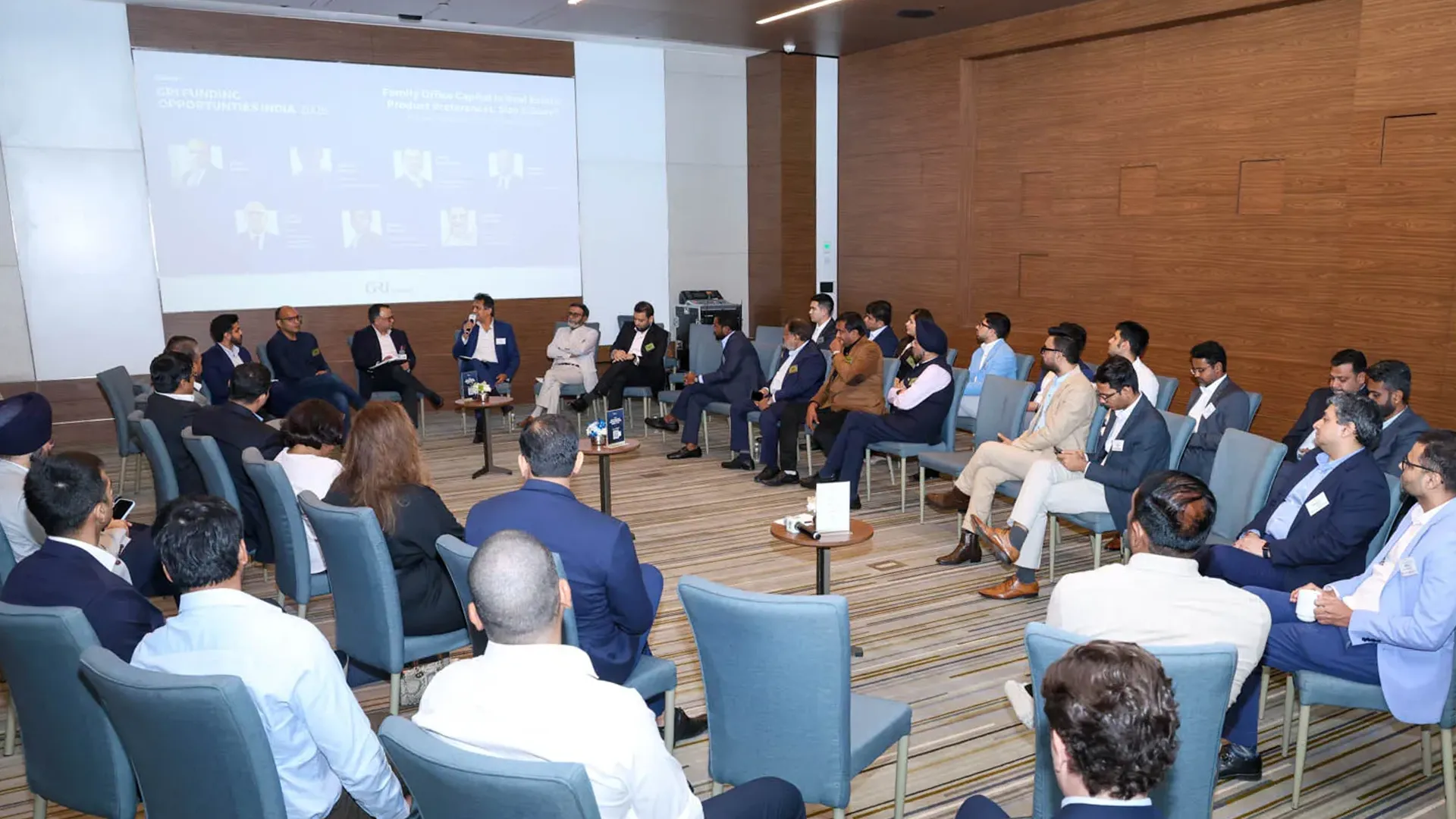
Discussions among top decision-makers at the Family Office Capital in Real Estate panel at the GRI Funding Opportunities India 2026 summit revealed that domestic private wealth is undergoing a profound strategic shift, driven by a new generation of principals who favour liquidity, formal governance, and predictable yields over legacy land holdings.
Panellists highlighted how capital is rapidly migrating towards structured financial paper, operational asset efficiency, and tailored co-investment frameworks that afford investors greater control over deal-level execution and governance.
With less than two months to go until India GRI 2026 in Mumbai on 8th October, we analyse how evolving allocation strategies are redefining the deployment of private wealth across Grade-A commercial spaces, rapid-turnaround logistics platforms, and short-term structured credit.
As domestic family offices increasingly subject real estate to rigorous competition against other private market asset classes, market participants must adapt to an environment shaped by institutional discipline, shorter investment horizons, and heightened demands for transparency.
► Read the full Spotlight report from GRI Funding Opportunities India 2026 here
Panellists highlighted how capital is rapidly migrating towards structured financial paper, operational asset efficiency, and tailored co-investment frameworks that afford investors greater control over deal-level execution and governance.
With less than two months to go until India GRI 2026 in Mumbai on 8th October, we analyse how evolving allocation strategies are redefining the deployment of private wealth across Grade-A commercial spaces, rapid-turnaround logistics platforms, and short-term structured credit.
As domestic family offices increasingly subject real estate to rigorous competition against other private market asset classes, market participants must adapt to an environment shaped by institutional discipline, shorter investment horizons, and heightened demands for transparency.
► Read the full Spotlight report from GRI Funding Opportunities India 2026 here
Key Takeaways
- Generational shifts are driving domestic wealth away from illiquid land banking towards yield-bearing, institutionalised financial assets.
- Capital deployment heavily favours Grade A commercial space, fast-deploying logistics, and high-yield structured credit over direct residential equity.
- Family offices are increasingly leveraging fund commitments to secure direct co-investment rights and stronger governance over individual deals.
The Evolving Private Wealth Landscape
With annual capital inflows into Indian real estate projected to exceed USD 6 billion, the deployment of domestic private wealth into the market is undergoing a profound structural evolution, marked by a decisive transition from traditional physical asset ownership towards formalised, institutionalised, and financialised investment models.Alternative asset classes now account for nearly 25% to 30% of investable domestic family office portfolios, with real estate continuing to serve as a core anchor despite potential headwinds identified by some players. Domestic capital currently accounts for 70% to 80% of total real estate fund raising through Alternative Investment Funds (AIFs).
Family offices supply roughly half of this domestic capital base through commingled fund commitments ranging from INR 100 million to INR 500 million, while high-net-worth individuals (HNWIs) and retail investors provide the remaining half through smaller tickets ranging from INR 10 million to INR 50 million.
Modern wealth managers increasingly structure family capital through formal Investment Policy Statements that segment portfolios into safety, growth, and alternative buckets.
Under this disciplined allocation framework, approximately 20% of capital could be assigned to safety assets such as fixed deposits to protect principal, up to 50% directed into liquid growth equities to participate in public markets, and around 30% might be earmarked for alternative investments.
Within this alternative bucket, real estate no longer functions as an automatic default asset, but must actively compete for capital allocation against private credit, pre-IPO opportunities, venture capital/startups, and land.
Generational Shifts and Land Financialisation
The mechanism through which private wealth is deployed reflects a fundamental divide in investment philosophy, driven largely by generational shifts in leadership, evolving risk appetites, and the emergence of financial instruments such as AIFs, Real Estate Investment Trusts (REITs), Infrastructure Investment Trusts (InVITs), and structured debt obligations.A central point of debate within private capital circles centres on the ideological tension between multi-generational land banking and modern portfolio financialisation.
Traditional investment logic, favoured by legacy wealth holders, operated on the conviction that strategic land acquisition held over multi-decade horizons offers an irreplaceable hedge against inflation, and an unmatched engine for exponential wealth creation.
Conversely, modern family office managers and younger principals increasingly view raw land holding as an illiquid, operationally burdensome, and high-risk endeavour burdened by opaque titling, slow-moving legal systems, and land-security concerns.
With this younger cohort prioritising liquidity, institutional governance, predictable cash flows, and clearly defined exit horizons, modern principals prefer gaining real estate exposure through financial paper backed by physical assets rather than directly managing physical property.

(GRI Institute)
Commercial Dominance and Foreign Capital Dynamics
This philosophical split heavily influences asset class allocations across commercial office spaces, industrial logistics, residential structures, and niche operational real estate. Grade A commercial office assets remain the most institutionalised segment in the country, attracting roughly 40% of institutional capital allocations.For domestic family offices seeking stability, commercial assets provide predictable yield profiles. Publicly listed REITs deliver distribution yields typically between 4.5% and 6%, while structured private investment funds targeting development or value-add commercial opportunities can project internal rates of return in the mid-to-high teens.
The influx of global private equity capital, driven by international funds allocating approximately 2% of their portfolios to developing economies, has exerted downward pressure on commercial cap rates.
While foreign funds accept compressed yields, domestic private investors leverage their deep local understanding to demand higher collateral coverage, superior risk-adjusted terms, and higher return margins from developers rather than accepting lower global return profiles.
Industrial Logistics and Operational Efficiency
Driven by national infrastructure expansion, industrial and logistics warehousing has rapidly emerged as a favoured alternative to traditional office space, appealing directly to investors who value operational speed and capital efficiency.The concept of return on time invested is particularly pronounced in logistics, where construction cycles are dramatically shorter than high-rise commercial developments, allowing capital to be deployed, leased, and monetised at a faster cadence.
Industrial assets offer a dual advantage by combining immediate operational yields with long-term land value appreciation. Development-stage logistics projects and specialised platform strategies target internal rates of return ranging from 16% to 18%, which can reach 20% when leveraged appropriately.
Over a 15-to-20-year horizon, peripheral warehousing hubs frequently absorb surrounding urban expansion, creating future options to convert industrial land into high-density residential or commercial developments.
However, investors distinguish between generic warehousing and specialised manufacturing facilities, noting that superior risk-adjusted returns are concentrated in specialised manufacturing parks or built-to-suit facilities with deeply entrenched corporate tenants.
Short-Term Structured Credit and Residential Dynamics
Residential real estate presents a starkly different profile, operating primarily as a venue for short-term high-yield structured debt rather than direct equity participation.Many major family office principals treat residential real estate equity as a low-preference asset class due to execution friction, regulatory burdens, and limited rental yields.
Where substantial capital - often ranging from INR 4 billion to INR 5 billion - is deployed into residential assets by large family principals, it is typically driven by personal family consumption rather than portfolio investment strategy.
These transactions involve acquiring premium end-use apartments priced between INR 500 million and INR 1 billion each for family members, making underlying rental yields and exit horizons entirely secondary.
From an investment standpoint, residential capital flows are dominated by Non-Convertible Debentures (NCDs) and structured debt targeting standard coupons between 14% and 18% over two- to four-year tenors.
To capture higher yields, family offices occasionally act as gap-funders for creditworthy mid-tier developers needing pre-approval or land acquisition capital that traditional banks cannot legally provide. These opportunistic, ultra-short bridge transactions carry tenors of 9 to 12 months, commanding yields between 20% and 23% backed by 2x to 3x collateral cover over project cash flows.
A notable exception to equity avoidance is the specialised market for urban redevelopment, slum rehabilitation, and plotted residential developments in densely built financial centres like Mumbai.
In these constrained urban markets, pre-vacation redevelopment investments and plotted projects can generate internal rates of return exceeding 30% to 35%, provided investors successfully manage community relationships, local execution, and extended regulatory timelines.
(GRI Institute)
Co-Investment Architecture and Direct Capital Deployment
The evolution of the market extends equally to investment architecture, specifically regarding the choice between blind-pool managed funds and direct co-investments.While commingled AIFs provide diversification and professional oversight, sophisticated family offices increasingly resist giving fund managers complete discretion over their capital.
A prevalent trend involves writing modest initial commitments of INR 50 million to INR 100 million into an AIF specifically to secure co-investment rights. This structure allows family offices to utilise the fund manager's deal-sourcing pipeline while retaining the unilateral right to double down on specific transactions on a direct basis.
While commingled AIF fund pools attract standardised commitments between INR 100 million and INR 500 million, direct deal-by-deal co-investments exhibit a much broader range, spanning from INR 30 million to INR 350 million based on transaction conviction.
HNWIs and retail investors supply the remaining fund balance through smaller cheques ranging from INR 10 million to INR 50 million. Larger family offices actively leverage their cheque size to demand direct board representation, customised terms, and transparent governance frameworks.
Niche Operational Assets and Market Realities
Emerging operational real estate sectors, including student housing, high-end senior living, industrial worker dormitories, co-living, co-working, and hospitality, represent an evolving frontier for domestic capital. However, investor sentiment regarding operational assets remains divided.Proponents highlight demographic shifts, expanding higher education enrolments, and organised manufacturing hubs, such as industrial dormitories catering to major manufacturing complexes, as key drivers of resilient demand.
Conversely, critics emphasise that operational assets function primarily as service and hospitality businesses where underlying property values are subservient to operator competence.
Successful execution in specialised niches relies heavily on operator capabilities, such as providing integrated medical facilities and non-slippery infrastructure for senior living facilities.
Across broader operational segments, market maturity varies significantly. Flexible co-working spaces are undergoing rapid consolidation, with over 400 operators in India shrinking as the top 25 to 30 players consolidate nearly 70% of total market share.
Similarly, post-pandemic hospitality performance has normalised into stable single-digit growth following an initial recovery surge.
As domestic family offices refine their investment mandates through formal constitutions and institutional asset allocation policies, their engagement with real estate continues to balance traditional impulses for permanent physical land ownership against modern imperatives for liquid, yield-bearing, and professionally managed financial structures.
► Don’t miss the chance to explore these issues further at India GRI 2026
These insights were shared during industry leader discussions at GRI Funding Opportunities India 2026.