 GRI Institute
Sheds, Servers, Security and Supply: The new structural drivers of European commercial real estate
Insights on how energy-heavy assets, defence spending, and technical retrofitting are creating new value-add opportunities for institutional capital in Europe
May 29, 2026Real Estate
Written by:Rory Hickman
Executive Summary
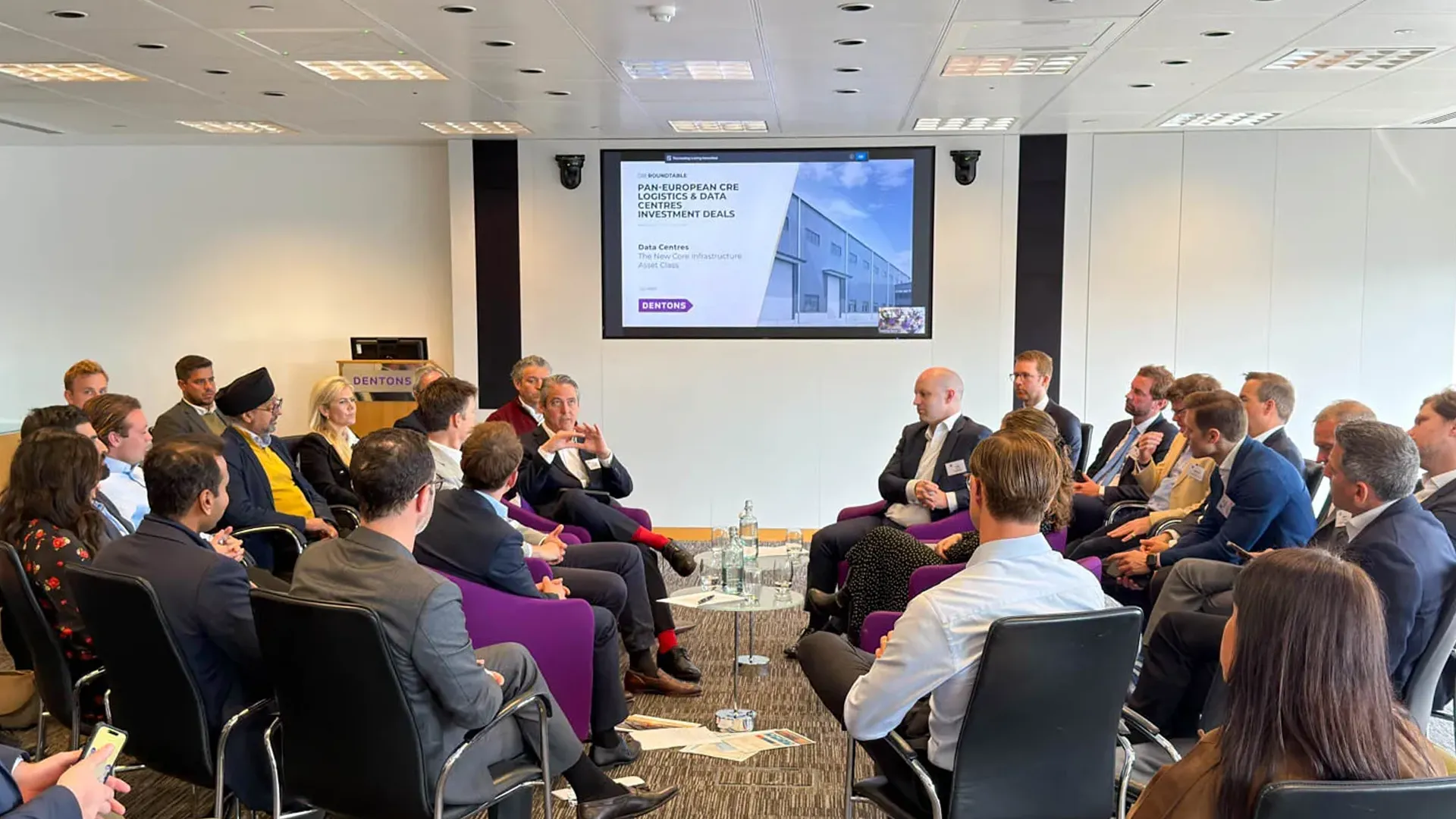
The European industrial landscape is shifting from a battle for space to a war for power. At the GRI Institute’s Pan-European CRE Logistics Deals & Investment Strategies roundtable in London, co-hosted by Dentons, it was clear that the traditional prime location is being redefined by grid capacity and energy resilience rather than mere geography.
As AI, automation, and EV fleets drive power requirements to unprecedented levels, the convergence of logistics and digital infrastructure is no longer a trend-it is a structural necessity. While planning friction and grid delays persist, future winners will be those who move upstream, securing energy-ready sites or leveraging on-site generation to bypass a strained system.
Ahead of the GRI Data Centres in Europe virtual roundtable on June 18th and Europe GRI 2026 Summer Edition on 9th-10th September in Paris, we examine how institutional capital is pivoting toward this hybrid infrastructure model to capture significant rental premiums, long-term security, and a 90% efficiency frontier.
As AI, automation, and EV fleets drive power requirements to unprecedented levels, the convergence of logistics and digital infrastructure is no longer a trend-it is a structural necessity. While planning friction and grid delays persist, future winners will be those who move upstream, securing energy-ready sites or leveraging on-site generation to bypass a strained system.
Ahead of the GRI Data Centres in Europe virtual roundtable on June 18th and Europe GRI 2026 Summer Edition on 9th-10th September in Paris, we examine how institutional capital is pivoting toward this hybrid infrastructure model to capture significant rental premiums, long-term security, and a 90% efficiency frontier.
Key Takeaways
- Infrastructure capacity and access to high-voltage power have superseded traditional geography as the primary determinants of prime real estate value.
- Persistent planning delays and structural stock shortages have resulted in significant economic losses, including an estimated GBP 10 billion in lost output.
- The convergence of logistics and digital infrastructure is forcing a shift toward on-site power generation and micro-grids to bypass systemic grid delivery failures.
The Infrastructure of Everything
The convergence of logistics and data centres has reached a critical inflection point and is fundamentally reshaping the European commercial real estate landscape, driven by a triad of scarcity in power, land, and capital.As European real estate markets navigate a landscape defined by structural undersupply and shifting demand, the traditional definition of a prime location is being rewritten by infrastructure capacity.
In this new era, the distinction between industrial warehousing and digital infrastructure is increasingly blurred, creating a hybrid sector where energy resilience dictates value.

(GRI Institute)
Lost Economic Potential
The European logistics market has been defined by a structural undersupply of stock that dates back to 2010, particularly within the UK. This supply crunch has resulted in significant economic consequences, including the loss of approximately 140,000 jobs and an estimated GBP 10 billion in economic output.Research into market demand suggests that if the necessary industrial stock had been available over the last decade, take-up levels would have been 40% higher than those actually recorded. This shortage has been felt most acutely in the Midlands, London, and the South East.
A primary cause of this imbalance is the inherent friction within the planning system. Current data shows that only 18% of major industrial applications are decided within the statutory 16-week period, while 26% of applications take longer than one year to reach a conclusion.
Furthermore, planning authorities are currently under no requirement to set specific targets for employment land in the same way they must for the housing sector, which often leads to land being misallocated or failing to reach the right locations for industrial growth.
AI, Defence, and Automation
New structural drivers are now adding to this pressure, specifically the rise of AI and a surge in defence spending.As governments increase defence expenditure toward targets such as 2.5% of GDP, it is estimated that the sector will require an additional 285,000 square metres of industrial space in the UK alone. This requirement represents approximately 10% of total annual market take-up, providing a significant demand-side driver that is often insulated from broader economic cycles.
At the same time, the rapid adoption of AI is increasing the need for both specialised logistics facilities and massive data centre capacity.
Although access to labour remains important, the availability of high-voltage power and robust connectivity is now the primary determinant of a site value. In some cases, the shift toward robotics may even reduce the importance of being near traditional low-cost labour pools, as facilities require fewer but more technically skilled workers.
From Location to Power
The industrial adage "location, location, location" has evolved into "power, power, power". Access to high-voltage electricity is now the primary factor redefining prime real estate. As warehouses become increasingly automated and the logistics industry transitions to electric vehicle (EV) fleets, the power requirements of tenants have skyrocketed.In response to these requirements, landlords and investors are increasingly adopting a capital expenditure heavy model to secure high-quality tenants. By investing in site infrastructure such as enhanced power access, reinforced roofing for solar arrays, and internal automation systems, owners are able to command significant rental premiums.
Recent lease agreements have achieved rents 15% to 20% above initial underwriting because the landlord provided the necessary technical infrastructure upfront. This model also benefits tenant retention, as occupiers who receive significant infrastructure support are often willing to sign longer leases, such as 11 years rather than the traditional five-year term.
Technological digitisation is also streamlining the leasing process itself. Some platforms have digitised the entire journey from initial enquiry to final netting, allowing for 75% of listings below 5,000 square feet to be managed through automated systems.
This increased efficiency can allow tenants to move into a facility in as little as three days if they are prepared to move quickly, providing a major advantage in a high-demand market.
(GRI Institute)
The Power Paradox
The industry faces a systemic challenge regarding power delivery that is more severe than many realize. Grid operators often provide delivery projections, such as 2032, that the market suspects are unrealistic, with 2040 being a more likely reality in many jurisdictions.This systematic shortage has made on-site generation and micro-grids a critical area of exploration. By generating power locally through gas turbines or fuel cells and keeping it off the main grid, occupiers can avoid significant distribution charges and renewable standard levies that inflate utility costs.
While gas is often viewed as a bridging mechanism, it is increasingly seen as a long-term hybrid solution for maintaining resilience. On-site generation is particularly effective when thermal efficiency is considered.
Approximately half of the energy used in power generation is traditionally lost as waste heat, but by co-locating data centres with industrial facilities or residential districts, this heat can be recaptured. This recaptured energy can be used for district heating, high-temperature industrial processes, or even cooling through absorption chillers.
Despite the clear benefits, a lack of established local heat districts and council support - particularly in the UK - remains a hurdle to achieving the 90% efficiency levels that these combined systems can offer.
Data Centres Move Upstream
The data centre sector is also evolving as operators move upstream in the development cycle. To secure capacity in a power-constrained world, hyperscalers and wholesale providers are buying land much earlier in the process, sometimes acquiring former power plants to convert them into data centre parks.While the US market is seeing a move toward remote mega-campuses in states such as Wisconsin or Texas, the European market remains focused on connectivity and latency. Tier-2 markets are emerging as major hubs, with Milan projected to overtake Dublin in scale and Berlin benefiting from massive fibre connectivity investments.
Investors are cautioned that not all power-capable land is equal. Emerging markets in Slovakia, Croatia, and Northern Norway offer vast power potential but face challenges regarding grid reliability and the risk of assets becoming "ice skating rinks" - where land is marketed with theoretical capacity that may never be delivered or is located too far from connectivity hubs to be useful.
The most valuable sites remain those that are shovel-ready and integrated into established digital clusters.
► Don’t miss our upcoming AI & Real Estate (9th June) and Data Centres in Europe (17th June) virtual roundtables

(GRI Institute)
Capital Markets and Value-Add Opportunities
In the capital markets, a widening spread between prime and secondary industrial assets is defining current activity. Prime assets continue to set benchmarks through equity-heavy institutional buyers, but secondary stock is often perceived as overpriced.Many secondary assets are held by debt-backed buyers who find it difficult to rebase prices because the current cost of debt makes the cash flow unsustainable at lower valuations. This has led to a market where the gap between vendor expectations and buyer reality remains difficult to bridge.
However, good secondary assets built between 2000 and 2010 offer significant value-add potential if they possess the right fundamentals, such as sufficient ceiling heights and floor loading.
These buildings can often be retrofitted for EV charging or enhanced efficiency at a lower cost than an office redevelopment, allowing them to capture rental growth as occupiers seek alternatives to expensive new-build schemes.
Joint ventures with experienced operating partners have become the preferred structure for these deals, as investors seek technical expertise to manage the complexities of power procurement and permitting.
The Future of Sheds and Servers
Ultimately, the successful strategy for the coming years will be based on resilience and adjacency. The collaboration between logistics and data centre operators - such as using warehouses near data centres for server storage and cabling hubs - represents a major frontier for the industry.This US trend is beginning to find traction in Europe as DC operators seek to rent adjacent spaces for connected businesses. As grid problems persist and demand for digital and physical goods grows, the ability to control and optimise infrastructure will be the primary driver of value in the European market.
Success will depend on understanding the compute layer and identifying the specific markets where power is not just promised, but systematically deliverable.
► Don’t miss Europe GRI 2026 Summer Edition on 9th-10th September in Paris
These insights were shared during the Pan-European CRE Logistics Deals & Investment Strategies roundtable, co-hosted by Dentons, featuring contributions from moderator Tom Dalton (Dentons), as well as Shelby Weiss (GREYKITE), Thor Johnsen (Digital Gravity Infrastructure Partners), and other top industry leaders.