 GRI Institute
France GRI 2026 Barometer: Repricing Lags, Operational Yields, and Capital Selectivity
Exclusive GRI survey findings on how real estate leaders are handling slow market corrections through operational niches and strategic debt restructuring
August 6, 2026Real Estate
Written by:Rory Hickman
Executive Summary
The French real estate market is transitioning to a disciplined, operator-led paradigm as pricing adjustments lag behind European peers.
As captured by senior leaders at France GRI 2026 in Paris, investment conviction has pivoted away from traditional offices toward operational platforms, demographic-backed living niches, and necessity retail assets.
Rather than a market defined by distress, a narrative of strategic restructuring is emerging. Industry leaders are managing elevated borrowing costs, strict credit underwriting, and persistent pricing gaps through alternative debt schemes and continuation vehicles rather than fire sales.
Success in this cycle is less about broad location bets and more about pure operational execution - solving for urban logistics bottlenecks, converting obsolete offices under evolving planning rules, and driving ESG-led decarbonisation.
Ahead of further regional discussions in Paris at Europe GRI 2026 - Summer Edition on 9th-10th September and Forum des Enjeux Immobiliers, co-hosted by CMS, on 17th September, this barometer outlines the strategic mindset shaping French real estate’s next investment cycle.
► Access more insights from France GRI 2026 in our full France GRI 2026 Spotlight report
As captured by senior leaders at France GRI 2026 in Paris, investment conviction has pivoted away from traditional offices toward operational platforms, demographic-backed living niches, and necessity retail assets.
Rather than a market defined by distress, a narrative of strategic restructuring is emerging. Industry leaders are managing elevated borrowing costs, strict credit underwriting, and persistent pricing gaps through alternative debt schemes and continuation vehicles rather than fire sales.
Success in this cycle is less about broad location bets and more about pure operational execution - solving for urban logistics bottlenecks, converting obsolete offices under evolving planning rules, and driving ESG-led decarbonisation.
Ahead of further regional discussions in Paris at Europe GRI 2026 - Summer Edition on 9th-10th September and Forum des Enjeux Immobiliers, co-hosted by CMS, on 17th September, this barometer outlines the strategic mindset shaping French real estate’s next investment cycle.
► Access more insights from France GRI 2026 in our full France GRI 2026 Spotlight report
Key Takeaways
- A majority of industry leaders believe French real estate requires further repricing before reaching a credible floor to attract global capital.
- Institutional equity is pivoting away from traditional offices toward defensive, operationally backed niches such as necessity retail, living assets, and urban logistics.
- Resolving office obsolescence demands complete asset reconversion or strategic disposal, as standalone green retrofits face severe underwriting barriers.
► Repricing Sentiment
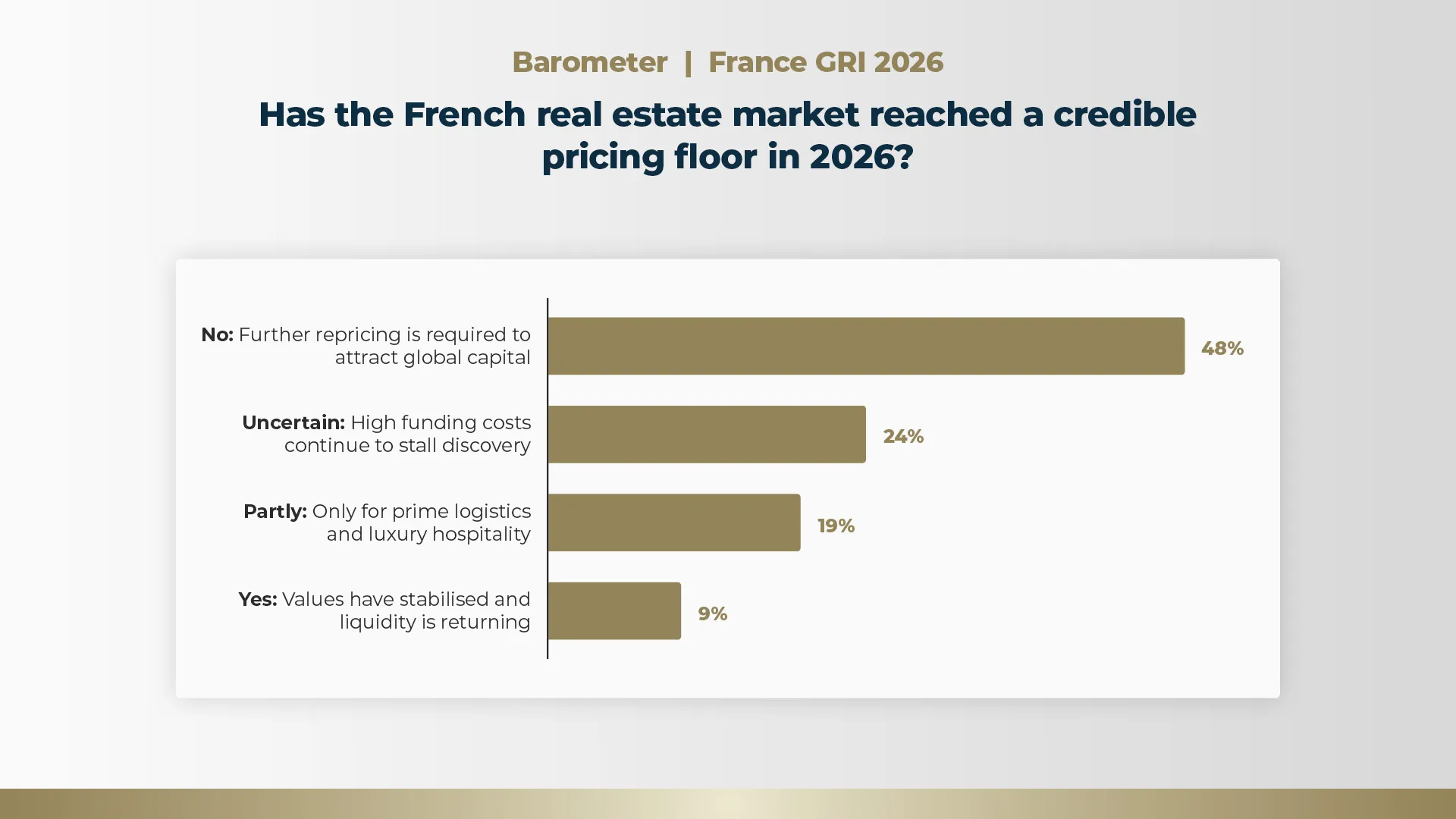
A 48% majority of senior real estate industry leaders believe that the French market has not yet reached a credible pricing floor, taking the view that further repricing is required to attract global capital.
This sentiment highlights a market lagging behind European peers such as the UK and Germany, with listed French property entities trading at discounts of up to 20% below net asset value.
Commercial office properties face severe structural headwinds requiring a multi-year period of devaluation, price stabilisation, and structural adjustment, whilst residential prices per square metre remain sticky despite falling transaction volumes, creating a disconnected market where activity stalls rather than repricing rapidly.
High funding costs remain a major impediment, with 24% of respondents expressing uncertainty as elevated borrowing friction continues to stall price discovery.
With 10-year French government bond yields reaching 3.75% and French domestic banks enforcing a sharp net tightening of corporate credit standards (net 18% compared to the euro area average of 7%), investor equity remains scarce even as institutional bank liquidity persists.
Meanwhile, 19% of leaders noted that pricing has stabilised only partly, limited to prime logistics - where core-plus yields expanded to 6% - and ultra-luxury hospitality, alongside operational growth niches like Purpose-Built Student Accommodation (PBSA), and outdoor campsite platforms.
Only 9% of respondents agreed that property values have fully stabilised and liquidity is returning. This minority perspective aligns with select outperforming segments, notably retail property, which completed an early repricing that doubled its share of overall transaction volumes from 20% to 40%.
Furthermore, prime green assets and multi-let configurations with strong cash flows are maintaining active liquidity, supported by intense lender competition, compressed financing margins of 65 to 100 basis points, and a net easing of credit standards for high-performing sustainable real estate.
► Long-term Defensive Yields
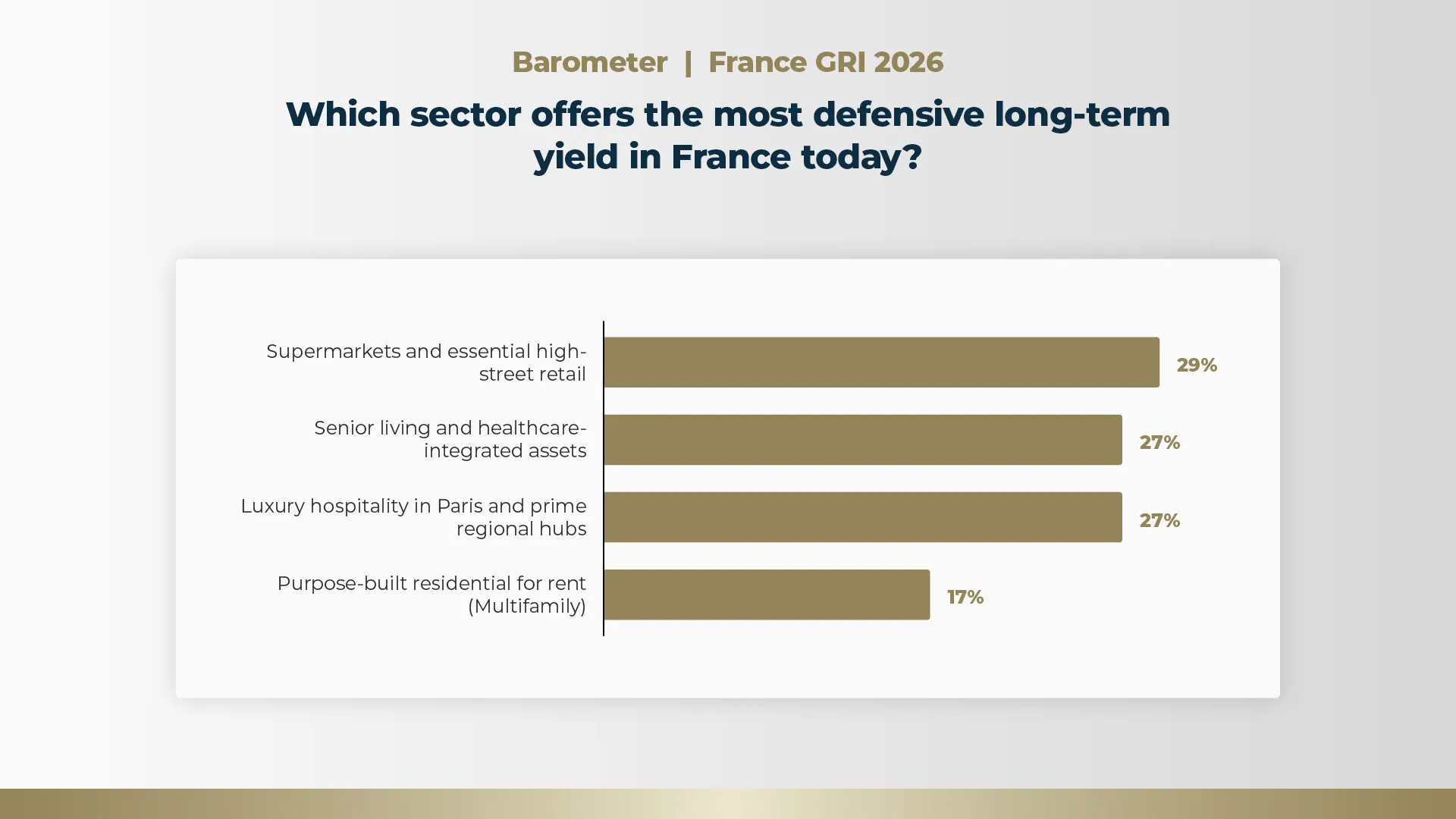
Senior real estate leaders identified supermarkets and essential high-street retail as the sector offering the most defensive long-term yield in France, capturing 29% of responses.
Supermarkets and out-of-town retail parks demonstrate superior resilience, supported by low operational overheads, affordable base rents, and a consumer shift towards discount networks, with prime assets trading at yields between 6% and 7%.
Strict urban planning regulations limiting new peripheral developments generate asset scarcity, whilst historical rent inflation on traditional high streets has redirected defensive capital toward necessity-driven formats over overextended fashion networks. This structural stability helped retail property double its share of overall transaction volumes from 20% to 40%.
Tied for second place at 27% each are senior living and healthcare-integrated assets, alongside luxury hospitality in Paris and prime regional hubs.
Healthcare portfolios, including private clinics and specialised nursing facilities, deliver core-plus yields reaching up to 10%, supported by demographic tailwinds and targeted strategies focusing on an entry age of 75 to 80 to secure stable occupancy. Institutional equity is actively pivoting away from secondary offices toward these operationally backed living niches.
Meanwhile, luxury hospitality in central Paris remains structurally insulated by steady corporate and high-net-worth demand, strict development limits, and revenue drivers like branded residences.
Hospitality assets also enjoy robust transactional depth, seamless financing execution, and high-margin operational models such as campsite platforms achieving gross operating profit margins above 50% and OpCo-PropCo sale-and-leasebacks yielding around 6%.
Selected by 17% of respondents, purpose-built residential for rent (multifamily) represents a defensive option underpinned by severe structural supply deficits across major French urban centres.
A deficit of available rental properties has triggered a 30% surge in tenant applications, while systemic landlord retrenchment - driven by unfavourable tax adjustments and mandatory energy renovation costs - has withdrawn individual housing stock from the market.
This widening supply constraint insulates multi-let residential models against economic volatility, driving the market toward unified block acquisitions under single institutional owners capable of funding long-term capital expenditure.
► Overcoming Obsolescence
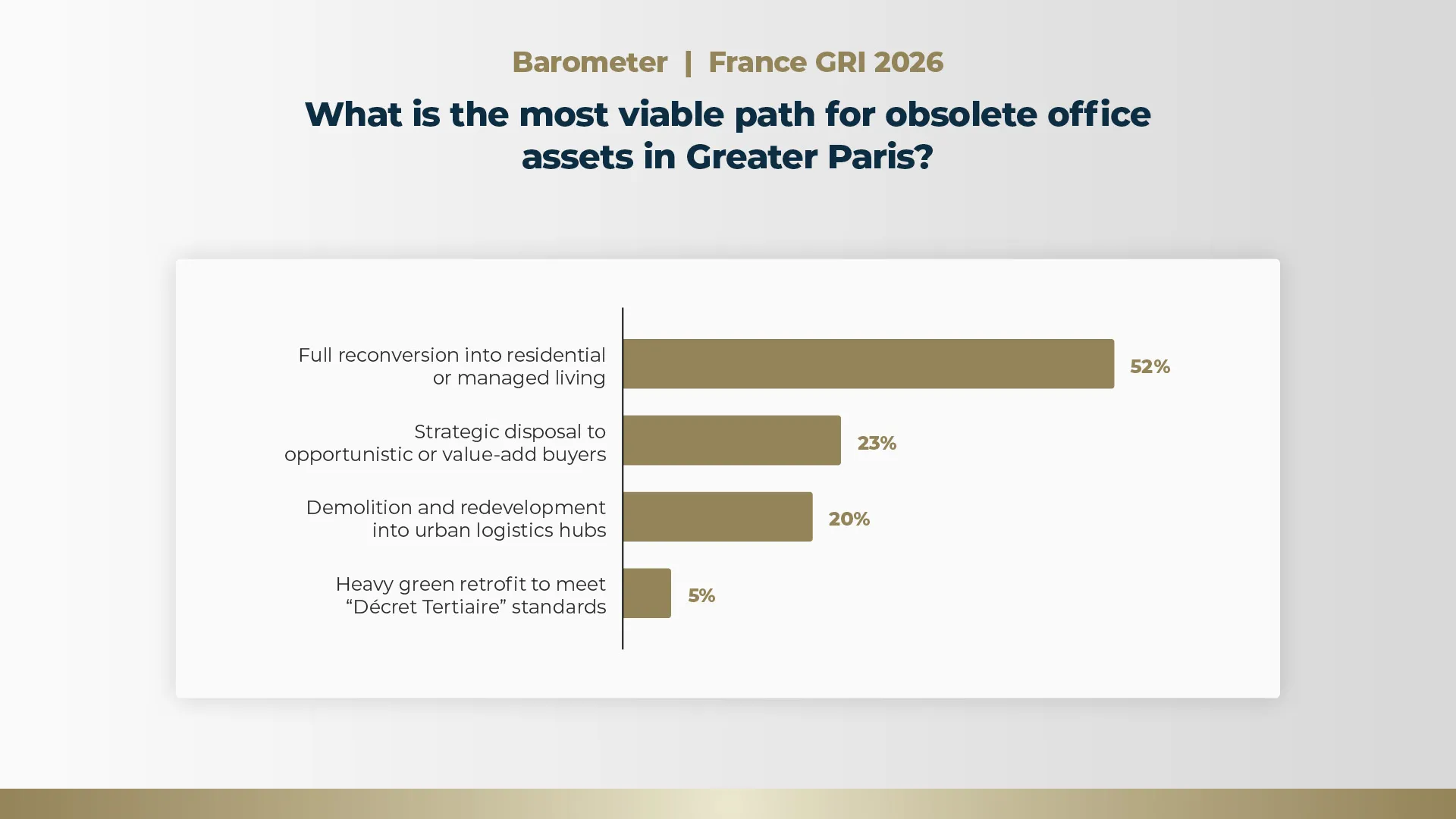
According to the survey, a 52% majority of senior real estate industry leaders identified full reconversion into residential or managed living as the most viable path for obsolete office assets in Greater Paris.
To break bureaucratic conversion gridlocks, legislative mechanisms such as the Gauguet and Noir laws empower officials to bypass standard urban planning rules for residential mutations, requiring mayors to prove explicit public utility or schooling deficiencies to block projects.
Despite this regulatory easing, actual office-to-residential transformations remain sluggish at just 1% to 2% due to high carrying costs, squatting liabilities, and a severe buyer-seller pricing gap.
To overcome these execution hurdles, sponsors are retrofitting obsolete single-use offices into flexible, mixed-use spaces combining office, hotel, and residential functions, while opportunistic strategies targeting niche hospitality conversions, such as youth hostels, are aiming for returns of up to 20%.
Strategic disposal to opportunistic or value-add buyers was chosen by 23% of respondents, reflecting the reality of secondary office properties experiencing extreme devaluations of 55% to 70%.
With commercial polarisation in central business districts compressing target returns, value-add capital is pivoting toward operational platform buy-outs, while fund managers facing portfolio maturities, strict bank credit rationing, and limited partners demanding line-by-line asset transparency are combining bank debt with alternative credit, discounted exits, and continuation vehicles to avoid fire sales.
Meanwhile, 20% favoured demolition and redevelopment into urban logistics hubs. Structurally, only one in ten obsolete offices is suitable for direct conversion, forcing developers to flatten superstructures while retaining basements to deliver functional light industrial and localised activity units.
Total site redevelopment is further driven by physical constraints, such as traditional column grids preventing conversion into data processing hubs.
A minimal 5% of leaders identified heavy green retrofitting to meet "Décret Tertiaire" standards as the most viable route, underlining severe financial, credit, and underwriting barriers to standalone upgrades.
Speculative office retrofits in peripheral regional markets have ceased entirely, as local rental growth cannot absorb escalating technical construction costs. While property managers execute calibrated five-year decarbonisation strategies to preserve mid-term asset value, fiscal discipline remains stringent, requiring every euro of capex to be explicitly justified.
Furthermore, energy-inefficient office assets face explicit physical climate risk penalties and tight lender credit rationing (net 14% tightening), driving investors to prioritise strategic disposals or complete asset transformations over standalone green retrofits.
► Logistics Returns
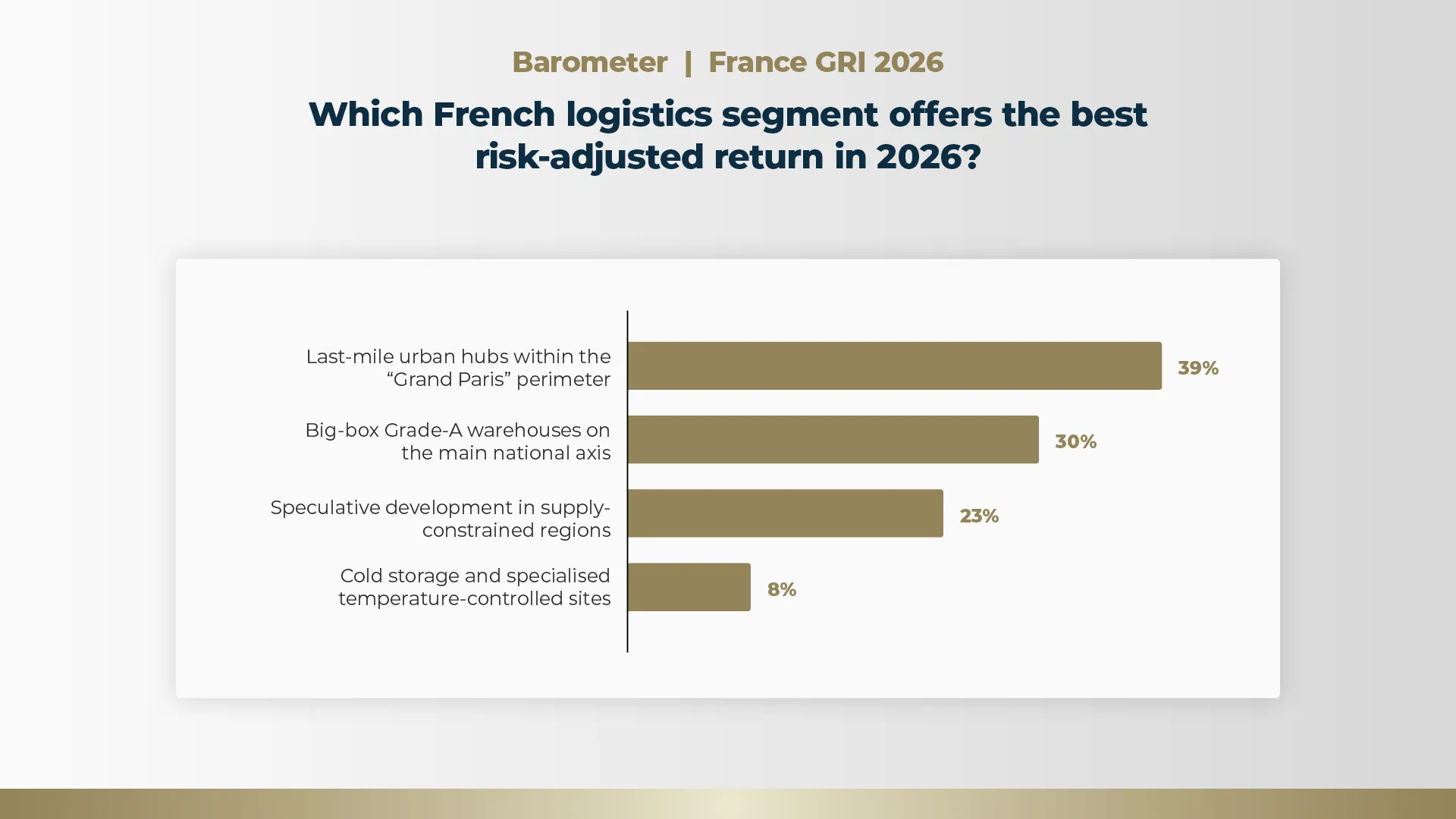
39% of respondents identified last-mile urban hubs within the "Grand Paris" perimeter as offering the best risk-adjusted return in the French logistics sector. Light industrial and localised activity units attract defensive capital because essential local service operators require functional urban storage space that remains largely decoupled from broader economic fluctuations.
Central Paris and the surrounding region remain structurally insulated due to strong corporate occupier demand, strict regulatory restrictions on new competing development supply, and institutional capital reallocating toward alternative growth sectors near urban population centres.
Additionally, with complex multi-storey vertical warehouses failing around French metropolitan areas due to layout inefficiencies, operational friction, and high construction costs, value creation remains firmly tethered to conventional single-level facilities with clearance heights of 10 to 20 metres within urban footprints.
Big-box Grade-A warehouses on the main national axis ranked second, capturing 30% of responses. Elite land plots along prime logistics corridors command premiums exceeding EUR 600 per square metre, protecting core property valuations on primary transport routes.
To safeguard valuations ahead of 3-to-5-year exits, property managers are transitioning Grade-A facilities into electric energy hubs equipped with massive rooftop solar photovoltaic systems and power infrastructure for electric truck fleets.
High-performing green industrial assets benefit from eased bank credit standards (a net -20% easing) alongside robust institutional loan demand (a net 28%). Concurrently, corporate occupiers are purchasing prime facilities outright to control their own supply chains, avoiding external landlord vulnerabilities and rental inflation.
In contrast, core-plus logistics assets with layout or location deficiencies saw yields expand to 6% from 5.25%, reinforcing the distinct valuation premium placed on top-tier Grade-A space.
Speculative development in supply-constrained regions was favoured by 23% of respondents, as high construction costs clashing with static market rents make resolving the construction equation exceptionally difficult.
Slower permitting timelines, higher delivery risks, and compressed rental growth relative to dynamic European peers limit speculative viability strictly to constrained prime regions, while secondary land values have collapsed to EUR 40 per square metre without attracting buyers.
With conservative banks enforcing strict leverage caps of 30% to 35% LTV/LTC, sponsors executing speculative projects must combine bank debt with alternative credit structures.
Finally, cold storage and specialised temperature-controlled sites were selected by just 8% of leaders.
In this niche segment, selective core funds enforce strict prohibitions against properties relying on traditional gas-fired boilers, categorising fossil-fuel dependence as a deal-breaker, while sponsors increasingly adopt integrated PropCo-OpCo operational models to manage technical execution, drive asset performance, and capture operating margins.
► Conclusion
In concert with discussions at France GRI 2026, these survey results signal that the French real estate market is undergoing a fundamental structural rebalancing rather than a temporary cyclical downturn.Investor sentiment reflects a decisive shift away from passive capital growth toward operational efficiency, cash flow durability, and asset-level transformation. While a persistent valuation disconnect between buyers and sellers continues to delay a comprehensive market recovery, capital has not abandoned France.
Instead, institutional equity is becoming hyper-selective, abandoning legacy office strategies in favour of asset classes underpinned by demographic tailwinds, essential consumer demand, and constrained supply.
This environment establishes a clear line between obsolete real estate facing structural devaluation, and high-performing, sustainable platforms capable of securing liquidity.
Going forward, the market will increasingly reward specialised operating capabilities, multi-source financing, and proactive asset management over prime locations alone.
Investors should expect a continued expansion of integrated operational models that bridge real estate ownership with business management, particularly across the living, logistics, necessity retail, and hospitality sectors.
As traditional domestic lenders maintain conservative underwriting standards and strict credit rationing, alternative debt structures, joint ventures, and continuation vehicles will become central to executing transactions and managing upcoming maturities.
Ultimately, liquidity will return incrementally to France, but it will selectively target sponsors who can resolve complex local planning hurdles, execute decarbonisation strategies, and generate resilient, operational yields.
► Discover the full range of insights from the France GRI 2026 Spotlight report here
This survey was conducted among the senior industry leaders attending France GRI 2026.
► Check out all upcoming GRI Institute Europe gatherings here.