 GRI Institute
Bangalore GRI 2026 Barometer: Structural bottlenecks, transit priorities, and GCC growth
Exclusive GRI survey findings reveal how leaders are rethinking investment, workplace demand, and portfolio resilience across India's premier tech capital
August 25, 2026Real Estate
Written by:Rory Hickman
Executive Summary
Exclusive GRI Barometer findings from a survey conducted among senior industry leaders at Bangalore GRI 2026 reveal how strategic priorities are rapidly shifting across urban infrastructure development, residential market dynamics, workplace requirements, and portfolio diversification strategies.
With India GRI 2026 fast approaching, we examine the critical structural bottlenecks constraining metropolitan expansion, evaluate whether the residential market is nearing an end-user affordability ceiling, unpack the essential features enterprise occupiers now demand in corporate space, and explore how developers plan to hedge their heavy exposure to the technology sector.
► Read the full Bangalore GRI 2026 Spotlight report
► Meet the industry leaders joining us at India GRI 2026 on October 8th in Mumbai
With India GRI 2026 fast approaching, we examine the critical structural bottlenecks constraining metropolitan expansion, evaluate whether the residential market is nearing an end-user affordability ceiling, unpack the essential features enterprise occupiers now demand in corporate space, and explore how developers plan to hedge their heavy exposure to the technology sector.
► Read the full Bangalore GRI 2026 Spotlight report
► Meet the industry leaders joining us at India GRI 2026 on October 8th in Mumbai
Key Takeaways
- Severe mobility deficits and infrastructure delays are widely seen as the primary structural bottleneck, accelerating a pivot toward self-contained developments.
- Market sentiment remains divided on residential trajectory, balancing resilient premium demand against mounting affordability pressures in lower price brackets.
- Commercial occupiers heavily prioritise transit accessibility and workplace amenities, while developers strongly favour non-tech GCC expansion to hedge technology exposure.
► Bangalore’s Bottlenecks
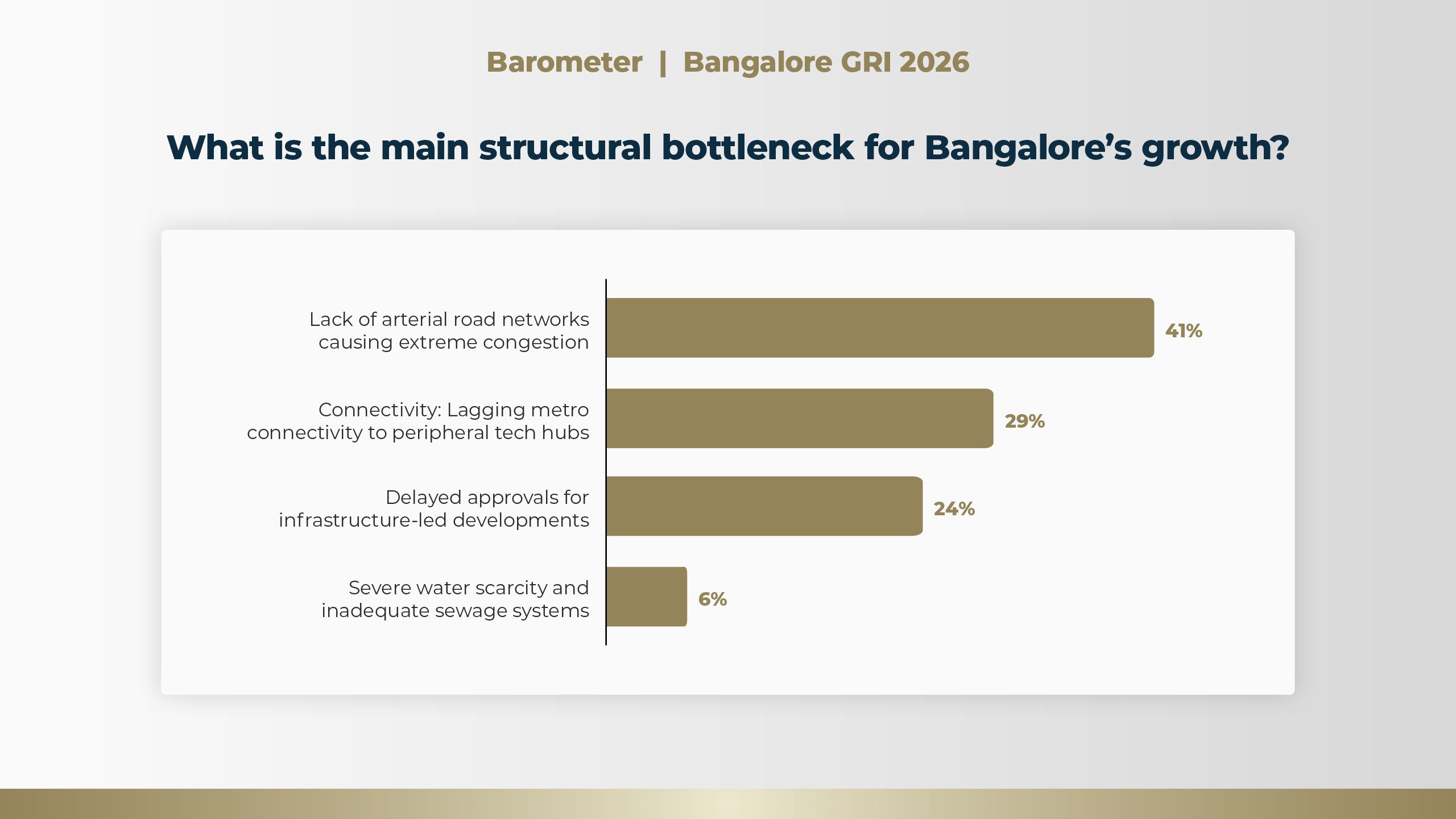
Senior real estate industry leaders highlighted mobility deficits as the primary structural constraint on Bangalore's expansion, with 41% of respondents identifying a lack of arterial road networks and extreme congestion as the main bottleneck.
Severe gridlock is fundamentally reshaping development strategies, compelling developers to construct self-contained integrated enclaves and mixed-use sites to internalise social infrastructure and keep travel minimal.
Furthermore, lagging metro connectivity to peripheral technology hubs emerged as the second largest concern, selected by 29% of participants.
Transit delivery delays have created notable funding bottlenecks, as institutional private equity funds routinely decline to underwrite speculative masterplans, requiring visible execution or near-completed metro lines before allocating capital.
Regulatory friction and environmental pressures also impose considerable constraints on project delivery, with delayed approvals for infrastructure-led developments cited by 24% of respondents, reflecting protracted statutory processes that average 4.5 years from land acquisition to launch.
These administrative delays significantly elevate holding costs, pushing effective land holding costs up to 35-40% of total project realisation.
Finally, severe water scarcity and inadequate sewage systems were chosen by 6% of participants.
Although registering a smaller response share, discussions among leaders revealed that acute groundwater depletion - with borehole depths now exceeding 1,400 feet - is forcing developers to construct onsite rainwater storage, effluent recycling, and sewage treatment plants to meet 30-35% of project water demand internally.
► Residential Affordability Ceiling
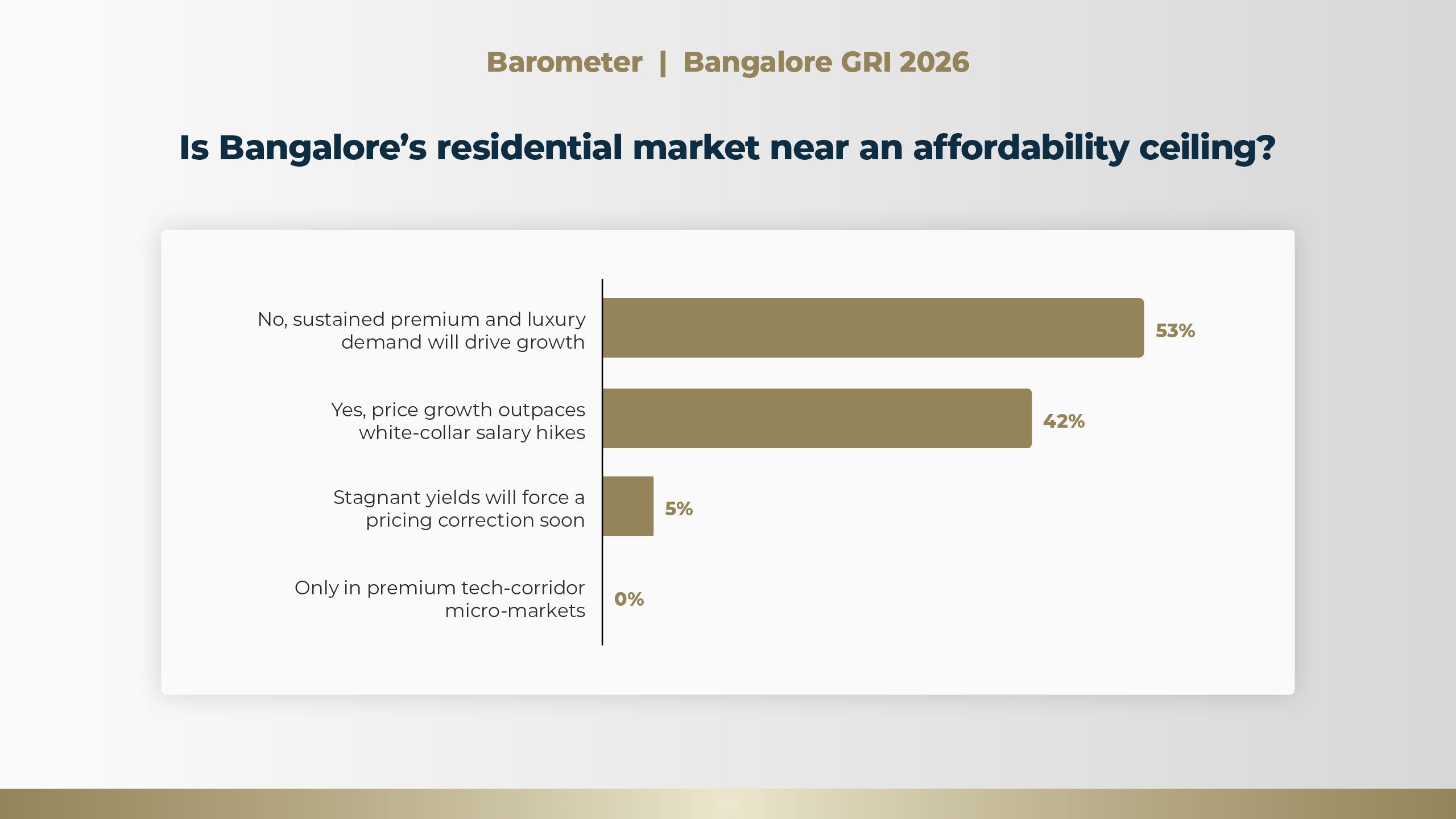
Opinions on Bangalore's residential market trajectory remain split, though a 53% majority of respondents contend that sustained demand within the premium and luxury segments will continue to drive overall growth.
Upper-tier purchasing power remains well supported by technology sector liquidity, startup equity, and ESOP payouts, alongside healthy end-user leverage where household EMI-to-income ratios stand at 33-35%, compared to 65% in Mumbai.
Although mild softening has appeared in the INR 2-5 crore price bracket, developers are navigating this shift through structured, flexible payment plans rather than direct price cuts.
On the other hand, 42% of industry leaders argue that price escalation has outpaced white-collar wage growth, reflecting severe erosion in entry-level affordability.
Surging land values and construction expenses of INR 8,000-9,000/sq ft have pushed retail pricing to INR 11,000-15,000/sq ft, causing the market share of sub-INR 1 crore housing to collapse from 65% to below 10%.
Consequently, overall price growth has slowed from 30% to single-digit figures (<10%), while inventory overhang has nearly doubled from 8 to 15 months as annual launches outstripped absorption by 25,000 units.
A further 5% of participants expect stagnant rental yields to trigger an outright price correction, whereas zero respondents saw these affordability pressures as isolated exclusively to premium tech-corridor micro-markets.
► Commercial Office Appeal
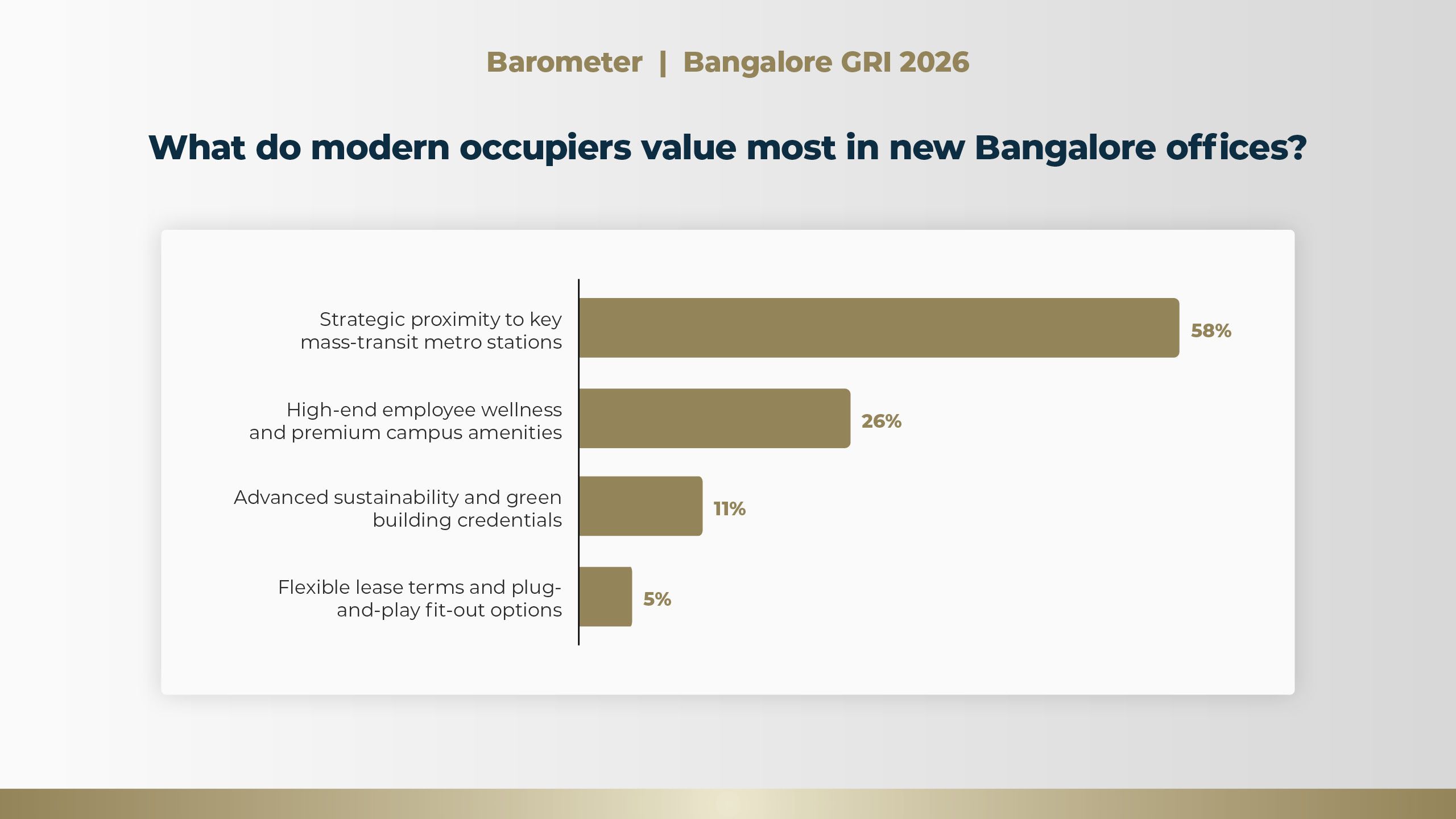
Transit accessibility stands out as the paramount consideration for Bangalore's commercial occupiers, with 58% of industry leaders identifying strategic proximity to key mass-transit metro stations as the primary driver of office selection.
Position along rapid transit corridors is now seen as vital for sustaining property valuations and easing arduous workforce commutes. Nevertheless, ongoing last-mile connectivity gaps continue to limit the full utility of the city's expanding transit network.
Beyond physical location, 26% of respondents underscored high-end employee wellness and premium campus amenities as their principal priority. Corporate occupiers are increasingly moving away from pure floor-plate efficiency to embrace talent-centric, experiential workplace designs.
To attract employees back to physical desks, occupiers are seeking developments equipped with large-scale amenities, including amphitheatres, crèches, gyms, and up to 72 onsite F&B options.
Environmental considerations and operational agility round out tenant preferences, with 11% selecting advanced sustainability credentials and 5% prioritising flexible lease terms with plug-and-play fit-outs.
While flexible leases received a smaller vote share as the single top decision factor, flex-space operators are nevertheless expanding at a 35% compound annual growth rate across the market, offering enterprise tenants the structural agility needed to manage compressed business cycles and bridge operational gaps seamlessly.
► Technology Hedges
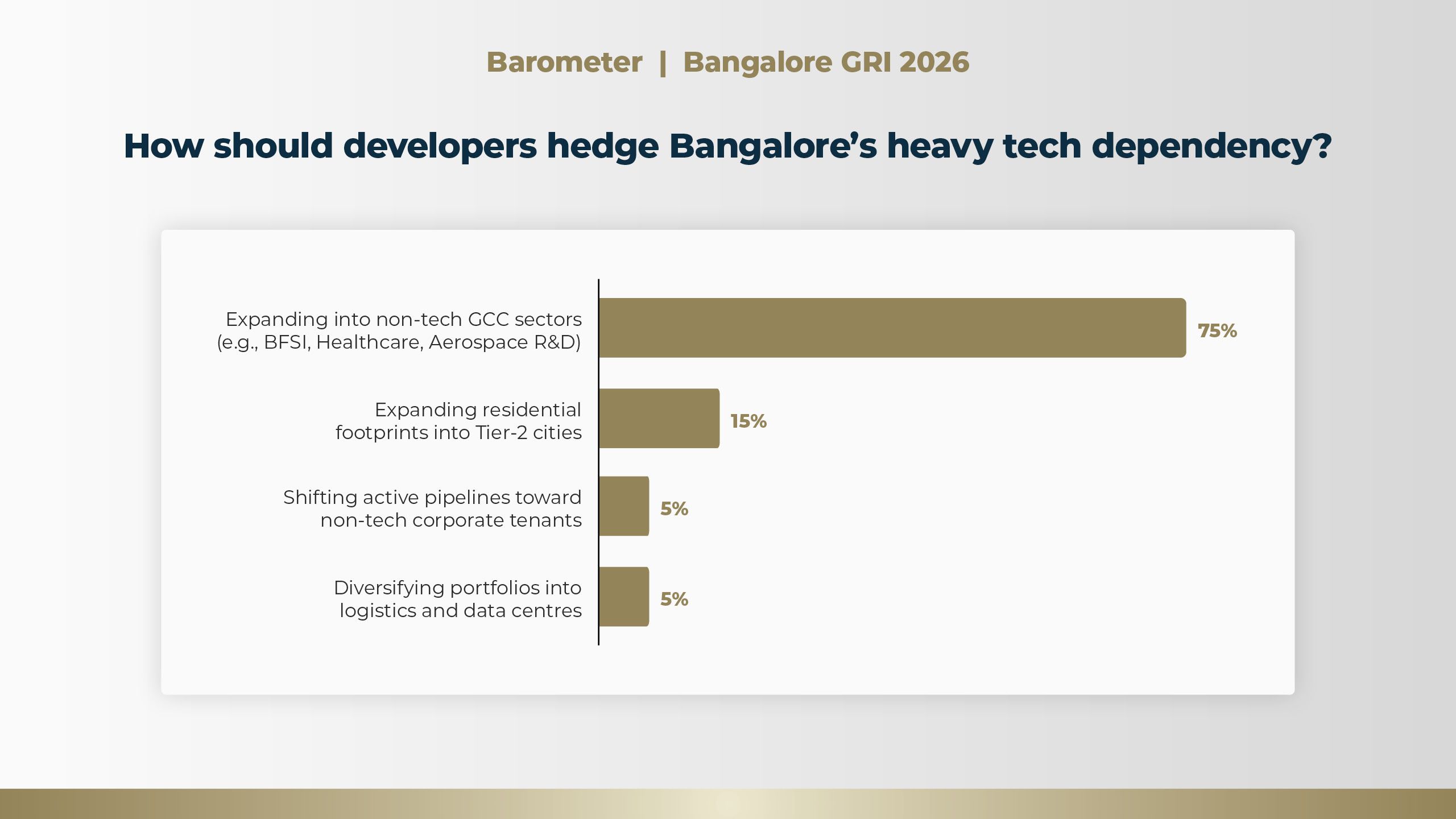
An overwhelming 75% majority of respondents view expansion into non-tech GCC sectors, including BFSI, healthcare, and aerospace R&D, as the optimal hedge against heavy tech concentration.
Rather than moving away from corporate capability hubs, market sentiment favours targeting higher-value operations within them.
The structural evolution of GCCs from legacy IT functions to complex, high-value roles has driven average compensation up from INR 10 lakh in 2018 to INR 35 lakh, generating sustained homebuying demand within the INR 1.5-2 crore bracket.
Geographic expansion into Tier-2 markets was endorsed by 15% of surveyed leaders, though major developers remain cautious about scaling down. Tier-2 ventures and boutique luxury projects often lack the scale and efficiency needed to justify the time invested when compared with core metropolitan developments.
Alternative commercial strategies received limited enthusiasm, with 5% recommending portfolio expansion into logistics and data centres, and an equal 5% favouring active pipeline shifts toward non-tech corporate tenants.
Nevertheless, developers are selectively evaluating niche real estate models - such as senior living, student housing, co-living, and managed rentals - to mitigate affordability barriers like traditional 10-month rental deposits and broaden their operational reach.
► Conclusion
Taken alongside insights shared by senior leaders at Bangalore GRI 2026, the survey signals a decisive shift in Bangalore's real estate market from speculative volume expansion toward a capital-disciplined, quality-driven regime.Rather than decentralising, strategy is consolidating around high-value core corridors. To succeed, developers must embrace structural self-reliance, internalising utilities, infrastructure, and sustainability within enclaves to offset civic deficits.
Ultimately, market leadership will belong to operators who adapt to the evolving demands of high-value occupiers and buyers. As transit connectivity, workplace experience, and private equity standards dictate viability, growth hinges on delivering transit-integrated, amenity-rich developments tailored to a maturing corporate ecosystem.
This survey was conducted among the senior industry leaders attending Bangalore GRI 2026.
► Access the full Bangalore GRI 2026 Spotlight report here
► Check out all upcoming GRI Institute India gatherings here