 Credit: GRI Institute
French Real Estate Outlook 2026 | Coup d’envoi du Marché Immobilier 2026
Real estate investment recovery and the "new norm" for offices at GRI Institute’s annual Coup d’envoi du Marché Immobilier 2026
January 19, 2026Real Estate
Written by:Helen Richards
Key Takeaways
- The French real estate market is transitioning to a "new norm" as CRE investment volumes slowly tick up and are expected to reach EUR 17 billion in 2027.
- Office demand is polarising, with a sharp divide between high-demand Paris CBD assets and peripheral areas facing supply gluts.
- Investment is rebounding gradually, though a 20% financing gap on expiring debt remains a critical challenge for 2026.
2026 is expected to be a pivotal year of stabilisation and strategic restructuring for the French real estate market.
During the GRI Institute’s annual Coup d’envoi du Marché Immobilier 2026, hosted in partnership with CMS and Colliers, in-depth market analysis presented by Ludovic Delaisse, General Manager at Colliers, provided a data-driven roadmap for 2026, revealing a market that is moving away from the post-pandemic shock towards a new, more selective norm.
However, this stabilisation comes with a strategic trade-off; as companies prioritise cost reduction, the market is witnessing a significant geographic reorientation as occupiers seek more competitive financial terms outside of traditional hubs.
Furthermore, the "new office" paradigm is creating a stark divide between modern requirements and existing stock. There is currently a major inadequacy in current supply, which places the burden of transformation on landlords to adapt buildings to meet the dual challenges of user ESG requirements and new spatial organisations influenced by AI and teleworking policies.
This shift is occurring within an economic environment where a resilient job market is beginning to reduce the "attractiveness" pressure on offices, forcing a deeper reflection on how the necessary green transitions and building modernisations will be financed in the years ahead.
The current investment market is being shaped by four critical drivers that dictate how capital flows and how assets are valued. Central to this shift is ongoing price adjustment, which is essential for the reconstitution of the risk premium.
As prices recalibrate to reflect the current economic reality, the potential for higher returns begins to outweigh the inherent risks, creating a more sustainable foundation for future growth.
Complementing this pricing shift is the need for fiscal stability; when tax frameworks remain predictable and competitive, it restores investor confidence and brings institutional players back to the table.
Beyond pricing and policy, the technical mechanics of the market - specifically yield decompression and debt structures - are driving significant movement. The decompression of yields is making real estate increasingly attractive relative to other asset classes, effectively signalling a return of capital to the sector.
However, this recovery is tempered by the pressures of the debt market. As refinancing options become increasingly limited due to tighter credit conditions, the market is seeing a rise in forced sales. While these liquidations can be disruptive, they often provide the necessary liquidity and entry points for new investors looking to capitalise on the market's broader reset.
2026 will be the year of active transformation. Investors are no longer just reacting to market movements; they are shaping a new cycle based on realistic pricing and sustainable standards.
During the GRI Institute’s annual Coup d’envoi du Marché Immobilier 2026, hosted in partnership with CMS and Colliers, in-depth market analysis presented by Ludovic Delaisse, General Manager at Colliers, provided a data-driven roadmap for 2026, revealing a market that is moving away from the post-pandemic shock towards a new, more selective norm.
Macro-Economic Foundations: Growth Amidst Resistance
Despite a globally sluggish economic backdrop, the French market shows signs of resilience through its persistent, albeit modest, growth.- GDP Growth: Forecasted at 1.0% for 2026, a slight uptick from the 0.9% expected in 2025.
- Inflation: After a peak in 2024, inflation is expected to stabilise at 1.5% in 2026.
- Employment: Despite an increase in corporate insolvencies, the job market remains a bulwark, with more than 33,000 salaried job creations projected for 2026.
The Rental Market: A "New Norm" for Offices
The Île-de-France (IDF) office rental market is shifting towards a "new norm" where demand is stabilising at lower volumes than the historical averages of the 2010s.- Take-up: The market saw a 9% decrease in total take-up, reaching approximately 1.64 million square metres.
- Supply vs. Demand: Available supply has surged by 130% since 2019, while take-up has dropped by 31% over the same period.
- Geographic Divergence: Paris remains the crown jewel, with the CBD (Quartier central des affaires) and other Paris sectors accounting for a massive share of activity, while peripheral areas, such as the Deuxième Couronne, face sharper declines.
However, this stabilisation comes with a strategic trade-off; as companies prioritise cost reduction, the market is witnessing a significant geographic reorientation as occupiers seek more competitive financial terms outside of traditional hubs.
Furthermore, the "new office" paradigm is creating a stark divide between modern requirements and existing stock. There is currently a major inadequacy in current supply, which places the burden of transformation on landlords to adapt buildings to meet the dual challenges of user ESG requirements and new spatial organisations influenced by AI and teleworking policies.
This shift is occurring within an economic environment where a resilient job market is beginning to reduce the "attractiveness" pressure on offices, forcing a deeper reflection on how the necessary green transitions and building modernisations will be financed in the years ahead.
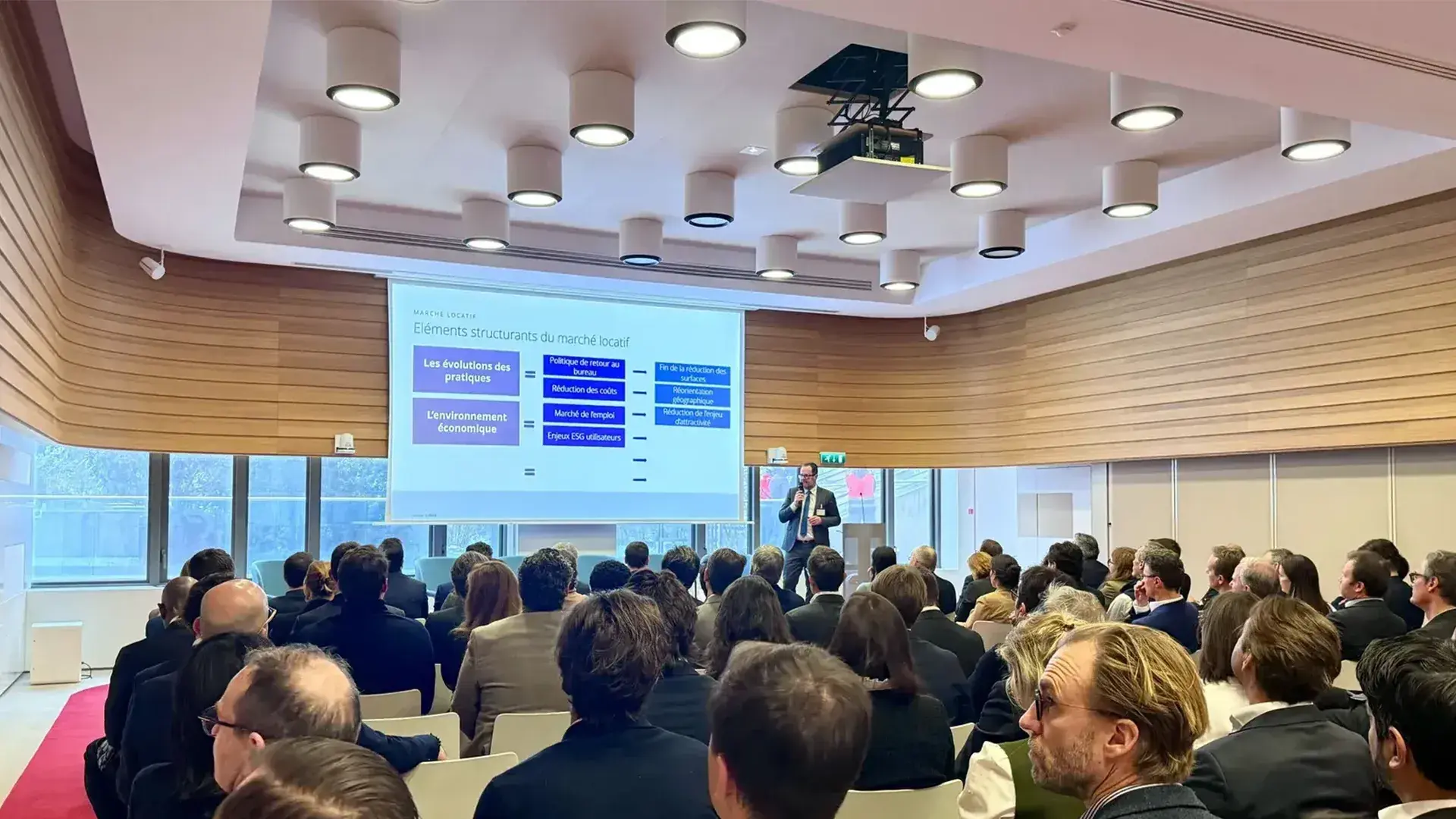
Ludovic Delaisse, Directeur Général at Colliers, presented the French economic and real estate outlook for 2026 at Coup d’envoi du Marché Immobilier 2026 in Paris. (Credit: GRI Institute)
Investment Trends: The Return of Selective Capital
The investment landscape is seeing a very gradual recovery, with a total volume of EUR 13.7 billion in 2025, up 8% from the previous year.- Sector Winners: Offices saw a 31% rebound in investment volume, reaching EUR 6.8 billion, while logistics saw a 17% dip.
- Yield Compression & Expansion: Prime yields in the Paris CBD are hovering around 4.25%, but a weak risk premium - the narrow gap between real estate yields and risk-free rates (OAT 10-year) - is currently hindering market fluidity.
- Financing Gap: A significant challenge for 2026 is the estimated 20% financing gap on expiring debt, which may trigger forced sales or require significant equity injections.
Future Outlook
As we look ahead, a steady rise in CRE investment volumes is projected, potentially reaching EUR 17 billion in 2027 as price adjustments settle and investors regain confidence.The current investment market is being shaped by four critical drivers that dictate how capital flows and how assets are valued. Central to this shift is ongoing price adjustment, which is essential for the reconstitution of the risk premium.
As prices recalibrate to reflect the current economic reality, the potential for higher returns begins to outweigh the inherent risks, creating a more sustainable foundation for future growth.
Complementing this pricing shift is the need for fiscal stability; when tax frameworks remain predictable and competitive, it restores investor confidence and brings institutional players back to the table.
Beyond pricing and policy, the technical mechanics of the market - specifically yield decompression and debt structures - are driving significant movement. The decompression of yields is making real estate increasingly attractive relative to other asset classes, effectively signalling a return of capital to the sector.
However, this recovery is tempered by the pressures of the debt market. As refinancing options become increasingly limited due to tighter credit conditions, the market is seeing a rise in forced sales. While these liquidations can be disruptive, they often provide the necessary liquidity and entry points for new investors looking to capitalise on the market's broader reset.
2026 will be the year of active transformation. Investors are no longer just reacting to market movements; they are shaping a new cycle based on realistic pricing and sustainable standards.
These insights were shared by Ludovic Delaisse (Colliers) during GRI Institute’s Coup d’envoi du Marché Immobilier 2026 roundtable, with participation from Benjamin Bill (CMS Francis Lefebvre), Florence Chérel (CMS Francis Lefebvre), Floriane Menguy (BlackRock), François Le Levier (WDP), Marc-Olivier Assouline (Columbia Threadneedle Investments), Nicolas Biganzoli (Nuveen Real Estate), Philippe Cervesi (Corum Asset Management), Rodrigo Clare (Altarea), Sandrine Amsili (Ardian), Sébastien Masson (Colliers), and Vincent Sadé (Prologis).
Special thank you to the sponsors of Coup d’envoi du Marché Immobilier 2026: Colliers and CMS.