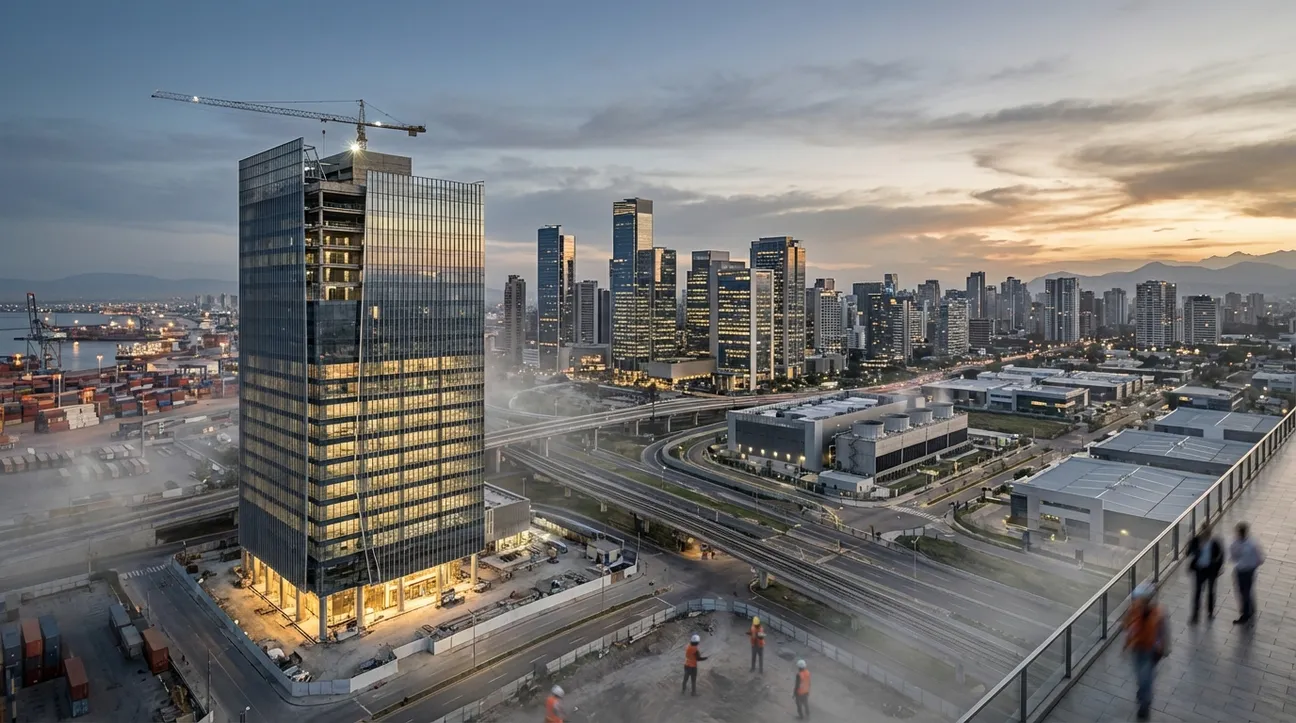
Urbanova and the urban future in Latin America: why the integrated model redefines value capture
Nearshoring, population migration, and municipal fiscal constraints are creating conditions for a new generation of planned urban developments in Mexico and the
Executive Summary
Key Takeaways
- Nearshoring in Mexico is generating accelerated demand for serviced land, housing, and logistics connectivity that fragmented urban growth cannot absorb.
- Integrated urban developments capture value across three dimensions: temporal, institutional, and resilience.
- Urbanova (Grupo Breca, Peru) demonstrates that mixed-use developments generate sustained value even in volatile macroeconomic environments.
- Transportation infrastructure is a necessary but insufficient condition; it requires associated comprehensive urban planning.
- Cross-border capital finds in integrated developments vehicles with diversified cash flows and long-term structural appreciation.
Integrated urban development as a long-term investment thesis
Latin American urbanization is entering an inflection phase. The combined forces of nearshoring, internal migration flows, and pressure on municipal finances are altering the value equation in the region's real estate development. In this context, integrated urban development models—those that combine housing, service infrastructure, commercial spaces, and public amenities within a single master plan—are emerging as the most robust strategy for capturing sustained value appreciation.
Urbanova, a leading real estate developer originally from Peru and part of Grupo Breca, offers a relevant case study for understanding this trend. Its track record in mixed-use developments and prime offices in Lima demonstrates that integrating urban functions within a single project generates value that transcends the conventional real estate cycle. The recognition Urbanova received at the GRI Awards Andean 2024 for its sustainability and innovation approach in the Paseo Begonias mixed-use project, according to GRI Institute records, confirms that the institutional market increasingly values this type of urban strategy.
The central question for industry leaders is no longer whether integrated developments work, but in which geographies and under what institutional conditions they can scale most rapidly. Mexico today concentrates several of these enabling factors.
Why does Mexico need new planned urban nodes to capitalize on nearshoring?
Mexico's Sectoral Program for Infrastructure, Communications, and Transportation 2025–2030, published by the Secretaría de Infraestructura, Comunicaciones y Transportes (SICT), establishes as a priority challenge for 2025 the implementation of logistics infrastructure to capitalize on nearshoring opportunities. This institutional recognition confirms a reality that developers and investment funds already observe on the ground: the relocation of global supply chains is generating accelerated demand for serviced land, worker housing, urban services, and logistics connectivity in corridors that previously operated at low density.
Fragmented urban growth models—where housing develops in one direction, industry in another, and services arrive years behind—are insufficient to absorb this transformation. Value capture is diluted among multiple uncoordinated actors, infrastructure costs fall on municipalities with limited fiscal capacity, and residents' quality of life deteriorates, which in turn increases labor turnover and reduces productivity for the companies that motivated the original investment.
Integrated urban development offers a structural alternative. By concentrating the provision of housing, retail, public amenities, and connectivity within a single master plan, the developer internalizes positive externalities that would normally be dispersed. Residents access services from the first day of occupancy, companies find more stable operating environments, and local governments obtain stronger tax bases without needing to finance primary infrastructure with their own resources.
The Ley General de Asentamientos Humanos, Ordenamiento Territorial y Desarrollo Urbano, currently in force in Mexico, establishes the basic standards for planning and regulating territorial management, setting out the concurrent jurisdiction of the federal government, states, and municipalities. This legal framework provides the regulatory basis for large-scale developments to negotiate public-private partnership schemes with different levels of government that distribute both the costs and benefits of urban growth.
The SICT projects that by 2045, Mexico will have consolidated a sustainable urban development model in which public spaces are accessible, safe, inclusive, and climate-resilient. Achieving that vision requires that projects designed today incorporate sustainability, resilience, and accessibility criteria from their inception—precisely the attributes that distinguish integrated developments from conventional urbanizations.
How does the integrated urban strategy compare across Mexico, Colombia, and the Andean corridor?
Urbanova's model in Peru serves as a natural benchmark for assessing the strategy's applicability in other Latin American markets. In Lima, the company has demonstrated that mixed-use developments can position themselves as prime assets even in volatile macroeconomic environments, because the diversification of income sources within the same project reduces exposure to individual sector cycles.
In Colombia, the dynamics are different but complementary. The country is undergoing an intensive investment cycle in connectivity infrastructure, as illustrated by COFIDES' financial backing of Grupo Ortiz for the construction of the Troncal de la Magdalena I and II concessions—projects spanning a total length of 532 km, according to information from COFIDES and Capital-Riesgo. These road infrastructure works generate development corridors that, without an associated integrated urban strategy, risk producing dispersed, low-value-added growth. The Colombian experience demonstrates that transportation infrastructure is a necessary but insufficient condition for quality urban development.
The contrast between both approaches offers a clear lesson for Mexico: the convergence of logistics infrastructure (driven by nearshoring) and planned urban development (inspired by models like Urbanova's) can create a value proposition greater than the sum of its parts. Developers who manage to articulate both dimensions will capture a disproportionate share of the value generated by industrial relocation.
The new generation of Latin American executives reflects this convergence. Diego Gutiérrez Chablé, profiled by GRI Hub as a key leader connecting digital technology with physical infrastructure, represents an emerging profile in the Mexican market that integrates data centers, hospitality, and urban development within a single strategic vision. This type of transdisciplinary leadership is what the planned cities model demands, where project complexity requires capabilities that transcend traditional real estate development.
The competitive advantage of integrated development: three dimensions of value
Value capture in an integrated urban development operates at three simultaneous levels that fragmented models cannot replicate.
First, the temporal dimension. A master plan allows the developer to capture the value increase that each project phase generates for subsequent phases. The delivery of a public park raises the value of surrounding housing, the opening of a shopping center increases office demand, and the consolidation of a critical mass of residents attracts healthcare and education services that elevate the value of the entire development.
Second, the institutional dimension. Integrated developments facilitate negotiation with municipal governments because they offer a single counterpart for the provision of complex urban services. In a context where municipal finances face significant constraints, a private developer's ability to finance and deliver primary infrastructure in exchange for regulatory and fiscal certainty constitutes a first-order strategic asset.
Third, the resilience dimension. Mixed-use projects diversify the developer's income sources and reduce dependence on a single market segment. When the residential cycle slows, commercial and office income partially offset the decline, and vice versa.
These three dimensions explain why institutional investors assign valuation premiums to integrated developments over monofunctional projects of comparable scale.
The strategic opportunity for cross-border capital
The confluence of nearshoring, demographic growth in industrial corridors, and regulatory frameworks that favor comprehensive planning creates a window of opportunity for cross-border capital. Latin American and international funds seeking exposure to Mexican urban growth find in integrated developments an investment vehicle with long horizons, diversified cash flows, and structural appreciation potential.
GRI Institute has documented through its regional gatherings, including the GRI Awards Andean 2024, how planned urban development models are gaining traction among the leading players in real estate and infrastructure across Latin America. Conversations within the GRI community reflect a growing consensus: the next value creation cycle in Latin American real estate will be led by those who succeed in integrating infrastructure, housing, and services within coherent urban ecosystems.
The integrated urban strategy represents the natural evolution of real estate development in markets simultaneously facing demographic pressure, accelerated industrial demand, and fiscal constraints at the municipal level. The cases of Urbanova in Peru, concessioned infrastructure in Colombia, and the new generation of Mexican executives such as Diego Gutiérrez Chablé all point in the same direction: long-term value capture belongs to those who think in terms of complete cities, not isolated projects.