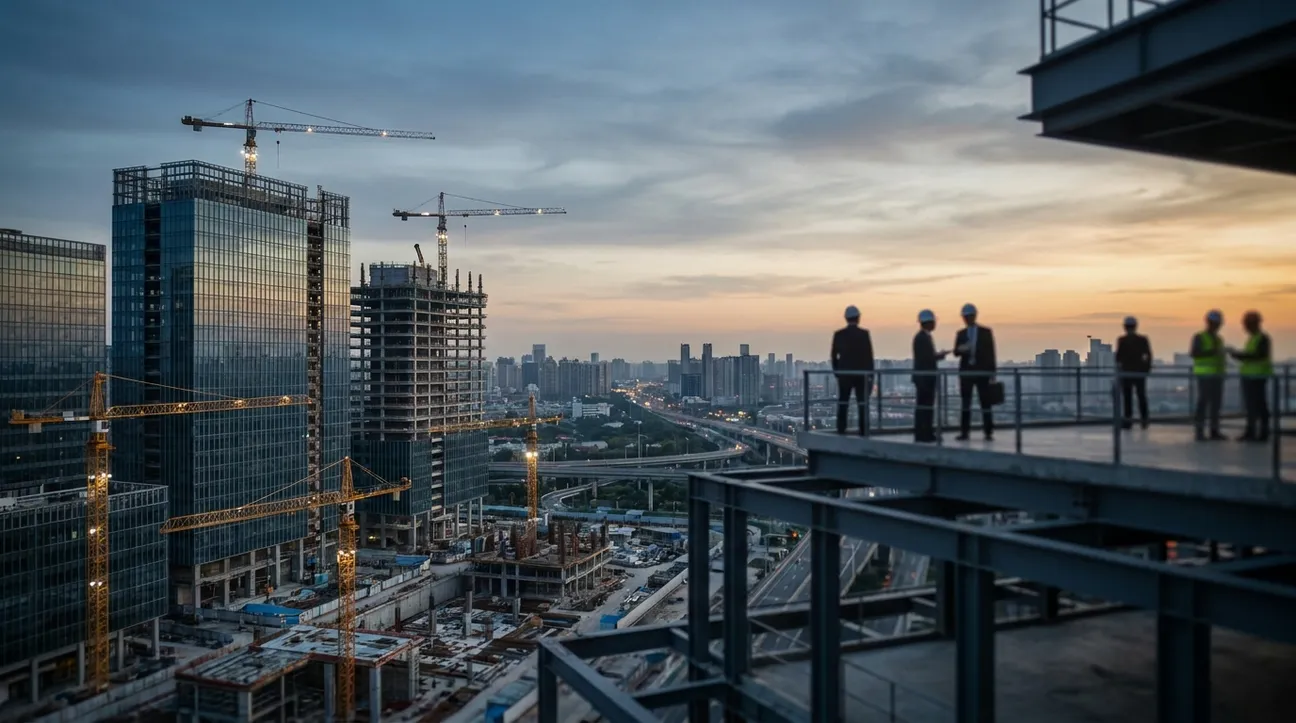
Unity Group owner and the family capital blueprint reshaping NCR's next institutional real estate corridor
As domestic capital dominates Indian real estate investment, family-led developers like Unity Group offer a strategic model for scaling institutional-grade corridors in Delhi NCR.
Executive Summary
Key Takeaways
- Domestic investors accounted for 76% of institutional capital inflows into Indian real estate in Q1 2026, deploying $1.2 billion.
- Unity Group has delivered over 10 million sq ft and holds a 15-million-sq-ft pipeline across retail, commercial, institutional, and hospitality segments.
- Delhi NCR recorded 9,677 residential launches in Q1 2026, up 26% YoY, with Gurugram commanding 73% market share.
- India's real estate sector may require Rs 50 lakh crore in capital over the next decade, per ANAROCK Capital.
- Family-led developers with professionalised governance are emerging as the dominant institutional model in Indian real estate.
The rise of family capital in Indian real estate's institutional era
India's real estate sector is witnessing a structural transformation in how capital forms, flows, and finds its way into large-scale development corridors. The question of who owns and controls the next wave of institutional-grade real estate platforms is no longer peripheral. It sits at the centre of how institutional investors, sovereign funds, and domestic family offices evaluate partnership opportunities across the subcontinent.
Unity Group, founded in 1996, represents one of the clearest case studies of this transition. The company has delivered over 10 million square feet of retail, commercial, institutional, and hospitality spaces, with a development pipeline of approximately 15 million square feet, according to IREED India. Its leadership structure reflects a family capital architecture that is increasingly common among North India's most ambitious developers: Govind Aggarwal leads operations and marketing, Harsh V Bansal serves as CEO, Krishan Aggarwal heads finance, and Naresh Aggarwal holds the position of director.
This distributed leadership model, anchored in family governance, is not a legacy artefact. It is an emerging institutional template. And it matters because domestic capital is now the dominant force shaping Indian real estate's trajectory.
Who owns Unity Group and why does ownership structure matter for institutional investors?
Searchers querying "Unity Group owner" are seeking a definitive answer, and the question carries strategic weight well beyond biography. Unity Group's leadership is distributed across multiple family members with clearly delineated operational responsibilities. Govind Aggarwal oversees operations and marketing, Krishan Aggarwal manages finance, Harsh V Bansal drives executive strategy as CEO, and Naresh Aggarwal serves as director, per data from IREED India and Unity Group's official disclosures.
The significance of this structure lies in what it signals to capital markets. Family-led developers in India have historically struggled to attract institutional partnerships due to opaque governance, concentrated decision-making, and informal succession planning. Unity Group's model, with its functional separation of roles across family members, mirrors the professionalisation trends that institutional investors increasingly demand.
This matters in a market where domestic investors accounted for 76% of total institutional capital inflows into Indian real estate in Q1 2026, deploying $1.2 billion and surpassing foreign capital for the third consecutive quarter, according to Cushman & Wakefield. The total institutional investment in Indian real estate reached $1.6 billion in Q1 2026, a 26% year-on-year increase. Domestic family offices and homegrown funds are no longer passive participants. They are the primary engine of institutional capital formation. Developers whose ownership structures facilitate transparent governance and clear accountability are best positioned to attract this capital.
Unity Group's ownership architecture, while not publicly detailed in terms of exact equity splits, presents a governance framework that aligns with the expectations of domestic institutional investors who are scaling their exposure to NCR's expanding corridors.
How are family-led developers scaling NCR's institutional corridors alongside new entrants?
Delhi NCR recorded 9,677 residential unit launches in Q1 2026, a 26% year-on-year increase, with Gurugram commanding 73% of the market share, according to Cushman & Wakefield. The corridor's expansion is no longer confined to Gurugram. Faridabad, where NeoLiv is developing a Rs 2,300 crore township, is emerging as a credible institutional-grade market, according to The Realty Today.
Unity Group's 15-million-square-foot pipeline positions it as a significant force in this corridor expansion. The group's diversified portfolio across retail, commercial, institutional, and hospitality segments provides the kind of mixed-use capability that institutional investors favour when evaluating corridor-level bets. Single-asset-class developers face concentration risk. Diversified family platforms that can deliver mixed-use environments at scale present a fundamentally different risk-return profile.
The Haryana Real Estate Regulatory Authority (HRERA), operating under the national RERA framework, has reinforced this institutional trajectory. The Gurugram bench approved 35 new projects between January and April 2026 and continues to mandate strict penalties, including 10.80% interest for delayed possessions. This regulatory backbone raises the compliance bar, which in turn favours established developers with the governance infrastructure to meet RERA standards. Family-led groups that have professionalised their operations, as Unity Group has done through its functional leadership model, gain a structural advantage in this environment.
The pattern extends beyond Unity Group. Eldeco Group, another prominent North Indian developer led by Chairman and Managing Director Pankaj Bajaj, has completed over 175 projects, according to Trendlyne. In western India, Honest Group operates in the ultra-luxury and public infrastructure space across Mumbai and Pune under the leadership of CEO Sanket Agrawal and Chairman and Managing Director Sunil Mittal, as documented by GRI Institute. These companies share a common trait: family or founder-led governance structures that are progressively adapting to institutional standards.
The convergence of family capital discipline with institutional compliance requirements is creating a new class of developer in India. These are firms large enough to anchor corridor-level developments, diversified enough to manage cyclical risk, and governed transparently enough to attract the domestic institutional capital that now dominates the market.
Can family capital architecture sustain the Rs 50 lakh crore investment India's real estate sector demands?
According to ANAROCK Capital, India's real estate sector may require Rs 50 lakh crore in capital over the next decade to meet development and infrastructure demands. Colliers projects that India will emerge as one of the fastest-growing destinations for institutional real estate capital within the APAC region in 2026, driven by domestic capital and infrastructure expansion.
These projections raise a fundamental question about scalability. Family-led developers have demonstrated their ability to build and deliver at meaningful scale. Unity Group's 10-million-square-foot track record and 15-million-square-foot pipeline are evidence of this capacity. Eldeco's 175-plus completed projects reinforce the pattern. The question is whether family governance structures can evolve quickly enough to absorb capital at the scale the market demands.
The answer depends on three variables. First, the willingness of family-led groups to open their capital structures to institutional co-investment, whether through joint ventures, platform-level partnerships, or eventual public listings. Second, the depth of professionalisation within these organisations, particularly in finance, compliance, and succession planning. Third, the regulatory environment's ability to provide the transparency and enforceability that institutional capital requires. HRERA's active enforcement and digital framework upgrades in 2025 and 2026 suggest the regulatory infrastructure is maturing in parallel with the developer base.
The current market context reinforces the urgency of this evolution. While NCR launches are growing at 26% year-on-year, the broader market is experiencing a shift toward quality and RERA-compliant developments. Institutional capital is gravitating toward developers that can demonstrate governance maturity alongside development capability. Family-led firms that treat ownership transparency and professional management as strategic assets, rather than concessions, will capture a disproportionate share of the capital flowing into Indian real estate.
Family capital in Indian real estate is no longer a transitional phase before institutional maturity. It is the institutional model, adapted to local market dynamics and governance traditions. The developers that recognise this and structure accordingly will define the next decade of India's built environment.
The GRI Institute perspective
The evolution of family-led developers into institutional-grade platforms is a recurring theme within the GRI Institute community. Across GRI Institute's India events and research initiatives, the interplay between domestic capital formation, developer governance, and corridor-level scaling consistently emerges as a defining strategic conversation among senior real estate leaders. Members engaged in NCR's expanding corridors, from Gurugram to Faridabad, are actively navigating this transition, seeking frameworks that balance family governance traditions with the transparency and scalability that institutional partnerships demand.
As India's real estate sector enters a decade that may require unprecedented levels of capital deployment, the ownership structures behind the country's leading developers will determine which corridors attract institutional investment and which remain fragmented. Unity Group's distributed family leadership model, Eldeco's project-delivery track record under Pankaj Bajaj, and Honest Group's sectoral diversification under Sunil Mittal and Sanket Agrawal each represent distinct answers to the same strategic question: how family capital can scale to meet institutional ambition.
The developers that solve this equation will not simply build India's next real estate corridors. They will define the institutional architecture of the sector itself.