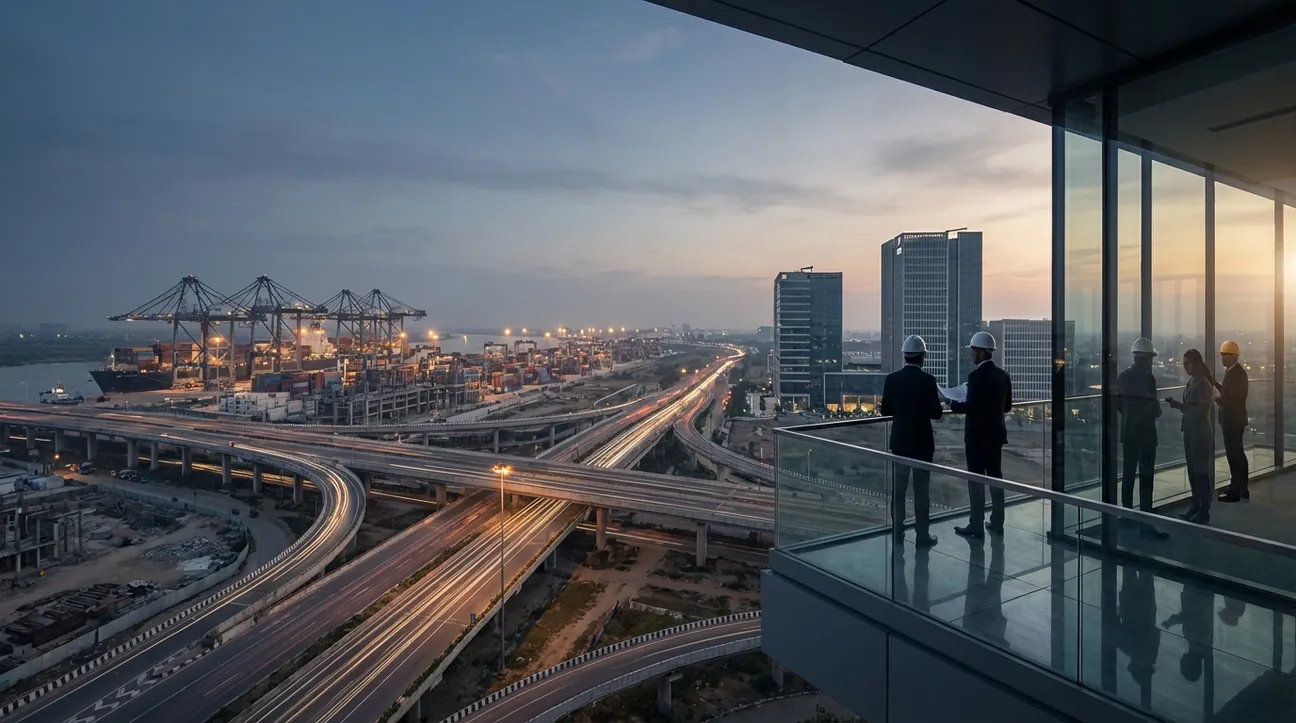
Infrastructure-linked developers reshaping India's logistics corridors in 2025–2028
Vertis Infrastructure Trust and RRC Ventures illustrate how road concessions and large-scale construction are converging to build a new asset class along nation
Executive Summary
Key Takeaways
- India's warehousing market is projected to reach $35 billion by 2027 at ~15% CAGR.
- Vertis Infrastructure Trust plans to develop 700+ Wayside Amenities along national highways by FY 2028–2029, up from 94 operational today.
- NHAI policy now allows standalone WSA development separate from road concessions, creating a new investable asset class.
- Private highway investment under BOT models is expected to approach ₹1 trillion by FY 2026–27.
- Warehousing absorption is projected at 36–42 million sq ft by end of 2025.
- Over $8 billion in institutional capital has flowed into warehousing since 2020.
India's warehousing market is projected to reach $35 billion by 2027, growing at roughly 15% CAGR, according to CareEdge Ratings. Behind that trajectory lies a less visible but equally consequential shift: the emergence of infrastructure-linked developers and special-purpose vehicles that are converting highway concessions into logistics, retail, and mixed-use real estate nodes. Two entities, Vertis Infrastructure Trust (formerly Highway Concessions One) and RRC Ventures Pvt Ltd, offer a concrete lens through which to map this transformation.
GRI Institute tracks this convergence as one of the defining themes in Indian real estate for the remainder of the decade. The interplay between road operators monetizing wayside assets and construction powerhouses executing corridor-scale projects is producing a new pipeline that institutional capital is only beginning to price.
From Highway Concessions One to Vertis: a platform redefining road-adjacent real estate
Highway Concessions One (HC1) rebranded its infrastructure investment trust to Vertis Infrastructure Trust in June 2025, according to NSE filings. The name change signals more than corporate identity. It reflects an operational pivot from toll-road management toward a diversified infrastructure platform that includes real estate-adjacent assets.
As of June 2025, Vertis Infrastructure Trust's assets under management reached approximately ₹25,000 crore, spanning 27 operational road projects across nine states, according to Vertis press releases filed with NSE India. The scale of this portfolio positions Vertis as one of the most geographically distributed infrastructure investment trusts in the country.
The platform's most ambitious initiative targets the development of over 700 Wayside Amenities (WSAs) along national highways by FY 2028–2029, according to the Vertis Infrastructure Trust Valuation Report. WSAs, which combine fuel stations, food courts, rest areas, and increasingly logistics micro-hubs, represent a new category of highway-linked real estate that straddles infrastructure and commercial property.
As of March 2025, 94 WSAs under the government's monetization plan have been made operational, according to NHAI data cited by Vertis. The gap between 94 operational units and a target of over 700 reveals the scale of the development pipeline ahead.
What policy changes are enabling the WSA development pipeline?
Two regulatory frameworks are accelerating this expansion. NHAI Policy Circular No. 18.102/2025, issued on April 4, 2025, descoped the construction of Wayside Amenities from road contractor scopes. This allows independent bidding by specialized entities, including InvITs, to develop, manage, and monetize WSAs separately from the underlying road concession. The policy is designed to improve quality and unlock dedicated revenue streams for WSA operators.
The second framework is the SEBI (Infrastructure Investment Trusts) Regulations, 2014, amended in 2024–25, which governs InvITs like Vertis. These regulations permit InvITs to acquire and manage infrastructure assets and associated real estate with specific valuation and borrowing norms, creating a regulated pathway for institutional capital to flow into highway-adjacent developments.
Together, these regulatory shifts convert what were previously ancillary construction obligations into standalone investable assets. For real estate investors, the WSA pipeline represents a category of brownfield-adjacent development with embedded demand from highway traffic volumes.
RRC Ventures: the execution engine behind corridor-scale developments
RRC Ventures Pvt Ltd occupies a different but complementary position in the value chain. The company has executed over 70 large-scale projects totaling more than 50 million square feet for developers including Hiranandani Group, Piramal Group, and Brookfield Properties, according to a press release cited by The Tribune in January 2025.
RRC Ventures functions primarily as an execution partner, constructing the hard infrastructure, commercial parks, and mixed-use townships that logistics operators and institutional landlords subsequently occupy. Its track record with Brookfield Properties is particularly relevant: Brookfield is among the largest institutional owners of logistics and office assets in India, and RRC's capacity to deliver at scale positions it as a critical link between capital deployment and physical asset creation.
In 2025, RRC Ventures formed a partnership named Mextech, operating as Miraya Realty, with Nandivardhan Group and Ekatva to launch a ₹1,000 crore luxury development in Thane, according to PTI News. While this project is residential rather than logistics-focused, it illustrates the company's expanding scope and its ability to anchor large capital commitments in corridor markets adjacent to Mumbai's industrial belt.
How does the logistics and warehousing pipeline connect to highway expansion?
India's warehousing and logistics sector absorption is projected to reach 36–42 million square feet by the end of 2025, according to Vestian's Logistics Outlook. This absorption figure represents the demand side. The supply side is increasingly shaped by the quality and reach of national highway infrastructure.
Private sector investment in national highways under the build-operate-transfer (BOT) model is expected to approach ₹1 trillion by FY 2026–27, according to industry sources cited by PropNewsTime. This capital wave is expanding the arterial network along which logistics parks, warehousing clusters, and mixed-use developments become viable.
The connection between road infrastructure and real estate development follows a clear sequence. Highway concessions create arterial connectivity. WSAs and service nodes generate commercial activity at key junctions. Logistics parks and warehousing facilities then cluster around these nodes, drawn by accessibility, existing services, and the traffic density that justifies last-mile distribution investment.
Vertis, with its 27 road projects and 700-plus WSA target, is building the connective tissue. Execution-focused firms like RRC Ventures are constructing the physical assets that sit on top of it. Institutional investors, from InvIT unitholders to global private equity firms, provide the capital layer.
Mapping the convergence: infrastructure trusts meet development execution
It is important to note that no verified evidence points to a direct joint venture between RRC Ventures and Vertis Infrastructure Trust. These entities operate as separate ecosystem players rather than formal partners. Their significance lies in what they represent collectively: a maturing value chain where road concession operators, construction firms, and capital platforms each play distinct but interdependent roles in creating logistics and mixed-use real estate along India's expanding highway network.
This ecosystem model is gaining traction across emerging markets, a theme that GRI Institute members have explored in recent discussions on infrastructure-linked real estate strategies. The Indian case is distinguished by its regulatory architecture, particularly the NHAI policy enabling standalone WSA development and SEBI's InvIT framework, which together create institutional-grade pathways for capital deployment.
The warehousing segment alone has attracted over $8 billion in institutional capital since 2020, underscoring the depth of investor appetite for logistics-linked real estate in India. As highway corridors extend and WSA networks densify, the addressable market for this capital will expand proportionally.
What should investors watch in 2025–2028?
Three metrics merit close tracking. First, the pace of WSA operationalization: the jump from 94 operational units to the 700-plus target by FY 2028–2029 will test both execution capacity and demand assumptions. Second, the trajectory of BOT-model private investment approaching the ₹1 trillion mark, which will determine how quickly new corridors become developable. Third, the warehousing absorption rate, with the 36–42 million square foot projection for 2025 serving as a near-term benchmark for demand momentum.
For infrastructure and real estate leaders, the Indian logistics corridor story is fundamentally a story of asset-class creation. Highway concessions are evolving from toll-collection instruments into platforms for diversified real estate development. Construction firms with proven scale are becoming indispensable partners for institutional capital seeking physical deployment. Regulatory innovation is enabling the unbundling of infrastructure and real estate value chains in ways that create new entry points for investors.
GRI Institute will continue to track these developments as part of its ongoing coverage of India's infrastructure-linked real estate transformation. The entities profiled here, Vertis Infrastructure Trust and RRC Ventures, represent early movers in a corridor development model that is likely to define institutional real estate strategy in India through the end of the decade.