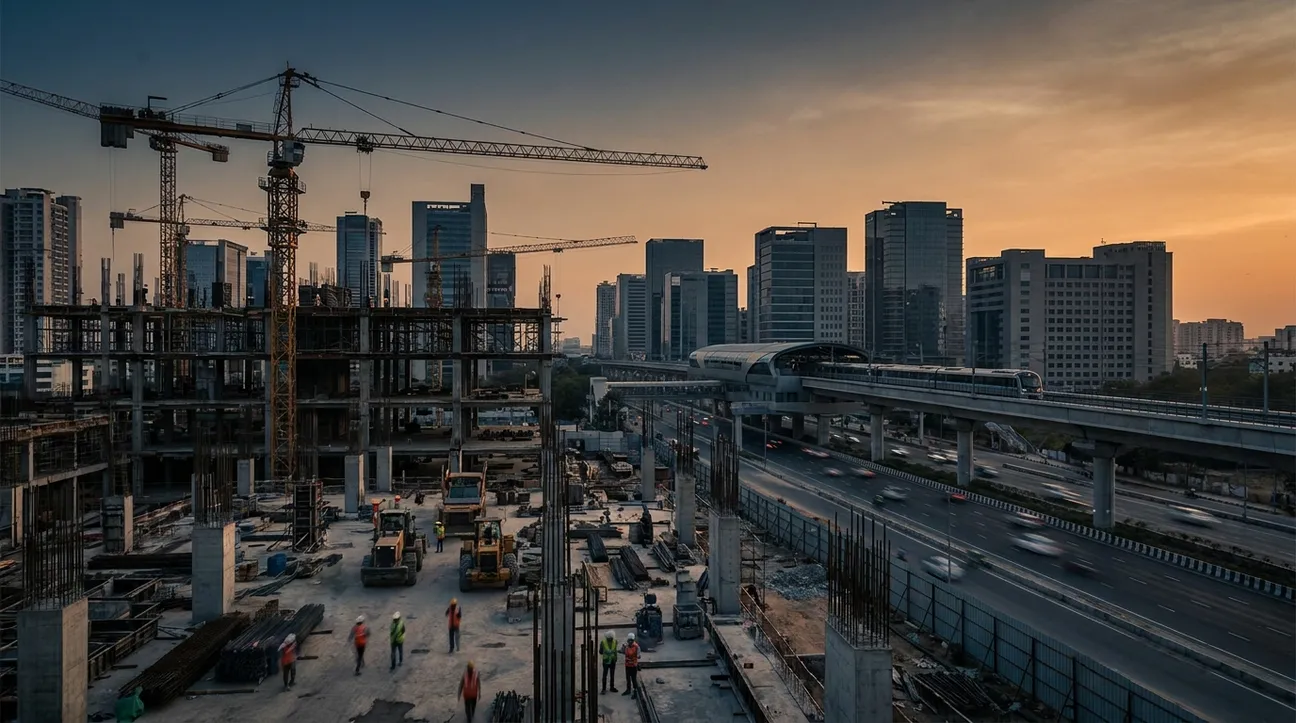
Ranjeet Pawar and the institutional capital architecture reshaping India's real estate corridors
As domestic capital overtakes foreign investment and Mumbai's redevelopment pipeline swells, Sugee Group's finance leader exemplifies a new operational model for Indian real estate.
Executive Summary
Key Takeaways
- Domestic institutional capital hit a record 63% of India's real estate investment flows in H1 2026, while foreign institutional investment fell 35%.
- Institutional investment reached USD 4.4 billion in H1 2026, up 25% year-on-year.
- SEBI reforms reclassified REITs as equity instruments and lowered credit risk thresholds, broadening institutional access to real estate.
- Mumbai's redevelopment pipeline spans an estimated 50,000–80,000 buildings, creating a massive but complex opportunity.
- Premium housing sales surged 30%, demanding developer credibility and financial stability.
- Finance roles in real estate are evolving from transactional to strategic, institutional-grade functions.
India's real estate sector is undergoing a structural realignment. Domestic institutional capital now commands the majority of investment flows, regulatory reforms are expanding the reach of listed real estate instruments, and Mumbai's urban fabric is entering an unprecedented cycle of redevelopment. At the intersection of these forces sits Ranjeet Pawar, Director of Finance and Operations at Sugee Group, whose operational leadership offers a window into how mid-market Indian developers are building institutional-grade platforms to capture a generational wave of capital and urban renewal.
The shift is measurable and significant. According to JLL's India Institutional Capital Flow Market Perspective, institutional real estate investment volumes reached USD 4.4 billion in H1 2026, a 25% increase compared to H1 2025. More striking still, domestic institutional capital accounted for a record 63% of total flows during the period, while foreign institutional investment declined by 35%. This reversal marks a turning point: India's real estate market is increasingly financed from within, and the developers best positioned to benefit are those who can meet domestic institutional investors' expectations around governance, transparency, and operational rigour.
What does Ranjeet Pawar's role reveal about the changing finance function in Indian real estate?
For much of the past two decades, the finance function in Indian real estate firms served a largely transactional purpose: securing project-level debt, managing cash flows, and navigating the complex regulatory environment around land acquisition. The rise of institutional capital, both domestic and foreign, has fundamentally altered this equation. Today, the finance and operations leadership at a developer like Sugee Group must architect capital structures that align with institutional standards, manage portfolio-level risk, and position the company to participate in regulated capital markets.
Ranjeet Pawar's mandate at Sugee Group encompasses precisely this scope. As Director of Finance and Operations, he oversees the financial architecture of a Mumbai-based developer operating in one of the world's most complex and high-value urban markets. His estimates, shared with NDTV Profit in December 2024, place the scope for building redevelopment in Mumbai at between 50,000 and 80,000 buildings, a figure that conveys the sheer scale of the opportunity facing developers with the operational capacity to execute.
This is where the institutional development architecture becomes relevant. The term describes the convergence of capital strategy, regulatory compliance, and operational systems that enables a developer to move from opportunistic project delivery to scalable, repeatable execution across urban corridors. Pawar's work at Sugee Group, a company deeply embedded in Mumbai's redevelopment ecosystem, positions him at the centre of this transformation.
The broader market context reinforces the urgency of this evolution. Residential sales across India rose 8% year-on-year to 70,631 units in Q1 2026, according to JLL's Residential Dynamics Report, driven by a 30% surge in premium housing priced above INR 10 million. Premium and luxury segments require developers to demonstrate brand credibility, construction quality, and financial stability, attributes that institutional capital partners demand as table stakes.
How are regulatory reforms accelerating institutional participation in Indian real estate?
Two regulatory interventions by SEBI in 2026 have materially expanded the institutional capital pool available to Indian real estate. The first, effective January 1, 2026, reclassified Real Estate Investment Trusts (REITs) as equity-related instruments rather than hybrid instruments. This reclassification enables mutual funds and specialised investment funds to allocate capital to REITs under equity mandates, significantly broadening the investor base for listed real estate vehicles.
The second, SEBI/LAD-NRO/GN/2026/302, effective April 16, 2026, lowered the minimum required credit risk value from 12 to 10 and expanded eligibility by including 'Class B-I' instruments within the potential risk class matrix. Together, these amendments reduce barriers to entry for institutional investors and create a more liquid, accessible market for real estate securities.
For developers like Sugee Group, these reforms carry direct operational implications. A more liquid REIT market creates exit pathways for institutional capital deployed at the project or platform level, which in turn makes it easier for developers to attract equity partners for new projects. The finance function must now integrate capital markets strategy into project-level planning, a capability that requires precisely the kind of institutional development architecture that Pawar's role represents.
The office sector has already responded to these tailwinds. JLL data shows that offices reclaimed their leadership position in H1 2026, capturing 54% of total institutional capital in the Indian real estate market. Global Capability Centres (GCCs) continue to drive this momentum, leveraging India's deep talent pool in artificial intelligence, data science, and digital engineering to automate global operations. While Sugee Group's primary focus remains residential redevelopment, the broader capital market dynamics created by office-sector strength benefit all asset classes by deepening institutional familiarity with Indian real estate as a viable allocation.
What makes Mumbai's redevelopment corridor a distinctive institutional opportunity?
Mumbai occupies a unique position in India's real estate landscape. Unlike greenfield markets in Bengaluru or Hyderabad, Mumbai's growth story is primarily a redevelopment story. The city's ageing building stock, estimated by Pawar at 50,000 to 80,000 structures requiring redevelopment, represents both a massive housing opportunity and a complex execution challenge. Each redevelopment project involves navigating tenant consent, municipal approvals, demolition logistics, and reconstruction timelines, all while managing the financial exposure of a business that generates revenue only upon completion and sale.
This complexity creates a natural moat for developers with established operational systems and deep local expertise. It also creates a compelling case for institutional capital, provided the developer can demonstrate the governance and financial controls that institutional investors require. The shift toward domestic institutional dominance in India's investment flows, now at 63% of total volumes, suggests that Indian institutional investors are increasingly comfortable underwriting this complexity, particularly when partnered with experienced operators.
The residential market's trajectory further supports this thesis. While the Knight Frank-NAREDCO Real Estate Sentiment Index for Q2 2026 indicates that future sentiment holds steady at a neutral threshold of 50, signalling a phase of normalisation and recalibration after a prolonged growth cycle, this stabilisation is constructive for institutional participants. Predictable, moderate growth environments reward disciplined operators and penalise speculative behaviour, precisely the market conditions under which institutional development architectures deliver superior risk-adjusted returns.
Developers who have invested in operational excellence, transparent financial reporting, and scalable execution models will capture a disproportionate share of institutional capital in this environment. Pawar's dual mandate across finance and operations at Sugee Group reflects an organisational design that integrates these capabilities, aligning the company's internal structure with the expectations of an increasingly institutional investor base.
The broader implications for India's real estate leadership
The convergence of domestic capital dominance, regulatory liberalisation, and urban redevelopment creates a new template for leadership in Indian real estate. The traditional developer-promoter model, characterised by concentrated decision-making and opaque financial structures, is giving way to a more distributed, professionally managed architecture. Finance leaders like Ranjeet Pawar represent this transition, bridging the operational demands of complex redevelopment projects with the governance standards required by institutional capital.
This evolution is a recurring theme within the GRI Institute community, where senior leaders from India's real estate and infrastructure sectors convene to examine capital flows, regulatory shifts, and operational best practices. The questions that Pawar's career trajectory raises, around how developers institutionalise their operations, how regulatory reforms reshape capital allocation, and how Mumbai's redevelopment pipeline can be financed at scale, are central to the strategic conversations taking place across GRI Institute events and research initiatives.
India's real estate market is entering a more mature phase. The USD 4.4 billion in institutional investment recorded in H1 2026 is a milestone, but the trajectory matters more than the number. Domestic institutions are building conviction, regulatory frameworks are becoming more accommodating, and the operational leaders who can translate these macro trends into project-level execution will define the next chapter of Indian real estate.
Ranjeet Pawar's position at the nexus of finance, operations, and urban redevelopment at Sugee Group places him squarely within this defining moment. The institutional development architecture he represents is both a response to current market conditions and a blueprint for the sector's future.