 GRI Institute
Pune's real estate market adapts to rising costs and shifting developer strategies
How financing challenges, land acquisition complexities, and new tenant demands are shaping the city’s booming property sector
April 28, 2026Real Estate
Written by:Isabella Toledo
Executive Summary
The rapid maturation of the real estate sector in Pune is showing signs of cracks as challenges such as slowing sales, rising inventory, and increasing financing complexities prompt developers to reassess their strategies.
Insights from the GRI Institute’s Pune Real Estate 2026 roundtable, co-hosted by Mango Advisors, highlight these evolving development trends, along with growing demand for flexible office spaces, future-proof infrastructure, and strategic location selection that capitalises on the government’s focus on improving connectivity in emerging areas.
Insights from the GRI Institute’s Pune Real Estate 2026 roundtable, co-hosted by Mango Advisors, highlight these evolving development trends, along with growing demand for flexible office spaces, future-proof infrastructure, and strategic location selection that capitalises on the government’s focus on improving connectivity in emerging areas.
Key Takeaways
- Pune's real estate market faces financing challenges as borrowing costs rise and capital access becomes more selective, prompting developers to reassess strategies.
- Developers are increasingly adopting customer-funded growth models and prioritising long-term stability over speculative short-term profits to navigate rising costs and market fluctuations.
- The shift towards ecosystem integration and emerging locations such as Karadi and Aundh reflects the need for interconnected developments, with strong infrastructure initiatives driving growth.
Financing challenges and developer strategies
The Pune real estate market has seen significant growth over the past five years, with property prices rising by nearly 40%. However, recent developments have revealed underlying challenges, including stagnating sales, growing inventory levels, and the increasing complexity of financing.These issues have prompted a reassessment of growth strategies, particularly as smaller developers quietly exit the market.
While developers report that capital is available, the terms are becoming increasingly restrictive, and the cost of borrowing has become prohibitive for many players. The real challenge lies not in the availability of funds but in the rising costs and the tightening criteria for securing favourable terms.
As industry veterans highlight, borrowing costs are now at record highs, and the market has become more selective. Even institutional lenders, once a reliable source of funding, have become hesitant, applying stricter conditions, which makes the capital markets appear both plentiful and elusive simultaneously.
In this environment, having a strong reputation and a proven track record are now essential for accessing lower-cost capital. The absence of a formal credit rating, on the other hand, can push financing costs even higher.
Despite these challenges, savvy stakeholders continue to navigate the market by relying on customer sales to fund construction or utilising alternative finance sources, such as Alternative Investment Funds (AIFs), which have stepped in to fill the gap left by traditional banks.
Risk appetite impacts on financing strategies
Developers are increasingly adopting slower, more deliberate growth strategies as the sector grapples with plateauing sales and rising capital costs. In this scenario, maintaining balance has become a prerequisite, and stakeholders are now prioritising long-term stability over quick, speculative gains.A key consideration today is risk appetite, which heavily influences developer approaches to financing. Some remain more aggressive, willing to take on high-cost debt in the hopes of fast project completions and short-term profits.
While this strategy can yield short-term rewards, it introduces significant risks - especially when delays or unforeseen complications arise.
Conversely, developers who favour lower-risk equity or customer-funded models are more conservative in their financing approach. This strategy reduces exposure to the high costs of debt but requires careful balancing of sales expectations and capital flow.
Although a cautious approach such as this may limit short-term profits, it also offers greater resilience in the face of external pressures and market fluctuations.
The use of high-cost debt to finance land acquisition has been a common tactic for many developers in Pune. However, this approach can create long-term pressure if sales slow or project timelines extend beyond expectations.
Taking on the burden of expensive, short-term capital can become overwhelming, particularly if unforeseen delays affect project completion. The experiences of industry players who have faced such challenges underscore the fragility of relying on high-cost debt without a well-calibrated risk management strategy.
In this context, understanding the nuances of financing has become crucial for weathering market volatility. The focus has shifted towards operational efficiency, financial discipline, and strategic risk management as the cornerstones of future growth.
The shift to customer-funded growth
In recent years, many developers in the Indian real estate sector have increasingly turned to customer-funded growth, using pre-sales to cover construction costs. This approach has gained significant traction, particularly in Pune, where developers have leveraged customer payments to reduce their reliance on external capital.However, this model carries inherent risks, particularly as sales plateau and the demand-supply balance shifts. Even a slight dip in sales can put developers who are heavily reliant on customer funds in a difficult position, making it challenging to complete projects.
This highlights the importance of adopting a more balanced financing strategy, diversifying their capital sources, and incorporating a mix of customer funds, equity, and stable debt structures to safeguard against potential market fluctuations and ensure long-term project viability.
Commercial vs. residential
Pune’s commercial real estate market has undergone impressive maturation, with growth largely driven by the expansion of global capability centres (GCCs) and rising institutional interest.This has led to a significant surge in leasing activity, with millions of square feet of new office space added to the market. Unlike the residential sector, the commercial real estate market has embraced more institutionalised capital structures, offering clearer exit strategies and enhanced transparency.
This growing divergence is increasingly significant as the city’s real estate landscape evolves. Residential developers are now facing heightened competition from institutional investors, who have the resources and scalability to dominate the commercial space.
The pressing question is therefore whether residential developers will continue to depend on homebuyer-driven funding or shift towards institutional partnerships to remain competitive in an increasingly complex market.
Additionally, stakeholders face a critical strategic decision between continuing to focus on residential developments or diversifying into the commercial real estate sector, which still shows strong growth potential.
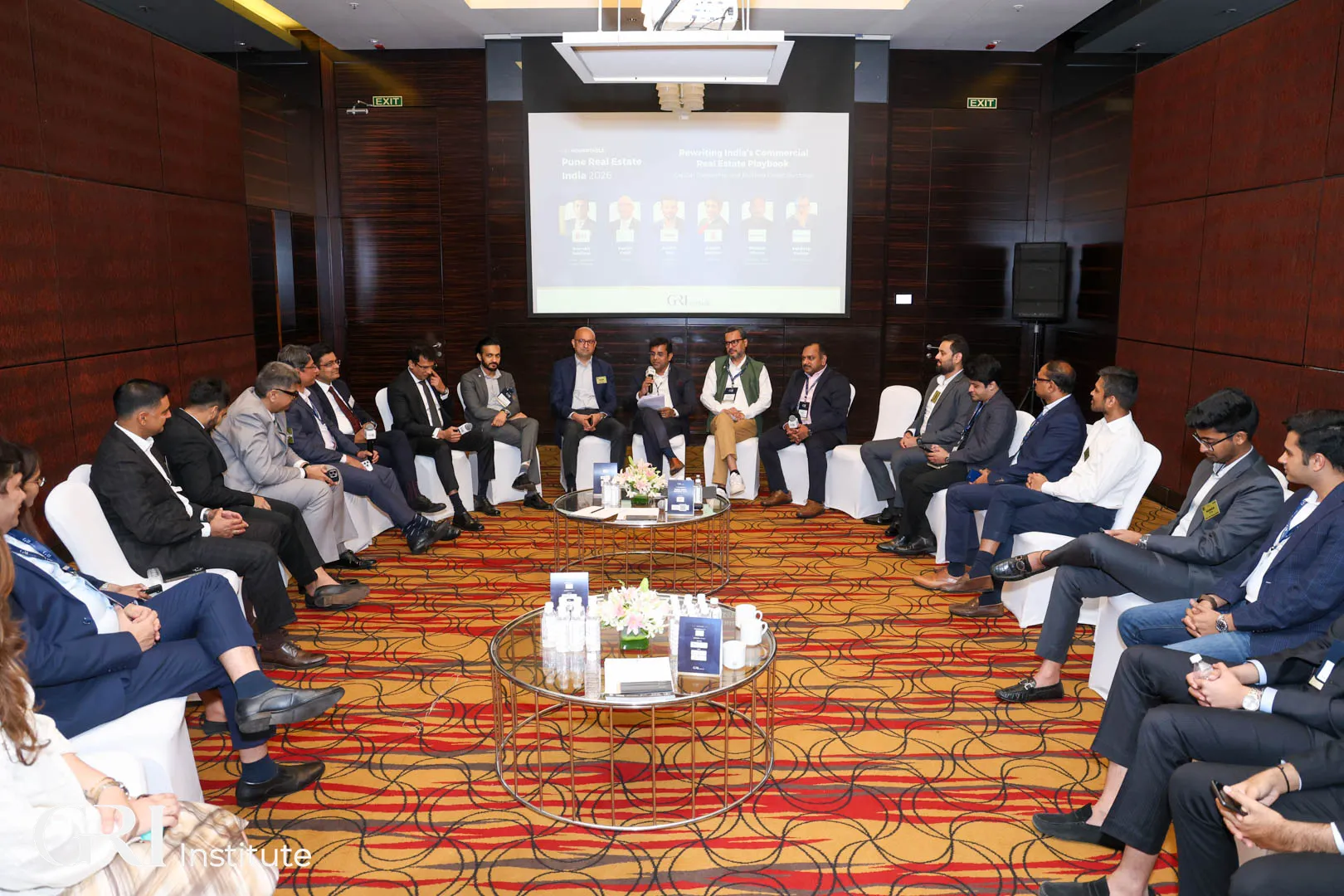
Industry leaders explore how financing complexities are prompting developers to reassess their strategies in Pune’s real estate market. (GRI Institute)
The complexities of landowner-developer relationships
In today’s real estate market, a more measured and pragmatic approach to land valuation is becoming increasingly common. Rather than relying on speculative pricing, developers now focus on calculating future returns through detailed analysis of land conditions, project stages, and realistic demand forecasts.This process considers several key factors, including the stage of land development, supply-demand dynamics, surrounding infrastructure, and the balance between development costs and anticipated profitability.
On the other hand, landowners often have more optimistic views about the values of their properties, frequently influenced by factors such as price trends in nearby areas or speculative online valuations. This can result in inflated expectations, which create tension during negotiations as both parties seek alignment on pricing.
This approach has led to a stronger focus on feasibility studies and long-term returns, with an emphasis on aligning investments with realistic market conditions and careful evaluation rather than speculative growth.
The relationship between landowners and developers remains a crucial aspect of successful land transactions. While financial terms are important, trust and transparent communication often prove more vital.
Stakeholders who can offer a clear data-driven vision for a project while also maintaining collaborative relationships with landowners are in a stronger position to negotiate favourable terms and ensure the long-term success of their projects.
Joint ventures in Pune's real estate development
The city's fragmented landownership structure, often involving multiple stakeholders on a single plot, has made joint ventures (JVs) an attractive option - allowing landowners to share in the profits without assuming the full development risk, while developers benefit from reduced upfront capital requirements.The regulatory environment, particularly the introduction of Unified Development Control Regulations (DCR) and an increased Floor Space Index (FSI), has further incentivised JV deals, creating added value for both landowners and industry players.
Additionally, the influx of national players and institutional investors into Pune’s market is raising the stakes for local developers.
Developers operating on a Pan-India scale, with stronger capital bases and established brands, can negotiate better terms and secure land in prime locations, while smaller, local developers may struggle to compete on price or scale, making JV partnerships increasingly crucial to leverage resources and capabilities.
However, JVs can present significant governance challenges. Landowners, often driven by tax benefits or the ability to defer income, may find those partnerships appealing, yet their understanding of the complexities involved in profit-sharing, cost-sharing, and long-term governance is frequently limited.
Managing expectations for quick returns, along with addressing the growing complexity of profit-sharing and governance, remains a persistent challenge. This is especially true when the long-term value of a project exceeds initial expectations, creating tensions over revenue distribution.
Pune’s commercial real estate playbook
Pune’s commercial real estate sector experienced a record absorption of 10 million square feet in 2025, with continued growth anticipated, largely driven by global capability centres (GCCs), which now account for 55% of the country’s total commercial space absorption.However, this expansion brings its own set of challenges, particularly in accessing affordable capital. Leasing commercial spaces at rates below a 10% capital cost is considered essential for generating competitive returns, adding pressure on developers.
In this context, developers are increasingly seeking cost-effective capital structures that allow them to remain competitive in a growing market without sacrificing margins. The recent shift towards more aggressive funding, particularly from family offices and investment funds, has opened up new opportunities in this space.
Navigating tenant demands
A key point in discussions about Pune’s commercial real estate landscape is the growing demand for buildings that can accommodate the evolving needs of occupiers.Developers are placing a stronger emphasis on flexibility, sustainability, and operational resilience, recognising that these features are not mere “nice-to-haves,” but essential for attracting tenants in an increasingly competitive market.
Additionally, enterprises in the technology and semiconductor sectors now require more than just visually appealing spaces. Power capacity and resilient infrastructure have become baseline expectations.
The shift towards energy-intensive operations, such as AI data centres, demands that buildings are future-proofed with the necessary technological and infrastructural support, and the city must evolve to meet the needs of future occupiers - particularly power and cooling systems.
Developers who understand these evolving needs will be well-positioned to design spaces not only meeting current demands, but that are also adaptable for future technological advancements.
Capitalising on infrastructure advancements
The next phase for Pune’s commercial real estate market is expanding beyond traditional locations to emerging areas such as Karadi and Aundh - following the increasing interest in creating destination-driven, integrated developments that combine workspaces with residential and recreational areas.This evolution will also depend on its ability to integrate with the region’s broader infrastructure developments, as the government’s focus on improving connectivity - particularly through metro expansions - is a key driver of growth.
For industry leaders, identifying locations with solid infrastructure and accessibility, especially in terms of transport links, will be crucial in positioning their projects for long-term success.
These insights were shared at the GRI Roundtable “Pune Real Estate 2026,” co-hosted by Mango Advisors, featuring a fireside chat with Rajesh Bhatia (Mango Advisors) and Rohit Gera (Gera Developments), an opening session led by Atul Bohra (Kalpataru), and a dynamic discussion moderated by Saurabh Bakliwal (JLL India), with panellists Aseem Kohli (Varde), Ashish Jain (Kundan Spaces), Ashish Mallpanni (Mallpani Group), Mahesh Mhetre (Alphawave Semiconductors), and Sandeep Poddar (Kimberly Clark).