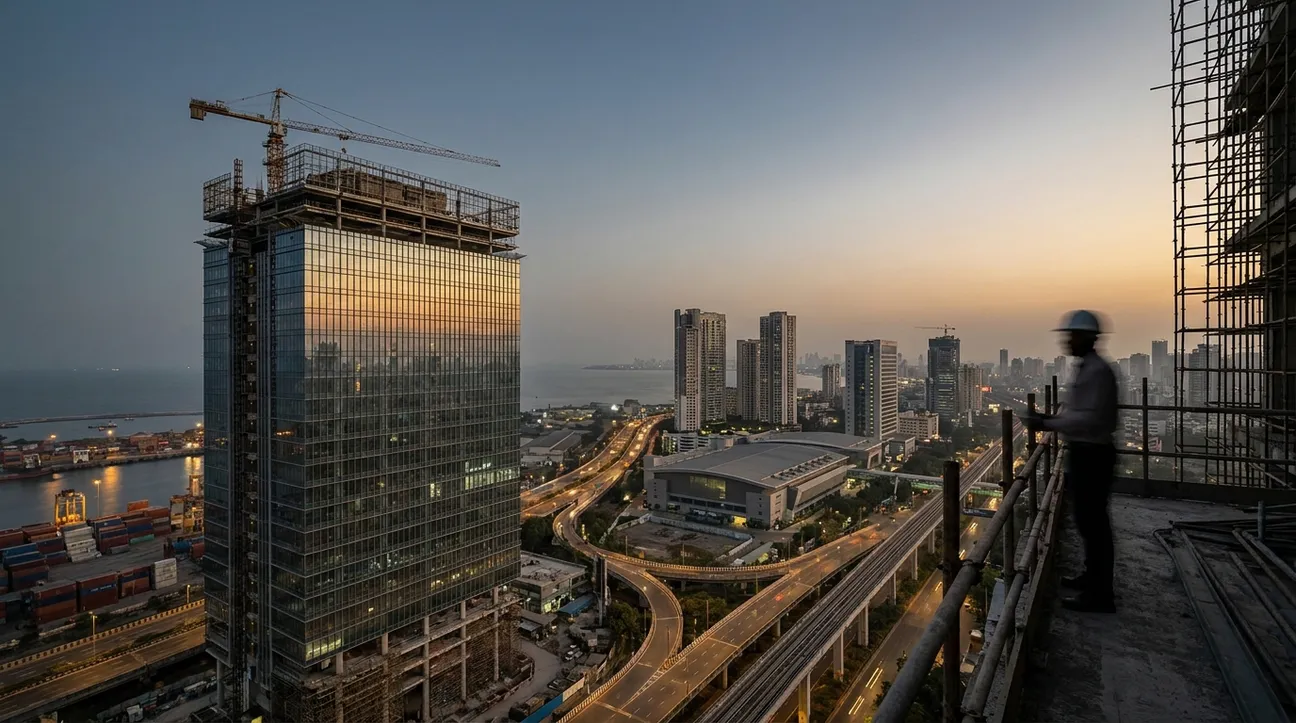
Prestige Group's Mumbai expansion is engineering a new institutional beachhead in Indian real estate
With 6.2 million sq ft of Grade-A office space planned by 2028, Irfan Razack's platform is redefining geographic diversification for listed Indian developers.
Executive Summary
Key Takeaways
- Prestige Group is building ~6.2 million sq ft of Grade-A office space in Mumbai by 2028, positioning itself among the city's most active institutional-grade developers.
- The company acquired full ownership of key Mumbai projects by buying out DB Realty's 50% stakes for over Rs 1,176 crore, prioritizing end-to-end asset control.
- Prestige's ownership-first model differs from Embassy's REIT approach and Nitesh Estates' co-investment strategy, offering greater long-term flexibility.
- Prestige led Indian real estate pre-sales in Q1 FY26 at Rs 12,126.4 crore.
- Execution risk and unconfirmed pre-leasing commitments remain key concerns.
A Bangalore giant plants its flag in India's financial capital
For decades, Prestige Group built its identity around Bangalore. The company founded by Irfan Razack grew into one of India's most recognised listed developers by mastering the southern city's commercial, residential, and hospitality segments. That identity is now being deliberately redrawn. Through a sequence of acquisitions, joint venture buyouts, and large-scale greenfield developments, Prestige is constructing a formidable Mumbai platform that could reshape competitive dynamics in India's most liquid commercial real estate market.
The scale of the ambition is significant. Prestige Group's upcoming commercial properties in Mumbai, including Prestige 101 BKC, Prestige Liberty Towers, and the Prestige-Valour campus, are projected to add approximately 6.2 million sq ft of Grade-A office space to the city by 2028, according to data compiled from Prestige Pallava Gardens. For context, this pipeline alone would rank Prestige among the most active office developers in Mumbai's institutional-grade segment.
This expansion arrives at a moment when Indian commercial real estate is attracting sustained interest from global capital allocators. Conversations within the GRI Institute community consistently highlight Mumbai's office sector as a primary target for institutional investors seeking yield-bearing assets in Asia's fastest-growing major economy. Prestige's decision to pursue full ownership of its Mumbai projects, rather than rely on joint venture structures, signals a clear conviction that controlling these assets end-to-end will maximise long-term value.
How did Prestige Group assemble its Mumbai office portfolio?
Prestige's Mumbai entry was neither sudden nor improvised. It followed a deliberate, multi-year strategy that combined partnership structures with decisive consolidation moves.
The foundational step came in 2023, when Prestige Group acquired the remaining 50% stakes in two Mumbai commercial projects, Prestige BKC Realtors and Turf Estate JV (Mahalaxmi), from DB Realty for over Rs 1,176 crore, according to Construction Week Online. This transaction gave Prestige 100% ownership of two strategically located commercial developments in Mumbai's most premium micro-markets, Bandra Kurla Complex and Mahalaxmi.
Achieving full ownership was a critical strategic choice. Joint ventures with local partners are a common entry mechanism for developers expanding into new cities, but they introduce complexity around decision-making, capital deployment, and eventual monetisation. By buying out its partner, Prestige secured unencumbered control over asset design, tenant selection, leasing strategy, and potential future REIT inclusion.
The momentum has continued into 2026. In April 2026, Prestige Estates acquired a 50% partnership interest in Aaramnagar Realty LLP for Rs 180 crores to develop a real estate project in Versova, Mumbai, as reported by ScanX Trade. This latest acquisition extends Prestige's Mumbai footprint beyond the traditional commercial corridors of BKC and Lower Parel into the western suburbs, a market increasingly favoured by technology companies and creative industries seeking modern office and mixed-use environments.
Prestige's flagship Mumbai development, Prestige Liberty Towers in Mahalaxmi, illustrates the scale the company is pursuing. The mixed-use complex features two towers of 290 metres and 200 metres, offering 2.26 million sq ft of office space and 390,000 sq ft of retail space, according to data from Prestige Pallava Gardens. Projects of this magnitude are rare in Mumbai's constrained land market and position Prestige to compete directly with established institutional landlords in the city.
What sets Prestige's strategy apart from other Bangalore-origin developers?
Prestige's geographic pivot gains additional meaning when viewed against the strategies of other prominent Bangalore-headquartered real estate leaders.
Aditya Virwani, Managing Director of Embassy Group, has pursued institutional capital partnerships through the REIT model, creating Embassy Office Parks REIT as a vehicle for monetising completed office assets. Embassy's approach centres on pooling stabilised assets into a listed trust structure, attracting passive institutional capital.
Nitesh Shetty, founder of Nitesh Estates, previously explored a different institutional pathway, pursuing a joint venture with Goldman Sachs valued at approximately $300 million for commercial assets. That strategy relied on co-investment with a global financial partner to access capital and credibility in new markets.
Prestige's Mumbai playbook represents a third, distinct model. Rather than creating a REIT vehicle first or partnering with a financial institution for co-investment, Prestige is building a wholly-owned development pipeline of institutional-quality assets from the ground up. The company is betting that constructing and controlling 6.2 million sq ft of Grade-A office space in Mumbai will create optionality: these assets can be held for recurring lease income, contributed to a future REIT structure, or selectively divested to institutional buyers at stabilised valuations.
This ownership-first approach carries higher near-term capital intensity but offers greater long-term strategic flexibility. It allows Prestige to capture the full development margin, control the tenant mix to attract multinational occupiers, and time its monetisation decisions based on market conditions rather than partner preferences.
The financial results suggest the broader platform is performing well. Prestige Group led Indian real estate sales in Q1 FY26, securing pre-sales of Rs 12,126.4 crore, driven by strong demand and expansion into new markets like Mumbai and Delhi-NCR, according to Star Estate. Pre-sales of this magnitude across multiple geographies demonstrate that the company's expansion has not diluted execution capacity in its core markets.
Can Prestige's Mumbai office pipeline attract institutional capital at scale?
The central question for global investors tracking Prestige's Mumbai strategy is whether these assets, once operational, will meet the underwriting standards of institutional capital.
Several factors work in Prestige's favour. Mumbai's office market benefits from structural demand drivers, including India's expanding financial services sector, global capability centres established by multinational corporations, and the continued formalisation of the Indian economy, all of which require modern, Grade-A workspace. The locations Prestige has chosen, BKC, Mahalaxmi, and now Versova, are among Mumbai's most liquid and well-connected micro-markets.
The sheer concentration of Prestige's pipeline also creates portfolio-level appeal. A single developer offering 6.2 million sq ft across multiple premium locations provides institutional investors with the opportunity to acquire or partner on a diversified Mumbai office portfolio without assembling it asset by asset. This portfolio logic is increasingly important for sovereign wealth funds, pension funds, and global real estate managers seeking meaningful exposure to Indian commercial real estate.
However, execution risk remains material. Mumbai's regulatory environment, construction timelines, and infrastructure dependencies can challenge even experienced developers. Prestige's track record in Bangalore provides confidence, but Mumbai operates with its own set of approvals, labour dynamics, and competitive pressures. The absence of publicly disclosed pre-leasing commitments for Prestige Liberty Towers and Prestige 101 BKC means that the market will watch occupier interest closely as these projects approach completion.
Discussions among senior real estate leaders within the GRI Institute network frequently identify execution quality and leasing velocity as the decisive factors separating successful geographic expansions from overextended ones. Prestige's Mumbai bet will ultimately be judged by the same criteria.
The strategic implications for Indian real estate
Prestige Group's Mumbai expansion carries implications that extend beyond one company's growth trajectory. It signals a maturing phase in Indian real estate where the largest listed developers are building national platforms capable of deploying capital across multiple gateway cities simultaneously.
The ownership consolidation model Prestige is pursuing, acquiring full control of projects rather than remaining in joint venture structures, reflects growing confidence among Indian developers in their ability to access capital markets independently. As Indian capital markets deepen and listed developers achieve greater scale, the need for local joint venture partners in new cities diminishes.
For institutional investors, Prestige's Mumbai pipeline represents exactly the type of large-format, single-ownership, Grade-A office portfolio that global capital has historically struggled to access in India. If these projects deliver on schedule and attract quality tenants, they could serve as a template for how listed Indian developers create investable platforms in secondary geographies.
The coming 24 months will prove decisive. By 2028, when the full 6.2 million sq ft pipeline is expected to reach the market, the answers to leasing velocity, rental benchmarks, and institutional interest will determine whether Prestige's Mumbai beachhead becomes a durable competitive advantage or a capital-intensive detour. For now, the strategic architecture is in place, and the Indian real estate market is watching closely.
GRI Institute continues to track the evolution of geographic expansion strategies among India's leading real estate platforms through its research and leadership community across Asia.