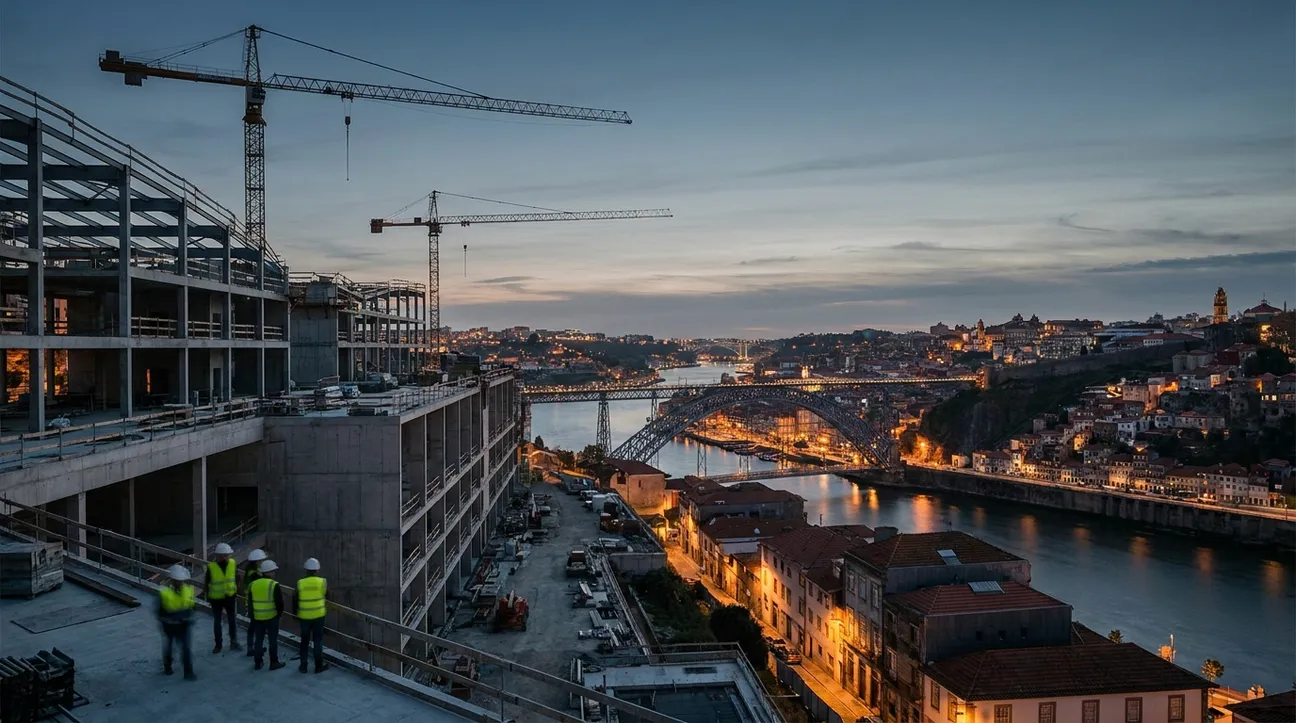
Pedro Baganha and the institutional capital flows reshaping Portugal's real estate market in 2026
Porto's urbanism chief operates as a connector-principal for cross-border investors as commercial volumes surge 39% and the city targets a fivefold expansion in public housing.
Executive Summary
Key Takeaways
- Portugal's commercial real estate investment hit €911M in Q1 2026, up 39% year-on-year, following €2.7B in 2025.
- Foreign real estate investment reached a record share of Portugal's total FDI in 2025, rising 10.4% year-on-year.
- Porto targets a fivefold increase in public housing (2% to 10%) by 2030, creating a major institutional pipeline.
- Golden Visa elimination filtered out speculative capital but concentrated institutional flows into commercial and build-to-rent segments.
- Porto's office take-up is projected to grow 14% in 2026, driven by tech-sector relocations.
- Pedro Baganha operates as a key connector-principal bridging municipal policy and cross-border capital.
Commercial real estate investment in Portugal reached €911 million in the first quarter of 2026, a 39% increase compared to Q1 2025, according to Savills Portugal. The figure underscores a broader repricing dynamic that has turned the country into one of Europe's fastest-moving institutional markets, drawing Atlantic and Middle Eastern capital into a pipeline shaped, in significant part, by public-sector principals such as Pedro Baganha.
Baganha serves as the Porto City Councilor for Urbanism, Public Space, and Housing, a role that positions him at the intersection of municipal planning authority and international investment appetite. For institutional investors conducting due diligence on Portuguese deal flow, understanding his policy agenda, the regulatory trajectory he influences, and the infrastructure of public-private engagement around Porto's urban transformation is now a prerequisite.
Who is Pedro Baganha and why does he matter to institutional investors?
Pedro Baganha is not a fund manager or a developer in the conventional sense. He is a public official whose remit over urbanism, public space, and housing in Portugal's second city gives him direct influence over licensing timelines, zoning frameworks, and the strategic allocation of municipal land for residential and mixed-use development.
GRI Institute has profiled Baganha as a "connector-principal," a category of public-sector leader who bridges sovereign and municipal policy with the capital allocation decisions of cross-border investors. At gatherings such as Portugal GRI 2026, institutional participants engage with figures like Baganha to map regulatory risk before committing equity to development pipelines. The value of such engagement lies in the directness of the dialogue: investors gain clarity on approval processes, affordable housing mandates, and the political sustainability of pro-investment policy stances.
Porto has established a municipal target to increase its public housing supply from 2% to 10% by 2030, according to data referenced by GRI Institute and the Câmara Municipal do Porto. That fivefold expansion represents a quantifiable development pipeline, one that requires private capital, institutional expertise in build-to-rent and affordable housing structuring, and a stable regulatory compact between the municipality and its development partners.
The public housing target alone signals a transformation of Porto's residential investment thesis. Delivering on the 10% goal demands thousands of new units across a city whose historic centre and riverfront districts have already been repriced by tourism-led demand. For institutional operators with experience in social and affordable housing across the United Kingdom, the Netherlands, or Germany, Porto's pipeline offers a scaled entry point into the Iberian residential sector.
How large is the foreign capital wave entering Portugal's property market?
Foreign investors poured a record amount into Portugal's property market in 2025, representing a 10.4% year-on-year increase, according to the Bank of Portugal. Real estate investment accounted for the highest share ever recorded of total foreign direct investment in the country that year, a structural shift that reflects Portugal's transition from a peripheral European play to a core allocation target.
Total commercial real estate investment volume in Portugal closed 2025 at approximately €2.7 billion, according to CBRE and Dils. That benchmark, combined with the €911 million recorded in Q1 2026 alone, suggests the market is on pace to meet or exceed the CBRE projection of approximately €2.4 billion in commercial real estate investment for the full year 2026.
The acceleration is notable given the regulatory recalibration the country underwent in 2023. The Mais Habitação legislative package, enacted in October of that year, eliminated the real estate investment route for Portugal's Golden Visa programme. The measure was designed to redirect foreign capital away from residential property speculation and toward productive economic sectors. Rather than dampening investor interest, the reform appears to have filtered out speculative retail capital while concentrating institutional flows into commercial and build-to-rent segments.
Portugal's real estate market absorbed record foreign investment in 2025 despite the elimination of the Golden Visa real estate route, a signal that institutional demand is now structurally anchored rather than incentive-dependent.
Porto's office market and the urban expansion pipeline
Office take-up in Porto is projected to increase by 14% in 2026, according to CBRE. The forecast reflects a sustained corporate relocation trend, driven by the city's technology ecosystem, lower operating costs relative to Lisbon, and a talent pool concentrated around the University of Porto and its technical institutes.
Baganha's urbanism portfolio intersects directly with this office expansion. Licensing velocity, the designation of innovation districts, and the integration of commercial zoning with public transport infrastructure all fall within the councilor's remit. For developers evaluating speculative or pre-let office schemes in Porto, the municipal planning framework is a critical variable, and Baganha is its primary architect.
The office growth thesis reinforces the broader narrative: Porto is evolving from a lifestyle-driven tourism destination into a diversified urban economy capable of absorbing institutional capital across multiple asset classes. Residential, office, logistics, and student housing pipelines are now operating simultaneously, creating the kind of diversified deal flow that portfolio allocators require before making city-level commitments.
Portugal's repricing in the European context
Across Europe's core real estate markets, the repricing cycle that began in 2022 has produced divergent recovery trajectories. Germany continues to work through a structural correction in its office and residential sectors. France faces political uncertainty that has slowed transaction activity. The United Kingdom has stabilised but offers compressed yield spreads in prime segments.
Portugal, by contrast, combines yield attractiveness with volume growth, a rare pairing in the current cycle. The 39% quarter-on-quarter surge in commercial investment volumes signals that the market is attracting capital not on the basis of distress but on the basis of forward-looking demand fundamentals: demographic tailwinds from immigration, a digitally enabled services economy, and a municipal leadership class willing to engage directly with institutional capital.
The Portuguese market is transitioning from an opportunistic allocation to a stable Eurozone anchor, and public-sector principals like Pedro Baganha are central to the institutional credibility that transition demands.
For cross-border investors accustomed to engaging with city-level leadership in Amsterdam, Barcelona, or Milan, Porto's model is familiar. The distinction lies in the scale of the opportunity relative to the maturity of the market: Porto's repricing is still in its early institutional phase, which means that the relationships formed now with municipal decision-makers will define access to the most consequential development sites over the next decade.
What does the Portugal GRI 2026 pipeline reveal about deal flow?
Portugal GRI 2026 ranks among the most-viewed event pages on the GRI Institute platform, reflecting strong institutional interest in the country's dealmaking landscape. The event functions as a closed-door forum where investors, developers, lenders, and public-sector principals exchange views on capital deployment strategies, regulatory risk, and asset-class positioning.
The presence of figures like Pedro Baganha at such gatherings illustrates a distinctive feature of the Portuguese market: the accessibility of decision-makers. In larger European markets, municipal leaders rarely engage directly with institutional investors outside formal procurement processes. In Portugal, the scale of the market and the ambition of its urban transformation agenda create a more direct channel between public policy and private capital.
Institutional investors querying Portuguese principals are conducting due diligence on the human infrastructure of the market, the network of relationships that determines whether a project moves from concept to construction.
GRI Institute serves as the convening platform for these relationships, enabling members to engage with the public and private decision-makers who control access to Europe's fastest-repricing real estate pipeline.
The institutional thesis in summary
Portugal's real estate market recorded €2.7 billion in commercial investment in 2025 and opened 2026 with a 39% quarterly surge to €911 million, according to Savills Portugal and CBRE. Foreign investment hit record levels, claiming the highest share of total FDI ever recorded by the Bank of Portugal. Porto's municipal government, under the urbanism leadership of Pedro Baganha, has set a target to quintuple public housing supply by 2030, creating a development pipeline that requires institutional-grade capital and operational expertise.
The convergence of these dynamics, record capital inflows, an expanding commercial pipeline, an ambitious public housing agenda, and a regulatory framework that has filtered out speculative demand, positions Portugal as a market that European and Atlantic institutional investors can no longer treat as peripheral. The principals shaping that market, Baganha foremost among Porto's public-sector leaders, are the gatekeepers to the next phase of deployment.