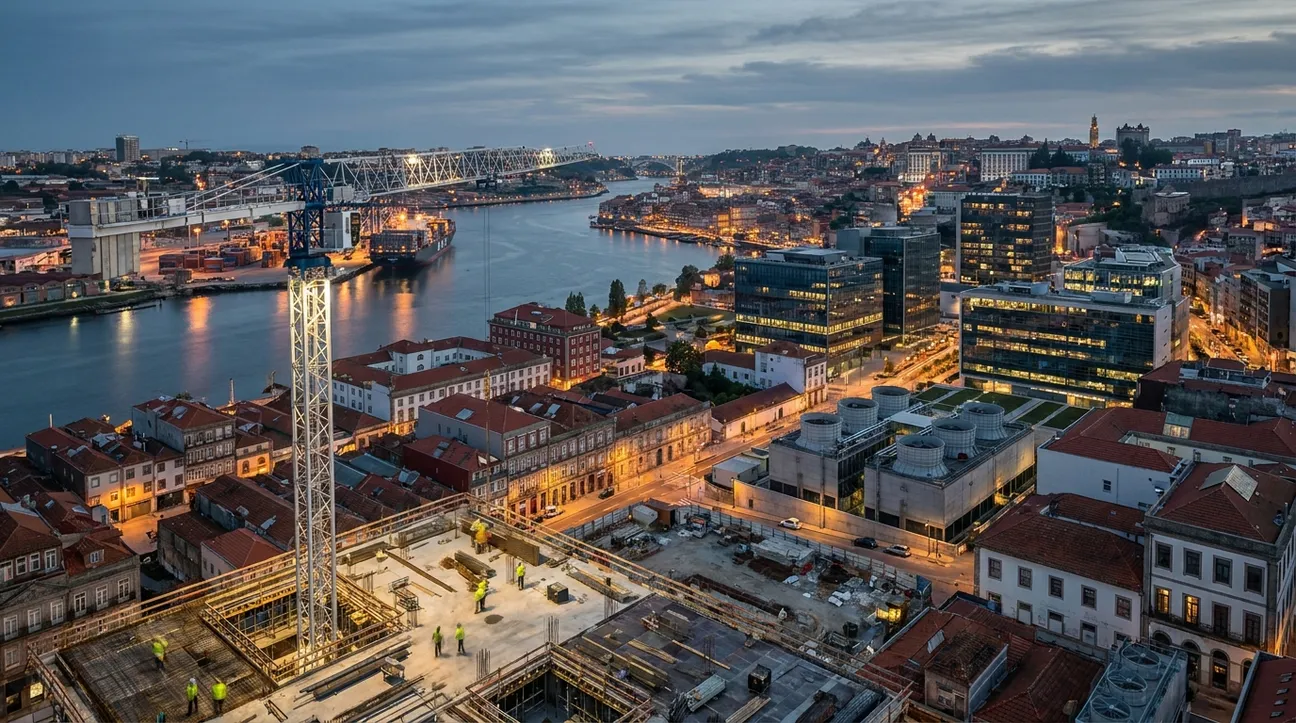
Pedro Baganha's regulatory influence: how Porto's urbanism chief shapes Portugal's real estate capital flows
As Portugal's commercial real estate investment surges 37% in Q1 2026, the Porto city councilor's policy framework becomes a reference point for institutional capital allocation nationwide.
Executive Summary
Key Takeaways
- Portugal's commercial real estate investment hit €898M in Q1 2026, up 37% year-on-year, with full-year 2025 reaching €2.8B.
- Pedro Baganha, Porto's urbanism councilor, has become a key figure for institutional investors navigating municipal regulatory frameworks.
- Golden Visa restructuring (Law 56/2023) redirected foreign capital from direct property purchases to regulated fund structures, institutionalising capital flows.
- Simplex Urbanístico (Decree-Law 10/2024) modernises urban planning with digital licensing, tacit approvals and reduced permit requirements.
- Municipal policy execution now directly determines risk-adjusted returns for institutional real estate projects.
Portugal's commercial real estate investment volume reached €898 million in the first quarter of 2026, a 37% year-on-year increase, according to Cushman & Wakefield. Behind the headline figures, a quieter structural shift is underway: the regulatory and urban planning decisions made by municipal leaders are increasingly shaping where and how institutional capital lands. Few public officials illustrate this dynamic more clearly than Pedro Baganha, Porto's city councilor for urbanism, public space and housing, whose policy agenda has made him one of the most closely watched figures in Portuguese real estate.
Who is Pedro Baganha and why does he matter for institutional real estate?
Pedro Baganha serves as the Vereador do Urbanismo, Espaço Público e Habitação at the Câmara Municipal do Porto, making him the principal public authority overseeing urban development, public space management and housing policy in Portugal's second-largest city. His role places him at the intersection of municipal regulation and institutional investment, a position that has elevated his profile well beyond Porto's city limits.
For cross-border investors evaluating Portuguese real estate opportunities, municipal-level policy is no longer a secondary consideration. It is a primary determinant of risk-adjusted returns. Baganha's approach to urban planning simplification, affordable housing delivery and public space revitalisation has positioned Porto as a laboratory for regulatory innovation, attracting attention from institutional allocators who increasingly view the city as complementary to, rather than subordinate to, Lisbon.
Baganha is a frequent participant in high-level institutional forums, including events convened by GRI Institute, where senior real estate leaders discuss capital allocation strategy, regulatory risk and cross-border investment flows. His presence at such gatherings reflects a broader recognition among institutional investors that understanding the regulatory architect is as important as understanding the asset itself.
Portugal's investment surge: the macroeconomic context
The backdrop to Baganha's rising influence is a Portuguese commercial real estate market in robust expansion. Full-year 2025 investment volume reached €2.8 billion, a 22% increase over the prior year, according to Dils Portugal. The momentum has carried into 2026, with the first quarter's €898 million representing the strongest opening to a year in recent memory.
Portugal's GDP is projected to grow by 2.3% in 2026, according to Cushman & Wakefield, providing a supportive macroeconomic environment for the commercial real estate sector alongside moderating inflation. CBRE projects full-year 2026 commercial real estate investment volumes of approximately €2.4 billion, suggesting that while annual totals may moderate from 2025's peak, underlying demand remains structurally sound.
These figures point to a market that has matured beyond its post-pandemic recovery phase and entered a period of sustained institutional interest. The question for allocators is no longer whether to invest in Portugal, but where within the country the risk-return profile is most attractive, and which regulatory frameworks best support long-term capital deployment.
How does Porto's urban policy influence national capital allocation?
Baganha's policy portfolio encompasses three domains that directly affect institutional investment decisions: urban planning regulation, housing strategy and public space infrastructure. Each carries implications for asset values, development timelines and the broader investability of Porto as a market.
On the regulatory front, Portugal's national framework has undergone significant modernisation. Decree-Law No. 10/2024, known as Simplex Urbanístico, introduced administrative simplification measures in urban planning and land use. The law eliminates the need for certain urban planning licences, replaces them with prior notifications, implements tacit approval mechanisms and mandates a digital platform for licensing. The digital mandates have been rolling out through 2026, creating a more transparent and predictable environment for developers and investors.
At the municipal level, officials like Baganha are responsible for translating these national simplification measures into operational reality. The speed and effectiveness with which a municipality implements Simplex Urbanístico directly affects development timelines, carrying costs and ultimately the internal rate of return on institutional projects. Porto's approach under Baganha's leadership has been closely monitored by the investment community as an indicator of how smoothly the national reform agenda can be executed locally.
Portugal's housing affordability challenge provides another lens through which Baganha's influence becomes visible. Porto's "Porto com Sentido" affordable housing initiative represents a municipal-level response to a national crisis, one that has direct implications for mixed-use development strategies and the social licence required to deliver large-scale institutional projects in Portuguese cities.
The Golden Visa pivot and its structural consequences
One of the most consequential regulatory shifts affecting Portuguese real estate capital formation is the restructuring of the Golden Visa programme under Law 56/2023, the Mais Habitação legislation enacted in October 2023. The law removed direct real estate purchases from the eligible investment menu for the Golden Visa, redirecting foreign capital toward €500,000 minimum investments in regulated venture capital or investment funds, scientific research and business capitalisation.
This legislative change has profound implications for how foreign capital enters the Portuguese market. Rather than flowing directly into residential property acquisitions, international investment is now channelled through regulated fund structures, creating a more institutionalised and intermediated capital formation ecosystem. For cities like Porto, where foreign buyer activity had been significant, the shift demands a recalibration of development strategy.
Foreign buyers in the Greater Lisbon area paid a 49% premium over domestic buyers for housing in Q4 2025, according to Statistics Portugal (INE). While this data point refers to Lisbon specifically, it illustrates the magnitude of international pricing power in Portuguese residential markets and underscores why the Golden Visa redirection carries such significance for asset pricing dynamics nationwide.
The transition from direct property acquisition to fund-based investment channels creates new opportunities for institutional intermediaries and regulated fund managers, while simultaneously requiring municipal authorities to develop policy frameworks that attract this newly structured capital. Baganha's position at the helm of Porto's urban planning apparatus makes him a key interlocutor for fund managers seeking regulatory clarity on development-linked investment strategies.
What role does Portugal GRI 2026 play in institutional capital formation?
The Portugal GRI 2026 conference, scheduled for June 2, 2026, at the Hyatt Regency Lisbon, serves as a focal point for the institutional conversations shaping Portuguese real estate strategy. Organised by GRI Institute, the event convenes senior decision-makers from across the European investment landscape to discuss capital flows, regulatory evolution and market positioning.
Baganha's profile within this ecosystem reflects a broader trend: the increasing centrality of public-sector voices in institutional real estate dialogue. As regulatory complexity grows, whether through Golden Visa restructuring, urban planning simplification or housing affordability mandates, the officials who design and implement these frameworks become essential counterparties for institutional capital.
GRI Institute's convening model, which brings together C-level executives, sovereign wealth fund principals, family office leaders and senior public officials, provides the infrastructure for these conversations. The Portugal event has consistently attracted significant attention from the European institutional community, reflecting the country's growing weight in cross-border allocation strategies.
Porto as a regulatory reference point
Portugal's commercial real estate market stands at an inflection point. Investment volumes are expanding, the regulatory framework is modernising and the capital formation ecosystem is becoming more institutionalised in the wake of the Golden Visa restructuring. Within this landscape, Pedro Baganha occupies a distinctive position.
As a municipal regulator rather than a private market participant, Baganha's influence operates through policy design and implementation rather than direct capital deployment. This distinction is important for institutional investors seeking to understand the Portuguese market's governance architecture. The quality of municipal regulation, the predictability of planning processes and the coherence of housing policy are all factors that determine whether institutional capital can be deployed at scale with acceptable risk parameters.
Porto's trajectory under Baganha's urban policy leadership offers institutional investors a case study in how municipal governance shapes market outcomes. The city's approach to balancing development, affordability and public space quality addresses the full spectrum of concerns that drive long-term capital allocation decisions.
For European institutional investors evaluating Portuguese opportunities, understanding the regulatory principals who shape the investment environment is as important as analysing the assets themselves. Pedro Baganha's prominence in institutional forums and his direct authority over Porto's urban development framework make him one of the most significant public-sector figures in Portuguese real estate today.
Portugal's 2.3% projected GDP growth for 2026, combined with the structural reforms embedded in Simplex Urbanístico and the Mais Habitação legislation, creates a favourable environment for continued institutional engagement. The question for allocators is how effectively municipal leaders can translate national reform ambitions into local investment conditions. On that measure, Porto's urbanism chief remains a figure to watch.