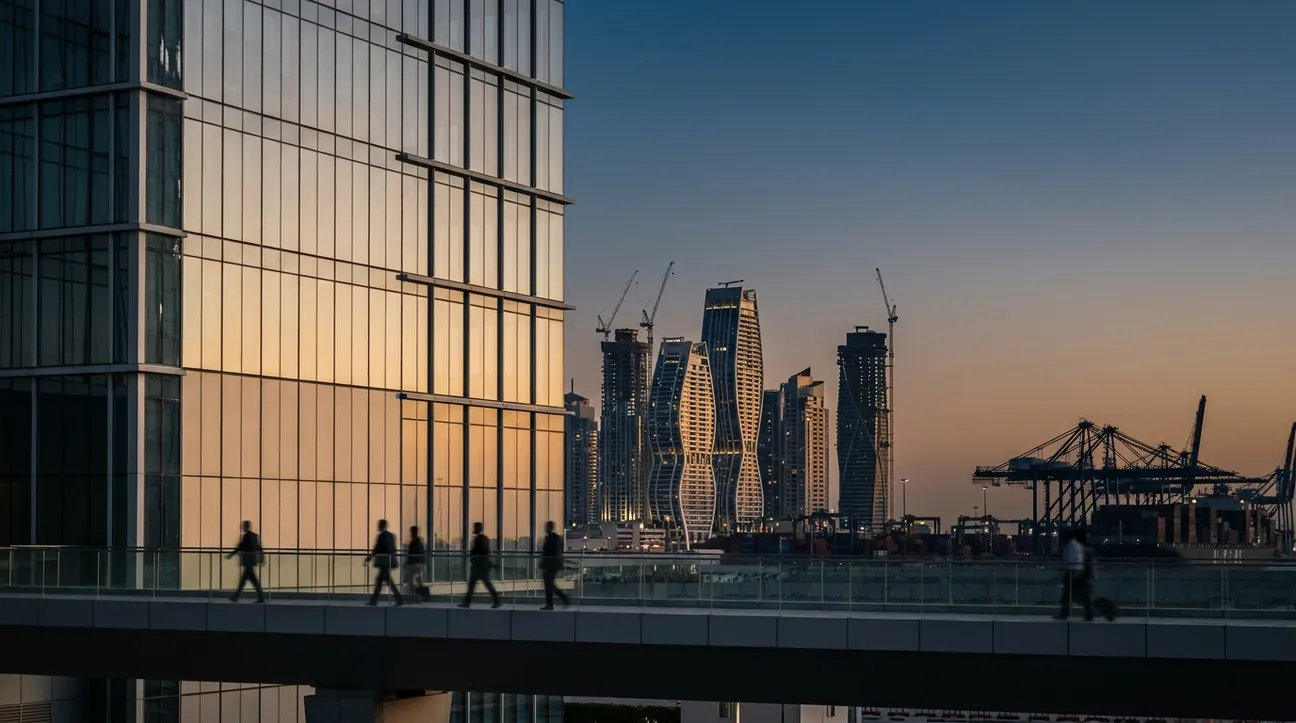
Omniyat's brand architecture and the design-led premium reshaping Dubai's ultra-luxury real estate pricing
How Mahdi Amjad's architectural curator model captured 37% of Dubai's $10 million-plus transactions and redefined value creation in the GCC's most competitive market.
Executive Summary
Key Takeaways
- Omniyat captured 37% of Dubai's $10M+ transactions in 2024, totaling AED 2.94 billion ($800.2M), and 58.1% of Palm Jumeirah's ultra-luxury market share.
- Its "architectural curator" model—partnering with firms like Zaha Hadid Architects and Foster + Partners—generates brand-driven pricing premiums reaching AED 10,000 per square foot.
- Design authorship is emerging as a distinct value driver in GCC real estate, separate from hospitality-branded residences.
- The model is difficult to replicate, requiring decade-long portfolio coherence and sustained starchitect relationships.
- Developer brand equity now warrants the same analytical rigor as location and construction cost for institutional investors.
The architect as brand engine
In a city where tower cranes outnumber most capitals' lampposts, differentiation is the scarcest resource. Dubai's ultra-luxury real estate segment has evolved beyond location, amenity lists, and square-footage arithmetic. A new pricing logic has taken hold, one rooted in design authorship, curatorial identity, and the enterprise value of a developer's brand system. Omniyat, the Dubai-based developer founded by Mahdi Amjad, stands as the most instructive case study of this shift.
According to Property Monitor data published in January 2025, Omniyat captured 37% of Dubai's $10 million-plus ultra-luxury residential transactions in 2024, achieving AED 2.94 billion ($800.2 million) in sales. On Palm Jumeirah alone, the developer commanded a 58.1% market share in the same price bracket, generating AED 2.18 billion ($593 million). These figures position Omniyat as the single most dominant force in a segment that defines the emirate's global positioning as a wealth destination.
The mechanism behind that dominance is worth close examination. It reveals a pricing model that traditional valuation frameworks, anchored in comparable transactions and replacement cost, struggle to capture fully. Omniyat's premium is, in significant part, a brand premium, constructed through deliberate partnerships with architects of global stature, a curated visual identity, and a corporate philosophy that treats each project as a discrete cultural proposition rather than a product rollout.
How does Omniyat's starchitect model create a pricing premium?
Omniyat's portfolio reads like an exhibition catalogue. The Opus, designed by Zaha Hadid Architects, introduced a sculptural void at the centre of a commercial tower on the Burj Khalifa district's axis. The Lana, a residences and hotel project developed in partnership with Foster + Partners, brought one of the world's most recognised architectural practices to Dubai's waterfront. These collaborations are strategic brand decisions with direct commercial consequences.
The ORLA Infinity project on Palm Jumeirah illustrates the economics clearly. According to Property Monitor, the development achieved sales prices of nearly AED 10,000 per square foot in 2024, a figure that positions it among the highest per-square-foot rates recorded in the emirate. That pricing level is not sustained by finish specifications alone. It reflects the buyer's perception that an Omniyat address carries a distinct cultural and aesthetic value, a perception reinforced by every architectural partnership the company announces.
This is the curator model at work. Where traditional developers commission architects to execute a brief, Omniyat positions itself as an intermediary between global design talent and the Dubai market, selecting practices whose aesthetic signatures align with the brand's overarching identity. The result is a portfolio with visual coherence despite architectural diversity, a tension that sustains collector-market dynamics among ultra-high-net-worth buyers.
The Omniyat logo itself encodes this philosophy. Built on platonic geometric forms, the identity system features a differentiated letter "A" that signals refinement and the ambition to elevate existing typologies. For a developer operating at the apex of a $45.11 billion luxury residential market, according to Mordor Intelligence's 2025 valuation, brand semiotics translate directly into pricing power.
Why is design-led development emerging as a distinct category in the GCC?
Omniyat's success reflects a structural evolution in the GCC real estate landscape. The region's ultra-luxury segment is bifurcating. One branch extends the hospitality-branded residences model, where hotel operators license their names and service standards to residential towers. GRI Institute has covered that pipeline extensively, tracking how global hospitality brands compete for Gulf markets.
The other branch, less examined but increasingly consequential, centres on design authorship as the primary value driver. In this model, the developer's own brand, not a third-party hospitality operator, carries the pricing premium. The developer becomes the luxury brand, and architectural partnerships serve as its product collaborations.
This category extends beyond Omniyat. Across different price tiers, developers are adopting design-centric positioning to distinguish their projects in a supply-rich market. HIVE Development, for example, has pursued a minimalist, community-oriented approach with projects such as ENTA Mina in Ras Al Khaimah, focusing on purposeful communal spaces and co-living concepts. While operating at a different price point from Omniyat's ultra-luxury portfolio, HIVE represents the same underlying principle: that design intentionality creates brand equity and, with it, commercial resilience.
The demand-side drivers are well documented. The UAE's Golden Visa programme, which grants a 10-year renewable residency visa for property investments of at least AED 2 million, has channelled sustained foreign capital into the luxury segment. But Golden Visa eligibility is a threshold condition, not a differentiator. Once a buyer qualifies, the allocation decision between competing ultra-luxury products rests on intangibles: architectural distinction, brand narrative, and perceived cultural capital. Design-led developers are engineered to win precisely that allocation decision.
What does Omniyat's dominance signal for the future of GCC ultra-luxury markets?
Projections from Mordor Intelligence place the UAE luxury residential real estate market at USD 49.32 billion in 2026, growing to USD 77.08 billion by 2031 at a compound annual growth rate of 9.34%. Propriétés De Charme forecasts average price growth of 6% to 10% in Dubai's premium real estate areas in 2026.
These growth trajectories will attract new entrants and intensify competition at the top of the market. The strategic question for developers, investors, and capital allocators across the GCC is whether Omniyat's brand architecture model is replicable or whether it reflects the specific conditions of Mahdi Amjad's curatorial vision and first-mover positioning.
Several factors suggest the model is difficult to replicate at scale. Starchitect partnerships require sustained relationships, design management capacity, and a willingness to subordinate short-term cost optimisation to long-term brand coherence. Omniyat's 58.1% market share in Palm Jumeirah's $10 million-plus segment did not materialise from a single project. It is the compound result of a portfolio strategy executed over more than a decade, where each completed building reinforces the brand's credibility for the next launch.
For institutional investors evaluating the GCC's ultra-luxury pipeline, the implication is clear: developer brand equity deserves the same analytical rigour as location, zoning, and construction cost. In a market projected to nearly double in value by 2031, the developers capable of sustaining design-led premiums will disproportionately capture value at the top of the pricing curve.
Leaders across the GRI Institute network have observed this dynamic in discussions at regional summits and through the Institute's ongoing research into capital flows across Gulf real estate markets. The consensus is that brand-driven pricing models represent a structural feature of the GCC's maturation as a global luxury real estate destination, not a cyclical phenomenon.
The brand as balance sheet
Omniyat's trajectory offers a lens into a broader transformation in how ultra-luxury real estate creates and captures value. The traditional development model treats the building as the product. The design-led model treats the brand as the product and the building as its physical expression.
This distinction has capital markets implications. Developer brand equity, when it is strong enough to command per-square-foot premiums at the level Omniyat achieves, functions as an intangible asset with measurable cash-flow consequences. It influences absorption velocity, buyer willingness to transact off-plan, and the developer's pricing power in negotiations with institutional co-investors.
As the UAE luxury residential market advances toward the projected USD 77.08 billion threshold by 2031, the developers that build enduring brand systems, not merely buildings, will define the next chapter of the GCC's real estate evolution. Omniyat, under Mahdi Amjad's leadership, has demonstrated that architectural curation and brand coherence can translate into market dominance. The question for the rest of the industry is whether they can construct brand architectures of comparable depth, or whether the design-led premium will remain concentrated among the few developers that understood its mechanics first.
GRI Institute continues to track the evolution of design-led development models across the Gulf Cooperation Council through its research programmes and leadership gatherings, where senior executives exchange perspectives on the strategies reshaping the region's real estate landscape.