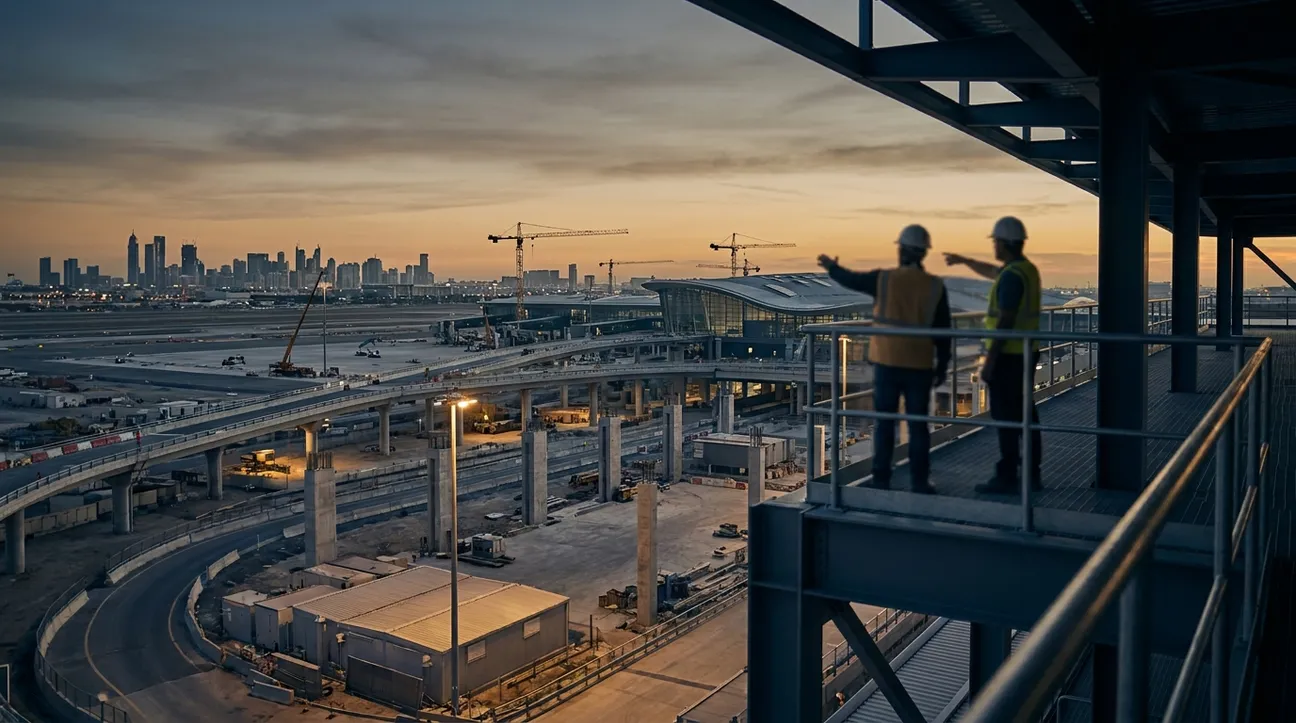
Nitu Samra's appointment at Noida International Airport signals a deeper shift in India's infrastructure governance
The interim CEO transition at India's most ambitious greenfield airport reveals how regulatory sovereignty and cross-border capital intersect in shaping the country's infrastructure future.
Executive Summary
Key Takeaways
- India mandates Indian nationals as CEOs of greenfield airports for security reasons, enforcing sovereign operational control over foreign-operated assets.
- Institutional investment in Indian real estate hit record highs in 2025, up 29% year-on-year, with NRI real estate investment also surging.
- Cross-border investors succeed in India by embedding local leadership and treating regulatory compliance as a strategic asset, not a constraint.
- Institutional capital is diversifying into high-tech warehousing and life science hubs beyond traditional Indian real estate corridors.
- India's governance model rewards partnership structures where Indian operational leadership is empowered from the outset.
A leadership transition that carries structural meaning
On April 24, 2026, Nitu Samra was appointed interim Chief Executive Officer of Noida International Airport (NIA), replacing Swiss national Christoph Schnellmann. The move, reported by Hindustan Times and ET Infra, was driven by compliance with India's aviation security regulations, specifically the Bureau of Civil Aviation Security (BCAS) AVSEC Order dated January 17, 2011, which mandates that the CEO of a greenfield airport in India must be an Indian national to serve as the facility's security coordinator.
On the surface, this is an administrative correction. Beneath it, however, lies a far more consequential narrative about how India is calibrating the balance between foreign capital participation and domestic operational sovereignty in its most capital-intensive infrastructure projects. Nitu Samra's elevation from Chief Financial Officer to interim CEO at a subsidiary of Switzerland's Zurich Airport International is not merely a compliance exercise. It is a case study in how regulatory frameworks, national security imperatives, and institutional capital converge at the frontier of Indian infrastructure development.
For the leaders who constitute the GRI Institute community, this transition raises questions that extend well beyond aviation into the broader architecture of cross-border investment in Indian real estate and infrastructure.
Why does India's regulatory sovereignty matter for institutional investors in real estate and infrastructure?
India's infrastructure pipeline is among the largest in the world, and its execution increasingly depends on foreign institutional capital. Institutional investment in Indian real estate hit a record high in 2025, marking a 29% year-on-year increase, according to Chestertons Global. This surge reflects growing confidence among global allocators in India's urbanization trajectory, its digital infrastructure buildout, and the maturation of its regulatory environment.
Yet the Noida International Airport episode illustrates a tension that every cross-border investor must understand. India welcomes foreign capital with increasing openness, but retains firm sovereign control over operational leadership in sectors deemed critical to national security. The BCAS mandate is unambiguous: the CEO of a greenfield airport must be an Indian citizen. This is not a new regulation; it has been active since 2011. What is new is its enforcement at a high-profile, foreign-operated asset, which sends a clear signal to the market.
The first phase of the Nodia International Airport was developed with a significant capital investment, underscoring the scale at which foreign operators are participating in Indian infrastructure. Zurich Airport International's commitment to the project has not wavered, but the leadership transition demonstrates that capital deployment and operational governance follow different rules in India's regulatory architecture.
This distinction is critical for institutional investors evaluating Indian real estate and infrastructure. The regulatory environment rewards those who build local leadership capacity alongside capital commitment. The most successful cross-border partnerships in India are those that treat compliance as a strategic asset, embedding Indian nationals in senior operational roles from the outset rather than retrofitting leadership structures under regulatory pressure.
For the institutional capital community that GRI Institute convenes across its India-focused gatherings, this principle applies equally to airports, data centers, logistics parks, and mixed-use urban developments. Sovereign operational control is a feature of India's investment landscape, and the investors who internalize this reality will secure more durable positions in the market.
How is cross-border capital reshaping Indian real estate beyond traditional corridors?
The Nitu Samra appointment gains additional significance when placed within the broader context of capital flows into Indian real estate. India's Non-Resident Indian (NRI) remittances reached a record high in 2025, with real estate constituting the single largest category of NRI investment, according to data from 99Realty. The NRI share in Indian property purchases is projected to rise dramatically from historical averages of 7-10% by 2026, according to estimates by Prateek Group and 99Realty.
This surge in diaspora capital is reshaping the demand profile for Indian real estate. NRI buyers, many of whom are based in the Middle East and the United Kingdom, are not passive portfolio investors. They are active participants in the residential and commercial markets, often anchoring demand in premium segments and new urban corridors. The Noida region, where the new international airport is located, stands to benefit directly from this dynamic. Airport-led urban development has historically catalyzed real estate appreciation across emerging markets, and the NIA project is expected to follow this pattern.
Simultaneously, institutional interest is broadening beyond conventional asset classes. Chestertons Global projects that 2026 will see institutional capital expand into high-tech warehousing and life science hubs, driven by cross-border logistics demand. This diversification reflects the growing sophistication of India's real estate market and the willingness of global allocators to underwrite emerging asset types in a country where demographic fundamentals and digital infrastructure investment are converging.
The intersection of diaspora capital, institutional investment, and infrastructure development creates a multi-layered opportunity set that requires nuanced navigation. Investors who approach India solely through a financial lens, without understanding the regulatory, cultural, and operational dimensions of the market, will find themselves at a structural disadvantage.
What does the Noida International Airport case reveal about India's infrastructure governance model?
The leadership transition at NIA illuminates a governance model that India is refining in real time. As the country attracts ever-larger volumes of foreign capital into infrastructure, it is simultaneously asserting that operational authority in critical sectors must rest with Indian nationals. This is a sovereign prerogative exercised by many countries, but its application at a project operated by a globally respected airport operator like Zurich Airport International gives it particular visibility.
Nitu Samra's profile underscores the caliber of Indian professionals who are prepared to step into these roles. As the former CFO of the airport, she brings financial acumen and institutional knowledge to a position that now requires her to integrate security coordination responsibilities with the commercial and operational demands of a greenfield airport preparing for its initial operational phase. Her appointment is a reflection of the deep bench of Indian leadership talent in infrastructure, a resource that foreign investors and operators can leverage as a strategic advantage rather than viewing compliance requirements as constraints.
The broader lesson for real estate and infrastructure investors is that India's governance model rewards partnership over extraction. The most productive foreign investments in India, whether in airports, data centers, logistics corridors, or residential townships, are structured as genuine partnerships where Indian operational leadership is empowered from the outset. Regulatory compliance becomes seamless when governance structures are designed with Indian sovereignty in mind.
This is a theme that resonates deeply within the GRI Institute ecosystem, where senior leaders from across the global real estate and infrastructure sectors exchange perspectives on market entry, capital structuring, and operational best practices in India and other high-growth markets. The conversations happening within this community reflect a growing consensus: India's infrastructure opportunity is immense, but capturing it requires a governance-first mindset.
The structural thesis
India's infrastructure and real estate markets are entering a phase of unprecedented institutional maturity. Record levels of institutional investment, surging NRI capital inflows, and the diversification of institutional interest into asset classes like high-tech warehousing and life science hubs all point to a market that is scaling rapidly and broadening its appeal to global capital.
The regulatory environment is keeping pace with this growth, asserting sovereign control where national security demands it while maintaining an open and increasingly transparent framework for foreign participation. The Nitu Samra appointment at Noida International Airport is a microcosm of this balance. It demonstrates that India can simultaneously welcome the world's leading infrastructure operators and insist that operational leadership reflects national priorities.
For cross-border investors, the strategic imperative is clear. India rewards those who invest in relationships, local leadership, and regulatory fluency alongside capital. The deals that will define the next decade of Indian real estate and infrastructure development will be structured by leaders who understand that governance and returns are complementary, not competing, objectives.
The GRI Institute continues to serve as the essential platform where these strategic perspectives are shaped, debated, and refined among the most senior decision-makers in global real estate and infrastructure. As India's market matures, the quality of insight and connection available within this community becomes an increasingly valuable asset for leaders seeking to navigate the country's complex and rewarding investment landscape.