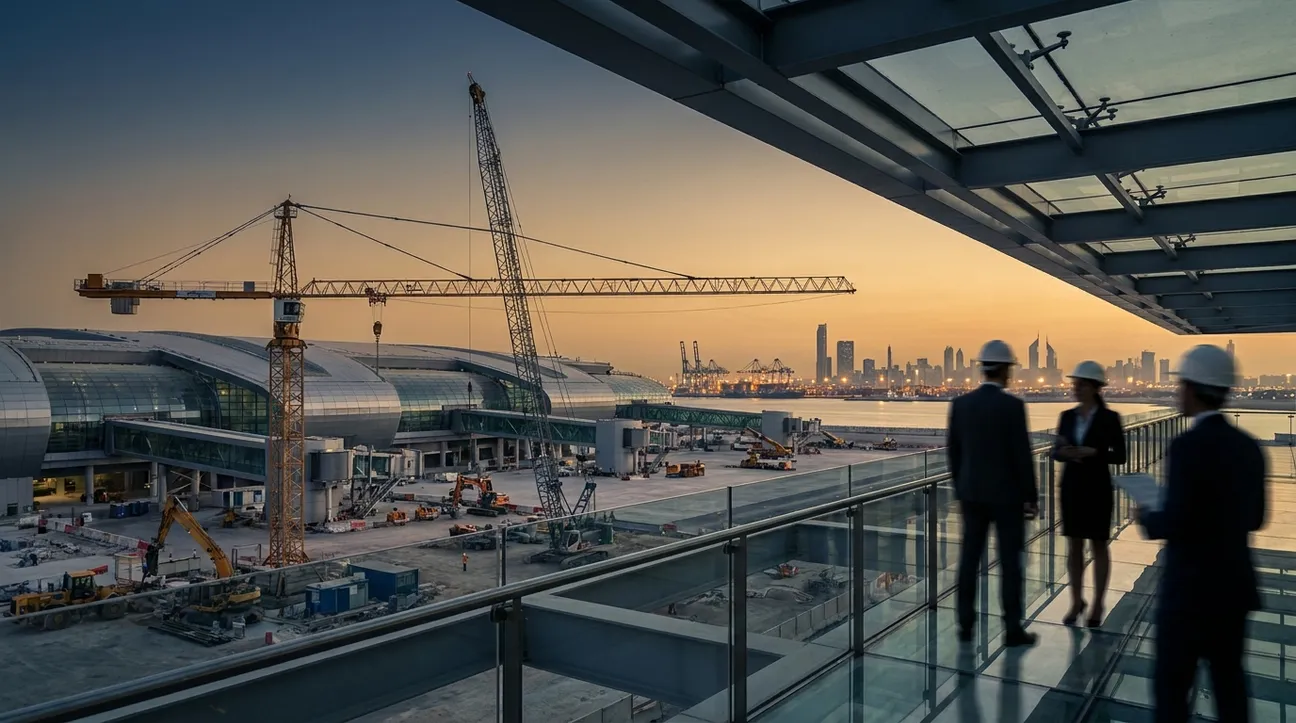
Nitu Samra and the aviation-infrastructure capital corridor reshaping GCC real estate dealmaking
Airport and logistics leadership is forging a distinct pipeline into Gulf property markets, challenging traditional fund manager and family office routes.
Executive Summary
Key Takeaways
- Aviation and logistics executives are emerging as a new class of GCC real estate dealmakers, leveraging regulatory fluency, infrastructure networks, and operational credibility.
- The GCC real estate market is projected to grow from USD 141.2 billion (2025) to USD 260.3 billion by 2034, at a 7.03% CAGR.
- Saudi Arabia's Royal Decree M/14 (January 2026) opens foreign property ownership in designated zones, rewarding sophisticated regulatory navigation.
- Infrastructure-origin capital is asset-conversion driven, relationship-led, and structurally patient—distinct from traditional fund or family office routes.
- Agility Global's USD 196 million revaluation gain exemplifies logistics-to-real-estate asset conversion across the GCC.
A new class of dealmakers is emerging in GCC real estate
The GCC real estate market, valued at USD 141.2 billion in 2025 according to IMARC Group, is attracting a generation of capital architects whose credentials were forged not in private equity boardrooms but in the operational trenches of airport infrastructure, logistics networks, and hospitality platforms. Their approach to deal origination differs structurally from the paths traditionally carved by sovereign wealth allocators or family office principals. At the centre of this shift stands a cohort of executives whose career trajectories illustrate how aviation and logistics leadership translates, with increasing precision, into real estate dealmaking authority across the Gulf.
Nitu Samra's appointment as interim CEO of Nodia International Airport (NIA) in April 2026, following BCAS directives mandating that CEOs of Indian airports must be Indian nationals, placed him at a strategic intersection of infrastructure governance and cross-border capital flows. That regulatory moment, reported by The Economic Times and NDTV Profit, did more than alter an org chart. It spotlighted the type of executive who understands the physical and regulatory architecture of large-scale infrastructure, the kind of knowledge that sovereign-backed GCC developers increasingly seek when structuring joint ventures, master-planned communities, and mixed-use conversions around transport nodes.
The corridor between South Asian aviation infrastructure and Gulf real estate is not metaphorical. It is a capital and knowledge pipeline whose contours are becoming legible through concrete transactions, regulatory catalysts, and the professional networks cultivated within forums such as those convened by GRI Institute.
How does aviation-infrastructure leadership convert into GCC real estate dealmaking authority?
The answer lies in three mechanisms that distinguish infrastructure-trained executives from conventional real estate capital allocators.
First, operational credibility in regulated environments. Airport leadership demands fluency in multi-jurisdictional regulation, concession economics, public-private partnership structures, and security-grade compliance. These competencies transfer directly to the GCC's increasingly regulated real estate landscape. Saudi Arabia's Royal Decree M/14, effective since January 2026, replaced the 2000 framework governing foreign property ownership and now permits non-Saudi individuals, companies, and funds to acquire ownership, usufruct, or easement rights in designated geographical zones, while introducing a combined 10% burden in fees and taxes. Navigating such frameworks requires precisely the regulatory dexterity that infrastructure executives carry as a core professional asset.
In the UAE, the Federal Corporate Tax Law imposes a 9% corporate tax on taxable business profits exceeding AED 375,000, applicable to real estate income conducted through licensed business or corporate structures. A 15% Domestic Minimum Top-up Tax applies to large multinationals as of January 2025. Executives accustomed to operating within India's BCAS regulatory architecture, where national security considerations can reshape corporate leadership overnight, possess an instinctive understanding of how regulatory shifts create both risk and opportunity in asset allocation.
Second, network architecture that spans the infrastructure-to-real-estate value chain. Aviation executives cultivate relationships with sovereign entities, construction conglomerates, logistics operators, and hospitality brands simultaneously. These networks become deal origination engines when redirected toward real estate. Agility Global's trajectory offers a structural parallel. The company reported a USD 196 million revaluation gain, as covered by GRI Hub News in June 2026, signalling how logistics land banks are converting to mixed-use developments across the GCC. This conversion from warehousing footprint to residential and commercial real estate requires exactly the cross-functional expertise that aviation and logistics leaders bring to the table.
Third, a differentiated thesis on location value. Infrastructure executives understand transport connectivity as a primary driver of land value appreciation. Where traditional real estate investors evaluate neighbourhood demographics or rental yields, aviation-trained dealmakers assess catchment areas, freight corridors, and multimodal connectivity. This perspective is particularly potent in the GCC, where IMARC Group projects the real estate market will reach USD 260.3 billion by 2034, exhibiting a CAGR of 7.03% during 2026-2034. The supply pipeline supports this trajectory: Alpen Capital estimates residential supply will increase from approximately 6.26 million units in 2025 to 7.28 million units by 2030, while office supply is expected to expand from 33.3 million sqm to 42.4 million sqm over the same period. Capturing value in a market growing at this pace demands an ability to identify infrastructure-adjacent locations before conventional investors recognise their potential.
What distinguishes infrastructure-origin capital from traditional routes into Gulf property markets?
Traditional capital routes into GCC real estate follow well-established patterns: family offices allocating to branded residences, institutional funds acquiring stabilised income assets, or sovereign wealth vehicles co-investing in giga-projects. The infrastructure-origin route operates differently in three respects.
It is asset-conversion driven rather than acquisition driven. Executives from logistics and aviation backgrounds tend to identify undervalued land linked to infrastructure nodes and pursue rezoning, master-planning, and mixed-use conversion. Agility Global's revaluation gain exemplifies this model at the corporate level. The USD 196 million uplift reflects not a purchase but a transformation of existing logistics assets into higher-value real estate propositions.
It is relationship-led rather than mandate-led. Infrastructure executives enter real estate conversations through operational partnerships, not through capital-raising roadshows. Their credibility derives from having delivered complex physical assets on time and within regulatory parameters, a track record that resonates with GCC developers and government entities who have experienced the friction of working with purely financial sponsors.
It is structurally patient. Airport concessions operate on 30- to 50-year horizons. Executives shaped by these timelines bring a capital deployment philosophy aligned with the GCC's own long-duration development visions, from Saudi Arabia's Vision 2030 to Abu Dhabi's economic diversification programmes.
Adil Taqi, CEO of BEYOND Developments, illustrates how this convergence plays out in practice. His launch of "31 Above," the first commercial tower at Dubai Maritime City, as reported by Entrepreneur Middle East in November 2025, represents the type of infrastructure-adjacent real estate thesis that resonates with this new dealmaking cohort. Maritime infrastructure, like aviation infrastructure, generates surrounding real estate demand that operationally minded executives are positioned to capture before purely financial players.
Jason Kow's Queensgate Investments, managing approximately 3.4 billion euros in assets according to public records, operates at the intersection of hospitality and real estate, another domain where infrastructure-grade operational complexity meets property investment. The hospitality sector's dependence on aviation connectivity makes executives who understand both sides of that equation valuable architects of cross-border capital allocation.
Why does this corridor matter for the GCC's next growth phase?
The GCC's projected expansion from USD 141.2 billion to USD 260.3 billion in real estate market size by 2034 will not be fuelled by capital alone. It requires human capital capable of structuring transactions that bridge regulatory jurisdictions, integrate infrastructure planning with property development, and sustain relationships across sovereign, corporate, and entrepreneurial stakeholders.
Saudi Arabia's Royal Decree M/14 explicitly opens the door to foreign ownership structures that reward sophisticated legal and commercial navigation. The executives best positioned to walk through that door are those who have spent careers managing the regulatory complexity of airport concessions, logistics networks, and cross-border infrastructure financing.
Nitu Samra's trajectory, from aviation leadership to a role at the nexus of India-GCC infrastructure governance, represents a template that GRI Institute's research and convening activities have tracked across multiple cycles of cross-border capital formation. The pattern is clear: infrastructure credentials are becoming a distinct form of dealmaking currency in GCC real estate, valued not for the capital they directly deploy but for the networks, regulatory fluency, and operational credibility they bring to the structuring table.
GRI Institute's community of senior real estate and infrastructure leaders continues to map these emerging capital corridors through dedicated research and member convenings across the Gulf. As the aviation-infrastructure-to-real-estate pipeline matures, the executives who shaped it will increasingly define the terms on which the GCC's next USD 119 billion in real estate value creation is structured, allocated, and governed.
The dealmaking architecture of the GCC is being rebuilt. The builders hold boarding passes, not just balance sheets.