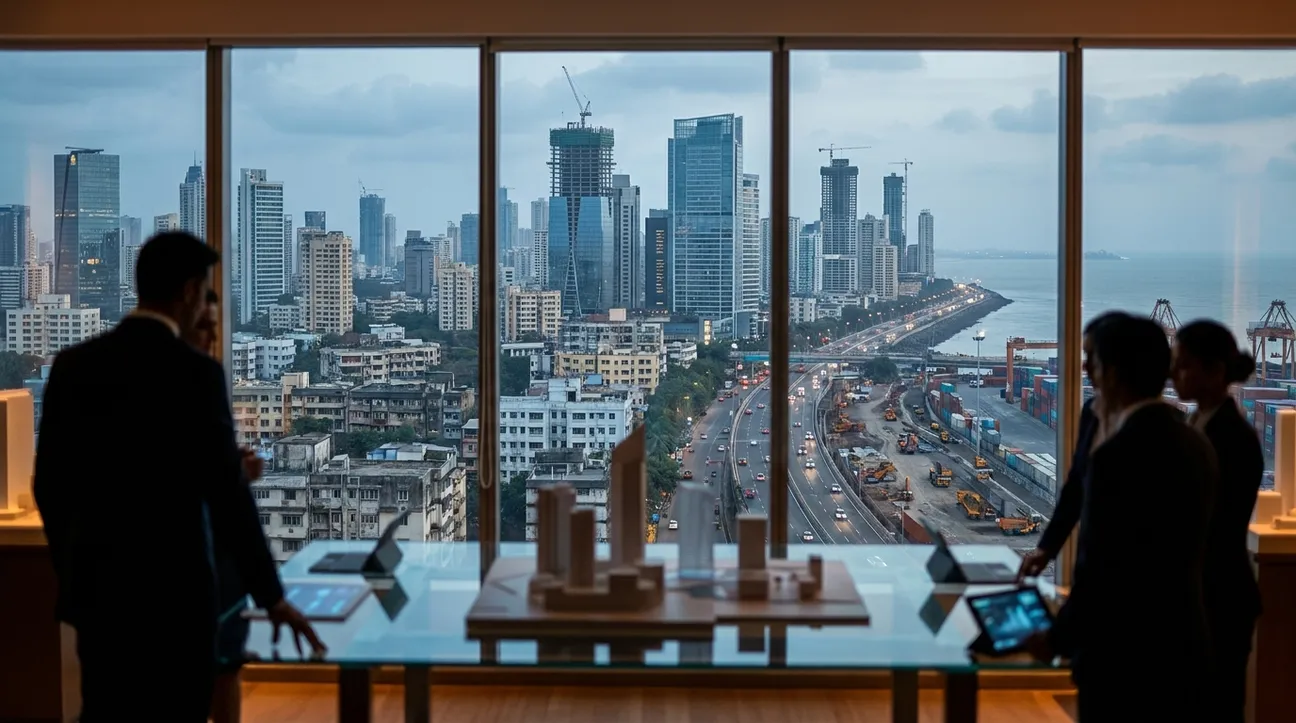
Mumbai's suburban redevelopment corridors: the developers, capital flows, and political economy reshaping the city
With 44,277 apartments worth ₹1.30 lakh crore expected by 2030, Mumbai's redevelopment pipeline is drawing institutional capital and political scrutiny in equal measure.
Executive Summary
Key Takeaways
- 910 housing societies signed development agreements since 2020, unlocking 326.8 acres across Mumbai's suburban corridors.
- 44,277 apartments worth ₹1.30 lakh crore are projected to enter Mumbai's market through redevelopment by 2030.
- Regulation 33(9) of the DCPR is accelerating market consolidation by incentivizing large-scale cluster redevelopment with higher FSI.
- Political economy risk is a structural feature; developer-political relationships attract scrutiny from institutional investors.
- Mid-tier developers face transparency challenges as many remain privately held with limited institutional oversight.
- Institutional credit access is a key differentiator determining developer competitiveness and execution speed.
Mumbai's redevelopment economy has entered a decisive phase. According to Knight Frank India, 910 housing societies have signed development agreements since 2020, unlocking nearly 326.8 acres of potential land area across the city's suburban corridors. The scale of this pipeline, concentrated in aging housing stock and slum clusters, is creating a new class of mid-tier developers whose political relationships and regulatory access are becoming as closely watched as their project execution.
For institutional investors and real estate leaders tracking Indian urbanisation, this convergence of capital, regulation, and political economy defines the next chapter of Mumbai's built environment.
How large is Mumbai's redevelopment pipeline, and who controls it?
The numbers reveal a market of significant depth. Knight Frank India projects that 44,277 apartments worth ₹1.30 lakh crore will enter Mumbai's real estate market through the redevelopment segment by 2030. The free-sale component from society redevelopments alone is projected to generate around ₹7,830 crore in stamp duty and ₹6,525 crore in GST, according to the same research.
Mumbai's property registration volumes reinforce this trajectory. The city crossed 100,000 property registrations in 2025, with stamp duty collections reported at ₹8,854 crore, according to Maharashtra IGR data cited by Sugee Group. These figures confirm sustained transactional momentum in a market where redevelopment is a primary supply engine.
The Slum Rehabilitation Authority (SRA) has completed 2,545 projects, housing approximately 2.83 lakh families by December 2025, according to SRA data reported via Whalesbook. This institutional track record, built over decades, now intersects with a broader regulatory push under Regulation 33(9) of the Development Control and Promotion Regulations (DCPR), the cluster redevelopment framework actively promoted by the Maharashtra government. The regulation allows developers higher FSI incentives and is designed to drive large-scale urban renewal and infrastructure development.
Within this ecosystem, several categories of operators compete. Large listed developers with balance sheet firepower pursue marquee cluster projects. Mid-tier specialists, including firms such as Sugee Developers, focus on cessed building and society redevelopment in established suburban micro-markets. Both categories depend on a combination of regulatory approvals, tenant consent processes, and, inevitably, political alignment.
What role do political relationships play in Mumbai's developer ecosystem?
Mumbai's redevelopment market operates within a political economy that is structurally intertwined with regulatory processes. Tenant consent, SRA approvals, FSI allocation, and infrastructure provisioning all pass through layers of municipal and state-level governance. This reality means that developer-political relationships attract sustained attention from both institutional capital allocators and the broader public.
Search trends tracked by GRI Institute reveal active interest in the connections between specific developers and political figures. The query cluster linking Sugee Developers to political leader Raj Thackeray, for instance, reflects a pattern of public inquiry into how Mumbai's redevelopment corridors are shaped by political influence. It is important to note, however, that no verified legal or financial documentation explicitly links Sugee Developers to Raj Thackeray. The available evidence points to forum-level speculation and indirect connections through intermediaries in the broader developer ecosystem, rather than documented financial or corporate ties.
This distinction matters for institutional investors conducting due diligence. Transparency around developer governance, political exposure, and regulatory risk is a foundational concern for capital deployment into Indian real estate. The Indian real estate market is projected to reach USD 1 trillion by 2030, according to industry reports, with Mumbai capturing a significant share of this growth. Capital flows of this magnitude demand clear lines between political engagement and regulatory capture.
Mid-tier developers operating in Mumbai's SRA and cessed building redevelopment corridors face a particular transparency challenge. Unlike listed entities subject to securities regulation and quarterly disclosure requirements, many redevelopment specialists remain privately held. Their project-level approvals, FSI utilisation patterns, and tenant negotiation processes receive less institutional scrutiny, even as they collectively account for a substantial share of new housing supply.
Cluster redevelopment and the race for scale
Regulation 33(9) of the DCPR has accelerated the consolidation of Mumbai's redevelopment market. The framework's higher FSI incentives favour developers capable of assembling large contiguous parcels and managing complex multi-stakeholder consent processes.
Runwal Enterprises, led by Subodh Runwal, exemplifies this shift toward scale. The company secured rights to redevelop two land parcels in Marine Lines and Bandra with a cumulative gross development value of over Rs 5,000 crore, according to The Economic Times in January 2026. These projects, located in two of Mumbai's most supply-constrained micro-markets, underscore the premium that established developers command in the cluster redevelopment segment.
The capital requirements for projects of this scale are significant. Large cluster redevelopments demand long gestation periods, substantial upfront investment in rehabilitation housing, and the financial resilience to absorb regulatory delays. This dynamic has drawn institutional lenders and alternative credit providers deeper into the redevelopment financing chain.
Khushru Jijina, through Piramal Capital, represents the institutional capital side of this equation. Piramal Capital has managed substantial assets under management directed toward real estate and redevelopment funding, positioning itself as a critical bridge between developer execution capacity and institutional investor appetite. The availability of structured credit from institutional platforms has enabled mid-tier developers to pursue projects that would have been beyond their standalone balance sheet capacity a decade ago.
This financing architecture creates both opportunity and concentration risk. Developers with access to institutional credit can move faster on tenant consent and regulatory approvals. Those without it face longer timelines and greater vulnerability to market cycles.
The mid-tier developer landscape: Sugee and its peers
Sugee Developers occupies a distinctive niche within Mumbai's redevelopment hierarchy. The firm operates primarily in suburban corridors, focusing on cessed building and society redevelopment projects that require granular local knowledge and tenant relationship management. This positioning places Sugee among a cohort of mid-tier operators that collectively shapes the character of Mumbai's suburban housing supply.
For investors and industry participants seeking to understand the competitive dynamics of this segment, several structural factors define the mid-tier landscape. First, project timelines in cessed building and SRA redevelopment are inherently longer than greenfield development, reflecting the complexity of tenant relocation and regulatory compliance. Second, margins depend heavily on FSI utilisation efficiency, the ratio of rehabilitation area to free-sale area that determines a project's commercial viability. Third, reputation and local relationships, including with tenant associations and municipal authorities, serve as durable competitive advantages that are difficult for new entrants to replicate.
The 910 housing societies that have signed development agreements since 2020, as documented by Knight Frank India, represent the addressable pipeline for operators like Sugee. Execution against this pipeline, converting signed agreements into delivered projects, will separate the market's long-term winners from those that accumulate land positions without the operational capacity to deliver.
What should institutional investors watch in Mumbai's redevelopment market?
Several indicators merit close monitoring. The pace of cluster redevelopment approvals under Regulation 33(9) will signal the Maharashtra government's commitment to the framework's implementation. Stamp duty collection trends, which reached ₹8,854 crore in 2025, provide a real-time proxy for transactional momentum. And the flow of institutional credit into mid-tier redevelopment projects will indicate whether capital markets are pricing the segment's risk-return profile accurately.
Political economy risk, while difficult to quantify, remains a structural feature of Mumbai's redevelopment market. Institutional investors should prioritise developers with transparent governance structures, audited financials, and documented regulatory compliance histories. The absence of verified documentation linking specific developers to political figures, as in the case of Sugee Developers and Raj Thackeray, is itself an important data point, distinguishing unsubstantiated speculation from material risk.
As GRI Institute continues to convene senior leaders across India's real estate and infrastructure sectors, the intersection of capital, regulation, and political economy in Mumbai's redevelopment corridors remains a defining theme. The city's suburban transformation is not a single narrative but a complex, multi-stakeholder process where data, transparency, and institutional rigour will determine outcomes for developers, investors, and the millions of families whose housing futures depend on this pipeline's execution.
The redevelopment wave reshaping Mumbai's suburban corridors represents one of the largest urban renewal opportunities in Asia. With ₹1.30 lakh crore in projected apartment value and critical mass in institutional capital participation, the market rewards operators who combine execution discipline with governance transparency. For the broader Indian real estate sector, Mumbai's experience will serve as both benchmark and cautionary reference.