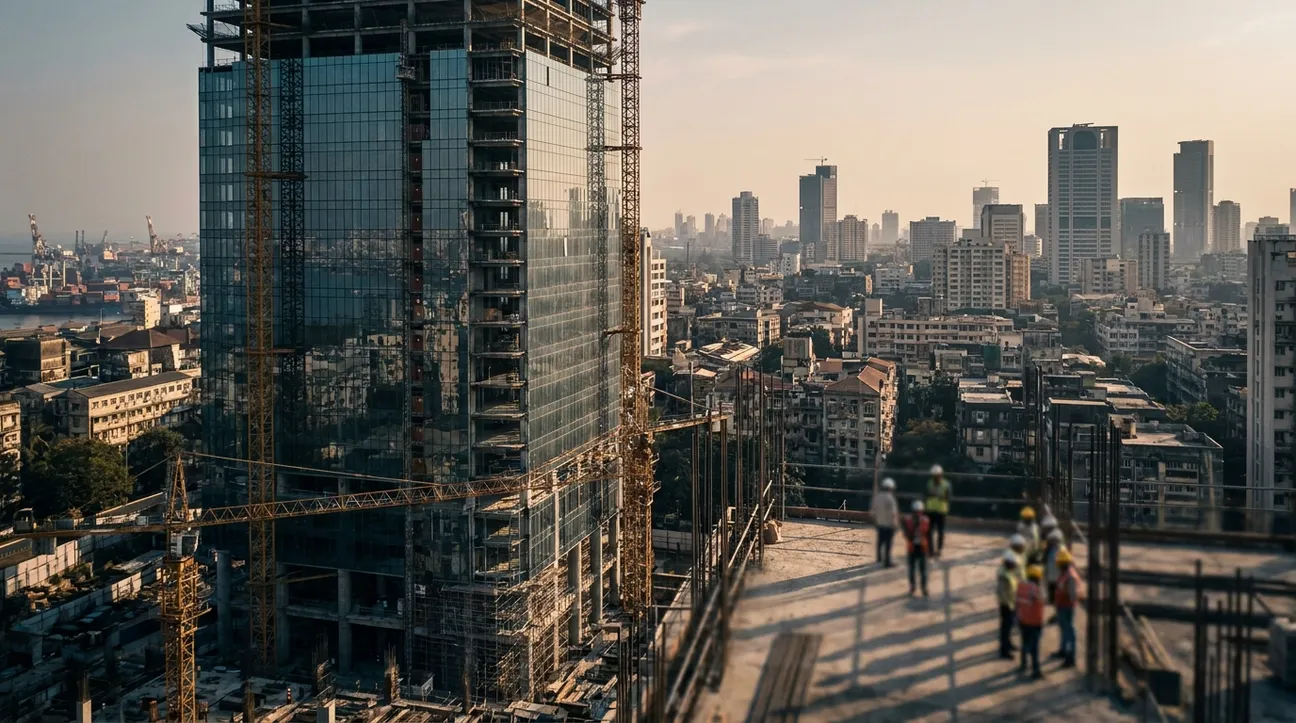
Mumbai's redevelopment boom exposes the political-developer nexus that institutional capital cannot ignore
A ₹1.30 lakh crore pipeline, sweeping legislative reform and the entanglement of political patronage are redefining risk calculus for every investor in Mumbai real estate.
Executive Summary
Key Takeaways
- Mumbai's redevelopment pipeline includes 44,277 apartments worth ₹1.30 lakh crore expected by 2030, making it India's most consequential urban real estate segment.
- Political patronage remains structurally embedded in project approvals, consent processes and regulatory timelines, creating tangible operational advantages for connected developers.
- A dual-track market is emerging: institutionally backed developers operate under public governance norms while smaller, politically connected firms operate informally.
- Three recent legislative reforms—Maharashtra Housing Policy 2025, MOFA Amendment and Land Revenue Code Amendment—are unevenly reshaping the regulatory landscape.
- Institutional investors must develop project-level political-regulatory risk frameworks to deploy capital effectively.
The redevelopment frontier and its political undercurrents
Mumbai's redevelopment market is entering a phase of unprecedented scale. According to Knight Frank India, as many as 44,277 apartments worth ₹1.30 lakh crore are expected to enter the city's real estate market through the redevelopment segment by 2030. At the same time, the broader Mumbai real estate market is projected to reach USD 1 trillion by the end of the decade, according to estimates cited by Raveshia Realty. These figures underscore a city where aging housing stock, constrained land supply and surging demand have turned redevelopment into the single most consequential asset class in Indian urban real estate.
Yet behind the headline numbers lies a structural reality that balance sheets rarely capture: political relationships remain a decisive variable in how projects are approved, how land is accessed and how regulatory timelines unfold. The search query "sugee developers raj thackeray," which has drawn significant online curiosity in recent months, is a symptom of this dynamic. It points to a broader question that institutional investors, lenders and developers must confront as capital flows into Mumbai's redevelopment corridors at ever-larger scale.
What does the Sugee Developers and Raj Thackeray connection reveal about Mumbai's political economy of redevelopment?
Sugee Group, led by Founder and Managing Partner Nishant Deshmukh, is a mid-market developer active in Mumbai's western suburbs redevelopment pipeline. Raj Thackeray, President of the Maharashtra Navnirman Sena (MNS), is among the most prominent political figures in the state. In July 2023, Thackeray publicly attended a felicitation event organized in association with Sugee Group, as reported by Lokmat Times. The event was focused on recognizing UPSC and MPSC achievers, a civic initiative rather than a commercial transaction.
It is essential to state clearly: no verified financial or equity ties between Raj Thackeray and Sugee Developers have been established in any public filing, regulatory disclosure or credible investigative report. The online curiosity around this pairing is largely fuelled by local speculation and internet conjecture rather than documented evidence. GRI Institute's research found no verified data on the number of redevelopment project approvals directly influenced by political figures, nor recent financial statements or market share data specifically for Sugee Developers.
However, dismissing the query as mere rumour would be analytically incomplete. The pattern it reflects is systemic. In Mumbai's redevelopment ecosystem, the intersection of political patronage, housing society consent processes, municipal clearances and land-use conversion creates a governance environment where political proximity confers tangible operational advantages. Developers who maintain relationships with local and state-level political figures can navigate consent timelines, manage community opposition and accelerate bureaucratic processes more effectively than those who operate at arm's length from the political apparatus.
This is the structural insight that institutional capital must internalize. Political risk in Mumbai redevelopment is not episodic; it is embedded in the operating model.
How are major developers and financiers institutionalizing Mumbai's redevelopment market?
While the Sugee-Thackeray query illuminates the informal dimensions of Mumbai's redevelopment economy, the formal side is undergoing rapid institutionalization, driven by capital markets activity and large-scale platform strategies.
Subodh Runwal, who leads the Runwal Group, received SEBI approval in August 2025 for Runwal Enterprises to launch an initial public offering worth ₹1,000 crore, as reported by The Economic Times. This IPO signals the maturation of a developer class that is moving from private, relationship-driven capital structures toward public market discipline, transparency requirements and quarterly disclosure norms. It is a direct indicator of how institutional standards are beginning to permeate a sector historically defined by opacity.
On the financing side, Khushru Jijina, Managing Director of Piramal Finance Limited, has been a central figure in channelling structured credit into Mumbai's real estate ecosystem. Under his leadership, Piramal Finance grew its assets under management from ₹2,500 crore in 2014 to ₹52,000 crore, according to CEO Insights. That trajectory reflects the massive appetite among non-banking financial institutions to underwrite redevelopment risk, provided the project economics and regulatory frameworks are sufficiently robust.
Bipin Gurnani, President and CEO of Prozone Intu Properties Ltd, represents another vector of institutionalization. Prozone Intu is developing over 18 million square feet of mixed-use developments across India, according to Franchise India. While not exclusively focused on Mumbai, the scale of such platforms illustrates the kind of institutional capital deployment that is reshaping the competitive landscape for mid-market developers like Sugee.
The coexistence of these institutional players with a political-developer nexus that remains informal, opaque and deeply local creates a dual-track market. Large, publicly listed or institutionally backed developers operate under one set of governance norms. Smaller, politically connected developers operate under another. The tension between these two tracks will define the risk architecture of Mumbai's redevelopment market for the remainder of the decade.
What regulatory changes are reshaping the rules of engagement?
Three pieces of recent legislation are actively redrawing the regulatory framework within which Mumbai's redevelopment market operates.
The Maharashtra Housing Policy 2025, branded "Majhe Ghar, Majhe Adhikar" and approved by the Maharashtra Cabinet in May 2025, commits a ₹70,000 crore outlay to construct 35 lakh homes over five years. Critically, it includes a ₹2,000 crore self-redevelopment fund, which empowers housing societies to undertake redevelopment without appointing a private developer. It also establishes a state-level grievance redressal committee to monitor redevelopment quality. This policy represents a direct attempt by the state to democratize redevelopment economics and reduce the leverage that politically connected developers hold over housing societies.
The MOFA (Validation and Amendment) Act, 2025, passed during the Winter Session in January 2026, amends the Maharashtra Ownership of Flats Act. Critics argue it dilutes penalties for developers, restricts magistrates' powers and excludes RERA-registered projects from MOFA's purview, thereby weakening redevelopment protections for existing flat owners. The legislation has sparked debate among legal experts and consumer advocates who view it as tilting the regulatory balance in favour of developers.
The Maharashtra Land Revenue Code (Second Amendment) Act, 2025, notified on December 31, 2025, streamlines non-agricultural land conversion by moving from a revenue-driven permission system to a planning-based framework aligned with the Maharashtra Regional and Town Planning (MRTP) Act. This reform directly affects the speed and cost of land conversion for redevelopment projects, removing a significant bottleneck that has historically favoured developers with political access to revenue authorities.
Taken together, these three legislative interventions create a more structured, if contested, regulatory environment. The self-redevelopment fund potentially disrupts the developer-centric model. The MOFA amendment arguably reinforces developer interests. The land revenue reform reduces one source of political rent-seeking. The net effect is a market in transition, where the old rules of political access are being partially displaced by formal regulatory frameworks, but where the displacement is uneven and incomplete.
The institutional imperative: pricing political risk correctly
For the institutional investors, sovereign wealth funds and global real estate platforms that increasingly allocate capital to Indian urban real estate, Mumbai's redevelopment market presents a paradox. The fundamentals are compelling: a Reuters poll of property analysts projects home prices in major urban centres, including Mumbai, to rise by 5% to 7% annually over the next three years. The supply pipeline is massive and the demand drivers, from urbanization to housing stock obsolescence, are structural rather than cyclical.
But the governance architecture remains layered. Political patronage networks coexist with SEBI-regulated IPOs. Self-redevelopment funds compete with developer-dominated consent processes. Legislative reforms advance transparency in some dimensions while arguably retreating in others.
The most sophisticated capital allocators in this market will be those who develop proprietary frameworks for assessing political-regulatory risk at the project level, not merely at the macro level. Understanding which developers maintain what kinds of political relationships, and how those relationships translate into project execution timelines, consent acquisition costs and regulatory compliance burdens, is an analytical capability that separates informed capital from naive capital.
GRI Institute's India Real Estate community continues to examine these dynamics through its convenings and research programmes, bringing together senior leaders from development, finance, regulation and advisory to map the evolving intersection of capital, policy and political economy in markets like Mumbai. The redevelopment frontier is where India's institutional real estate ambitions will be tested most rigorously, and where the quality of governance intelligence will matter most.
The political-developer nexus in Mumbai is neither new nor disappearing. What is changing is the scale of capital exposed to it and the urgency with which that capital must learn to read it accurately.