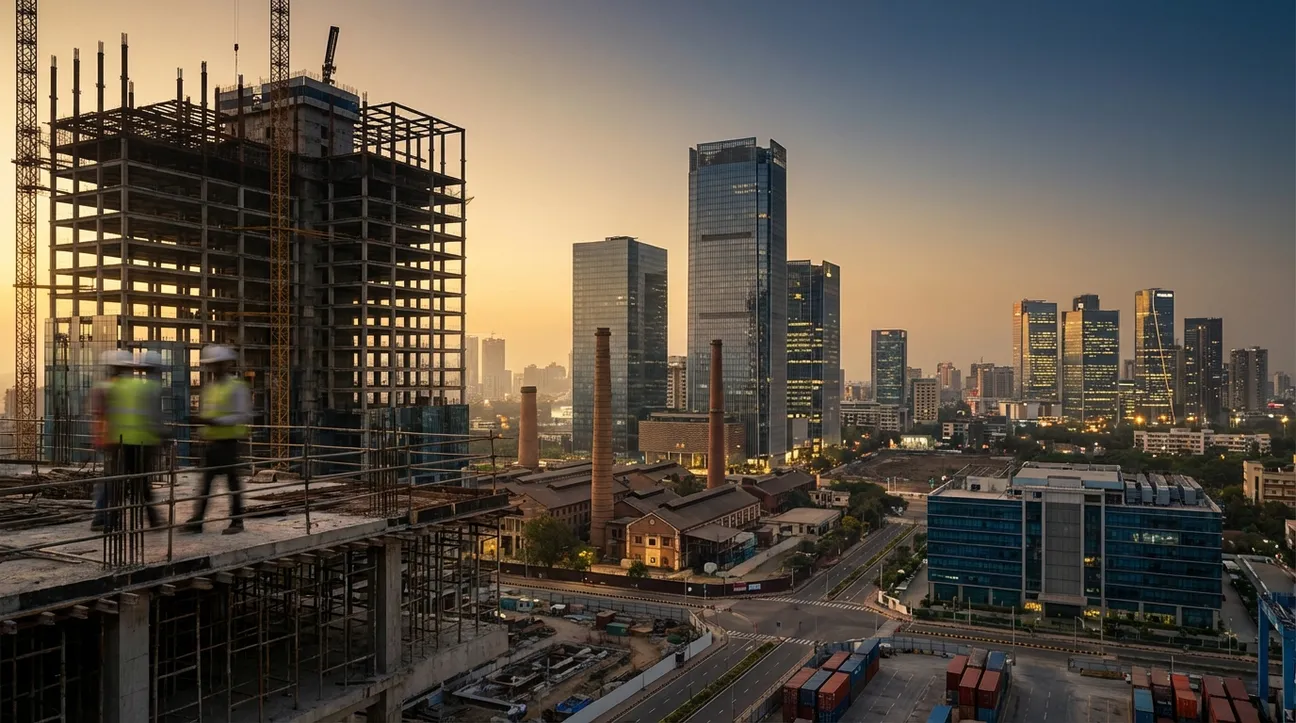
Mayank Ruia and the capital architecture turning Mumbai's industrial land into India's next asset class
From Phoenix Mills' pioneering mill-land conversions to MAIA Estates' institutional playbook, a new generation of developers is redefining mixed-use investment
Executive Summary
Key Takeaways
- Mumbai led India's 2025 land transactions with 32 deals covering 500+ acres, signaling institutional appetite for complex mixed-use conversions.
- Regulatory amendments to DCPR 2034 offer incentive FSI for mill-land and chawl redevelopment, materially improving return profiles for institutional capital.
- Next-generation developers like Mayank Ruia, Sandeep Runwal, and Nikhil Chaturvedi are bridging local redevelopment expertise with institutional governance and capital markets fluency.
- Industrial-to-mixed-use conversion is emerging as a distinct asset class with a hybrid risk-return profile that defies traditional core/value-add/opportunistic categories.
- Mumbai's mill-land conversion playbook is portable to other urbanizing Indian cities.
The industrial-to-mixed-use thesis gaining institutional momentum
Mumbai's real estate market has long operated on a principle that distinguishes it from nearly every other major Indian city: the recycling of industrial land into high-density urban districts. From the cotton mill compounds of Lower Parel to the warehouse corridors of the eastern suburbs, the conversion of legacy industrial plots into residential, commercial, and mixed-use developments has generated some of the highest land value appreciation in Asia over the past two decades. What is changing now is the capital architecture behind these conversions, and the emergence of a new cohort of developer-operators building institutional-grade strategies around a process that was historically opaque, family-driven, and resistant to outside capital.
Mayank Ruia represents one trajectory within this shift. As a former Group Director of Residential Business at Phoenix Mills, one of the original architects of Mumbai's mill-land redevelopment model, Ruia gained firsthand exposure to the complexity of converting industrial plots into mixed-use destinations. Phoenix Mills' transformation of its Lower Parel compound into a retail, hospitality, and commercial district remains one of the most studied redevelopment cases in Indian real estate. Ruia subsequently founded MAIA Estates in Bengaluru, building a development platform oriented toward institutional capital disciplines: transparent governance structures, defined return frameworks, and asset strategies designed to attract global investors rather than rely solely on promoter capital.
This evolution from family-led redevelopment to institutionally structured conversion platforms is one of the most consequential trends in Indian real estate today, and Mumbai sits at its epicenter.
Why does Mumbai's land transaction surge signal a structural shift in mixed-use capital flows?
The numbers confirm a market entering a new phase of institutional activity. According to Anarock Research, the Mumbai Metropolitan Region emerged as India's most active real estate market for land transactions in 2025, recording 32 land deals covering over 500 acres. Nationally, 126 land deals involving more than 3,772 acres were closed during the same period, with 8 deals covering over 1,045 acres specifically earmarked for mixed-use developments.
These figures reveal more than transactional volume. They indicate a maturing investor appetite for land parcels that require complex entitlement work, regulatory navigation, and multi-phase development execution, precisely the characteristics that define industrial-to-mixed-use conversions. The fact that mixed-use earmarks accounted for a significant share of total acreage transacted suggests that institutional buyers are no longer confining themselves to clean greenfield sites or stabilized income-producing assets. They are moving upstream into the conversion value chain itself.
Commercial developments and data centers accounted for around 79 acres across 12 deals in India during 2025, according to Anarock Research. This intersection of digital infrastructure demand with physical land recycling adds another dimension to the mixed-use thesis. In Mumbai, where available land is severely constrained, the ability to layer data center capacity, commercial office stock, and residential density onto former industrial sites creates a compound return profile that pure-play residential or commercial developments cannot match.
The regulatory environment is also evolving to support this transition. An approved amendment to the Development Control and Promotion Regulations (DCPR) 2034, under Section 37(1)(ka) of the MRTP Act, 1966, provides additional incentive Floor Space Index to developers undertaking the redevelopment of old residential buildings and chawls on Mumbai's historic mill lands. This regulatory change, with notification pending as of early 2026, directly enhances the economic viability of conversion projects by expanding the developable footprint available to developers who take on the social obligations embedded in these sites, including rehabilitation housing mandated under Regulation 35(7)(A) of DCPR 2034.
For institutional investors, this regulatory clarity transforms what was previously a speculative land play into a structured development opportunity with quantifiable entitlement upside.
How are next-generation developers like Mayank Ruia, Sandeep Runwal, and Nikhil Chaturvedi reshaping the capital stack?
The generational transition underway in Mumbai's developer landscape is as significant as the regulatory changes. Figures such as Mayank Ruia, Sandeep Runwal and Subodh Runwal of Runwal Group, and Nikhil Chaturvedi of Prozone Realty represent a cohort that combines deep local market knowledge with capital markets fluency.
Runwal Group, under the leadership of Sandeep Runwal and Subodh Runwal, has built one of Mumbai's largest retail and mixed-use portfolios across the central suburbs, a corridor that includes several former industrial zones. Their approach integrates retail-led mixed-use development with institutional partnership structures, a model that allows them to deploy capital at scale while maintaining operational control over complex redevelopment timelines.
Nikhil Chaturvedi, Managing Director at Prozone Realty, has articulated one of the most ambitious projections for the sector's trajectory. He has stated that the real estate sector's contribution to the Indian economy is projected to grow to 16% or more as India scales to a $10 trillion economy over the next decade. Chaturvedi has further projected that the intrinsic growth of the Indian real estate industry is expected to yield a CAGR of more than 30% over the same period.
If these projections hold, the capital required to fund India's urbanization will dwarf current deployment levels, and industrial-to-mixed-use conversions will absorb a disproportionate share of that capital in land-constrained markets like Mumbai.
Mayank Ruia's journey from Phoenix Mills to MAIA Estates illustrates a related but distinct model. Rather than scaling within a single metropolitan market, Ruia has built a platform designed around institutional capital compatibility from inception. MAIA Estates' Bengaluru operations reflect a thesis that the disciplines learned in Mumbai's mill-land conversions, including regulatory complexity management, stakeholder alignment, and phased capital deployment, can be exported to other Indian cities where similar industrial-to-urban transitions are accelerating.
This portability of the conversion playbook is a critical insight for global investors. Mumbai's mill-land model is not an isolated phenomenon. It is a template for value creation in every Indian city where legacy industrial zoning is being overtaken by urbanization pressure.
The institutional asset class that does not yet have a name
Industrial-to-mixed-use conversion in India occupies an unusual position in institutional portfolios. It does not fit neatly into core, value-add, or opportunistic classifications as traditionally defined by global real estate investors. The entitlement risk resembles opportunistic investing. The long-term cash flow profile of completed mixed-use assets resembles core. The active asset management required during the conversion phase resembles value-add. This hybrid character has historically deterred institutional capital, which prefers clean categorization.
What is emerging in Mumbai, and increasingly in Bengaluru, Pune, and Hyderabad, is the formalization of conversion as a distinct asset strategy with its own risk-return framework. Developers who can demonstrate repeatable processes for navigating regulatory approvals, managing rehabilitation obligations, and delivering phased mixed-use projects are attracting capital on terms that would have been unimaginable a decade ago.
The convergence of favorable regulation, constrained land supply, digital infrastructure demand, and a new generation of institutionally minded developers creates conditions for industrial-to-mixed-use conversion to become one of the defining themes of Indian real estate over the next investment cycle.
GRI Institute's India-focused convenings and research programs have consistently identified this convergence as a priority for institutional investors entering the market. The community of senior decision-makers within GRI's membership, spanning developers, asset managers, sovereign wealth representatives, and infrastructure investors, is actively engaged in defining the capital structures and governance frameworks that will channel institutional flows into these conversion opportunities. Discussions at recent GRI events have underscored that the barriers to entry for global capital in Indian redevelopment are decreasing, but the need for local operational partnerships remains paramount.
Strategic implications for capital allocators
Three conclusions emerge for institutional investors evaluating India's industrial-to-mixed-use conversion opportunity.
First, regulatory momentum in Mumbai is creating a window of enhanced development economics. The incentive FSI provisions under the DCPR 2034 amendments materially improve the return profile of mill-land and chawl redevelopment projects, making them viable for risk-adjusted institutional capital for the first time at scale.
Second, the developer landscape is bifurcating. On one side stand listed platforms with established REIT and capital markets access. On the other stand unlisted or emerging developers with deep redevelopment expertise but less transparent capital structures. The most compelling investment opportunities may sit at the intersection, with next-generation leaders who combine operational knowledge with institutional governance standards.
Third, the mixed-use conversion thesis extends beyond Mumbai. The playbook being refined in the city's mill lands is applicable wherever India's urbanization is consuming legacy industrial zones. Investors who build relationships and operational knowledge in Mumbai's conversion ecosystem today will have a structural advantage as this asset class scales nationally.
The capital architecture of India's urban transformation is being rewritten. The developers and investors who define its terms will shape the physical landscape of the country's largest cities for decades to come.