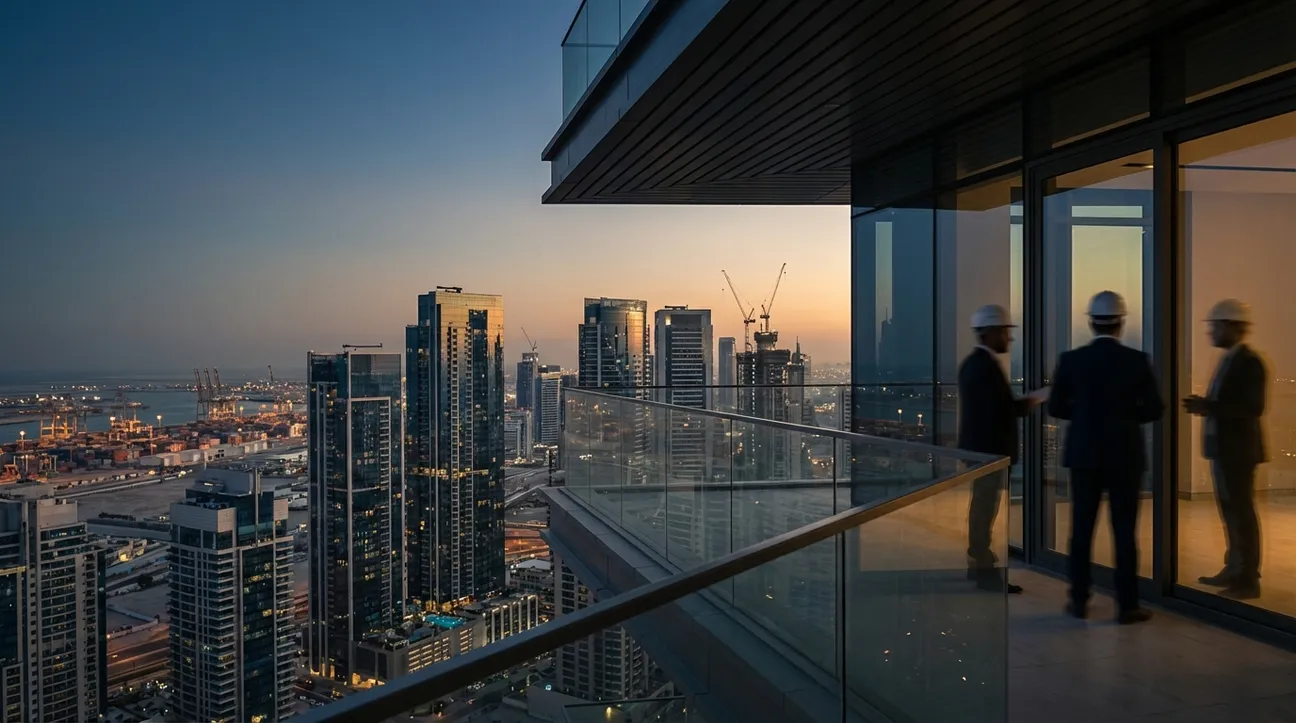
Mahdi Amjad and the Architecture of Ultra-Luxury: How Omniyat Is Reshaping GCC Real Estate
The founder's uncompromising design-led strategy positions Omniyat at the nexus of sovereign capital, branded residences, and Dubai's post-Expo identity — with
Executive Summary
Key Takeaways
The thesis: Ultra-luxury in the GCC is no longer a market segment — it is a strategic asset class
The Gulf Cooperation Council's real estate landscape has entered a new phase. The era of volume-driven development, where scale alone dictated market dominance, is giving way to something more refined, more capital-intensive, and more globally connected. At the center of this transformation in Dubai stands Mahdi Amjad, the founder and chairman of Omniyat, whose approach to ultra-luxury development has become a reference point for how design, brand, and capital converge in the contemporary Gulf.
Amjad's trajectory — from early-stage entrepreneurship in Dubai's formative property years to presiding over one of the emirate's most recognizable luxury portfolios — mirrors the maturation of the GCC real estate market itself. But to frame Omniyat's story as merely a corporate success narrative would miss the deeper structural shift it represents. What Mahdi Amjad has built is not simply a collection of trophy assets. It is an argument that ultra-luxury real estate in the Gulf can function as a distinct asset class, one that attracts sovereign wealth, international family offices, and ultra-high-net-worth individuals through architectural distinction rather than sheer square footage.
This argument has profound implications for the competitive dynamics between Dubai, Riyadh, Doha, and other GCC capitals now vying for global capital and talent.
Who is Mahdi Amjad, and why does his strategy matter for GCC capital flows?
Mahdi Amjad founded Omniyat with a proposition that was, at the time, countercultural in Dubai's fast-moving development market: prioritize design integrity and exclusivity over rapid unit turnover. The firm became known for commissioning internationally acclaimed architects and delivering properties that functioned as much as cultural statements as residential or commercial products.
Omniyat's portfolio — spanning ultra-luxury residences, hospitality assets, and mixed-use developments across prime Dubai locations — reflects a deliberate strategy of scarcity. Where many GCC developers pursued large-scale master-planned communities, Amjad focused on limited-edition projects with singular architectural identities. Each development carried the imprint of a specific design vision, often tied to globally recognized names in architecture and interiors.
This approach resonated with a buyer profile that was evolving. The GCC's ultra-luxury buyer is no longer solely a regional high-net-worth individual seeking domestic prestige. Today, the market draws from a global pool of capital — European family offices diversifying into Gulf assets, Indian industrialists establishing dual residences, and institutional investors seeking yield in branded hospitality-residential hybrids. Figures such as Sanjay Hinduja, whose family's diversified interests span continents, exemplify the type of international capital that gravitates toward curated ultra-luxury propositions in the Gulf.
Mahdi Amjad's strategic significance lies in having anticipated this convergence. Omniyat positioned itself not as a volume developer competing on price, but as a platform connecting global architectural talent with global capital through Dubai's regulatory and lifestyle infrastructure. The result is a portfolio that commands pricing power precisely because it cannot be easily replicated.
For the broader GCC real estate ecosystem, this model raises a critical question: as sovereign-backed giga-projects in Saudi Arabia and Qatar absorb vast quantities of capital and attention, does the design-led boutique model offer a more sustainable path for certain segments of the market?
Can Dubai's ultra-luxury model survive the rise of Saudi giga-projects?
The competitive landscape across the GCC has shifted dramatically. Saudi Arabia's Vision 2030 agenda has unleashed an unprecedented pipeline of real estate and infrastructure development — from NEOM's futuristic city concepts to the Red Sea coastal tourism projects and Riyadh's urban transformation. These initiatives, backed by the Public Investment Fund and other sovereign vehicles, operate at a scale that dwarfs anything the private sector in Dubai can match on its own.
Yet scale and exclusivity serve different functions in the capital markets. Dubai's post-Expo 2020 positioning has doubled down on the city's role as a global hub for high-net-worth migration, with regulatory reforms around residency, taxation, and corporate structuring reinforcing its appeal. Within this framework, developers like Omniyat serve a complementary role: they provide the physical product — the residences, the hotels, the branded experiences — that anchors global capital to the city.
The branded residence segment is particularly instructive. Across the GCC, branded residences have become a primary vehicle for attracting international buyers who seek both lifestyle and asset security. Dubai leads the region in branded residential inventory, and Omniyat's partnerships with luxury hospitality and design brands position it at the premium end of this spectrum.
Saudi Arabia's ambitions in hospitality and luxury living are formidable, and figures such as Abdulla Bin Habtoor and Abdulaziz Albassam represent the rising generation of GCC business leaders whose activities span the Saudi-UAE corridor. But the Kingdom's ultra-luxury segment remains nascent compared to Dubai's established ecosystem of buyers, operators, and secondary market liquidity. For international investors evaluating GCC exposure, Dubai's track record of transaction transparency, freehold ownership frameworks, and established property management infrastructure continues to provide a risk-adjusted advantage — at least for now.
The coexistence of Saudi giga-projects and Dubai boutique ultra-luxury is not necessarily zero-sum. Capital that flows into NEOM or the Red Sea does not automatically divert from Dubai's Business Bay or Palm Jumeirah. Different risk profiles, return expectations, and lifestyle motivations drive allocation decisions. What Mahdi Amjad's model demonstrates is that design-led scarcity can create its own demand category, largely insulated from the volume dynamics that govern mass-market development.
What does Omniyat's trajectory reveal about the future of GCC real estate investment?
Omniyat's evolution offers several strategic insights for real estate investors and developers operating across the Gulf.
First, architectural identity has become a form of competitive moat. In a region where capital is abundant and construction capacity is deep, the differentiating factor for ultra-luxury assets is increasingly intangible — design provenance, brand association, and the curatorial sensibility of the developer. Mahdi Amjad understood early that in a market where nearly anything can be built, the question of what should be built becomes the primary source of value creation.
Second, the convergence of hospitality and residential real estate is accelerating. Omniyat's portfolio blurs the line between hotel and home, reflecting a global trend where ultra-high-net-worth buyers expect hospitality-grade services in their residences. This hybrid model demands operational sophistication that goes well beyond traditional development capabilities, and it favors developers with established relationships with global hospitality operators.
Third, the GCC's ultra-luxury segment is becoming a barometer for international capital sentiment. Transaction activity in Dubai's prime residential market — particularly in the segments where Omniyat operates — often signals broader shifts in how global wealth views the Gulf as a destination for capital preservation, lifestyle optimization, and geopolitical diversification. When European or Asian family offices increase their Dubai allocations, it reflects confidence not just in a single asset, but in the regulatory and economic trajectory of the emirate.
These dynamics are central to the discussions that take place within GRI Institute's GCC-focused gatherings, where senior investors, developers, and policymakers convene to examine the forces shaping real estate and infrastructure across the region. The interplay between sovereign-led mega-development and private-sector luxury curation is among the most consequential themes in GCC real estate today, and it surfaces consistently in GRI's member dialogues and research initiatives.
The strategic horizon
Mahdi Amjad's Omniyat stands as evidence that the GCC real estate market has matured beyond the binary of build-and-sell. The most sophisticated developers in the region now operate as platforms — integrating design, capital, hospitality, and brand into cohesive propositions that speak to a global audience.
The question for the sector is not whether ultra-luxury will continue to thrive in the Gulf. Demographic trends, wealth migration patterns, and sovereign investment strategies all point toward sustained demand at the top end. The more pressing question is whether the region can produce more developers capable of operating at this level of strategic sophistication — and whether cities beyond Dubai can build the institutional infrastructure necessary to support such models.
For GRI Institute members tracking the GCC opportunity, Omniyat's trajectory offers a case study in how vision, discipline, and design can transform real estate from a commodity business into a capital magnet. As the Gulf's competitive landscape intensifies, the developers who understand this distinction will define the next chapter of the region's built environment.
The capital follows conviction. In GCC ultra-luxury, Mahdi Amjad has made his conviction architectural — and the market has responded accordingly.