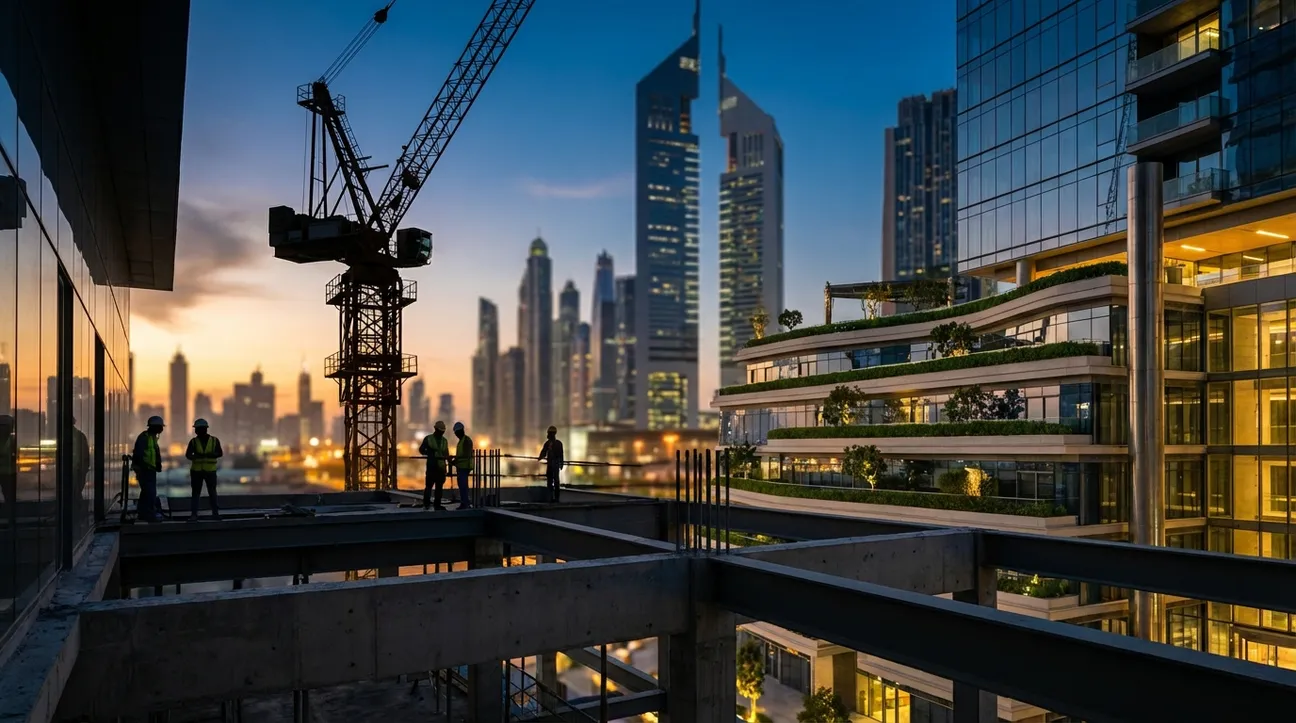
Mabanee's mixed-use pivot and the Kuwaiti capital reshaping GCC retail-to-residential conversions
With a USD 4.90 billion market cap and green-financed projects ahead of schedule, Mabanee anchors a broader GCC shift from legacy retail to mixed-use developmen
Executive Summary
Key Takeaways
- Mabanee's market cap reached ~USD 4.90 billion by December 2025, reflecting investor confidence in its retail-to-mixed-use pivot.
- An USD 81 million NBK green loan for the 40,121 sqm Sabah Al-Ahmad mixed-use project signals bankability of the conversion thesis.
- Aventura's residential component hit 82% completion a full year ahead of schedule, boosting operational credibility.
- The GCC real estate market is projected to nearly double from USD 141.2 billion (2025) to USD 260.3 billion by 2034.
- Comprehensive conversion economics benchmarks remain absent, creating data asymmetry that favours experienced operators.
Mabanee's market capitalization reached KD 1.504 billion, approximately USD 4.90 billion, as of December 2025, according to the company's own disclosures. The figure positions the Kuwaiti developer as one of the GCC's most valuable listed real estate operators and underscores the market's confidence in a strategic pivot that is redefining what legacy mall owners can become. Across the Gulf Cooperation Council, a region whose real estate market was valued at USD 141.2 billion in 2025 according to GRI Institute data, the repositioning of retail-anchored portfolios into mixed-use ecosystems is gaining institutional traction.
The economics of this transition remain underquantified at the regional level. Specific conversion yields, per-square-meter repositioning costs, and cap rate differentials between legacy retail and converted mixed-use assets in the GCC are areas where market transparency has yet to catch up with developer ambition. What the available data does reveal, however, is a clear directional shift, with Mabanee at its centre.
Green finance as an enabler of mixed-use conversion
In November 2025, National Bank of Kuwait extended an USD 81 million (KD 25 million) green loan to Mabanee to finance the Sabah Al-Ahmad Project, known as S3, a 40,121 square meter mixed-use development (source: NBK / GCC Business News, November 2025). The transaction is significant on multiple dimensions. It confirms the availability of sustainability-linked debt instruments for GCC developers pursuing asset class diversification. It also signals that Kuwaiti lenders view the mixed-use conversion thesis as bankable, a prerequisite for institutional scale.
Green loans and sustainability-linked financing structures have become increasingly important for GCC developers seeking to attract international limited partners and sovereign co-investors. For a legacy mall operator like Mabanee, securing green-labelled capital for a mixed-use project serves a dual purpose: it lowers the weighted average cost of capital for the specific development and it repositions the corporate balance sheet toward the environmental, social, and governance standards that global institutional allocators require.
The Sabah Al-Ahmad Project integrates residential, retail, and community components across its 40,121 square meters, a footprint that reflects the mid-scale mixed-use format gaining favour across the GCC. These are developments designed to generate diversified income streams, blending the recurring revenues of residential leasing and retail tenancy with the capital appreciation potential of a master-planned neighbourhood.
How far along is Mabanee's Aventura project, and what does the timeline signal?
The residential component of Mabanee's Aventura project, designated J3, reached 82% completion as of April 2025, a full year ahead of schedule, according to Gulf Construction. Aventura is described as a smart urban development integrating retail, residential, and hospitality components, and its accelerated delivery timeline offers a meaningful data point for the broader GCC market.
Ahead-of-schedule delivery in a region where project delays have historically eroded investor confidence represents a competitive advantage that compounds over time. For Mabanee, it reinforces the developer's operational credibility as it transitions from a single-asset-class operator, historically defined by The Avenues mall in Kuwait, into a diversified mixed-use platform.
The Aventura timeline also reflects a favourable construction environment in Kuwait, where labour availability and material supply chains have stabilised relative to pandemic-era disruptions. Developers that locked in construction contracts during periods of lower input costs are now realising schedule and budget advantages that may prove difficult to replicate in later market cycles.
What does the GCC's growth trajectory mean for mixed-use demand?
The GCC real estate market is projected to reach USD 260.3 billion by 2034, according to GRI Institute research. That trajectory, from USD 141.2 billion in 2025 to USD 260.3 billion within a decade, implies a near-doubling of market value and creates structural demand for new asset formats that traditional retail or standalone residential developments cannot fully address.
Mixed-use developments sit at the intersection of several demand drivers that this growth trajectory activates. Population growth across the Gulf states, particularly in Saudi Arabia where residential supply is estimated to grow by 499,000 units to reach 3.45 million by 2030 according to Alpen Capital and GRI Institute data, requires dense, amenity-rich environments that combine living, working, and retail in integrated formats. Urbanisation policies embedded in national vision programmes, from Saudi Vision 2030 to Kuwait Vision 2035, explicitly prioritise mixed-use urbanism over suburban sprawl.
The Saudi residential pipeline alone, at 499,000 additional units by 2030, represents one of the largest single-country housing delivery programmes in the world. A significant share of that pipeline is expected to be delivered within mixed-use master plans rather than as isolated residential towers, creating a regional template that Kuwaiti operators like Mabanee can adapt to their domestic market conditions.
Cross-border capital and the Kuwaiti connection
The conversion of GCC retail assets into mixed-use platforms is attracting attention from capital allocators operating across borders. Abdulaziz Albassam, CEO of AIMS Investment, has executed direct international real estate transactions, including the 2024 sale of a Manchester residential portfolio, according to GRI Institute data. His activity illustrates the bidirectional nature of GCC capital flows: Kuwaiti and Gulf-based investors deploy internationally while simultaneously seeking domestic repositioning opportunities that offer risk-adjusted returns superior to mature market yields.
Figures like Nader Fares of LP Bens represent another dimension of this capital ecosystem, serving as a bridge for Latin American investment into GCC real estate opportunities. The involvement of diaspora and emerging market capital in Gulf developments adds liquidity depth to a market that has historically relied on sovereign and family office allocations.
International developers are also monitoring the GCC's mixed-use momentum. Abhishek Lodha's Macrotech Developers, while primarily focused on India's residential market, is noted within the broader context of cross-border real estate movements that GRI Institute tracks across its global membership network. The convergence of GCC, South Asian, and Latin American capital interests in mixed-use real estate reflects a maturing market where geographic diversification and asset class innovation are no longer separate strategies but intertwined imperatives.
The developer economics gap
Despite the directional clarity of the GCC's mixed-use pivot, the market lacks comprehensive quantitative benchmarks for conversion economics. There are no widely published datasets covering cap rate differentials between legacy retail and repositioned mixed-use assets in the Gulf. Per-square-meter conversion costs, construction period yields, and post-conversion stabilised returns remain largely proprietary, held within developer balance sheets and lender credit committees rather than available in public market research.
This data gap creates both risk and opportunity. For developers like Mabanee that are accumulating a track record of successful conversions, proprietary performance data becomes a competitive moat. For institutional investors evaluating the segment, the absence of standardised benchmarks increases due diligence costs and favours operators with established local relationships.
GRI Institute's ongoing coverage of this segment aims to narrow the information asymmetry by aggregating transaction-level intelligence through its member network of senior real estate and infrastructure leaders. Discussions at GRI club meetings, where principals and C-suite executives exchange insights under conditions that facilitate candour, often surface the granular economic data that public reports cannot capture.
Structural implications for the GCC retail sector
The mixed-use conversion trend carries implications that extend beyond individual developer strategies. As legacy mall operators reposition assets, the competitive dynamics of GCC retail change fundamentally. Malls that do not integrate residential, hospitality, or office components risk losing footfall to developments that offer the convenience and density of mixed-use environments.
Mabanee's pivot is instructive because it originates from a position of strength. The Avenues, its flagship Kuwait City mall, remains one of the highest-performing retail destinations in the Gulf. The decision to diversify into mixed-use formats reflects a forward-looking assessment that even dominant retail assets benefit from adjacent revenue streams and the demand stability that residential and hospitality components provide.
For the GCC real estate market as a whole, the transition from single-use to mixed-use represents a maturation of the development model. A market projected to nearly double in value over the coming decade requires asset formats that can absorb capital at scale while delivering the diversified, resilient income profiles that institutional investors demand. Mabanee's trajectory, anchored by green-financed projects, ahead-of-schedule delivery, and cross-border capital relationships, offers one of the clearest case studies of how that maturation is unfolding in practice.