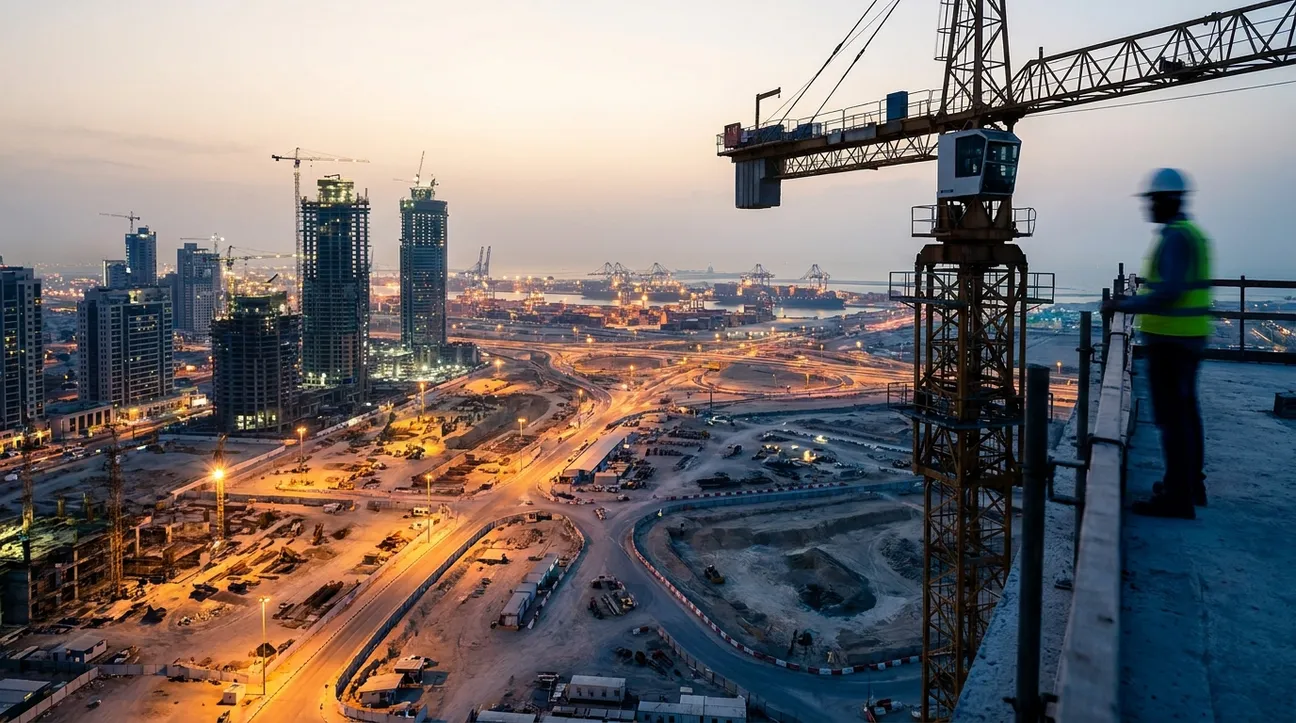
The execution layer: how European project directors like Lucio Frigo determine whether GCC mega-developments actually get built
A USD 141.2 billion real estate market and a USD 167.3 billion construction sector depend on an overlooked operational class that bridges vision and delivery.
Executive Summary
Key Takeaways
- The GCC real estate market (USD 141.2B in 2025) and construction sector (USD 167.3B) depend on an under-analyzed operational layer of project directors who bridge vision and delivery.
- European project directors like Lucio Frigo bring regulatory fluency, lifecycle thinking, and urban-regeneration expertise critical to increasingly complex GCC mega-projects.
- Q1 2026 contract awards fell 9.7% YoY, raising the premium on execution certainty and capital discipline.
- GCC construction is projected to reach USD 233.4B by 2032, driven by rising complexity, tightening capital discipline, and accelerating sustainability mandates.
- This structural demand favors European-caliber operational expertise trained in regulation-dense, margin-conscious environments.
The gap between pipeline and performance
The Gulf Cooperation Council has committed to one of the most ambitious built-environment programs in modern history. According to IMARC Group, the GCC real estate market was valued at USD 141.2 billion in 2025, with the UAE commanding a dominant 61.1% share. Running in parallel, the GCC construction market reached an estimated USD 167.3 billion in 2025, according to P&S Intelligence, propelled by large-scale infrastructure investment and national economic diversification programs.
These headline figures, however, obscure a critical operational reality. The region's capacity to translate capital commitments into completed, performing assets depends on a professional layer that receives remarkably little analytical attention: the project directors who manage on-the-ground delivery. Within this cohort, a distinct archetype has emerged, the European project director who operates inside or alongside GCC developer structures, importing technical rigor, regulatory fluency, and lifecycle thinking into environments defined by speed and scale.
Lucio Frigo represents this archetype. As Founder and CEO of Materia Inc, a UAE-based real estate investor and developer focused on urban regeneration, housing, and social infrastructure across the Arab world and Africa, Frigo occupies the precise intersection where European development methodology meets GCC execution reality. His trajectory illustrates a broader phenomenon: the quiet consolidation of European operational expertise at the heart of Gulf mega-project delivery.
Who is Lucio Frigo, and why does his model matter for GCC execution?
Lucio Frigo's professional identity resists easy categorization. He is neither a passive capital allocator nor a conventional contractor. Through Materia Inc, he operates as an investor-developer with a mandate that extends beyond commercial real estate into urban regeneration and social infrastructure, sectors where execution complexity is highest and where the gap between design intent and delivered outcome is widest.
This positioning is significant for the GCC context. The region's development pipeline increasingly demands operators who can navigate the full chain from conceptual design through entitlement, procurement, construction management, and asset stabilization. National strategies like Dubai's Real Estate Strategy 2033, which leverages AI and blockchain to transition the emirate's property market into a liquid, transparent, and data-driven asset class, and Dubai's Quality of Life Strategy 2033, a ten-year program featuring over 200 projects focused on urban environment, wellness-centric design, and green spaces, require delivery partners capable of interpreting complex policy frameworks into built form.
Frigo's focus on urban regeneration positions Materia Inc at the forefront of this shift. Regeneration projects, by definition, operate within existing urban fabric, demanding a level of stakeholder coordination, regulatory navigation, and design sensitivity that greenfield mega-projects do not. The European tradition of adaptive reuse, community-integrated development, and lifecycle cost optimization translates directly into competitive advantage within a GCC market that is maturing beyond speculative volume toward qualitative urban outcomes.
The operational methodology that European project directors bring, characterized by structured risk frameworks, phased delivery programs, and integrated design-build oversight, addresses a concrete market need. The total value of project contracts awarded across the GCC in Q1 2026 was USD 61.2 billion, according to MEED Projects, representing a 9.7% year-over-year decline attributed to regional instability. In a contracting awards environment, the premium on execution certainty rises. Developers and sovereign clients increasingly favor operators who can demonstrate a track record of delivering complex projects within defined time and cost parameters.
How do international mega-contractors and specialized developers complement the European project director?
The GCC execution ecosystem operates as a layered structure where distinct actor types fulfill complementary roles. Understanding Lucio Frigo's position requires mapping the broader landscape.
At the infrastructure scale, international mega-contractors such as China Communications Construction Company (CCCC) execute state-level programs that form the backbone of national development agendas. CCCC is actively present in the GCC, including through a USD 3.97 billion EPC contract for Phase 1 of Kuwait's Mubarak Al-Kabeer Port, with site preparations having begun in January 2026 according to reporting by Zawya and Times Kuwait. These contractors bring massive mobilization capacity, balance sheet strength, and engineering specialization for port, road, rail, and utilities infrastructure.
At a different scale and typology, specialized developers such as Hive Development operate within the UAE property market, focusing on specific product segments and submarket dynamics. These firms translate macro demand signals into targeted residential, commercial, or mixed-use offerings, often with agile delivery timelines and concentrated geographic focus.
The European project director archetype, as embodied by Frigo, occupies the strategic middle ground. This layer connects sovereign vision to physical delivery, bridging the gap between the macro-infrastructure contractors building ports and highways and the specialized developers building individual residential or commercial schemes. The project director's value proposition lies in integration: assembling and coordinating multidisciplinary teams across design, engineering, procurement, and construction while maintaining alignment with the client's strategic, financial, and urban-planning objectives.
This tripartite structure, comprising international mega-contractor, specialized developer, and integrating project director, is the actual mechanism through which GCC development programs materialize. Capital allocation decisions, sovereign wealth fund mandates, and national vision documents capture media attention. The operational layer that converts these intentions into completed assets operates with far less visibility but with decisive impact on outcomes.
What structural forces will increase demand for this operational expertise through 2032?
The growth trajectory of the GCC built environment virtually guarantees expanding demand for execution-layer professionals. P&S Intelligence projects the GCC construction market to grow at a CAGR of 4.9%, reaching USD 233.4 billion by 2032. IMARC Group estimates the GCC real estate market will reach USD 260.3 billion by 2034, exhibiting a CAGR of 7.03%. These projections describe a market that will nearly double in scale within a decade.
Several structural factors will intensify the need for European-caliber project direction within this expanding market.
First, program complexity is increasing. The GCC's development agenda has evolved from standalone towers and master-planned communities toward integrated urban districts, transit-oriented developments, cultural institutions, and social infrastructure. Dubai's Quality of Life Strategy 2033 alone encompasses over 200 projects, each requiring sophisticated coordination across multiple government entities, private-sector partners, and community stakeholders. This complexity favors operators with deep experience in multi-stakeholder, regulation-dense environments, precisely the conditions that define European development practice.
Second, capital discipline is tightening. The 9.7% year-over-year decline in Q1 2026 contract awards signals that the era of unconstrained spending is moderating. Sovereign and institutional investors are applying more rigorous stage-gate processes, demanding detailed feasibility analysis, independent cost verification, and robust risk allocation before committing capital. European project directors, trained in environments where margins are thinner and regulatory scrutiny is higher, bring an inherent orientation toward capital efficiency that aligns with this shift.
Third, the sustainability and ESG compliance agenda is accelerating. Green building certification, embodied carbon accounting, circular construction practices, and social impact measurement are becoming standard requirements in GCC procurement frameworks. European professionals carry native fluency in these domains, having operated under the EU's progressively stringent environmental and reporting regulations for years.
The convergence of these forces, rising complexity, capital discipline, and sustainability mandates, creates structural demand for the precise skill set that European project directors bring. The question for GCC market participants is whether the supply of qualified operational talent can scale in proportion to the pipeline.
The execution imperative
The GCC's development ambitions are extraordinary in scope and strategic importance. Yet ambitions are realized through execution, and execution depends on people, systems, and methodologies operating at the project level.
Lucio Frigo and Materia Inc exemplify an emerging class of European-origin operators who are embedding themselves within the GCC's development fabric, bringing technical discipline, urban-regeneration expertise, and lifecycle thinking to markets that have historically prioritized speed and scale above all else. Alongside international mega-contractors like CCCC and specialized developers like Hive Development, these project directors form the operational infrastructure upon which sovereign visions are built.
The execution layer is where value is created or destroyed in real estate development. As the GCC construction market advances toward USD 233.4 billion by 2032, the professionals who manage the interface between capital, design, and construction will determine which projects deliver on their promise and which remain renderings.
GRI Institute continues to convene the senior leaders shaping this landscape through its GCC-focused events and research programs, providing a platform where capital partners, developers, and execution specialists engage directly on the operational challenges that define project outcomes. The European project director archetype, long underrepresented in market analysis, deserves sustained attention as a decisive factor in the region's development trajectory.