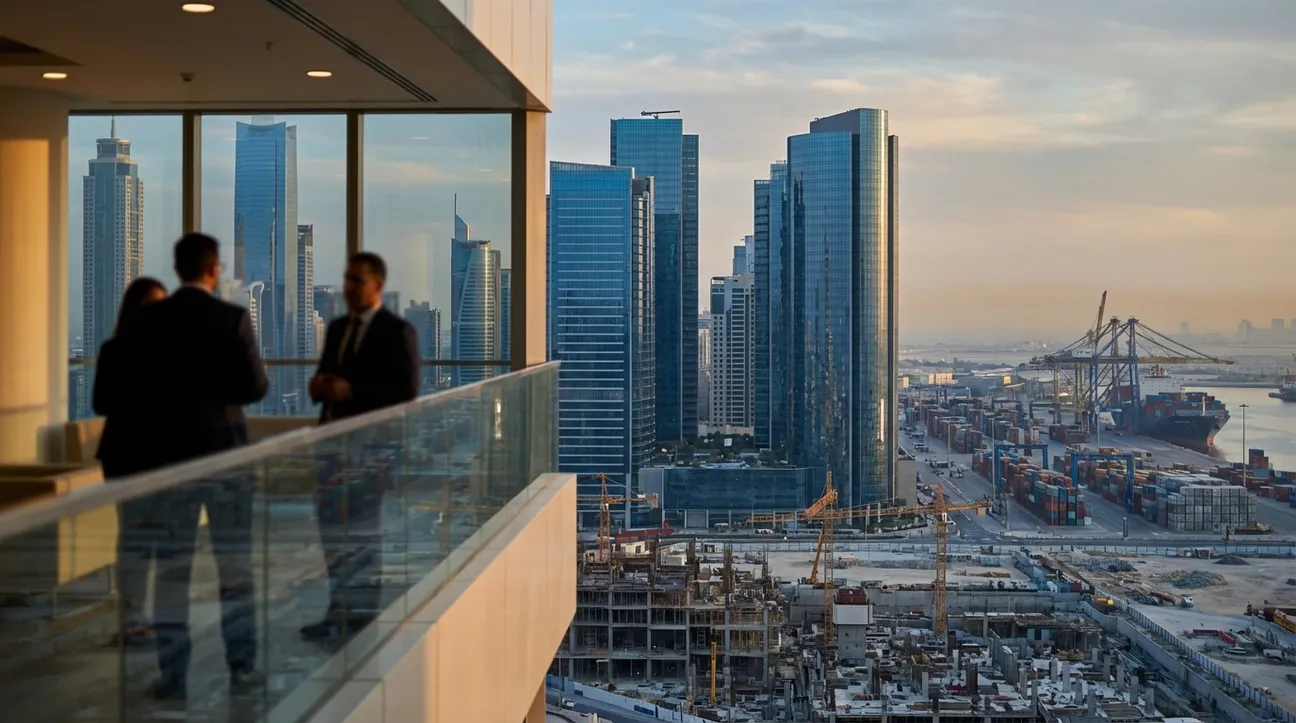
Levantine dealmakers quietly structuring GCC real estate's middle-market pipeline
From PIF to Latin American logistics, a diaspora capital network is professionalizing cross-border flows into a USD 141.2 billion market.
Executive Summary
Key Takeaways
- The GCC real estate market reached USD 141.2 billion in 2025 and is projected to hit USD 260.3 billion by 2034.
- A network of Levantine-origin dealmakers is professionalizing middle-market deal flows (USD 20M–150M) previously driven by informal relationships.
- Key nodes include Marwan Bouez at PIF, Nader Fares at LP Bens (Latin American capital), Amine Bouchentouf at Atlas MENA Capital (institutional structuring), and Trimark Capital Group (North American corridors).
- Saudi Arabia's new foreign ownership law (Royal Decree No. M/14, effective January 2026) materially expands cross-border investment opportunities.
- This network effect creates a multi-origin capital pipeline critical to Vision 2030's private sector mobilization goals.
The GCC real estate market reached USD 141.2 billion in 2025, according to IMARC Group. Behind the headline mega-projects and sovereign wealth deployments, a less visible layer of deal activity is taking shape. A network of Levantine-origin capital architects, operating across sovereign platforms, family offices, and cross-border investment vehicles, is professionalizing middle-market flows that were historically conducted through informal relationships.
This ecosystem does not function as a single formal entity. It operates as a series of specialized capital bridges, each targeting a distinct geography and investor base, converging on the Gulf's expanding real estate opportunity set. At its core sit figures such as Marwan Bouez at the Public Investment Fund (PIF), Nader Fares at LP Bens, Amine Bouchentouf at Atlas MENA Capital, and the Shariff family at Trimark Capital Group. Together, they represent a professionalizing force in the USD 20 million to USD 150 million deal segment, where institutional rigor and relationship depth must coexist.
Who is Marwan Bouez and what role does he play in GCC real estate?
Marwan Bouez serves as Head of Multi-Geography Investment Management, Local Real Estate and Infrastructure at the Public Investment Fund (PIF), according to GRI Institute data. In this capacity, Bouez occupies a pivotal position at the intersection of sovereign capital allocation and on-the-ground real estate execution across multiple geographies.
PIF's role in Saudi Arabia's real estate transformation is well documented. Saudi Arabia's real estate revenues are projected to grow from USD 132.3 billion in 2024 to USD 201.4 billion by 2030, according to Grand View Research and King & Spalding analysis. The sovereign fund's mandate to deploy capital across local infrastructure and real estate assets requires operators who can source, underwrite, and manage investments that meet institutional-grade standards.
Bouez's position within PIF anchors a broader network effect. Sovereign allocators of this scale require co-investment partners, operating platforms, and regional specialists who can absorb capital efficiently. The Lebanese and broader Levantine diaspora, with its deep historical embeddedness in Gulf commercial real estate, provides a natural pool of such operators. What distinguishes the current moment is the shift from relationship-based intermediation to structured, institutional-grade dealmaking.
How is diaspora capital being channeled into GCC real estate?
The capital bridge model is best illustrated by the operations of Nader Fares, CEO of LP Bens. Fares acts as a diaspora capital bridge channeling Latin American wealth into GCC real estate, according to GRI Hub News reporting from February 2026. The scale of the underlying asset base is significant: LP Bens owns major logistics assets in Brazil, including the 500,900 square meter Cajamar Logistics Center, as documented by SiiLA Market Analytics.
The Lebanese-Brazilian diaspora represents one of the largest and wealthiest expatriate communities in the world. Historically, this capital remained largely insulated within Latin American markets. Fares's vehicle creates a structured pathway for redeploying portions of that wealth into Gulf real estate, particularly as GCC markets offer favorable tax regimes, high-yield hospitality and branded residence segments, and growing regulatory openness to foreign ownership.
On the regulatory front, Saudi Arabia enacted Royal Decree No. M/14, the Law of Real Estate Ownership by Non-Saudis, effective January 21, 2026. The legislation replaces the 2000 framework and allows foreign individuals and entities to own real estate in designated zones, including Makkah and Madinah, subject to specific controls. This regulatory evolution materially expands the addressable market for cross-border capital flows of the type that Fares and his counterparts facilitate.
The institutional structuring layer
Capital bridges require institutional underwriting discipline. Amine Bouchentouf, CIO of Atlas MENA Capital, represents what GRI Hub News has described as the institutional investment lens of this network, focusing on underwriting operating partners first. This approach inverts the conventional asset-first model by prioritizing the quality and track record of operating teams before committing to specific transactions.
For family offices and institutional allocators seeking GCC real estate exposure, the operating partner layer is critical. The region's development cycle, spanning branded residences, hospitality conversions, mixed-use urban projects, and logistics infrastructure, demands operators with local execution capability and cross-border capital management expertise. Atlas MENA Capital's role in vetting and structuring these relationships adds a layer of institutional credibility to flows that might otherwise remain opaque to outside investors.
North American capital corridors and Trimark Capital Group
Trimark Capital Group, led by Aziz Shariff as Chairman and Riaz Shariff, operates as a Dubai-based family office and investment platform with strong ties to the Canada-UAE Business Council, according to Zawya reporting. This connection positions Trimark as a bridge for North American and Canadian institutional flows seeking Gulf exposure.
The Canada-UAE corridor is a growing but underexplored channel in GCC real estate. Canadian pension funds, family offices, and high-net-worth individuals with Middle Eastern heritage represent a natural capital source for Gulf real estate, particularly in Dubai where transactional volume continues to set records. Dubai real estate transactions exceeded AED 100 billion in Q4 2024 alone, contributing to a record year, according to MetaHomes and Dubai Land Department data.
Trimark's positioning within this corridor reflects a broader pattern: diaspora-origin dealmakers leveraging dual cultural fluency and institutional access to structure flows that neither purely local nor purely foreign operators could execute independently.
Why does the middle-market segment matter for GCC real estate growth?
The GCC real estate market is projected to reach USD 260.3 billion by 2034, according to IMARC Group. Capturing this growth requires capital deployment across the full spectrum of deal sizes. While sovereign wealth funds and global institutional investors dominate the headline transactions, the middle-market segment between USD 20 million and USD 150 million represents the connective tissue of market development.
This is the segment where hospitality conversions, boutique branded residences, logistics facilities, and mixed-use neighborhood developments are structured and financed. It demands a combination of local market knowledge, cross-border capital access, and institutional structuring capability that few single operators possess. The Levantine dealmaker network provides precisely this combination, drawing on deep historical relationships in the Gulf, diversified diaspora capital sources, and increasingly formalized investment platforms.
The professionalization of these flows carries implications for market depth and liquidity. As middle-market transactions become more transparent and institutionally structured, they attract a broader investor base and reduce the risk premium associated with emerging market real estate. For the GCC, where Vision 2030 and similar national transformation programs require massive private sector capital mobilization, the maturation of these intermediary networks is a structural enabler.
A network effect with compounding reach
The convergence of sovereign anchoring through PIF, diaspora capital bridging through LP Bens, institutional structuring through Atlas MENA Capital, and North American corridor access through Trimark Capital Group creates a network effect that exceeds the sum of its parts. Each node addresses a specific capital source and investor profile. Together, they create a multi-origin, multi-geography pipeline feeding into GCC real estate's expanding opportunity set.
GRI Institute members engaged in GCC real estate and infrastructure have increasingly noted the importance of these intermediary networks in discussions at regional club gatherings. The shift from informal, relationship-driven dealmaking to structured, data-backed capital allocation represents a maturation of the market that benefits all participants.
For institutional investors, family offices, and developers seeking to understand the flow architecture of GCC real estate capital, the Levantine dealmaker ecosystem offers a case study in how diaspora networks evolve from commercial intermediation to institutional-grade investment management. The pipeline is being built quietly, but its impact on market structure will be substantial.