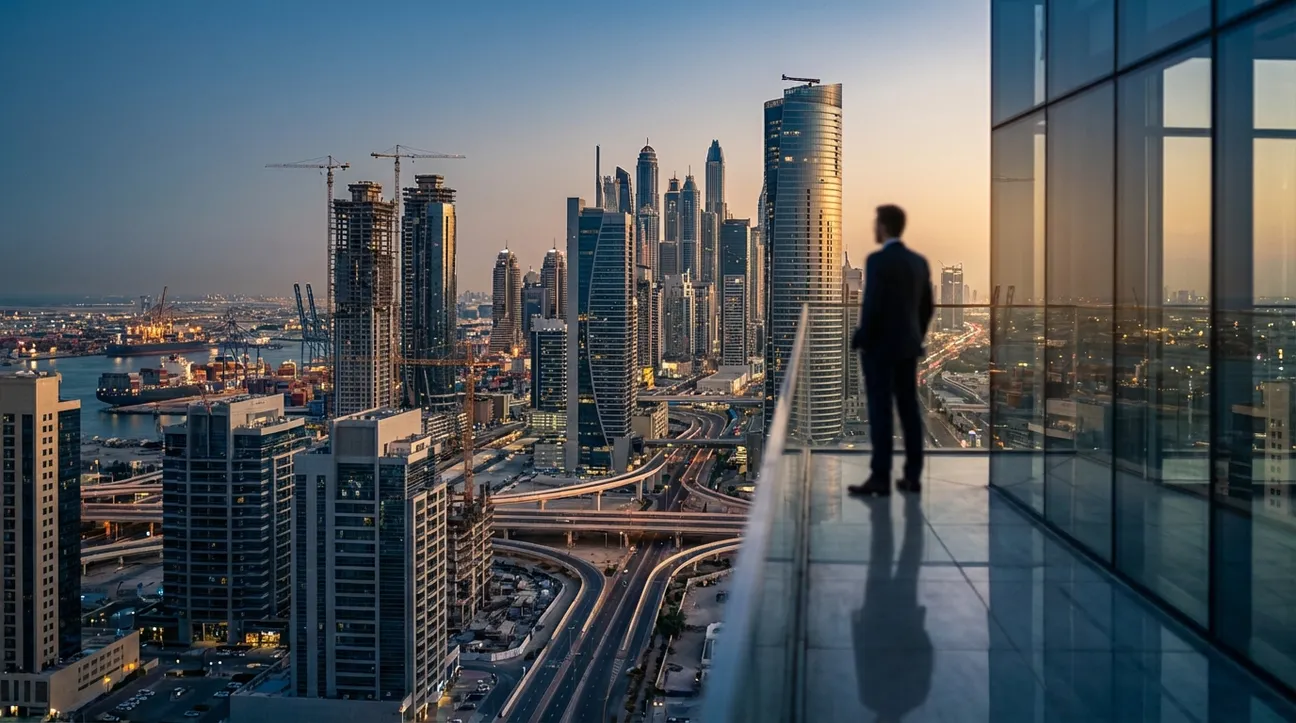
Karim Mourad and the new wave of middle-market dealmakers structuring GCC real estate for institutional scale
A cohort of Gulf-native capital structurers is bridging the gap between family wealth and full institutional mandates across a USD 141 billion market.
Executive Summary
Key Takeaways
- A new cohort of Gulf-native dealmakers is bridging family wealth and institutional capital across a USD 141.2 billion GCC real estate market projected to reach USD 260.3 billion by 2034.
- Saudi Arabia's Royal Decree No. M/14 (January 2026) enables fund-based foreign ownership structures, creating immediate demand for institutional-grade intermediaries.
- GCC residential supply is expected to grow from 6.26 million to 7.28 million units by 2030, requiring capital formation at institutional scale.
- These middle-market structurers combine local deal origination with global governance standards, offering allocators a third path beyond sovereign platforms or global fund managers.
The Gulf Cooperation Council real estate market, valued at USD 141.2 billion in 2025 according to IMARC Group, has long been narrated through two lenses: the sovereign mega-developers that shape skylines and the ultra-high-net-worth families that fill them. Between these poles, a critical layer of capital intermediation has matured with remarkably little scrutiny. Professionals such as Karim Mourad at the Abu Dhabi Investment Authority, Amr Aboushaban at Allegiance Real Estate, Jason Kow at Queensgate Investments, and Amine Bouchentouf at Atlas MENA Capital represent a new generation of dealmakers who are packaging GCC real estate opportunities for institutional deployment. Their collective significance lies in the connective tissue they provide, linking regional deal flow to global allocation frameworks at a moment when regulation, supply, and cross-border appetite are converging.
This cohort operates in a structural sweet spot. They are senior enough to access principal-level relationships, yet agile enough to originate and structure transactions that sovereign wealth funds and pension allocators increasingly demand. Understanding their role is essential for any investor seeking institutional-grade exposure to a market projected to reach USD 260.3 billion by 2034, a compound annual growth rate of 7.03% according to IMARC Group.
Who are the middle-market structurers reshaping GCC real estate capital flows?
The term "middle-market" can be misleading in the Gulf context, where transaction sizes routinely exceed what would constitute upper-market activity in most European or Asian jurisdictions. In the GCC, it refers to the intermediation layer between the largest sovereign platforms and the fragmented broker-led market that still characterises much of the region's secondary activity.
Karim Mourad occupies a distinctive position within this landscape. As Global Head of Infrastructure at ADIA, he oversees investments in renewables and digital infrastructure, asset classes that increasingly intersect with real estate through data centres, logistics parks, and mixed-use developments anchored by infrastructure concessions. Mourad's mandate reflects the broadening definition of real estate capital allocation in the Gulf, where institutional investors no longer draw rigid boundaries between property, infrastructure, and operational assets.
Amr Aboushaban brings a different but complementary dimension. Now CEO of Allegiance Real Estate, Aboushaban previously served as Chief Investor Relations Officer at Damac, where he raised USD 900 million. That capital-raising track record positions him as one of the few GCC-based operators who can speak fluently to both regional family capital and international institutional allocators. The ability to translate between these two investor universes is precisely what defines the middle-market structurer: a professional who understands the governance expectations of global institutions and the relationship-driven decision-making of Gulf families.
Jason Kow, founder and CEO of Queensgate Investments, advises and manages approximately GBP 3 billion in assets with a focus on hospitality and operationally intensive real estate. Queensgate's emphasis on hotel assets and branded residences places it at the intersection of the two fastest-growing segments in GCC property. Hotel room supply across the GCC is anticipated to grow from 345,400 rooms in 2025 to 409,900 rooms by 2030, according to Alpen Capital. Kow's platform demonstrates how London-headquartered managers with deep Gulf relationships can structure cross-border vehicles that satisfy both UK-standard governance and the return expectations of Middle Eastern capital.
Amine Bouchentouf, Chief Investment Officer at Atlas MENA Capital, adds a family office perspective with institutional discipline. Atlas MENA Capital maintains offices in Abu Dhabi and Morocco, focusing on experiential real estate and cross-border partnerships. The firm's geographic positioning across North Africa and the Gulf exemplifies the expanding definition of "GCC-adjacent" capital structuring, where deal origination extends beyond the six Council states into complementary markets.
The common thread among these four professionals is their capacity to structure transactions that meet institutional due diligence standards while originating from a regional deal flow that remains opaque to most global allocators. They function as translators, structurers, and de-riskers simultaneously.
Why does regulatory modernisation demand a new class of institutional intermediary?
The arrival of Saudi Arabia's Royal Decree No. M/14, the Law of Real Estate Ownership and Investment by Non-Saudis, entered into force in January 2026 and represents a watershed for institutional capital formation in the Kingdom. The decree replaces a restrictive, purpose-based regime with a zoning-driven framework, allowing non-Saudis to own real estate or in rem rights within designated Geographical Zones and establishing fund-based structures for broader foreign participation.
This regulatory shift creates immediate demand for professionals who can structure compliant vehicles that channel international capital into Saudi real estate. The scale of the opportunity is considerable. Saudi Arabia's residential real estate sales reached approximately SAR 118 billion, around USD 32 billion, in 2024, according to Deloitte. Fund-based structures, now explicitly enabled by the new law, require a level of institutional packaging, from offering documents to governance frameworks to reporting standards, that the traditional broker-led model cannot deliver.
The broader GCC regulatory trajectory amplifies this dynamic. Across the Council states, governments are actively encouraging institutional participation through freehold zone expansions, REIT frameworks, and residency-linked investment programmes. Each reform adds complexity that favours the structured intermediary over the transactional broker. The middle-market dealmaker thrives in precisely this environment, where regulatory knowledge becomes a competitive moat.
GCC residential supply is expected to increase from approximately 6.26 million units in 2025 to 7.28 million units by 2030, while office supply is estimated to expand from 33.3 million square metres to 42.4 million square metres over the same period, according to Alpen Capital. Absorbing this pipeline requires capital formation at a pace and scale that only institutionally structured vehicles can sustain. The era of ad hoc, relationship-only transactions is not ending, but it is being supplemented by a parallel architecture of institutionally governed partnerships, co-investment platforms, and sector-specific funds.
What does this mean for global allocators evaluating GCC real estate?
For international institutional investors, pensions, endowments, and insurance allocators, the emergence of this intermediation layer addresses one of the most persistent barriers to GCC real estate exposure: deal access and structuring quality. Global allocators have historically relied on the largest sovereign-adjacent platforms or entered through global fund managers with Gulf mandates. The middle-market structurer offers a third path, one that combines local origination with institutional governance.
The professionals profiled in this analysis share several characteristics that distinguish them from traditional intermediaries. They have direct experience within sovereign or quasi-sovereign institutions. They have raised or managed capital at scale in prior roles. They operate across multiple GCC jurisdictions and, in several cases, across continents. And they structure transactions with the documentation, governance, and reporting infrastructure that institutional limited partners require.
This matters because the next phase of GCC real estate growth will be defined by the quality of capital formation rather than the volume of development launches. A market growing at 7.03% annually toward USD 260.3 billion by 2034 will attract capital, but the terms on which that capital enters, and the governance structures that protect it, will determine whether the growth cycle produces durable institutional returns or another generation of misaligned partnerships.
GRI Institute's research and convening activity across the GCC has consistently identified the capital structuring gap as a strategic priority. Events such as the GCC-India Real Estate Week and sessions within the Global Capital Connectors programme have drawn precisely this cohort of professionals into dialogue with large-scale allocators. The Institute's community provides a platform where the emerging structurer class and established institutional capital can engage on equal terms, accelerating the professionalisation of a market segment that remains under-covered in mainstream real estate media.
The emergence of middle-market dealmakers as a recognised institutional category in GCC real estate marks a maturation point for the region's capital markets. Figures such as Karim Mourad, Amr Aboushaban, Jason Kow, and Amine Bouchentouf are defining a discipline, not merely executing transactions. Their work shapes the architecture through which billions of dollars in regional and international capital will flow into Gulf property assets over the coming decade. Investors who understand this intermediation layer, and engage with it early, will hold a structural advantage in one of the world's fastest-growing real estate markets.