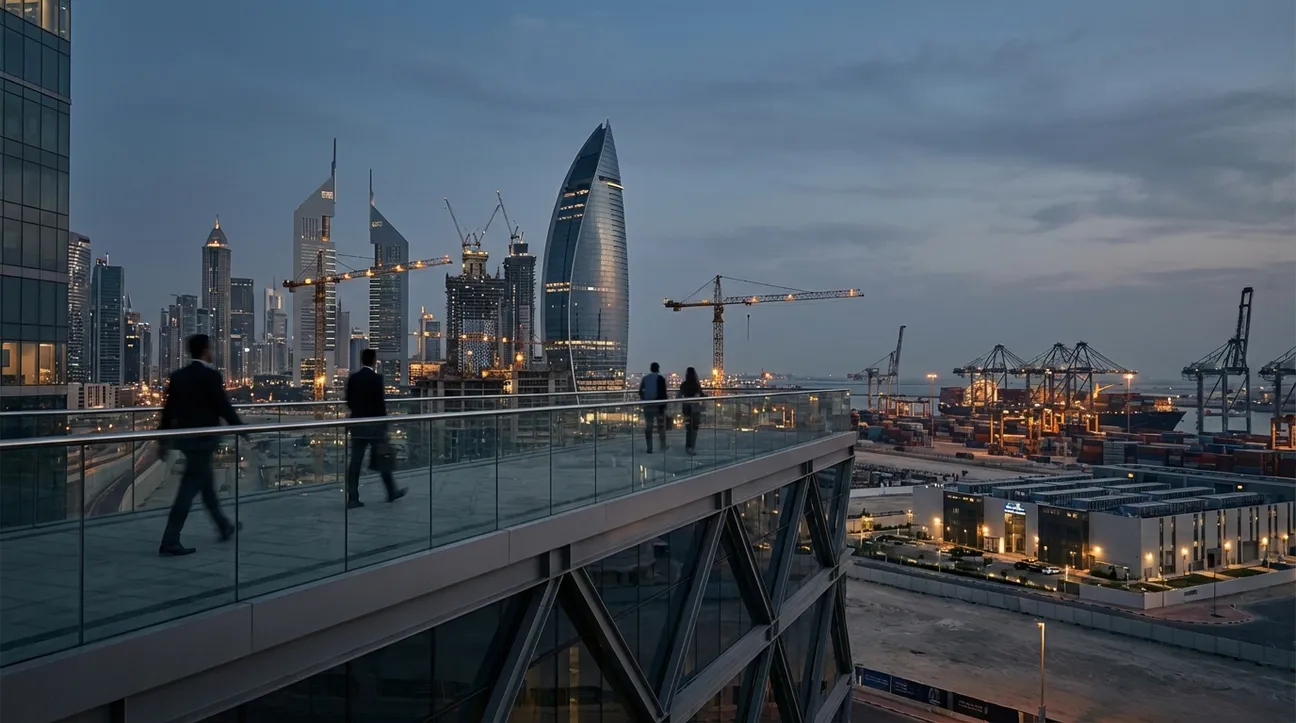
Jonathan Emery and Aldar's next frontier: engineering a regional expansion playbook from Abu Dhabi
The UAE's largest listed developer is building a co-investment architecture, tapping global debt markets, and positioning governance as a competitive moat.
Executive Summary
Key Takeaways
- Aldar reported record AED 8.8 billion net profit in 2025 (+36% YoY) on AED 40.6 billion in group sales, cementing its position as the GCC's leading listed developer.
- Aldar and Mubadala launched Aldar Capital, targeting a USD 1 billion inaugural fund to give global institutional investors regulated access to GCC real estate.
- A USD 1 billion subordinated hybrid notes deal with Apollo signals global alternative managers view Aldar as investment-grade.
- Geographic expansion into Dubai (14,000 homes with Dubai Holding) and potential Saudi Arabia entry broadens Aldar's growth runway.
- Listed-company governance and ADGM regulation create a transparency moat that attracts institutional capital over private competitors.
The listed-developer advantage in a region dominated by private principals
Across the Gulf Cooperation Council, the most consequential real estate narratives of 2025 and 2026 are being written by a relatively small number of principals with the balance-sheet depth, sovereign alignment, and institutional credibility to operate at scale. Among them, Aldar Properties occupies a distinctive position. As the UAE's largest listed developer, it combines the capital discipline of public markets with the strategic backing of Abu Dhabi's sovereign ecosystem, a combination that is proving increasingly difficult for private competitors to replicate.
Jonathan Emery, who leads Aldar Development, sits at the centre of this architecture. His mandate has evolved from delivering landmark Abu Dhabi projects to orchestrating a multi-geography, multi-asset-class expansion that now spans residential, hospitality, logistics, and emerging sectors such as data centres. The scale of execution is significant: Aldar awarded AED 66 billion in development contracts across the UAE in 2025, with almost 45% of that value recirculated into the local economy through the national In-Country Value (ICV) Programme, according to company disclosures. That level of economic embeddedness creates a feedback loop between developer performance and sovereign policy objectives, reinforcing Aldar's preferential positioning in land allocation and joint venture formation.
The financial results underscore the momentum. Aldar reported a record net profit after tax of AED 8.8 billion in 2025, a 36% year-on-year increase, driven by group sales of AED 40.6 billion, according to the company's February 2026 earnings release. These are figures that place Aldar in a category of its own among GCC-listed developers and signal a structural shift in how institutional capital views the region's real estate sector.
How is Aldar's co-investment architecture reshaping GCC capital formation?
The most strategically significant development in Aldar's recent trajectory may not be a building or a masterplan. It is a platform. In December 2025, Aldar and Mubadala Capital launched Aldar Capital, an investment management vehicle headquartered in Abu Dhabi Global Market (ADGM) designed to connect global institutional investors with GCC real estate opportunities. The platform's first fund targets a size of USD 1 billion, with an expected launch in 2026.
This move represents a fundamental evolution in the developer-investor relationship across the Gulf. Traditionally, international limited partners seeking GCC real estate exposure had to navigate bilateral relationships with sovereign wealth funds or accept the opacity of private family-office structures. Aldar Capital introduces a regulated, institutional-grade entry point with the governance standards that pension funds, endowments, and insurance allocators require.
The implications extend beyond Aldar's own balance sheet. By creating a dedicated capital formation engine with Mubadala, one of the region's most sophisticated sovereign investors, Aldar is effectively building the infrastructure for a new asset class: listed-developer-sponsored GCC real estate funds. For global LPs evaluating allocation shifts toward Gulf markets, this architecture offers a governance premium that private principals cannot easily match.
The timing aligns with broader institutional interest in the region. Entities such as KAUST Investment Management Company (KAUST IMC), which oversees the endowment for King Abdullah University of Science and Technology in Saudi Arabia, represent the kind of sophisticated capital pools increasingly active across GCC real estate corridors. As sovereign endowments and institutional allocators in Saudi Arabia and the UAE seek co-investment opportunities with credible operating partners, platforms like Aldar Capital are positioned to capture meaningful inflows.
GRI Institute's own research and convenings have tracked this convergence of institutional capital and developer-led platforms across the Gulf. The pattern is clear: the next phase of GCC real estate growth will be defined by those who can structure institutional-quality vehicles around operational excellence.
What role does debt capital markets strategy play in Aldar's competitive moat?
Capital structure is becoming a differentiator in GCC real estate, and Aldar is pressing the advantage with deliberate intensity. The company raised AED 18.7 billion in capital in 2025, according to its financial disclosures, and followed that in January 2026 with a USD 1.0 billion (AED 3.7 billion) subordinated hybrid notes issuance to Apollo Global Management, as reported by TradeArabia.
The Apollo transaction deserves particular attention. Subordinated hybrid notes occupy a specific position in the capital stack, providing equity-like characteristics for rating purposes while delivering fixed-income returns to the investor. For Aldar, this instrument strengthens the balance sheet without diluting existing shareholders. For Apollo, it represents a structured entry into one of the Gulf's most creditworthy real estate platforms. The transaction signals that global alternative asset managers view Aldar's credit profile and growth trajectory as investment-grade in substance, regardless of formal rating considerations.
This debt capital markets sophistication creates a structural advantage. Developers that can access diverse funding sources, from public equity and investment-grade bonds to hybrid instruments and sovereign co-investment, operate with a flexibility that undercapitalised competitors cannot replicate. In a market where land acquisition costs are rising and project scale is increasing, that flexibility translates directly into competitive positioning.
Aldar's develop-to-hold pipeline, which the company projects will drive further scale, diversification, and earnings growth over the next four years through 2029, benefits directly from this capital structure. Recurring income from held assets provides the cash flow stability that supports further leverage, creating a virtuous cycle between development activity and balance-sheet strength.
Expanding the geography: Dubai, Saudi Arabia, and beyond
Aldar's geographic ambitions are expanding in concentric circles outward from Abu Dhabi. The most tangible evidence is the expanded joint venture with Dubai Holding, which now includes two new strategic land plots in Nad Al Sheba and Palm Jebel Ali, expected to deliver almost 14,000 new homes, according to Aldar's February 2026 announcement. The Palm Jebel Ali component, an ultra-luxury waterfront development, is projected to launch home sales in 2027.
This Dubai expansion is strategically significant. It demonstrates that Aldar can operate as a credible development partner outside its home emirate, competing on quality and brand rather than relying solely on Abu Dhabi government-linked advantages. The joint venture structure with Dubai Holding, itself backed by the ruling family of Dubai, provides political alignment in a market where such alignment remains essential.
The Saudi Arabian opportunity, while less concretely defined in public disclosures, represents the logical next frontier. The Kingdom's Vision 2030 programme is generating real estate demand at a scale that exceeds domestic development capacity, creating openings for experienced cross-border operators. Aldar's institutional credibility, sovereign alignment, and newly established co-investment architecture through Aldar Capital position it as a natural partner for Saudi entities seeking development expertise in residential, mixed-use, and emerging asset classes.
Innovation districts and knowledge-economy corridors, such as those adjacent to institutions like KAUST, represent particularly attractive entry points. These developments require the kind of master-planning sophistication and institutional governance that Aldar has demonstrated in Abu Dhabi projects like Saadiyat Island and Yas Island.
The governance premium as competitive moat
In a region where many of the largest real estate principals operate through private, opaque structures, Aldar's listed status confers an underappreciated advantage. Public reporting requirements, independent board oversight, and capital markets scrutiny create a transparency framework that institutional investors increasingly demand. This governance premium is becoming a competitive moat in capital formation, joint venture structuring, and talent acquisition.
The launch of Aldar Capital through ADGM, one of the region's most rigorously regulated financial centres, reinforces this positioning. For international LPs conducting due diligence on GCC opportunities, the combination of listed-developer transparency, sovereign co-investment backing from Mubadala, and ADGM regulatory oversight addresses many of the concerns that have historically limited institutional allocation to Gulf real estate.
As discussions at GRI Institute events have consistently highlighted, the developers that will define the next decade of GCC real estate are those that can bridge the gap between regional ambition and global institutional standards. Aldar, under Jonathan Emery's development leadership, is constructing that bridge with deliberate, measurable progress.
The strategic calculus is clear: scale without governance is unsustainable, and governance without scale is irrelevant. Aldar is pursuing both simultaneously, and the results, measured in record profits, expanding geographies, and institutional capital partnerships, suggest the model is working.
What this means for the GCC real estate landscape
Aldar's trajectory offers a template for how GCC developers can evolve from project-level operators into institutional platforms. The combination of sovereign alignment, public market discipline, diversified capital access, and regulated co-investment vehicles creates a model that is replicable in principle but difficult to execute in practice.
For investors, operators, and policymakers tracking the region's development, three dynamics deserve sustained attention. First, the institutionalisation of GCC real estate capital formation through vehicles like Aldar Capital will reshape how global allocators access the market. Second, debt capital markets innovation, exemplified by the Apollo hybrid notes transaction, will increasingly separate well-capitalised developers from the rest. Third, cross-border expansion within the GCC, particularly into Saudi Arabia, will test whether Abu Dhabi-honed operational models can translate into new political and regulatory environments.
GRI Institute will continue to track these developments through its research programmes and leadership convenings across the Gulf, where the intersection of capital, governance, and development execution remains the defining conversation of the region's real estate future.