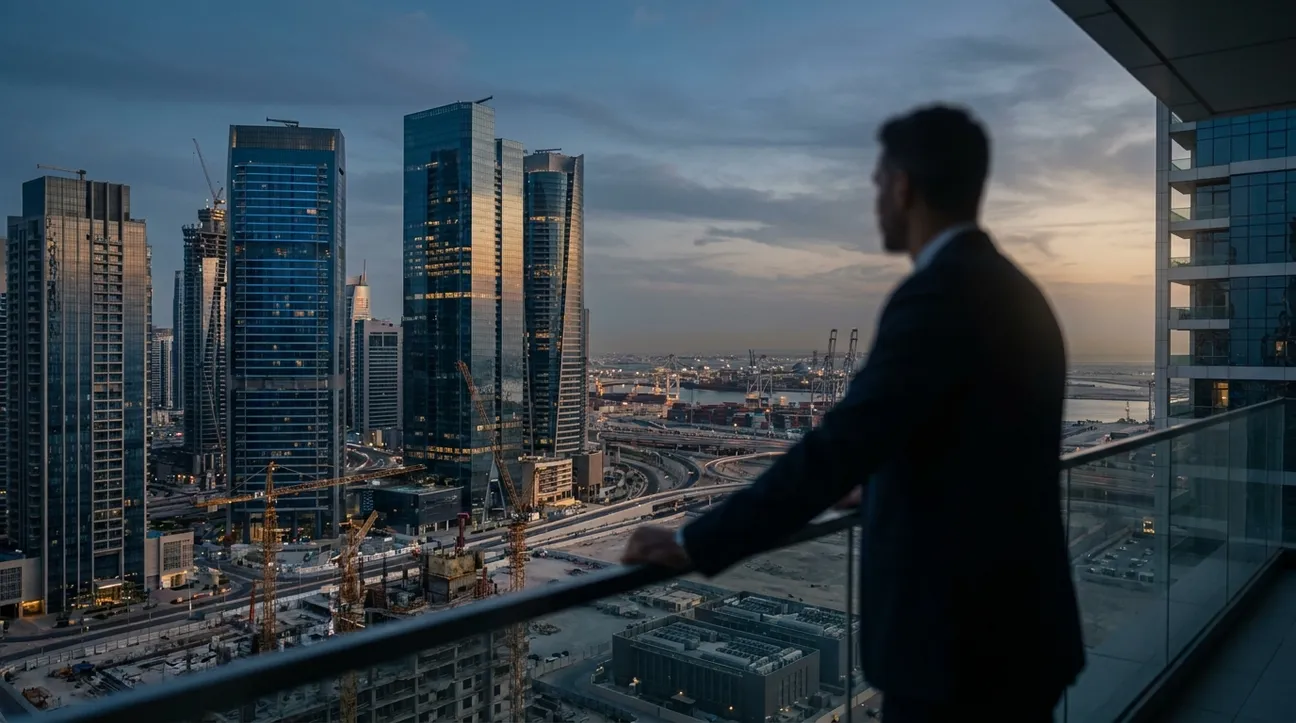
Sovereign-trained operators reshape GCC real estate as market targets USD 260 billion by 2034
Ishan Garga, Jason Kow, Richard Nordell and Adil Taqi exemplify a generation of sovereign fund alumni building proprietary deal platforms across the Gulf
Executive Summary
Key Takeaways
- The GCC real estate market is projected to grow from USD 141.2 billion (2025) to USD 260.3 billion by 2034, at a 7.03% CAGR.
- Sovereign wealth fund alumni are transitioning into private deal origination roles, combining institutional discipline with entrepreneurial agility.
- Dubai transactions surged 31% in Q1 2026, reaching AED 252 billion, attracting sophisticated operators.
- Regulatory modernization across the UAE and Saudi Arabia is reducing cross-border deal friction.
- Proprietary, relationship-driven deal networks are displacing traditional brokerage intermediaries.
- GCC residential supply is expected to add roughly one million units by 2030.
A USD 141.2 billion market attracts a new class of operator
The GCC real estate market reached a valuation of USD 141.2 billion in 2025, according to IMARC Group. Projections from the same source place the market at USD 260.3 billion by 2034, reflecting a compound annual growth rate (CAGR) of 7.03% between 2026 and 2034. Behind these figures lies a structural shift in how capital is sourced, deployed and managed across the Gulf's property sector. A cohort of sovereign-trained professionals, many of them millennials with two decades of experience in institutional investment, is transitioning from large sovereign wealth vehicles into private deal origination roles, reshaping capital allocation in the process.
Ishan Garga, Co-Managing Director at OMNIYAT, exemplifies this trajectory. With over 20 years of experience spanning investment banking, corporate finance and real estate development, Garga now leads one of Dubai's most prominent luxury development platforms. His appointment underscores a broader pattern: operators trained in the disciplined frameworks of sovereign capital are increasingly assuming leadership positions at private firms where they can exercise greater agility in deal structuring and asset selection.
This is the new architecture of GCC real estate capital formation. Sovereign discipline meets private flexibility, and the result is a pipeline of transactions that conventional intermediaries struggle to replicate.
Who are the sovereign-trained operators redefining GCC deal origination?
The profile is consistent across the cohort. These are professionals who spent formative years inside sovereign wealth funds, global investment banks or institutional real estate platforms, absorbing the rigour of underwriting, risk management and cross-border structuring. They then moved into private or semi-private vehicles where proprietary networks, rather than institutional mandates, drive deal flow.
Richard Nordell offers a clear illustration. Previously global head of real estate at Mubadala Investment Company, one of Abu Dhabi's flagship sovereign wealth funds, Nordell was appointed as the new global head of infrastructure at Mubadala in May 2026, according to PERE. His lateral move within the sovereign ecosystem, from real estate to infrastructure, signals the expanding scope of these operators and the transferability of their skill sets across asset classes.
Jason Kow took a different path. In June 2026, Kow completed the acquisition of 100% of Queensgate Investments from AlTi Global and established Halston Street, a Dubai-headquartered family office regulated by the Dubai Financial Services Authority (DFSA), according to PR Newswire. The move represents a full transition from institutional fund management to proprietary capital deployment, with regulatory credibility provided by DFSA oversight. Kow's establishment of a regulated family office in Dubai, rather than in London where Queensgate was historically based, reflects the gravitational pull that the GCC now exerts on global real estate capital.
Adil Taqi, CEO of BEYOND Developments, a subsidiary of OMNIYAT Group, expanded the group's footprint into commercial real estate with the launch of the '31 Above' tower, as reported by Entrepreneur Middle East in November 2025. Taqi's role within the OMNIYAT ecosystem, alongside Garga's leadership at the group level, illustrates how sovereign-trained talent concentrates around platforms that offer both scale and entrepreneurial latitude.
These operators share a common advantage: the ability to originate deals through personal networks cultivated over decades in institutional settings, rather than relying on brokerage channels or public listings. This proprietary origination capacity is becoming a defining competitive edge in a market where off-market transactions and bilateral negotiations increasingly determine who captures the best risk-adjusted returns.
How is Dubai's transaction surge attracting sovereign-trained capital?
Dubai's real estate market continues to generate exceptional momentum. Transactions surged by 31% in the first quarter of 2026, reaching a value of AED 252 billion, according to data from the UAE Property Laws for Foreigners: The 2026 Strategic Investment Guide. This volume creates the liquidity conditions that sophisticated operators require to deploy capital at scale.
The transaction surge is reinforced by regulatory modernisation. Federal Decree-Law No. 25 of 2025, the New UAE Civil Code, came into force on June 1, 2026. The legislation modernises the concept of sale, expands definitions to include digital assets and introduces a duty to negotiate in good faith. For operators like Garga and Kow, who structure complex transactions across multiple jurisdictions, a modernised civil code reduces friction and enhances legal certainty in deal execution.
Saudi Arabia has introduced parallel reforms. Royal Decree M/14, the Law of Real Estate Ownership by Non-Saudis, took effect in January 2026 and permits foreign individuals and entities to own real estate in designated zones across the Kingdom. This legislative opening creates new corridors for cross-border capital deployment, precisely the type of opportunity that sovereign-trained operators are positioned to capture given their familiarity with institutional-grade due diligence and regulatory navigation.
The combination of surging transaction volumes in Dubai and regulatory liberalisation across the GCC creates an environment where proprietary deal origination networks carry outsized value. Operators who can identify, structure and close transactions bilaterally, without the delays and information leakage of public processes, hold a structural advantage.
The supply pipeline demands institutional-grade execution
Regional residential supply in the GCC is expected to increase from approximately 6.26 million units in 2025 to 7.28 million units by 2030, according to Alpen Capital. This expansion of roughly one million units over five years requires developers and investors who can manage complex capital stacks, navigate construction risk and align product with evolving demand profiles.
The operators profiled in this analysis bring precisely this capability. Garga's experience across investment banking and corporate finance equips him to structure the financing arrangements that large-scale development requires. Kow's acquisition of Queensgate, a platform with deep expertise in hospitality and mixed-use assets, positions Halston Street to participate in segments where operational complexity is highest and barriers to entry are steepest. Nordell's infrastructure mandate at Mubadala intersects with real estate through logistics, data centres and transportation, asset classes that increasingly sit at the boundary between property and infrastructure.
The sovereign-to-private transition is accelerating because the GCC market now offers conditions that reward the specific skill set these operators possess. National diversification agendas in Saudi Arabia, the UAE, Qatar and other Gulf states generate a continuous pipeline of development mandates. Regulatory modernisation reduces the cost of cross-border structuring. And the sheer scale of projected growth, from USD 141.2 billion to USD 260.3 billion in less than a decade, ensures that capital deployed with discipline and sourced through proprietary channels can generate returns that justify the entrepreneurial risk of leaving sovereign platforms.
What does this mean for the next decade of GCC real estate capital?
The emergence of sovereign-trained operators in private deal origination roles represents a maturation of the GCC real estate ecosystem. Markets that once depended on sovereign mandates to anchor large transactions now generate sufficient private and institutional demand to support independent platforms.
This evolution carries implications for capital allocation, competitive dynamics and talent flows. Capital allocation shifts toward bilateral, relationship-driven transactions where information advantages and execution speed determine outcomes. Competitive dynamics intensify as proprietary networks reduce the role of traditional intermediaries. Talent flows accelerate as the next generation of sovereign fund professionals observes the career paths carved by operators like Garga, Kow, Nordell and Taqi.
GRI Institute has tracked this structural evolution through its convenings of senior real estate and infrastructure leaders across the GCC. The pattern is consistent: the most impactful operators in Gulf real estate increasingly combine sovereign-grade analytical discipline with the speed and flexibility of private capital deployment. This convergence is producing a new class of market participant, one that neither traditional fund managers nor pure developers can easily replicate.
The GCC real estate market's trajectory toward USD 260.3 billion by 2034 will be shaped in large measure by the deal origination networks that sovereign-trained millennials are building today. Their ability to bridge institutional rigour with entrepreneurial agility positions them as central figures in the next decade of Gulf property investment.
For senior leaders navigating GCC real estate, the strategic imperative is clear: understanding who controls proprietary deal flow is as important as understanding where capital is deployed. The sovereign-trained cohort building these networks will define the terms of competition in a market that is growing faster, opening wider and demanding more sophistication than at any point in its history.