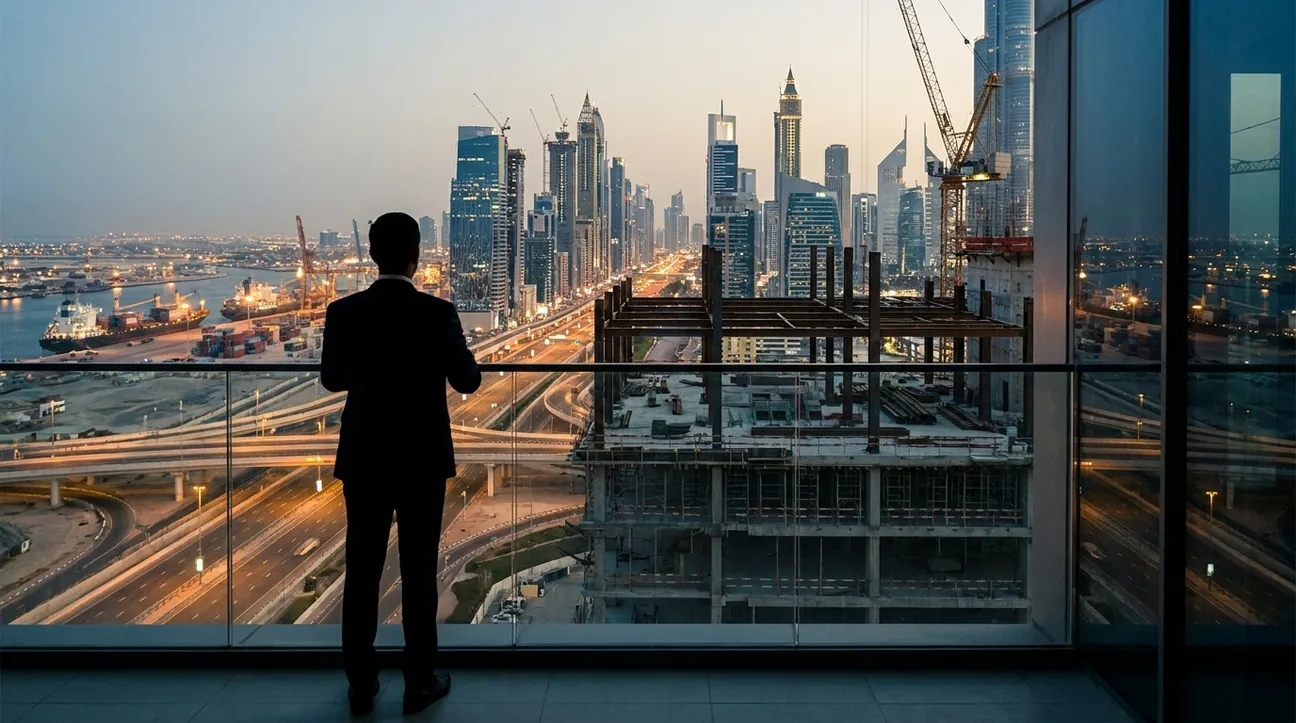
Indian principals are building direct GCC real estate platforms from institutional foundations
A new generation of sovereign-trained Indian professionals is structuring dedicated capital vehicles to capture a GCC market projected to reach USD 260.3 billion by 2034.
Executive Summary
Key Takeaways
- Dubai recorded AED 286.4 billion (~US$78B) in property sales in H1 2026, with Q1 alone up 31% year-on-year.
- The GCC real estate market is projected to reach USD 260.3 billion by 2034, growing at 7.03% CAGR.
- Sovereign-trained Indian principals are building institutional platforms—structured debt, private credit, branded residences—rather than executing one-off transactions.
- UAE's 9% corporate tax framework favors institutionally sophisticated operators with cross-border structuring expertise.
- The India-GCC corridor is becoming a self-reinforcing ecosystem integrating capital structurers, developers, and hospitality brands.
Dubai recorded AED 286.4 billion in property sales in H1 2026, and Indian institutional capital is racing to structure dedicated vehicles for the corridor
Dubai registered approximately AED 286.4 billion (US$78 billion) in property sales during the first half of 2026, according to data compiled by W Capital Real Estate Brokerage and reported by Arabian Business. The figure underscores the sustained velocity of capital flowing into Gulf real estate, a market that drew USD 141.2 billion in total GCC real estate value in 2025, according to IMARC Group. What distinguishes the current cycle from previous booms is the caliber and institutional sophistication of the capital entering the region, particularly from India.
A cohort of next-generation Indian principals, many trained at global sovereign wealth funds, private credit desks, and listed developers, is now constructing direct GCC real estate platforms. These professionals bring structured finance discipline, fund governance frameworks, and cross-border tax optimization expertise to a market historically dominated by high-net-worth individual purchases and brokerage-led transactions. The shift represents a structural maturation of the India-GCC real estate corridor.
How large is the GCC real estate opportunity these platforms are targeting?
The scale of the addressable market explains the institutional interest. IMARC Group projects the GCC real estate market will reach USD 260.3 billion by 2034, exhibiting a compound annual growth rate of 7.03% from 2026 to 2034. Supply-side fundamentals reinforce the thesis. Regional residential supply across the GCC is expected to increase from approximately 6.26 million units in 2025 to 7.28 million units by 2030, according to Alpen Capital. Commercial office supply is estimated to expand from 33.3 million square metres in 2025 to 42.4 million square metres over the same period, per the same source.
Dubai's property market recorded over AED 252 billion in the first quarter of 2026 alone, representing a 31% year-on-year increase in transaction value, according to the Dubai Land Department. The velocity of Q1 transactions signals that capital deployment is accelerating, creating structural demand for intermediary platforms that can aggregate institutional-grade deal flow, structure debt and equity tranches, and provide fiduciary governance to cross-border investors.
The combination of supply expansion, transaction velocity, and regulatory modernization makes the GCC the most capital-absorptive real estate corridor accessible to Indian institutional money today.
Amit Goenka and the Nisus Finance model: structured debt as an entry architecture
Amit Goenka, who leads Nisus Finance, is building a Dubai platform targeting US$1 billion in assets under management to bridge Indian institutional capital into structured Gulf real estate debt vehicles, as reported by GRI Hub News in February 2026. The Nisus model is significant because it prioritizes debt over equity, a deliberate architectural choice that reflects both regulatory constraints and risk management preferences of Indian institutional allocators.
Structured real estate debt vehicles offer several advantages in the GCC context. They provide predictable cash flows in a market where rental yields remain compressed relative to capital appreciation. They allow institutional investors to gain GCC exposure without taking direct development risk. And they create a scalable origination platform that can serve multiple institutional mandates simultaneously.
Goenka's approach exemplifies the broader trend of Indian principals applying institutional fund management frameworks to GCC real estate, moving beyond single-asset acquisitions toward platform-level capital structuring. The US$1 billion AUM target signals ambition commensurate with the market opportunity, positioned within a corridor where institutional intermediation remains underdeveloped relative to the volume of capital in motion.
What role does the UAE's corporate tax framework play in structuring these platforms?
UAE Federal Decree-Law No. 47 of 2022 on the Taxation of Corporations and Businesses introduced a federal corporate tax at a headline rate of 9%. This legislation has structurally shifted how institutional capital, real estate funds, and private credit vehicles structure their GCC real estate investments.
For Indian principals building dedicated platforms, the corporate tax framework creates both complexity and opportunity. Vehicles must be structured to optimize tax efficiency across jurisdictions, accounting for India's treaty network, the UAE's qualifying free zone regime, and the treatment of real estate income under the new corporate tax law. This regulatory layer favors operators with institutional structuring experience, precisely the skill set that sovereign-trained professionals bring to the market.
The tax framework has accelerated the professionalization of GCC real estate capital markets. Ad hoc investment structures that functioned adequately in a zero-tax environment now require formal fund governance, transfer pricing documentation, and substance requirements. Indian principals with backgrounds in regulated fund management are well positioned to navigate this environment, giving them a competitive advantage over less institutionally rigorous operators.
The developer corridor: Raju Shroff, Abhishek Lodha, and branded residential platforms
The institutional capital flow runs parallel to a developer-led corridor. Raju Shroff, who leads Signature Developers, partnered with Marriott International to develop the W Residences Dubai in Jumeirah Lake Towers, featuring over 180 luxury apartments, as reported by Hotelier Middle East in October 2024. This branded residence model represents the demand-side complement to the structured capital platforms being built by professionals like Goenka.
Branded residences have become a defining asset class in GCC luxury real estate. They combine hospitality operational expertise with residential capital appreciation, creating hybrid investment products that appeal to both end-users and yield-seeking investors. Indian developers with established relationships with global hospitality brands bring a competitive advantage to this segment, leveraging brand partnerships cultivated in India's own luxury residential market.
Abhishek Lodha, who leads Lodha Group, represents the family-office dimension of Indian capital flowing into the GCC. While specific capital allocation figures for Lodha's direct GCC investments are not publicly disclosed for 2026, the presence of principals from India's largest listed residential developers in the Gulf market signals the depth and permanence of the corridor.
The convergence of institutional capital structurers and branded residential developers creates a vertically integrated India-GCC real estate ecosystem. Capital platforms provide financing. Developers provide product. Hospitality brands provide operational infrastructure and pricing power. The ecosystem is self-reinforcing, and its institutional foundations distinguish it from earlier waves of Indian investment in Gulf property.
Dhruva Agarwal and the private credit generation
Dhruva Agarwal represents an emerging node in this capital flow. Formerly positioned at BlackRock's private credit operations in India, Agarwal's profile has generated significant organic interest among GRI Institute's membership base, indicating active market attention to his next moves. While specific details of any current GCC real estate platform or venture are not yet publicly documented, the trajectory is consistent with the broader pattern: sovereign and institutional alumni applying global private credit frameworks to GCC real estate opportunities.
The private credit skill set is particularly relevant to the current GCC cycle. As traditional bank lending faces regulatory capital constraints and developers seek flexible financing structures, private credit operators can fill a structural gap. Professionals trained at global asset managers bring origination discipline, credit underwriting rigor, and portfolio construction expertise that the GCC real estate debt market requires as it scales.
GRI Institute members tracking this corridor should monitor the emergence of dedicated private credit vehicles targeting GCC real estate, a segment where institutional supply has not yet matched the depth of investable demand.
Nishant Pradhan and the AI-driven capital structuring frontier
Nishant Pradhan, positioned at Mirae Asset Investment Managers, represents the technology-augmented dimension of India-GCC capital structuring. The integration of artificial intelligence into investment management workflows, from deal sourcing and underwriting to portfolio monitoring and risk management, is creating a new operational layer for cross-border real estate platforms.
AI-driven capital structuring tools allow smaller teams to manage larger portfolios with greater analytical depth, a critical capability for Indian platforms operating in a market where local knowledge and data infrastructure remain fragmented. The combination of institutional governance frameworks with AI-enhanced analytical capabilities positions this generation of Indian principals to build scalable, technology-native platforms rather than traditional advisory practices.
A structural corridor, not a cyclical flow
The India-GCC real estate corridor is consolidating around institutional architecture. The principals driving this consolidation, from Amit Goenka's US$1 billion debt platform to Raju Shroff's branded residence developments and the emerging private credit generation represented by professionals like Dhruva Agarwal, share a common foundation: training at globally regulated institutions, fluency in structured finance, and the operational discipline to build platforms rather than execute transactions.
In a GCC market projected to nearly double in value over the next eight years, the competitive advantage belongs to operators who can aggregate institutional capital, structure compliant cross-border vehicles, and deliver governance standards that satisfy both Indian and Gulf regulatory frameworks. The next-generation Indian principals building these platforms are positioning themselves at the center of what may become the most consequential south-south real estate capital corridor of the decade.
GRI Institute continues to track the principals, platforms, and capital structures shaping the India-GCC real estate corridor through its membership network and editorial coverage.