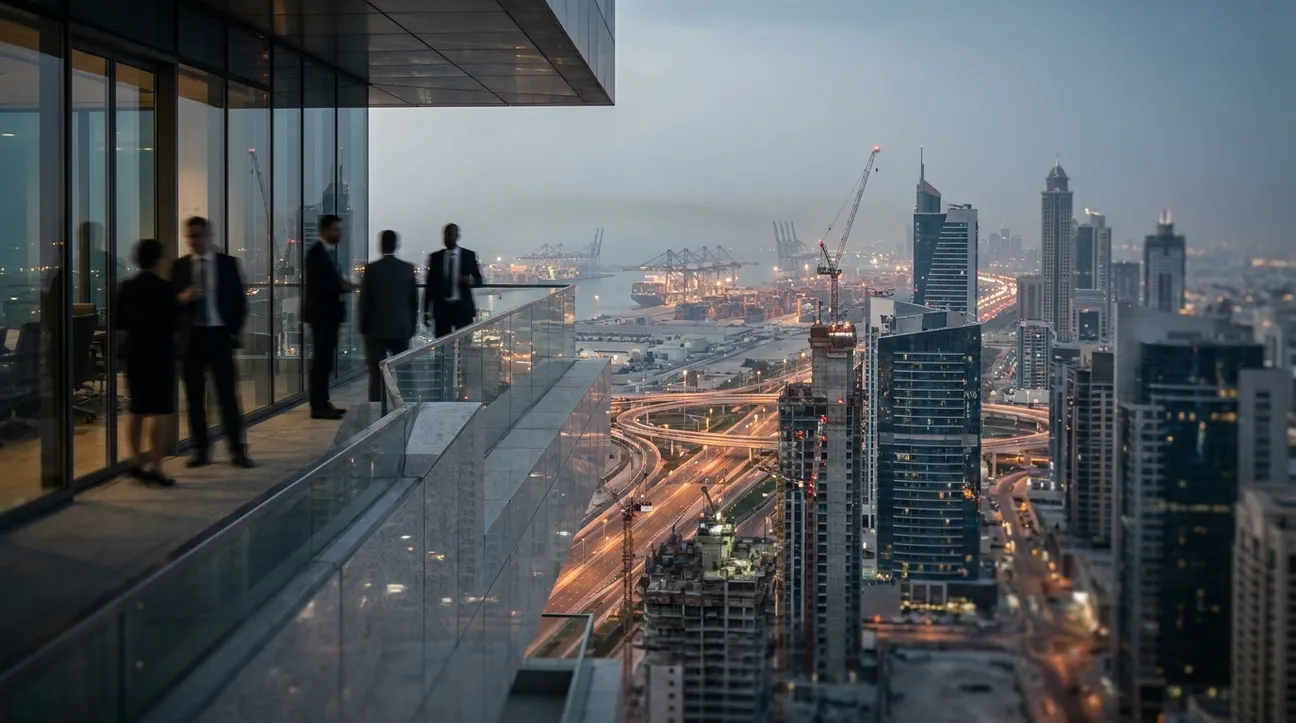
Indian family offices scale commercial real estate platforms across the GCC as market heads toward USD 260 billion
Mid-market Indian capital is reshaping GCC commercial real estate, with Dubai alone recording AED 917 billion in transactions in 2025 and Indian buyers leading foreign residential purchases.
Executive Summary
Key Takeaways
- Indian nationals are Dubai's largest foreign investor group, accounting for 22–23% of foreign residential purchases with an estimated AED 35–40 billion invested in 2025.
- Dubai's 7.47% rental yield significantly outperforms London (3.3%) and New York (5.8%), attracting yield-seeking Indian family offices.
- The GCC real estate market is projected to grow from USD 141.2 billion in 2025 to USD 260.3 billion by 2034.
- Indian family offices are shifting from individual apartment purchases to platform-level commercial investments and joint ventures.
- Saudi Arabia's 2026 regulatory reforms open new expansion opportunities for Indian capital already established in Dubai.
Indian investors now account for nearly a quarter of Dubai's foreign property purchases
Indian nationals invested an estimated ₹85,000 to ₹95,000 crore (AED 35–40 billion) in Dubai's residential real estate in 2025, according to The Economic Times. That figure positions Indian buyers as the single largest foreign investor group in the emirate, accounting for 22% to 23% of all foreign residential property purchases during the year, per data from Anarock Property Consultants.
The scale of this capital deployment is not incidental. It reflects a structural alignment between Indian family office strategies and GCC market fundamentals that has been building for the better part of a decade. As the GCC real estate market, valued at USD 141.2 billion in 2025 according to IMARC Group, advances toward a projected USD 260.3 billion by 2034 at a compound annual growth rate of 7.03%, the role of Indian-origin operators and capital allocators in shaping the region's commercial property landscape deserves close analytical attention.
Who are the Indian family offices driving GCC real estate capital flows?
The Indian capital presence in GCC real estate is far from monolithic. It spans publicly listed institutional vehicles, mid-market family offices, and high-net-worth individual portfolios. Within GRI Institute's network and the broader industry, several names have emerged as representative figures of this capital corridor.
Raju Shroff, CEO of Regal Group and a figure in Dubai's development landscape through Signature Developers, represents the category of Indian-origin operators who have built vertically integrated platforms combining development, asset management, and brokerage. His activities illustrate how first-generation Indian entrepreneurs in the Gulf have transitioned from trading businesses into structured real estate operations.
Amit Goenka, founder of Nisus Finance, exemplifies a more institutional approach. Nisus Finance expanded its UAE property portfolio with a ₹247 crore investment in residential apartments in Majan, Dubai, as reported by Hindustan Times in March 2026. This deployment signals a deliberate strategy of targeting mid-market residential segments where yield compression has been less aggressive than in the ultra-luxury tier.
Pawan Chindalia, recognized for his role as Head of Finance at Emaar Malls, represents Indian-origin executives who operate within the GCC's largest corporate real estate structures and bring institutional discipline to capital allocation decisions.
Parag Gathani occupies a distinct position within this ecosystem. Associated with Harrsh Exim, Gathani's profile reflects the trajectory of mid-market Indian family offices that have built commercial scale through trading operations and are now channeling accumulated capital into GCC real estate platforms. While specific portfolio details for Gathani's real estate holdings are less publicly documented than those of his peers, the search interest around his activities, tracked by GRI Institute, indicates growing market attention to this category of operator.
The common thread among these figures is a willingness to deploy patient, family-controlled capital into GCC real estate at a moment when institutional investors from Europe and North America are still recalibrating their regional risk assessments.
Why does Dubai's yield advantage attract Indian commercial real estate capital?
Dubai's rental yield stood at 7.47% as of June 2025, according to Markaz. That figure substantially outperforms comparable global gateway markets: London registered 3.3% and New York 5.8% over the same period.
For Indian family offices, this yield differential is particularly meaningful. Many of these investors benchmark returns against Indian domestic commercial real estate, where yields in prime Mumbai or Bangalore office markets have compressed significantly. Dubai offers higher current income, lower tax friction under the UAE's federal framework, and a regulatory environment that has progressively liberalized foreign ownership.
Federal Decree-Law No. 26 of 2020 removed the previous 49% foreign ownership cap and the Emirati sponsor requirement for onshore companies and properties in designated freehold areas. This legislative shift fundamentally altered the calculus for Indian family offices considering platform-level investments rather than individual unit purchases.
The transaction volume supports this thesis. Dubai recorded 270,000 real estate transactions worth AED 917 billion in 2025, according to the Dubai Land Department. Indian-origin capital contributed a measurable share of this activity, and the trend points toward deeper engagement with commercial asset classes, including office, retail, and logistics.
The GCC supply pipeline creates new entry points
The opportunity set for Indian family offices extends well beyond Dubai's residential sector. Across the GCC, the supply pipeline is expanding in ways that create natural entry points for mid-market commercial investors.
Regional residential supply is expected to increase from approximately 6.26 million units in 2025 to 7.28 million units by 2030, according to Alpen Capital. More relevant for commercial-focused family offices, office supply across the GCC is estimated to expand from 33.3 million square metres in 2025 to 42.4 million square metres by 2030, per the same source.
This 27% expansion in office supply over five years represents a significant volume of development activity that requires equity, mezzanine financing, and operating partnerships, precisely the types of capital structures where Indian family offices have demonstrated competence in their domestic market.
Saudi Arabia's regulatory evolution adds another dimension. Royal Decree M/14, effective as of January 22, 2026, permits foreign individuals, companies, and funds to acquire ownership, usufruct, or easement rights in designated zones. This replaces a 2000-era framework that was considerably more restrictive. For Indian family offices that have built GCC expertise through Dubai operations, Saudi Arabia's opening represents a logical geographic expansion.
The convergence of supply growth, regulatory liberalization, and yield advantage creates structural tailwinds for Indian commercial real estate platforms operating across multiple GCC jurisdictions.
How is geopolitical uncertainty affecting Indian capital deployment in the GCC?
Geopolitical tensions in early 2026, particularly around the US-Israel-Iran axis, have introduced a measure of caution into transaction volumes among Indian buyers in Dubai. Industry participants report a shift toward bargain-hunting rather than withdrawal, suggesting that Indian family offices view the current environment as an opportunity to acquire assets at more favorable entry points rather than as a reason to exit.
This behavioral pattern is consistent with the long-term orientation of family office capital. Unlike institutional fund managers operating under quarterly reporting pressures, family offices can extend their holding periods and deploy counter-cyclically.
The long-term fundamentals supporting Indian capital flows into GCC real estate remain intact. Population growth, economic diversification programs, tourism infrastructure expansion, and the continued deepening of the Dubai-India economic corridor all provide structural support.
Indian family offices are increasingly sophisticated in their approach to GCC real estate. The era of individual apartment purchases as a capital preservation strategy is giving way to platform-level investments in commercial assets, joint ventures with local developers, and structured finance arrangements.
A maturing capital corridor
The Indian family office presence in GCC commercial real estate has evolved from opportunistic to strategic. Figures such as Raju Shroff, Amit Goenka, Pawan Chindalia, and Parag Gathani represent different facets of this evolution, from vertically integrated development platforms to institutional finance vehicles to mid-market family offices scaling their regional presence.
The data supports the narrative. A market growing toward USD 260.3 billion by 2034, yields that outperform global benchmarks by 200 to 400 basis points, and a regulatory framework that increasingly welcomes foreign ownership all point toward continued and deepening Indian capital engagement.
For industry participants tracking these flows, the mid-market family office segment deserves particular attention. These operators combine the agility of private capital with increasing institutional sophistication, and they are building the commercial real estate platforms that will define the next phase of GCC market development.
GRI Institute continues to track the evolution of cross-border capital corridors in GCC real estate through its network of senior industry leaders and its program of member-led discussions across the region. The Indian-origin operator and capital allocator segment remains one of the most dynamic verticals within this coverage.
As the GCC real estate market enters its next growth phase, the operators who have built cross-border platforms with patient, family-controlled capital are positioned to capture disproportionate value. The market data confirms that this capital is already arriving at scale. The strategic question is where it deploys next.