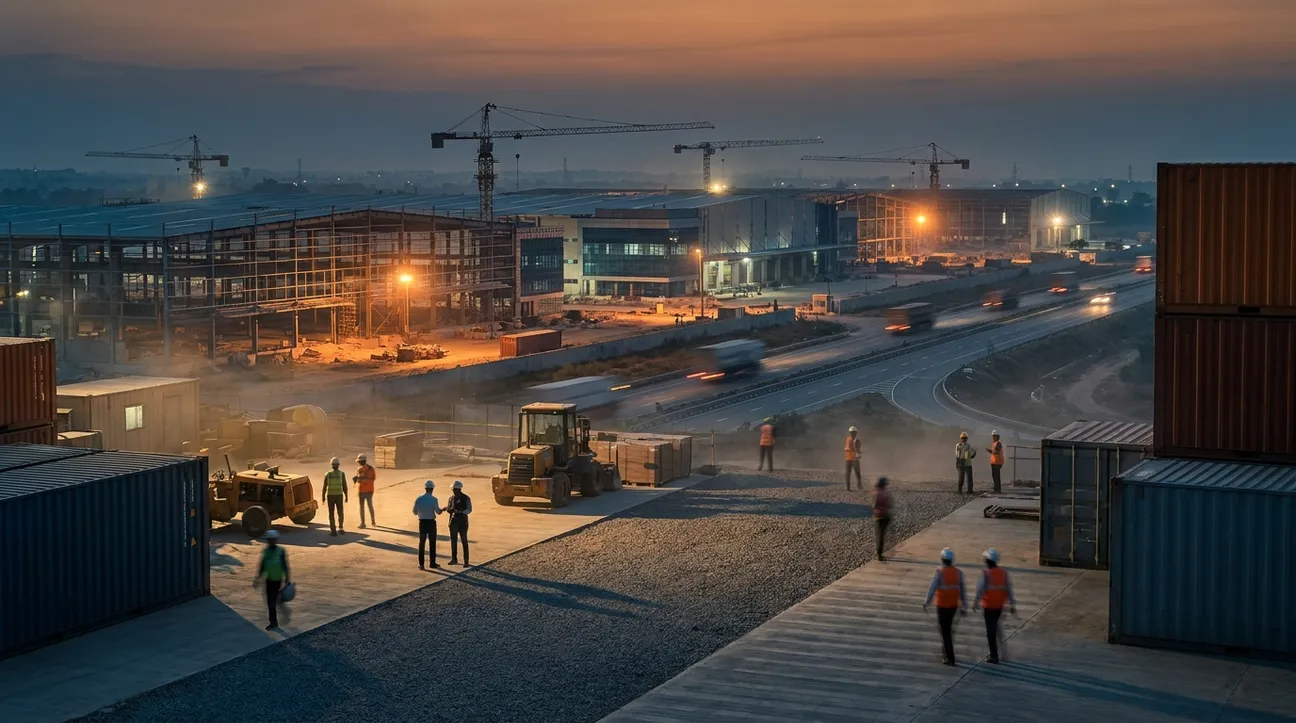
India's warehousing capital wave: how $6.7 billion in real estate investment is reshaping logistics deal flow
Institutional gatherings are becoming critical infrastructure for capital allocation as India targets a $300 billion warehousing opportunity over the next 15 years.
Executive Summary
Key Takeaways
- Private equity in Indian real estate hit $6.7B in 2025 (up 59% YoY), with logistics and warehousing emerging as a defining asset class.
- India's warehousing market represents a $300B opportunity over 2025–2040, attracting 76% foreign capital.
- Grade-A warehousing absorption rose 24.5% YoY in H1 2025 to 34 million sq ft, confirming structural demand.
- National policies are compressing logistics costs from 10–12% of GDP toward 7–8%, with further room to improve.
- Curated institutional gatherings are becoming critical deal origination infrastructure, compressing timelines and shaping capital flows before formal advisory channels.
Private equity capital deployed into Indian real estate reached $6.7 billion in 2025, a 59% year-over-year increase, according to Savills India. Within that surge, the industrial and logistics segment has emerged as a defining asset class, drawing institutional investors, sovereign wealth funds, and global operators into a market that now holds approximately 400 million square feet of Grade-A warehousing space, per Avendus Capital.
The scale of capital flowing into Indian logistics real estate is no longer a trend. It is a structural shift. And the mechanisms through which that capital finds its targets, whether through curated roundtables, investor gatherings, or sector-specific convenings, are becoming as consequential as the assets themselves.
A $300 billion opportunity attracts global capital
India's warehousing and logistics market is valued at a $300 billion opportunity over the next 15 years, according to Avendus Capital. That projection spans the period from 2025 to 2040 and reflects the convergence of several macro forces: rapid urbanization, the digitization of supply chains, the expansion of e-commerce fulfillment networks, and a regulatory environment increasingly oriented toward logistics modernization.
Foreign investors contributed 76% of total private equity inflows into Indian real estate in 2025, according to Savills India. This dominance of cross-border capital underscores the degree to which India's logistics infrastructure has become a global investment destination, attracting players from Singapore, the Middle East, North America, and Europe.
Private equity investment inflows in Indian real estate are projected to reach between $6.5 billion and $7.5 billion in 2026, according to Savills India. That sustained momentum suggests the capital pipeline is deepening, with logistics and warehousing positioned as a core allocation vertical alongside data centers and mixed-use developments.
How are institutional gatherings shaping warehousing deal origination?
The conventional pathway for deal origination in real estate, through bilateral broker introductions and capital advisory mandates, is being supplemented by a more structured form of relationship building. Institutional gatherings and sector-specific roundtables have become forums where principals meet principals, where capital allocation strategies are discussed before formal processes begin, and where the contours of future transactions take shape.
GRI Institute, a global club for leaders in real estate and infrastructure, convenes gatherings that bring together investors, developers, and operators across asset classes. Events such as the GRI Warehousing & Logistics India 2026, scheduled for November 2026 in Mumbai, exemplify this model. These are closed-door, curated discussions where participants are senior decision-makers with direct capital deployment authority.
The value of such gatherings lies in their capacity to compress the deal origination timeline. In a market where $6.7 billion in private equity capital was deployed in a single year, the ability to identify counterparties, assess alignment on risk-return expectations, and establish trust before formal due diligence begins offers a measurable competitive advantage.
Institutional gatherings are becoming critical infrastructure for capital allocation in Indian logistics real estate, functioning as pre-market forums where deal flow is mapped before it reaches formal advisory channels.
What role does India's policy framework play in accelerating warehousing investment?
Three policy instruments are actively shaping the environment for institutional warehousing investment in India.
The National Logistics Policy aims to reduce logistics costs to 10% of GDP and create a favorable environment for organized and standardized warehouse developments. India's logistics cost as a share of GDP has already fallen from 10-12% to around 7-8%, according to data from Bimtek Group shared in a GRI Institute interview in July 2026. While this represents significant progress, it still trails the 3-4% benchmark of developed markets, indicating substantial room for efficiency gains through infrastructure investment.
The PM GatiShakti National Master Plan emphasizes the need for standardized physical assets, processes, and service quality benchmarks in logistics and warehousing. This framework provides the infrastructure backbone, multimodal connectivity, freight corridors, and port linkages, that underpins the viability of Grade-A warehousing assets in emerging corridors.
The State Warehousing Policy 2026, a five-year state-level policy, offers a 25% fixed capital subsidy capped at ₹2 crore for projects in delta and Category C districts, aiming to support a $1 trillion state economy by 2030. This policy is significant because it incentivizes warehousing development beyond the traditional Tier-1 clusters of Mumbai, Pune, Bengaluru, and Delhi-NCR, pushing institutional capital toward secondary and tertiary markets.
The regulatory architecture supporting Indian warehousing is maturing rapidly, creating a policy environment that rewards institutional-grade development and penalizes informality.
Absorption data confirms structural demand
The industrial and warehousing real estate segment witnessed absorption of 34 million square feet in H1 2025, a 24.5% year-over-year increase, according to Savills India. This absorption figure reflects genuine occupier demand driven by third-party logistics operators, e-commerce fulfillment centers, quick-commerce dark stores, and manufacturing firms restructuring their supply chains.
With approximately 400 million square feet of Grade-A warehousing space currently available across India, per Avendus Capital, the absorption rate suggests healthy demand dynamics. Supply is expanding, but occupier demand is keeping pace, a balance that supports both rental growth and development-stage returns for institutional investors.
India is projected to be among the top six users of warehouse automation systems worldwide, with the market expected to reach $2 billion annually, according to JLL. This automation trajectory adds a technology premium to warehousing assets that incorporate robotics-ready floor loads, higher clear heights, and integrated warehouse management systems.
The people driving warehousing capital allocation
Capital flows follow conviction, and conviction in institutional real estate is built through relationships between principals. The leaders shaping India's warehousing investment landscape reflect the sector's increasing sophistication.
Quaiser Parvez was appointed CEO, India for CapitaLand Investment in July 2026, with a mandate covering logistics, data centres, and business parks. His appointment signals CapitaLand's deepening commitment to Indian logistics infrastructure and its intention to scale its platform across development corridors that align with national multimodal connectivity plans.
Honest Group, a Mumbai and Pune-based developer known for ultra-luxury residential and infrastructure projects, is emerging as a non-legacy developer platform scaling institutional real estate in Tier-2 corridors. The group's trajectory reflects a broader pattern: established developers diversifying into logistics and warehousing as the asset class matures from an operational niche into an institutional allocation category.
These leadership appointments and platform expansions are precisely the kind of developments that surface in institutional gatherings before they appear in market reports, reinforcing the value of curated convenings as intelligence infrastructure.
The convergence of capital, policy, and convening
India's warehousing and logistics sector sits at the intersection of three accelerating forces. Capital availability is at historic levels, with $6.7 billion deployed in 2025 and projections of $6.5 billion to $7.5 billion in 2026. Policy support is multi-layered, spanning national logistics cost reduction targets, multimodal infrastructure planning, and state-level capital subsidies. And the convening infrastructure, through platforms like GRI Institute, is creating the relationship architecture that converts capital intent into deployed transactions.
The $300 billion opportunity identified by Avendus Capital over the next 15 years will not be captured through market reports alone. It will be captured through the density and quality of relationships between the principals who control capital allocation, and through the forums that facilitate those relationships at scale.
For institutional investors evaluating Indian logistics real estate, the question is no longer whether the fundamentals support allocation. The absorption data, the policy trajectory, and the capital deployment numbers have answered that question decisively. The operative question now is how to position within the deal origination ecosystem, and that positioning increasingly runs through the curated gatherings where India's warehousing capital wave is being mapped in real time.
As India's logistics cost structure continues to compress toward developed-market benchmarks, and as automation systems scale toward a $2 billion annual market, the warehousing asset class will demand increasingly sophisticated capital partners. The institutional gatherings that bring those partners together are no longer peripheral to the investment process. They are central to it.