 Freepik
India Warehousing Exit Strategy: GRI’s Guide to Private Sales, InvITs, and IPOs
Real estate experts explain how scale, valuation, and growth potential dictate the right exit path, from private sales to IPOs
October 28, 2025Real Estate
Written by:Jorge Aguinaga
Key Takeaways:
- Exit strategies are dictated by scale, with various options available depending on the platform's size, structure, and strategic goals.
- Smaller platforms benefit from private sales for speed and simplicity, while mid-size portfolios are better suited for InvITs due to stable cash flows.
- Large platforms with significant growth potential may consider IPOs, but this strategy carries substantial risks and requires long-term investor commitment.
As India’s warehousing and logistics real estate sector matures, the conversation has decisively shifted from development to the critical question of exits.
With strong market demand and capital available from diverse sources - including a significant rise in domestic Indian capital - platforms are now evaluating the right logistics platform exit.
The choice is not one-size-fits-all; the optimal path for a private sale vs IPO warehousing or an InvIT depends entirely on scale, structure, and strategic goals.
Comparing warehousing exit strategies
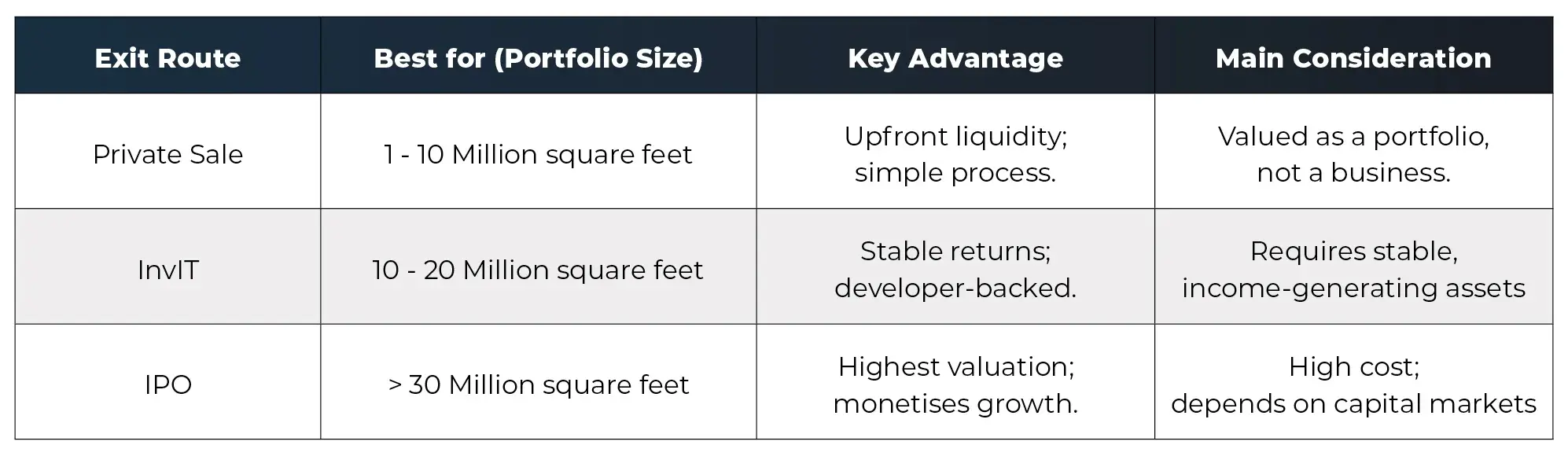
Key factors for choosing an India warehousing exit strategy (GRI Institute)
Exit Strategy 1: The Private Sale for Speed and Simplicity
For small to mid-sized platforms, a private sale is often the most efficient and direct exit route. This strategy is best suited for portfolios ranging from one to 10 million square feet or for those that are concentrated in a single city or product type.The primary advantages are clear: the platform receives upfront liquidity and can often secure favourable cap rates. Furthermore, a private sale can offer significant tax advantages.
The main trade-off for this simplicity is control. The developer cedes control of the assets and the platform is valued as a static portfolio rather than for the ongoing value of the business itself.
Exit Strategy 2: Why a Warehousing InvIT is Ideal for Stabilised Portfolios
For platforms that have achieved a medium scale, typically in the 10 to 20 million square feet range, a warehousing InvIT presents an ideal structure.While REITs are an option for commercial real estate, InvITs are the primary vehicle for logistics as the industrial sector is not classed as real estate.
This route is designed for stabilised, income-generating portfolios, as investors are primarily seeking stable cash flows.
A key advantage for an InvIT is being "developer-backed". This structure is a near-necessity, as it ensures a continuous pipeline of assets.
This is crucial because InvITs are legally required to distribute 90% of their net distributable cash flow, leaving little retained capital for new construction. A committed developer sponsor provides this crucial growth pipeline, assuring investors of continued returns.
 Top experts at India GRI 2025 discuss the future of warehousing exits, debating the right track for India's logistics platforms. (GRI Institute)
Exit Strategy 3: The Warehousing IPO in India for Large-Scale Growth and Valuation
A warehousing IPO in India is considered the best route for large-scale platforms, typically those exceeding 30 million square feet. This path is uniquely suited for organisations with large undeveloped land banks and significant future growth potential.The single biggest advantage of an IPO is that it allows the developer to monetise the entire business - the brand, the management team, and the development pipeline - not just the completed assets. This can result in "significantly better" valuation multiples.
However, this high-reward strategy comes paired with much higher stakes, demanding patient investors with an 8 to 10-year horizon and involving substantial costs. Once public, the company faces relentless higher quarterly pressure for growth.
The risks of an IPO are not just financial but structural, and success is highly dependent on conducive capital markets at the time of listing; a poor market could result in a worse outcome than a private sale.
Looking Forward
Ultimately, there is no single right track. The choice of a logistics platform exit is a complex strategic decision that must align with a platform's scale, investor alignment, corporate structure, and risk tolerance.The maturation of these distinct exit paths signals a new phase of value creation for the sector. As more platforms successfully navigate these strategies, it will likely unlock a fresh wave of institutional and retail capital, further fuelling the growth of India's sophisticated logistics and industrial real estate landscape.
We extend our thanks for these strategic insights to the participants of the India GRI 2025 panel discussion on warehousing platforms. The session was moderated by Hemant Prabhu, COO - Industrial & Logistics at Hiranandani Group, and featured reflections from leading experts including Abhay Goyal, Chief Investment Officer at Logicap Investment Advisers; Abhijit Malkani, CEO of ESR India; Alok Jain, Managing Director at Blackstone; Girish Singhi, Founder of Crest Capital Management; Krishnan Iyer, CEO of NDR InVIT; Pallavi Bhargava, Senior Director at CDPQ; R K Narayan, President - Strategy & Business Development at Horizon Parks; and Rohit Hegde, Managing Director of KSH Infra.