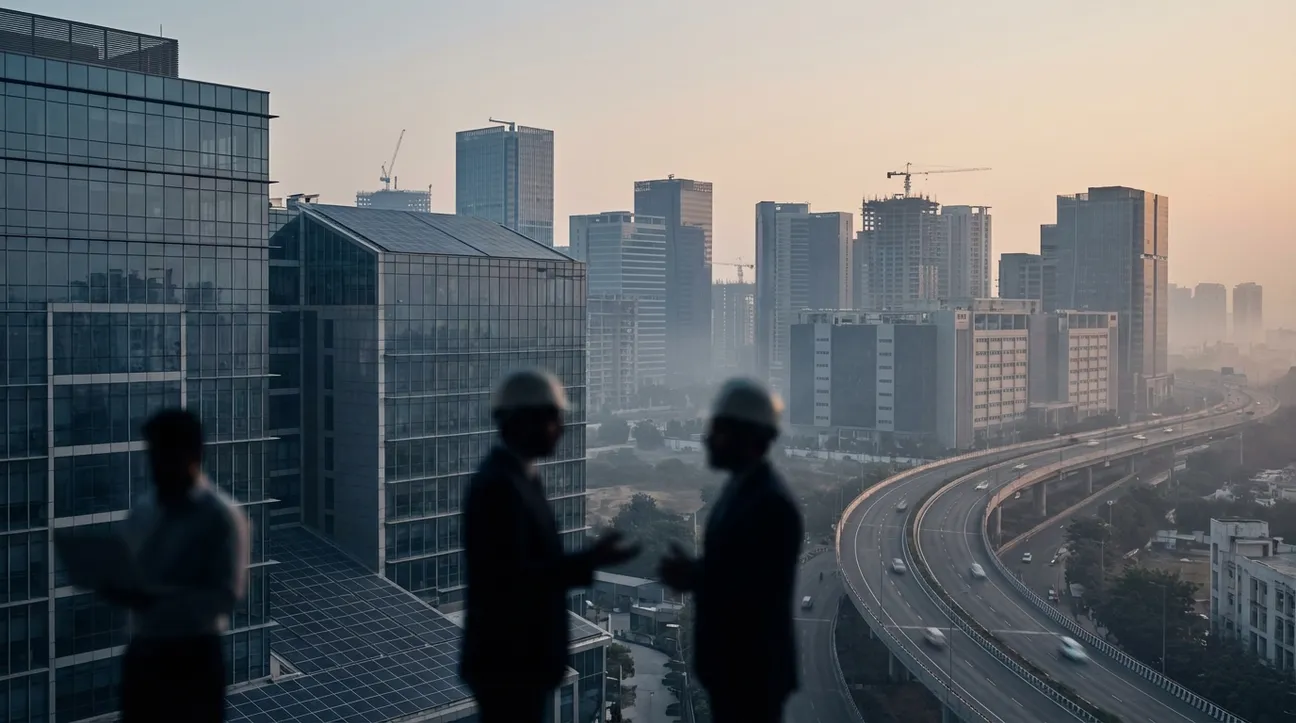
India's renewable energy-real estate convergence unlocks new asset classes worth ₹50,000 crore
Clean power operators, institutional investors, and construction partners are forging a cross-sector pipeline that reshapes how Indian real estate is powered an
Executive Summary
Key Takeaways
- Avaada Group and Brookfield have each committed ₹50,000+ crore to renewable energy projects in individual Indian states, creating downstream demand for new real estate typologies.
- Renewable energy operators like ReNew Power are becoming de facto infrastructure partners for capital-intensive assets such as data centers and industrial campuses.
- India's Green Energy Open Access Rules (2022) lowered the threshold from 1 MW to 100 kW, enabling smaller commercial real estate assets to procure renewable power directly.
- India's data center pipeline of ₹2 lakh crore structurally pairs data center developers with renewable operators.
- Regulatory mandates are transforming renewable energy procurement from optional to obligatory for commercial real estate.
Avaada Group has committed ₹50,000 crore to renewable energy projects in Madhya Pradesh alone, spanning solar, wind, and pumped storage assets (Source: Avaada Group / EQ Magazine, February 2025). The figure is significant for real estate leaders because it represents a category of capital deployment that increasingly intersects with physical asset development, from manufacturing campuses and green industrial parks to data center corridors requiring dedicated clean power infrastructure. Across India, a parallel investment of comparable scale is taking shape in Andhra Pradesh, where Brookfield has proposed over ₹50,000 crore in renewable energy assets over the next three to five years (Source: EQ Magazine / PTI, August 2024). These are not isolated energy bets. They are structural commitments that create downstream demand for new real estate typologies.
GRI Institute tracks this convergence as one of the defining themes shaping Indian real estate's next cycle. The operators, financiers, and construction partners driving it form an ecosystem that members across the club's India network are actively navigating.
From power generation to physical asset creation: the Avaada model
Avaada Group offers the clearest illustration of how a renewable energy company becomes a real estate developer by necessity. The group inaugurated a 1.5 GW solar module manufacturing facility in Noida (Dadri) and is developing a 5 GW integrated manufacturing unit in Greater Noida (Source: Construction World / Economic Times, March 2025). These are industrial real estate assets at scale, requiring land acquisition, zoning approvals, logistics connectivity, and workforce housing, the full suite of considerations familiar to any commercial developer.
The Noida and Greater Noida facilities represent a model in which energy companies anchor large land parcels and catalyse surrounding development. A 5 GW integrated unit demands substantial built area, warehousing, and transportation infrastructure. For institutional real estate investors, such projects create adjacency opportunities: logistics parks serving component supply chains, worker accommodation, retail nodes, and potentially carbon-neutral campus developments that leverage the on-site clean power generation.
Avaada's ₹50,000 crore commitment in Madhya Pradesh reinforces the geographic breadth of this trend. State-level renewable energy deployments of this magnitude require physical infrastructure buildouts that blur the line between energy project and real estate development.
How is ReNew Power reshaping the energy-real estate relationship?
ReNew Power's strategic pivot illustrates a different but equally consequential model. Rather than building real estate directly, ReNew has positioned itself as a utility partner for high-consumption real estate assets. The company signed a partnership with RackBank Datacenters to build a 500 MW hybrid renewable energy facility specifically to power a hyperscale data center (Source: ReNew Power / PR Newswire, August 2021). This partnership established a template in which the renewable operator and the real estate asset owner co-develop energy infrastructure.
Balram Mehta, who served as COO of ReNew and was a key architect of the company's wind and asset management strategy before his exit in early 2026, helped shape ReNew's approach to providing Round-the-Clock (RTC) green power to commercial and industrial clients. This C&I strategy effectively makes renewable operators infrastructure partners for commercial real estate portfolios, data centers, office parks, and industrial campuses that require guaranteed clean power supply to meet tenant mandates and regulatory requirements.
The data center sector amplifies this convergence dramatically. India's data center capacity is expected to reach 7.1 GW with an investment pipeline of ₹2 lakh crore (Source: EQ Magazine / Industry Reports). Every gigawatt of data center capacity requires a corresponding commitment to power supply, and as corporate sustainability mandates tighten, that power must increasingly be renewable. The result is a structural pairing: data center developers and renewable operators entering into long-term agreements that shape site selection, land use, and capital allocation simultaneously.
Renewable energy operators are becoming de facto infrastructure partners for India's most capital-intensive real estate assets, particularly data centers and industrial campuses.
What role do construction partners and institutional capital play in this convergence?
The renewable energy-real estate convergence creates demand across the value chain, extending well beyond energy operators and into the construction and financing ecosystem. RRC Ventures Pvt Ltd, a Mumbai-based construction firm, has delivered over 50 million square feet of projects for major developers including Hiranandani and Brookfield (Source: Miraya Realty / Business Standard, March 2025). Firms with this execution track record become essential partners when institutional capital deploys at the scale Brookfield has signalled in Andhra Pradesh.
Brookfield's proposed ₹50,000 crore renewable investment in Andhra Pradesh over three to five years will require physical construction of energy assets, associated industrial infrastructure, and potentially mixed-use developments around energy hubs. The relationship between institutional investors like Brookfield and construction execution partners like RRC Ventures illustrates how renewable capital flows translate into real estate construction activity.
On the financing side, the convergence attracts international institutional interest. Professionals such as Martin Soell, Director of Real Estate Finance at Natixis Pfandbriefbank AG and a participant in GRI events, represent the cross-border capital perspective on green real estate assets. European institutional lenders increasingly evaluate Indian real estate through a sustainability lens, and the availability of on-site or dedicated renewable power supply can influence asset-level financing terms and valuations.
The construction and financing ecosystem around renewable-linked real estate is maturing rapidly, with execution partners scaling to meet institutional capital requirements.
Regulatory architecture accelerating convergence
Two regulatory instruments are accelerating the integration of renewable energy into real estate asset planning.
The Green Energy Open Access Rules, 2022 reduced the limit for open access transactions from 1 MW to 100 kW. This change is consequential for commercial real estate because it allows smaller assets, including individual office parks, logistics warehouses, and mid-sized data centers, to purchase green power directly from producers. Before this rule change, only the largest consumers could access open market renewable energy. The lower threshold expands the addressable market for renewable-real estate partnerships significantly.
The Energy Conservation (Amendment) Act, 2022 empowers the government to mandate the use of non-fossil sources for energy and feedstock, directly impacting compliance requirements for industrial and commercial real estate. For asset owners and developers, this legislation transforms renewable energy procurement from an optional sustainability initiative into a regulatory obligation for certain building categories.
Together, these regulations create a policy environment in which real estate developers must engage with renewable energy operators as a matter of compliance, not merely preference. India's regulatory framework now structurally links renewable energy procurement to commercial real estate operations, making clean power a core component of asset planning.
Market scale and forward trajectory
India's renewable energy market is projected to reach $52.58 billion by 2034 (Source: IMARC Group). This trajectory, combined with the data center investment pipeline of ₹2 lakh crore and state-level commitments exceeding ₹50,000 crore from operators like Avaada and institutional investors like Brookfield, suggests that the capital flowing into renewable-linked real estate will constitute a significant share of India's total real estate investment over the next decade.
The asset typologies emerging from this convergence include solar-linked manufacturing campuses (as in Avaada's Greater Noida project), renewable-powered data center corridors (as in ReNew's partnership model), green industrial parks anchored by state-level energy commitments, and EV charging infrastructure-adjacent commercial developments. Each typology represents a distinct investment thesis, but all share a common structural feature: the renewable energy component is integral to the real estate asset's value proposition, not an add-on.
Mapping the ecosystem ahead
GRI Institute's ongoing engagement with leaders across India's real estate and infrastructure sectors positions the club to track this convergence as it deepens. The operators profiled here, Avaada, ReNew, Brookfield, and their ecosystem of construction and financing partners, represent the first wave of a trend that will likely draw additional entrants as regulatory mandates expand and tenant sustainability requirements intensify.
For real estate investors and developers evaluating India's next growth cycle, the renewable energy convergence presents both an asset creation opportunity and a compliance imperative. The data points are clear: capital commitments of ₹50,000 crore or more per state-level deployment, manufacturing facilities measured in gigawatts, and a data center pipeline requiring dedicated clean power at unprecedented scale. The operators building this infrastructure are creating new real estate asset classes in the process.