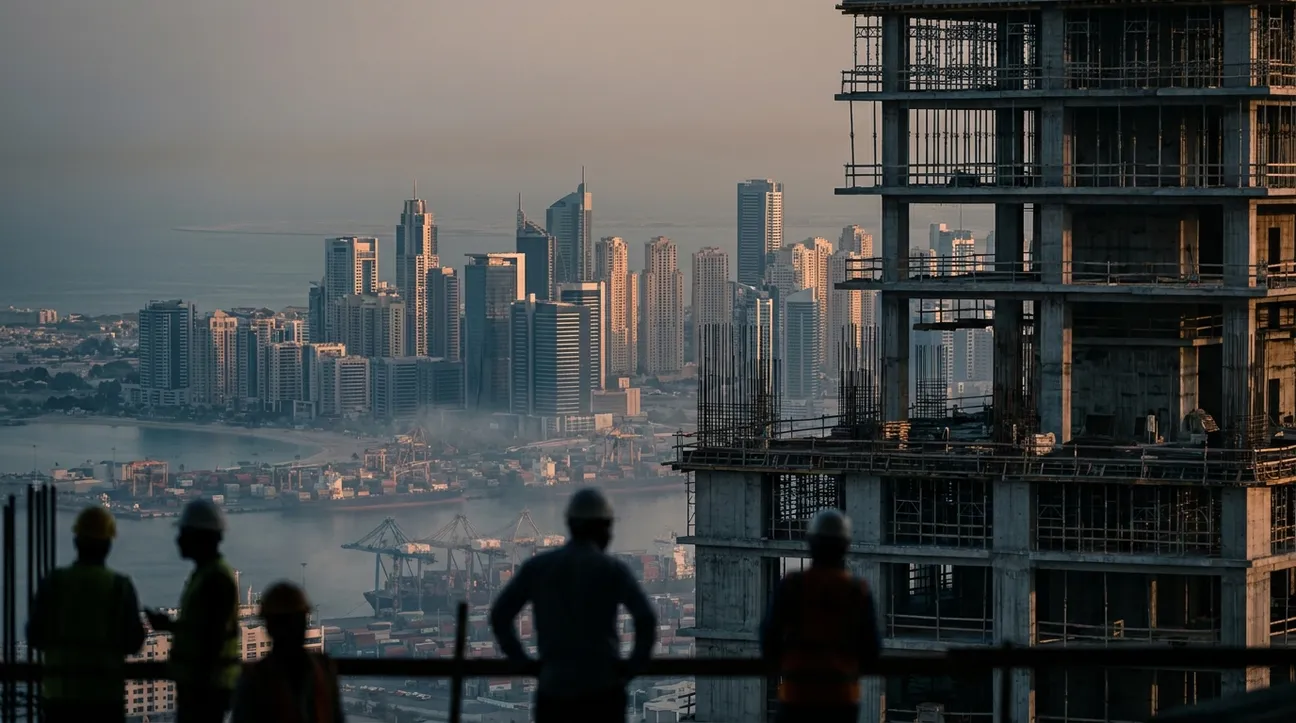
India's real estate consolidation is accelerating, and Mumbai's developer shrinkage tells the deeper story
As one-third of Mumbai's developers vanish post-pandemic, the structural forces reshaping Indian real estate demand a new capital architecture for survival and growth.
Executive Summary
Key Takeaways
- Mumbai's active developers shrank from 18,000 to 12,000 post-pandemic, signaling rapid market consolidation.
- RERA compliance costs are pricing out undercapitalised developers, transferring market share to organised, institutionally backed players.
- India's residential market is projected to reach USD 702.43 billion by 2031 (9.88% CAGR), with commercial growing even faster at 16.80% CAGR.
- Data centres added a record 440 MW in 2025, creating new real estate–infrastructure convergence opportunities.
- Surviving developers gain advantage by building "capital architecture"—governance and partnership frameworks that attract institutional capital.
The consolidation thesis India's real estate market can no longer ignore
India's real estate sector, valued at USD 595.8 billion in 2025 according to Grand View Research, stands at the threshold of one of the most consequential structural shifts in its modern history. The market is consolidating at pace. In the Mumbai Metropolitan Region alone, the number of active real estate developers has contracted from 18,000 to roughly 12,000 since the pandemic, a reduction of one-third, according to data shared at GRI Institute and NAREDCO forums. This contraction is the clearest quantitative signal that India's property market is moving from a fragmented, promoter-driven ecosystem toward a more institutionalised, capital-efficient architecture.
The forces behind this consolidation are well understood: the Real Estate (Regulation and Development) Act, 2016, known as RERA, raised compliance barriers and transparency requirements, effectively pricing out undercapitalised operators. The pandemic accelerated the shakeout. What remains less examined is the strategic positioning of the firms and leaders who stand to benefit, including Mumbai-focused developers like Viceroy Properties, led by Cyrus Mody, who are navigating this landscape with strategies calibrated to post-RERA market realities.
The consolidation wave, however, is broader than any single city or firm. It reflects a fundamental repricing of risk, capital access, and operational scale across India's residential, commercial, and digital infrastructure verticals.
What structural forces are compressing India's developer landscape?
Three interlocking dynamics are driving the compression.
First, regulatory formalisation has permanently altered the cost structure of Indian real estate development. RERA mandates project registration, escrow requirements for buyer funds, and stringent timelines for delivery. For smaller developers without robust balance sheets, compliance costs have become prohibitive. The result is an ongoing transfer of market share toward organised players with access to institutional capital.
Second, demand patterns have shifted toward quality and trust. Housing sales across India's top eight cities reached 348,207 units in 2025, while new residential launches stood at 362,148 units in the same period, according to Knight Frank. The near-parity between launches and absorption signals a maturing market where speculative oversupply, long the hallmark of India's residential sector, is giving way to disciplined, demand-driven development. Buyers increasingly gravitate toward branded developers with track records, further disadvantaging smaller operators.
Third, institutional capital is entering Indian real estate at scale, and its requirements are reshaping how deals are structured. The Indian residential market is projected to reach USD 702.43 billion by 2031, growing at a CAGR of 9.88% from 2026, according to Mordor Intelligence. The commercial segment is expected to expand even faster, reaching USD 116.26 billion by 2031 at a CAGR of 16.80%. These growth corridors are attracting sovereign wealth funds, global pension capital, and private equity platforms that demand governance standards, joint venture clarity, and exit visibility that most legacy developers cannot provide.
The consolidation of India's developer base is a structural correction, aligning the supply side of the market with the governance expectations of institutional capital.
How are next-generation strategists positioning within this consolidation cycle?
The developers surviving and thriving in this environment share identifiable characteristics. They maintain capital discipline, structure joint ventures with clear risk-sharing frameworks, and operate in segments where demand fundamentals are strongest.
In Mumbai, where the developer contraction has been most visible, firms such as Viceroy Properties under Cyrus Mody have focused on luxury residential and commercial development. The strategic logic is straightforward: premium segments command higher margins and attract buyers less sensitive to interest rate fluctuations, providing a natural buffer against cyclical downturns. Mumbai's status as India's financial capital ensures sustained demand from high-net-worth individuals and corporate occupiers.
The broader pattern, visible across discussions within the GRI Institute community of senior real estate leaders, is that successful consolidation-era developers are building what might be termed "capital architecture," the deliberate design of corporate structures, partnerships, and deal frameworks that align developer incentives with institutional investor requirements. This includes transparent governance, RERA-compliant project pipelines, and the ability to underwrite risk at the asset level rather than the corporate level.
Developers who master this architecture gain a decisive competitive advantage. They access cheaper capital, attract better joint venture partners, and secure land parcels that fragmented operators cannot compete for.
The developers defining the next phase of Indian real estate are those who treat capital structure as a strategic asset, designing governance and partnership frameworks that institutional investors recognise and reward.
Where does the growth frontier extend beyond residential?
While residential consolidation captures the most attention, the commercial and digital infrastructure segments are generating equally significant strategic opportunities.
Gross office leasing volume across India's top eight cities reached 21.9 million square feet in Q1 2026, representing 13% year-on-year growth, according to Cushman & Wakefield. Net absorption for the full year is projected to remain robust near 55 million square feet. This sustained demand is anchored by India's technology services sector, global capability centres, and the expansion of domestic financial services, all of which require Grade A office space at scale.
The data centre vertical presents perhaps the most compelling adjacency. India's data centre capacity reached approximately 1,700 MW in 2025, with a record 440 MW added during the year, according to CBRE South Asia. JLL projects an additional 791 MW of capacity by 2026, requiring USD 5.7 billion in investment and 10 million square feet of real estate space. Data centres represent a convergence point for real estate development, infrastructure capital, and technology demand that is creating entirely new joint venture structures and investor categories.
For developers with the capital architecture to participate, these segments offer diversification beyond the residential cycle and access to longer-duration income streams valued by institutional investors.
The firms that extend their platform from residential into commercial and digital infrastructure will define the next decade of Indian real estate, capturing growth across the full USD 5.8 trillion market that FICCI and KPMG project by 2047.
What does this mean for institutional capital entering India?
Institutional investors evaluating Indian real estate exposure face a paradox. The market's scale and growth trajectory are exceptional, yet the partner universe is narrowing as consolidation eliminates smaller developers. This concentration creates both opportunity and risk.
The opportunity lies in the quality of remaining partners. Developers who have survived RERA, the pandemic, and the current consolidation cycle are, by definition, better capitalised, better governed, and more operationally resilient. Joint ventures with these operators carry lower execution risk and stronger alignment of interest.
The risk is that consolidation could reduce competitive tension in key micro-markets, particularly in premium segments where only a handful of developers have the balance sheet and land bank to operate. Institutional investors must monitor market concentration alongside traditional metrics like internal rates of return and equity multiples.
The All-India House Price Index increased by 3.58% year-on-year in Q3 of the 2025-26 fiscal year, according to the Reserve Bank of India. This moderate price appreciation, well below construction cost inflation in many markets, suggests that the sector has not yet reached the frothy valuations that historically signal cycle peaks. For institutional capital, the entry window remains constructive.
Premium residential launches are expected to exceed 300,000 units in 2026, according to Cushman & Wakefield, reinforcing the thesis that organised developers are scaling into the market share vacated by smaller operators.
The consolidation playbook in context
India's real estate consolidation mirrors patterns observed in other maturing markets, from China's developer shakeout to the institutionalisation of European logistics. The distinguishing factor in India is the speed of formalisation driven by RERA, combined with the sheer scale of demand generated by urbanisation and economic growth.
Senior leaders within the GRI Institute ecosystem have consistently identified this consolidation as the defining theme for Indian real estate capital allocation over the next decade. The conversations at GRI India events, where chief executives from domestic developers, global investors, and institutional platforms converge, reflect a consensus that the era of fragmented, relationship-driven development is ending.
What replaces it is a more disciplined, institutionally legible market where capital architecture, governance quality, and strategic positioning determine which developers capture the extraordinary growth ahead. The firms and leaders who recognised this shift earliest, including those operating in Mumbai's compressed developer landscape, will be the primary beneficiaries.
India's consolidation cycle is compressing the developer universe, but it is simultaneously expanding the opportunity set for those with the strategic architecture to compete at institutional scale.