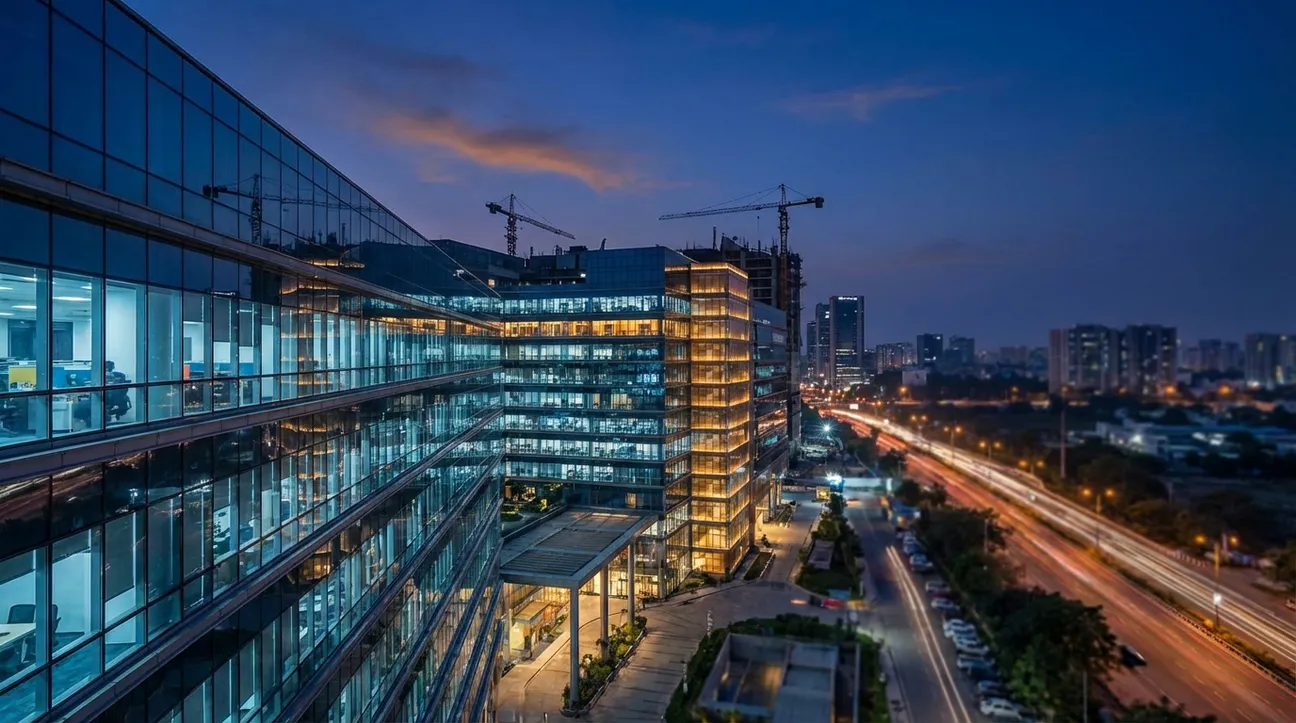
India's office market hits record 80-83 million sq ft in leasing as GCCs and co-working reshape valuations
Institutional capital, flexible workspace expansion and GCC lease dominance are recalibrating office asset economics across Bangalore, Hyderabad and Pune.
Executive Summary
Key Takeaways
- India's office leasing hit a record 80–83 million sq ft in 2025, driven by GCCs, co-working operators, and institutional capital.
- GCCs accounted for 37–45% of total office leasing and are projected to lease 50–55 million additional sq ft by FY2027.
- Flexible workspace stock is expected to surpass 100 million sq ft by 2026, reshaping institutional underwriting models.
- Institutional real estate investment reached historic highs, with foreign capital comprising 43% of inflows.
- Bangalore, Hyderabad, and Pune form the core valuation triangle, each with distinct cap rate and tenant dynamics.
- ESG compliance and tenant quality now measurably influence cap rate formation.
India's gross leasing volume for office space reached an estimated 80 to 83.3 million square feet in 2025, a record high according to JLL and Knight Frank. The milestone reflects a structural shift in how office assets are occupied, underwritten and valued across the country's top cities. Global Capability Centers, flexible workspace operators and institutional investors are converging on Grade A stock, compressing yield spreads and forcing a recalibration of office asset economics that will define the 2025–2028 cycle.
For leaders across India's real estate and infrastructure sectors, the data points to a market where tenant quality, lease duration and ESG compliance now carry measurable weight in cap rate formation. GRI Institute has tracked this evolution through its dedicated India office and GCC programming, where cross-border capital allocation and occupier strategy remain central themes.
GCCs now anchor nearly half of India's office absorption
Global Capability Centers accounted for approximately 37 to 45 percent of total office leasing in India in 2025, according to Vestian and JLL. Bangalore led GCC leasing activity, securing the highest share among Indian cities, per JLL and Vestian data published in January 2026.
The dominance of GCCs in India's office market is reshaping how developers and investors approach asset creation. GCCs typically demand large floor plates, campus-style configurations, high sustainability certifications and long-term occupancy commitments. This demand profile favours institutional-grade development and penalises older, non-compliant stock.
ICRA projects that GCCs will incrementally lease 50 to 55 million square feet of Grade A office space between FY2026 and FY2027. The number of GCCs in India is expected to rise from approximately 1,700 to over 2,500 by 2030, according to ICRA and FICCI-Anarock. These projections underscore a durable structural tailwind for Grade A office supply, particularly in southern and western Indian cities where technology and services ecosystems are deepest.
The flight to quality is measurable. Office rental values in major Indian cities appreciated year-on-year in 2025, according to Anarock. Developers positioned at the intersection of ESG compliance, campus-scale delivery and GCC tenant relationships are capturing disproportionate rental premiums.
How are co-working operators influencing institutional underwriting?
Flexible workspace operators captured a record share of leasing activity in 2025, according to Knight Frank and Cushman & Wakefield. India's flexible workspace stock is expected to cross 100 million square feet by 2026, per Coworking Insights and Knight Frank.
This expansion carries direct implications for office asset valuations. Co-working operators function as both tenants and asset managers, absorbing large blocks of Grade A space and re-leasing it at granular levels to enterprise clients and startups. Their growing share of total absorption introduces a layer of intermediation that institutional investors must account for in underwriting models.
For asset owners, co-working tenancy can accelerate lease-up velocity and reduce vacancy risk, but it also introduces operator credit risk and shorter effective lease durations compared to direct corporate leases. Institutional underwriters are increasingly bifurcating their valuations based on tenant mix, applying tighter cap rates to assets with direct GCC or multinational tenancy and wider spreads to assets with heavy co-working exposure.
Typical fit-out costs for Grade A office spaces in India in 2025 ranged from ₹1,500 to ₹2,500 per square foot, according to Address Advisors. For co-working operators, these fit-out economics are a core variable in margin formation, and for landlords, they represent a negotiating lever in lease structuring. The co-working segment's trajectory from a niche flex product to a mainstream absorption channel marks one of the most consequential shifts in India's office market over the past five years.
What role does institutional capital play in redefining office asset values?
Institutional investments in Indian real estate reached a historic high in 2025, with the office sector attracting the majority of inflows, according to Colliers India. Foreign capital maintained a significant presence, representing 43 percent of institutional investment share in 2025, even as domestic capital scaled meaningfully.
This dual-source capital flow is compressing cap rates for premium office assets. GCC-anchored buildings with long-term occupancy, strong ESG credentials and institutional-grade specifications command the tightest yields. The convergence of domestic REITs, sovereign wealth funds, pension allocators and European institutional lenders has created a deep, competitive capital market for India's top-tier office stock.
Professionals operating at the intersection of cross-border capital flows and Indian office assets, including figures such as Mihir Nerurkar in capital markets advisory and Martin Soell in European institutional lending, represent the connective infrastructure through which global allocators access Indian office exposure. Their roles in structuring debt, equity and hybrid instruments for office portfolios are increasingly central to how transactions are priced and executed.
On the domestic side, leadership continuity at major developers signals stability. Gaurav Pandey was reappointed as MD and CEO of Godrej Properties for a three-year term starting January 1, 2026, according to Godrej Properties and Business Standard. Godrej Properties' position as a listed developer with diversified exposure, including commercial and mixed-use projects, makes this appointment relevant to office market participants tracking development pipeline credibility.
Mid-market operators are also gaining visibility. RRC Ventures Pvt Ltd, a Mumbai-based construction and development firm, posted projected FY25 revenue of approximately ₹248 crore, according to Tracxn and Ministry of Corporate Affairs data. While smaller in scale than listed developers, firms like RRC Ventures represent the expanding ecosystem of construction partners and joint venture vehicles that institutional investors rely on for project execution.
Regulatory recalibration favours agile development
The regulatory environment is evolving in ways that support office-adjacent asset creation. The Special Economic Zones (Amendment) Rules, 2025, notified on June 3, 2025, relaxed land requirements for SEZs specifically for semiconductor and electronic component manufacturing, reducing the threshold to 10 hectares and allowing the use of leased or mortgaged land. While targeted at high-tech manufacturing, these amendments indirectly benefit office developers by facilitating mixed-use ecosystems within and around SEZ zones.
The government's approach to the DESH Bill (Development of Enterprise and Services Hubs), originally proposed to replace the SEZ Act, reflects a preference for agile rule amendments over comprehensive legislative overhaul. The DESH Bill has been largely shelved in favour of targeted notifications that address specific industry needs. For office developers and occupiers, this incremental regulatory approach provides functional clarity without the uncertainty of a full legislative transition.
Bangalore, Hyderabad and Pune: the valuation triangle
The three cities forming the core of India's GCC-driven office market, Bangalore, Hyderabad and Pune, present distinct valuation dynamics.
Bangalore's position as the leading GCC leasing destination translates directly into the tightest cap rates and highest rental appreciation among Indian office markets. The city's depth of technology talent, established campus ecosystems and institutional investor familiarity create a self-reinforcing cycle of demand and capital flow.
Hyderabad has emerged as a competitive alternative, benefiting from proactive state government policy, large land parcels suitable for campus development and a growing GCC base. Its relative yield premium compared to Bangalore offers institutional investors a value proposition anchored in rental growth potential.
Pune's office market benefits from proximity to Mumbai, a strong engineering talent pool and lower operating costs. The city's co-working penetration is particularly notable, with flexible operators capturing significant absorption share and reshaping the tenant mix in Grade A assets.
Across all three cities, the common thread is institutional demand for assets that combine tenant quality, lease stability and ESG compliance. The office market reset underway in India is fundamentally about the repricing of these attributes.
The structural repricing ahead
India's office real estate market is entering a cycle defined by tenant-led quality differentiation. GCCs anchoring nearly half of all absorption, co-working operators crossing 100 million square feet in stock, and institutional capital reaching historic deployment levels collectively represent a market where asset economics are being structurally repriced.
The period from 2025 to 2028 will determine whether current valuation premiums for Grade A, ESG-compliant, GCC-anchored office assets are sustainable or whether supply responses dilute the quality premium. For investors, developers and capital markets professionals, the data leaves little ambiguity about where the market is heading.
GRI Institute continues to convene the decision-makers shaping this transition through its India office and GCC-focused programming, where lease economics, capital structures and city-level strategies are examined with the rigour the market demands.