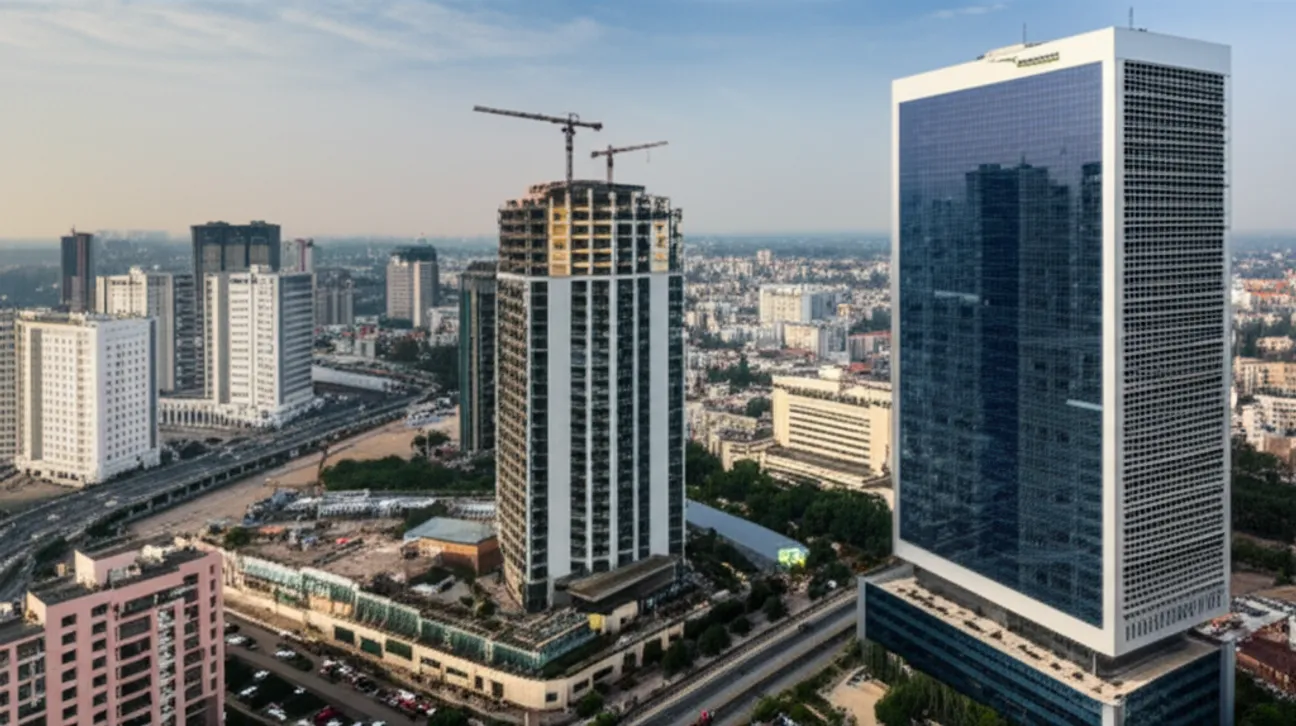
India's GCC office pipeline in numbers: 50M+ sq ft of new absorption reshapes Hyderabad, Pune and Chennai
Global Capability Centres now account for 45% of India's office leasing. The next wave of demand is shifting beyond Bangalore to regional corridors.
Executive Summary
Key Takeaways
- GCCs account for 45% of India's office leasing in 2025, expected to exceed 50% by 2026.
- GCC office absorption reached 34.9M sq ft in 2025, up 20% YoY; 50-55M sq ft projected over FY2026-FY2027.
- Hyderabad captured 19% of GCC absorption, emerging as the leading market after Bangalore.
- Tier-II cities like Indore, Coimbatore, and Kochi are becoming new GCC expansion frontiers driven by talent availability and cost advantages.
- India's GCC count is expected to grow from ~1,700 to 2,500+ by 2030, generating over $100B in revenue.
Global Capability Centres accounted for 45% of total office leasing activity in India in 2025, according to data from Vestian. The figure confirms a structural shift in how multinational corporations consume commercial real estate across the country, and it places GCCs at the center of every institutional investment thesis targeting Indian office markets.
The trajectory is accelerating. GCC-led office absorption reached 34.9 million square feet in 2025, a 20% year-on-year increase, according to Vestian. ICRA projects that GCCs will incrementally lease 50 to 55 million square feet of Grade A office space during FY2026 and FY2027 alone. By 2030, the number of GCCs operating in India is expected to rise from approximately 1,700 to more than 2,500, generating over $100 billion in revenue, according to ICRA.
For real estate developers, investors, and fund managers, the question is no longer whether GCCs will dominate Indian office demand. The question is where.
How large is the GCC absorption pipeline beyond Bangalore?
Bangalore remains the anchor market for GCC leasing in India, but the geography of demand is diversifying rapidly. Hyderabad accounted for 19% of the total area absorbed by GCCs in India in 2025, making it the second-largest GCC office market in the country, according to Vestian.
This 19% share represents a meaningful concentration of global corporate demand in a single city outside the traditional Bangalore corridor. For institutional investors mapping capital deployment across Indian office assets, Hyderabad's position signals both depth of tenant demand and the maturation of its commercial infrastructure.
Pune and Chennai round out the top-tier GCC destinations. While city-specific absorption forecasts for these markets are not disaggregated in publicly available data, both cities consistently rank among India's top six office markets and are home to large-scale GCC operations spanning financial services, engineering, technology, and life sciences.
The share of GCCs in total office leasing in India is expected to cross 50% by 2026, according to Vestian. This threshold is significant. Once GCCs account for more than half of all office leasing, their location preferences, campus specifications, and expansion timelines will effectively set the pace of India's entire Grade A office development cycle.
Which developers are building the next wave of GCC-ready campuses?
The scale of projected GCC demand, 50 to 55 million square feet over just two fiscal years, requires a corresponding pipeline of institutional-quality office supply. Several developers are positioning themselves at the forefront of this cycle.
Panchshil Realty, led by Chairman Atul Chordia, has been a dominant force in Pune's commercial real estate market for over a decade. The firm is now expanding its footprint to capture GCC demand in emerging corridors. Panchshil is investing Rs 1,000 crore to develop a 1 million square foot IT Park in Indore specifically targeting GCC companies, according to the Times of India. The Indore project reflects a broader industry pattern: established developers in Tier-I GCC cities are extending their platforms to Tier-II markets where operational cost advantages and talent availability create compelling propositions for global corporations.
Caspian Techparks India Pvt Ltd represents a different model, one focused on specialized IT infrastructure development in partnership with state entities. Caspian has built managed office spaces across southern India, including a 450,000 square foot workspace in Infopark Phase-II, according to Business Standard. The company's approach, developing purpose-built tech campuses in state-backed technology parks, positions it to serve GCCs that prioritize plug-and-play infrastructure and proximity to concentrated technology talent pools outside of Bangalore.
In Pune and Gurugram, Kalpesh Mehta, Founder of Tribeca Developers, is driving major commercial and luxury real estate expansions, including the Trump World Center in Pune. Tribeca's projects add branded, premium-grade commercial inventory to markets where GCC tenants increasingly demand world-class specifications for their India headquarters.
These three developers, Panchshil, Caspian Techparks, and Tribeca, illustrate the range of strategies being deployed to meet GCC demand: Tier-II market expansion, state-partnered tech campus development, and branded premium office product. Each approach responds to a different segment of GCC requirements, from cost-optimized engineering centers to flagship corporate campuses.
What do the rental and investment dynamics look like for GCC corridors?
GCC tenants typically absorb large floor plates, often 100,000 square feet or more per transaction, and sign long-term leases that provide institutional landlords with predictable cash flows. This demand profile supports rental premiums in corridors with high GCC concentration.
Hyderabad's HITEC City and Gachibowli corridors, Pune's Hinjewadi and Kharadi zones, and Chennai's OMR and Guindy submarkets have all benefited from sustained GCC leasing activity that has tightened vacancy rates and supported upward rental trajectories in recent years.
For developers and investors, the GCC pipeline creates a virtuous cycle. Large pre-commitments from multinational GCCs de-risk new construction, enabling developers to secure project financing and attract institutional equity partners. As ICRA's projection of 2,500 GCCs by 2030 suggests, the demand runway extends well beyond typical real estate development cycles, giving long-term capital a structural tailwind.
The regulatory environment further supports institutional participation. The Real Estate (Regulation and Development) Act, 2016 (RERA), while not exclusive to GCCs, has been cited as a major factor leveling the playing field and making disciplined regional commercial operators viable for institutional capital allocation. RERA compliance requirements give institutional investors greater confidence when deploying capital with mid-sized developers operating in emerging GCC corridors.
The Tier-II expansion frontier
Panchshil Realty's Rs 1,000 crore investment in Indore is an early indicator of a trend that could reshape India's commercial real estate map over the next decade. As GCC headcount in India grows toward the levels implied by ICRA's 2030 projections, talent availability in Tier-I cities will face increasing constraints. Cities such as Indore, Coimbatore, Kochi, and Ahmedabad offer deep engineering and business talent pools at lower salary benchmarks, making them attractive for GCC operations focused on scale.
Caspian Techparks' model of state-partnered campus development in Kerala's Infopark ecosystem demonstrates how Tier-II and Tier-III cities can build GCC-ready infrastructure through public-private collaboration. This approach reduces development risk and accelerates time-to-market for new office supply in cities that lack the established private developer ecosystems of Bangalore or Hyderabad.
For institutional investors, the Tier-II GCC opportunity carries both higher potential returns and greater execution risk. Rental yields tend to be more attractive in secondary markets, but tenant diversification is thinner and exit liquidity is less established. The developers who build track records in these markets early, as Atul Chordia's Panchshil is doing in Indore, will likely command premium positioning when institutional capital flows accelerate.
Implications for institutional capital allocation
The data points assembled here describe an office market increasingly defined by a single demand driver. GCCs already account for 45% of India's office leasing. That share is expected to exceed 50% by 2026. The absorption pipeline of 50 to 55 million square feet over FY2026-FY2027 represents one of the largest concentrated sources of office demand in any global market.
For institutional investors evaluating Indian real estate, three strategic considerations emerge from this data.
First, portfolio construction should reflect the geographic diversification of GCC demand. Hyderabad's 19% share of GCC absorption makes it a core allocation target alongside Bangalore, and Pune and Chennai command attention as established GCC clusters with expanding campus pipelines.
Second, developer selection matters more in this cycle than in previous ones. The scale and specification requirements of GCC tenants favor developers with demonstrated capability to deliver large-format, Grade A campuses on schedule, firms such as Panchshil Realty, Caspian Techparks, and Tribeca Developers that have built track records across multiple GCC-oriented projects.
Third, the Tier-II opportunity requires early positioning. The economics of GCC expansion favor secondary cities on a five-to-seven year horizon, and developers investing now in markets like Indore are building first-mover advantages that will be difficult to replicate.
GRI Institute continues to track these dynamics through its India-focused programming, including dedicated convenings on the GCC-real estate nexus where developers, investors, and corporate occupiers engage directly on the data and strategies shaping this market.
The GCC wave is rewriting the geography of Indian office real estate. The numbers make the direction clear. The investment opportunity lies in mapping the next corridors of concentrated demand before the market fully prices them in.