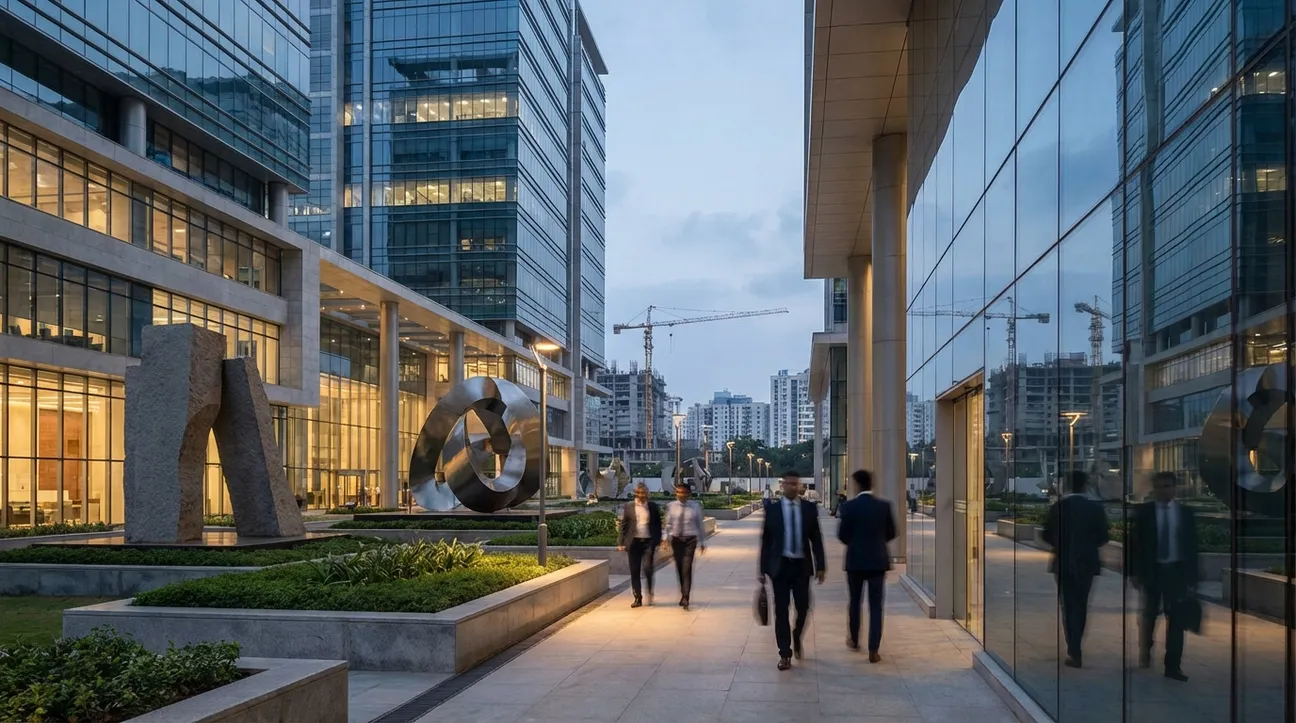
India's art-culture real estate premium in numbers: how Bangalore Art Weekend and placemaking are repricing assets in 2025–2026
Institutional capital flows toward culture-adjacent mixed-use developments as placemaking strategies drive rental escalations and yield compression across India's prime urban centres.
Executive Summary
Key Takeaways
- Institutional inflows into culture-adjacent mixed-use real estate surged massively YoY in Q1 2025, signaling art-culture adjacency is being priced into asset returns.
- RMZ Foundation's sponsorship of Bengaluru Art Weekend 2026 marks cultural programming as a core asset-level value creation strategy, not peripheral marketing.
- SEBI's reclassification of REIT units as equity instruments (Jan 2026) and new SM REIT regulations are expanding investor access to placemaking-driven portfolios.
- No standalone index yet isolates the art-culture premium from broader placemaking and branding premiums, representing a key data gap.
Mixed-use real estate anchored by cultural programming and placemaking saw a massive year-over-year surge in institutional inflows in Q1 2025, according to data from Economic Times and Squarea, marking a turning point in how India's largest developers and investors price art-culture adjacency into asset returns. From Bengaluru to Mumbai to Pune, the convergence of institutional sponsorship, curated cultural events, and design-led development is reshaping the premium segment of Indian real estate.
The trend is not confined to a single city. Across India's top urban centres, the integration of cultural infrastructure into commercial and residential developments is accelerating, driven by record institutional investment, favourable regulatory shifts, and measurable demand from both tenants and buyers for environments that prioritise experience and identity.
Bengaluru Art Weekend: the anchor event redefining placemaking economics
Bengaluru Art Weekend has rapidly established itself as one of India's most significant cultural-real estate convergence events. The 2025 edition ran at full capacity across more than nine venues, according to The Usual Suspects, demonstrating the depth of engagement between the city's creative economy and its built environment. The 2026 edition, running from March 28 to April 6 under the theme 'Second Nature', spans multiple cultural venues including Sabha, BLR, and the Museum of Art and Photography, as reported by Homegrown and Sabha BLR.
What distinguishes this event from conventional art festivals is the direct participation of institutional real estate capital. RMZ Foundation hosted the Opening Night of the Bengaluru Art Weekend 2026, according to Business News This Week. RMZ Corp, one of India's largest office-space developers, is channelling foundation-level sponsorship into cultural programming as a deliberate placemaking strategy for its commercial portfolio. This signals a structural shift: cultural events are no longer peripheral marketing exercises but core components of asset-level value creation.
Bengaluru's placemaking ecosystem now functions as a live laboratory for the thesis that curated cultural programming can drive tenant demand, footfall density, and ultimately rental premiums in mixed-use and commercial developments.
How is institutional capital repricing culture-adjacent assets across India?
Institutional investment in Indian real estate reached record levels in 2025, with a pronounced shift toward income-generating, placemaking-driven assets, according to Hindustan Times. Prime urban centres including Bengaluru, Mumbai, and Delhi experienced significant rental escalations driven by constrained supply and premium placemaking strategies.
The rental premium dynamics are especially pronounced in the commercial REIT segment. Listed REITs that own leased commercial portfolios with strong placemaking and amenities distribute significantly higher yields compared to standard residential assets, which yield between 2% and 4%, as reported by Hindustan Times. This yield differential is central to understanding why institutional allocators are gravitating toward culture-integrated developments.
Mixed-use real estate, which relies heavily on placemaking, cultural integration, and curated retail, recorded a massive year-over-year surge in institutional inflows in Q1 2025, according to Economic Times and Squarea. The implication is clear: assets that combine commercial utility with cultural identity are attracting disproportionate capital precisely because they generate superior risk-adjusted returns.
SEBI's reclassification of REIT units as equity-related instruments for mutual funds, effective January 1, 2026, has triggered a rebalancing of institutional and retail portfolios toward income-yielding real estate assets. This regulatory catalyst amplifies the capital rotation toward the very placemaking-driven portfolios that cultural programming supports.
What role does design-led development play in commanding premiums?
Atul Chordia, Chairman of Panchshil Realty, has pioneered art and design-led real estate development in India, partnering with international design figures including Philippe Starck and Kelly Hoppen to deliver a substantial portfolio of prime real estate, according to reporting by CEAT Indian Supercross Racing League. Panchshil's approach, which embeds high design and cultural curation directly into the product, has historically commanded significant premiums. Design-led branded residences developed by Panchshil Realty, such as Trump Towers Pune, historically commanded substantial premiums over prevailing market prices, as noted by Forbes India.
The Panchshil model illustrates a broader market principle now validated across multiple Indian cities: when real estate products are designed and programmed as cultural artefacts rather than commodity shelter, pricing power increases materially. Average home prices in major Indian cities are expected to rise by 6.5% in 2025, driven largely by demand for premium-segment properties that integrate lifestyle, culture, and placemaking, according to Global Property Guide and The Market Pulse.
This premium-segment demand is structural, not cyclical. India's expanding base of high-net-worth individuals and the growing corporate preference for experiential workplaces are both secular tailwinds for culture-adjacent assets.
Regulatory architecture supporting the art-culture-real estate convergence
Three regulatory developments are accelerating the institutionalisation of the art-culture real estate premium in India.
First, SEBI's REIT reclassification, active since January 2026, has expanded the investor base for income-yielding commercial portfolios that benefit most from placemaking strategies. By classifying REIT units as equity-related instruments for mutual fund purposes, the regulator has enabled a wider pool of domestic institutional capital to flow into the very assets where cultural programming creates measurable yield uplift.
Second, SEBI's Small and Medium REIT regulations have brought fractional ownership within a formal regulatory perimeter, allowing investors to enter high-yield commercial schemes with a minimum ticket size of ₹10 lakh. The SM REIT segment has the potential to unlock massive value in eligible mid-market commercial stock, according to Hindustan Times. As these vehicles mature, culture-adjacent properties in secondary precincts of Bengaluru, Pune, and Hyderabad could become accessible to a broader base of yield-seeking investors.
Third, Bhopal became the first Indian city to initiate official placemaking guidelines designed to ensure the visible transformation of unused and underused areas into active cultural and commercial spaces. While Bhopal is not a primary institutional real estate market, the regulatory precedent is significant. It establishes a framework that larger cities could adopt to formalise the relationship between cultural infrastructure and real estate development approvals.
REIT market penetration in India, currently near 16% of total institutional real estate exposure, is projected to grow to 25–30% by 2030, according to Hindustan Times. As penetration deepens, the share of REIT-held assets that incorporate placemaking and cultural programming is expected to rise in tandem.
The data gap: isolating the art-culture premium
A critical caveat for investors and developers is that the exact financial premium generated exclusively by cultural events and programming, separated from general luxury amenities, placemaking design, and branded development, remains difficult to isolate. No dedicated city-by-city comparative index of real estate premiums specifically linked to art events in India exists for 2025–2026.
The available evidence demonstrates that placemaking strategies, which include cultural programming as a core element, drive rental escalations in prime urban centres and higher yields for commercial REITs. However, the art-culture premium is typically bundled into the overall mixed-use or branded residence premium rather than tracked as a standalone metric. Developing granular measurement frameworks for this premium represents a significant opportunity for market intelligence providers and institutional research teams.
GRI Institute has identified this convergence as a priority theme for its India-focused leadership discussions, recognising that the intersection of cultural infrastructure and institutional real estate will shape asset allocation strategies through 2028 and beyond.
National outlook through 2028
The trajectory is clear across India's major real estate markets. Bengaluru leads with the most developed cultural-real estate ecosystem, anchored by events like Bangalore Art Weekend and institutional sponsors like RMZ Foundation. Mumbai and Delhi benefit from significant rental escalations tied to placemaking in constrained prime markets. Pune, through developers like Panchshil Realty, demonstrates the viability of design-led premiums in Tier 1.5 cities.
As REIT structures mature, SM REITs open mid-market access, and municipal placemaking frameworks formalise, the pipeline of culture-adjacent real estate development will expand beyond the current concentration in a handful of premium precincts. For institutional investors, the strategic question is no longer whether cultural programming creates value in Indian real estate, but how to capture and measure that value systematically across a growing national portfolio.
The leaders who define the measurement standards and development models for this asset class will set the terms of competition in India's premium real estate market for the next decade.