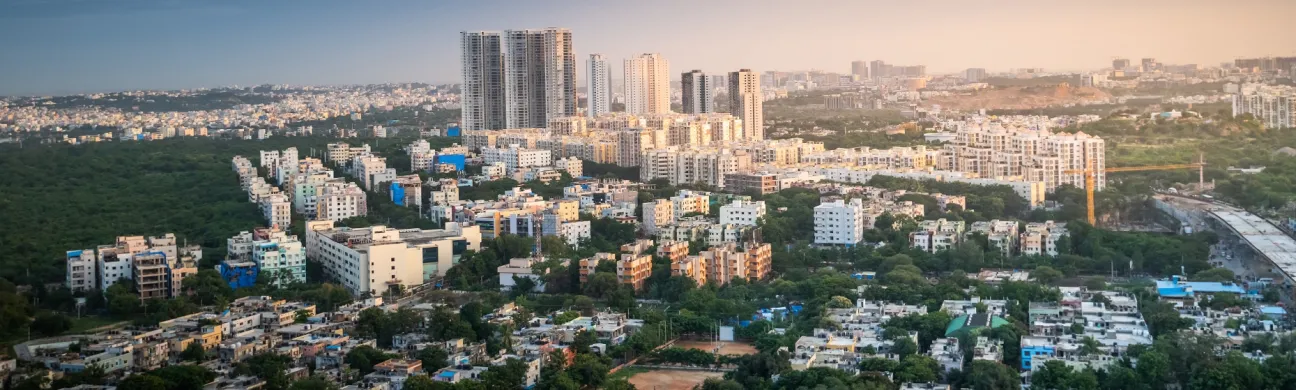
 Adobe Stock
Hyderabad’s real estate market matures across multiple segments
Commercial, residential, and industrial assets continue to show resilience, supported by strong occupier demand and infrastructure-led expansion
May 5, 2026Real Estate
Written by:Isabella Toledo
Executive Summary
Hyderabad’s real estate market is becoming increasingly balanced and more clearly differentiated across segments, supported by ongoing infrastructure expansion and a deepening occupier base.
Rather than being driven by a single growth narrative, the city is now characterised by resilient office demand, disciplined residential development, sustained strength in the industrial and warehousing sector, and stable retail activity.
Ahead of the GRI Institute’s Hyderabad Real Estate 2026 roundtable, we analyse how these dynamics are reshaping investment strategies, influencing development priorities, and reinforcing the city’s position in India’s resilient property sector.
Rather than being driven by a single growth narrative, the city is now characterised by resilient office demand, disciplined residential development, sustained strength in the industrial and warehousing sector, and stable retail activity.
Ahead of the GRI Institute’s Hyderabad Real Estate 2026 roundtable, we analyse how these dynamics are reshaping investment strategies, influencing development priorities, and reinforcing the city’s position in India’s resilient property sector.
Key Takeaways
- Hyderabad’s office sector continues to lead growth, driven by strong leasing momentum, large-format transactions, and tightening vacancy that is supporting sustained rental increases.
- Residential and retail markets reflect a more balanced and disciplined cycle, with selective supply, stable demand, and steady price growth underpinned by infrastructure-led expansion.
- Industrial and logistics remain standout performers, while overall market dynamics point to a more mature real estate landscape focused on efficiency, location quality, and long-term value creation.
Office market remains a major growth engine
Hyderabad’s office sector maintains strong leasing momentum in Q1 2026, with gross leasing volume reaching 3.15 million square feet, up 22% year on year (YoY), according to a recent report by Cushman & Wakefield. Net absorption stands at 2.21 million square feet, underscoring sustained occupier demand.Large-format transactions dominated the quarter, accounting for 81% of total leasing activity. Madhapur alone contributed 91% of this volume, reinforcing its position as Hyderabad’s primary demand centre and a focal point for institutional-grade office space.
The Information Technology and Business Process Management (IT-BPM) sector led the results with a 36% share of leasing, followed by flexible workspace operators at 30% and Banking, Financial Services, and Insurance (BFSI) firms at 23%.
On the supply side, office completions totalled 2.3 million square feet in the quarter, remaining flat YoY. Despite stable deliveries, tightening availability supported upward pressure on occupier costs, with average rents increasing by 8% YoY and 1% quarter on quarter (QoQ).
With no new Grade-A completions during the period, vacancy compressed to 20.22%. At the same time, stock-weighted quoted rents rose by 3.4% QoQ and 11.6% YoY. While the forward pipeline remains substantial, the current gap between supply and demand is reinforcing rental growth, particularly in core submarkets.
Total office transactions reached 5.9 million square feet, marking a 48% increase compared to the same period last year - already exceeding more than half of the total transaction activity recorded across the city in 2025.
Residential development turns more selective
In the residential market, Hyderabad continues to follow a stable trajectory, balancing measured supply with steady demand and ongoing price appreciation.Research by Knight Frank indicates that 9,541 residential units were sold in Q1 2026, reflecting a modest 1% YoY increase and signalling resilient end-user demand despite a more cautious development environment.
On the supply side, developers appear to be adopting a more disciplined approach. According to Cushman & Wakefield, the city recorded 9,126 unit launches during the quarter, down 8% QoQ and 19% YoY.
Geographically, the West zone continues to dominate, accounting for 65% of total launches, led by the Financial District and Nanakramguda corridor. At the same time, the North zone is gaining traction, supported by Balanagar and emerging peripheral locations benefiting from improved connectivity and infrastructure investment.
By segment, mid-market housing led activity with a 42% share of launches, followed by high-end at 28%, affordable at 19%, and luxury at 10%. This distribution highlights a broad-based demand profile, spanning both owner-occupiers and increasingly discerning premium buyers.
Pricing trends remain supportive. Knight Frank data shows capital values continuing to strengthen, with the weighted average residential price reaching 8,211 per unit, representing a 9% increase YoY, although remaining flat quarter on quarter.
At a micro-market level, the strongest annual price appreciation was concentrated in Narsingi and Kokapet, reinforcing the sustained appeal of western growth corridors where infrastructure development, proximity to employment hubs, and land availability continue to shape demand dynamics.
Industrial and logistics continue to outperform
Hyderabad’s industrial and warehousing sector continues to stand out as one of the city’s strongest performing segments, underpinned by robust occupier demand and sustained investor interest.Warehousing leasing reached 1.71 million square feet in H2 2025, taking full-year absorption to 4.19 million square feet, a sharp 79% increase compared to 2024 - primarily driven by engineering and manufacturing, third-party logistics (3PL) operators, and Fast-Moving Consumer Goods (FMCG) occupiers.
According to Cushman & Wakefield, activity remains concentrated in the Northern and Southern corridors, where the availability of ready-to-move inventory, build-to-suit options and distribution-led requirements continue to support transaction volumes.
The industrial segment also recorded improved leasing momentum in the second half of last year, with the Southern corridor emerging as the dominant hub. Manufacturing-led demand played a central role in shaping this growth, reflecting Hyderabad’s expanding industrial base and supply chain integration.
Rental growth remains measured but positive. Warehouse rents increase by 2.5% YoY, while industrial rents rise by 1%, indicating stable occupier demand in a largely balanced market.
Looking ahead, regulatory frameworks such as the Hyderabad Industrial Land Transformation Policy (HILTP) are expected to play a defining role in shaping supply dynamics and development feasibility.
The policy seeks to facilitate the transformation of legacy industrial land within the city, particularly inside the Outer Ring Road, by allowing the conversion of underutilised or non-viable industrial plots into alternative uses, including residential and commercial developments.
At the same time, HILTP is designed to relocate polluting and outdated industrial units to planned clusters on the city’s periphery, easing environmental pressure and aligning land use with Hyderabad’s rapid urban expansion - an effort to prevent the coexistence of heavy industry and dense residential zones, a challenge seen in more mature urban centres.
While the policy is expected to unlock land value, improve urban liveability, and create a more efficient industrial footprint over the long term, it also introduces additional layers of regulatory oversight, financial obligations, and execution complexity.
Ongoing public and political debate around land valuation, implementation timelines, and governance underscores the importance of policy clarity, which will be critical in determining the pace and scale at which new industrial and logistics supply can be delivered.
Retail demand stays steady and well distributed
Hyderabad’s retail market remains stable in Q1 2026, with leasing volume reaching 0.43 million square feet, broadly in line with the previous quarter. According to Cushman & Wakefield, high streets continue to outperform shopping centres, accounting for 64% of total leasing activity.Core submarkets lead demand with a 66% share, driven primarily by Gachibowli and Madhapur, reinforcing their positions as established retail and consumption hubs.
In terms of tenant mix, fashion remains the dominant category, followed by food and beverages (F&B), entertainment, and department stores - reflecting a consumer base that is both diversified and resilient.
The absence of new supply during the quarter contributes to a further tightening in market fundamentals, with vacancy easing to 5.66%. Against this backdrop, high street rental values record modest growth, increasing by 1% QoQ and 2% YoY, indicating steady occupier demand in prime locations.
Looking ahead, planned infrastructure upgrades, particularly the proposed Metro Phase II and III expansions, are expected to enhance connectivity across peripheral and suburban catchments.
With approximately 1.9 million square feet of new supply anticipated over the next two years, the market appears positioned for measured, demand-led expansion rather than rapid or speculative growth.
A market maturing into its next phase
Taken together, these trends indicate that Hyderabad’s real estate market is evolving beyond expansion for its own sake. Across asset classes, performance is increasingly defined by a more disciplined balance between demand, supply, and infrastructure.Occupiers, developers, and investors are responding to a sector that places a premium on location quality, operational efficiency, and long-term strategic planning.
As the city’s economic base continues to deepen and diversify, Hyderabad is strengthening its position as one of India’s most resilient and multi-dimensional real estate markets, characterised by steady fundamentals and a maturing investment landscape.
► Join us at GRI Institute’s Hyderabad Real Estate 2026 roundtable on 21st May