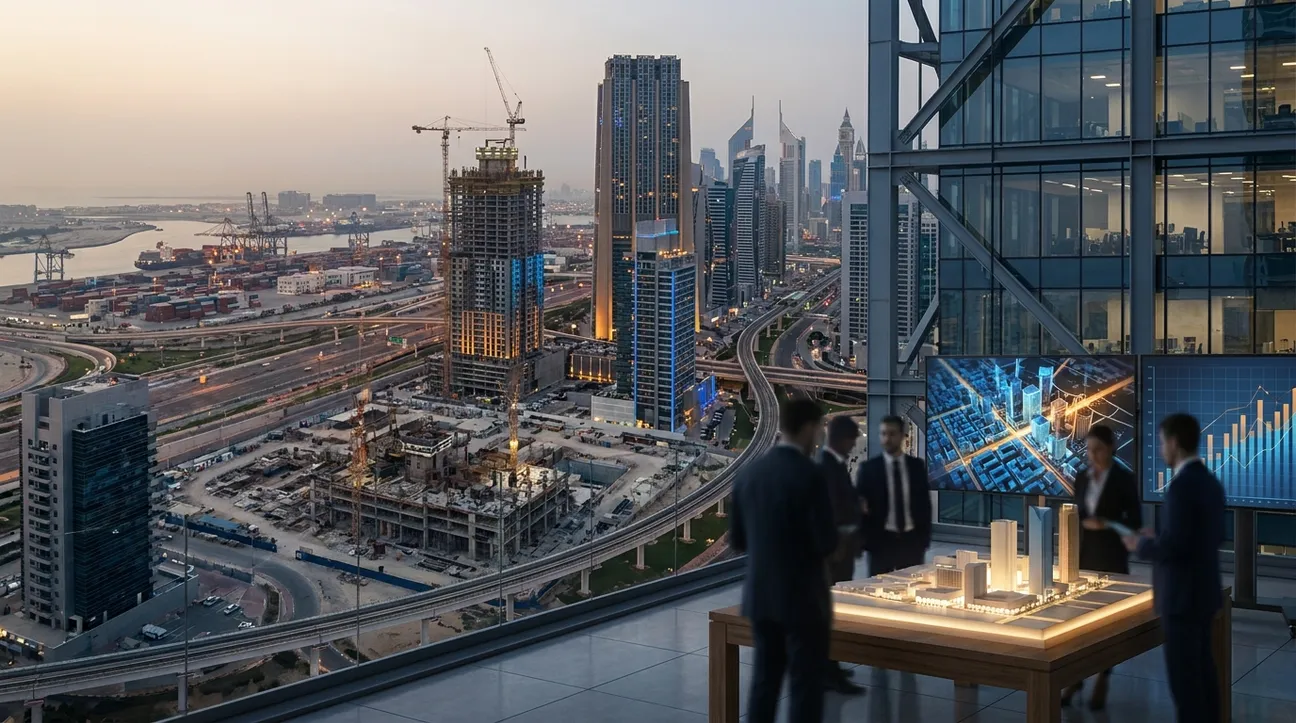
Gowra Ventures in numbers: a ₹1,490 crore land bet and Hyderabad's next-generation developer dynasties through 2028
Data-driven analysis of ownership structures, capital pipelines and institutional positioning across Hyderabad's evolving real estate corridor.
Executive Summary
Key Takeaways
- Gowra Ventures acquired a 6.29-acre Raidurg land parcel for ₹1,490.73 crore—over 50 times its ₹28.9 crore annual revenue, signaling significant off-balance-sheet or structured capital partnerships.
- Hyderabad's Q1 2026 residential launches rose 13.8% QoQ to 10,665 units, with office leasing hitting 3.15 million sq ft, supporting mixed-use development bets.
- The Kokapet SEZ (22 million sq ft) is expected to push corridor pricing to Financial District levels by 2028-29.
- India's commercial real estate market is projected to reach USD 223.25 billion by 2028.
- Next-generation developer dynasties are increasingly blending legacy land assets with institutional-grade capital structures.
Gowra Ventures Pvt Ltd recently acquired a 6.29-acre multi-use land parcel in Hyderabad's Raidurg growth corridor for nearly ₹1,490.73 crore, according to the Deccan Chronicle. The transaction ranks among the most significant single-plot acquisitions by a privately held developer in the city's history and marks a decisive inflection point for the company founded by Aditya Gowra in January 2006. This article maps the platform's financial trajectory, its positioning within Hyderabad's broader developer ecosystem, and the structural forces that are reshaping capital allocation across India's next-generation real estate dynasties.
Revenue baseline and capital deployment: what do the numbers reveal about Gowra Ventures?
Gowra Ventures generated a revenue of ₹28.9 crore for the financial year ending March 31, 2025, according to Tracxn. Against that revenue figure, the ₹1,490.73 crore Raidurg land acquisition represents a capital commitment exceeding 50 times annual top-line revenue, a ratio that signals either significant off-balance-sheet capital partnerships, promoter-level equity infusion, or structured financing arrangements with institutional lenders.
The scale of this single transaction suggests that Gowra Ventures is transitioning from a mid-tier development firm into a platform-level operator capable of absorbing large-format, mixed-use projects. For industry observers tracking Hyderabad's developer landscape, the gap between reported revenue and deployment capacity is the most revealing data point. It underscores a capital structure that extends well beyond operating cash flows.
Aditya Gowra serves as Founder and Managing Director of the company, which was incorporated in January 2006, according to the Ministry of Corporate Affairs via Tracxn. The two-decade tenure of the platform gives it deep land-banking relationships and regulatory familiarity in Telangana, competitive advantages that newer entrants struggle to replicate.
How does Hyderabad's market context support a bet of this magnitude?
Hyderabad's real estate fundamentals provide structural justification for aggressive capital deployment. The city's mass residential market saw new launches increase by 13.8% quarter-on-quarter to reach 10,665 units in Q1 2026, according to JLL. Simultaneously, the office market recorded gross leasing volumes of approximately 3.15 million square feet in Q1 2026, per Cushman & Wakefield. Both metrics point to sustained absorption across asset classes, a prerequisite for the mixed-use development that the Raidurg parcel is zoned to accommodate.
The Raidurg corridor sits adjacent to Hyderabad's Financial District and benefits from proximity to the Kokapet growth zone, where a 22-million-square-foot Special Economic Zone development has received government approval. This SEZ approval acts as a structural catalyst for the corridor's real estate pricing. Westside Realty projects that the Kokapet corridor will reach Financial District-level pricing by 2028-29, a trajectory that would significantly enhance the residual value of Gowra Ventures' newly acquired land.
For a developer securing land at current valuations in a corridor with embedded pricing upside, the risk-reward calculus favours early movers with the capital discipline to hold through the appreciation cycle.
Hyderabad's developer dynasties: platform positioning and competitive landscape
Hyderabad's developer ecosystem is dominated by a constellation of family-controlled platforms, including established names such as MyHome, Rajapushpa, and Vasavi, alongside newer entrants scaling rapidly. What distinguishes the current cycle from previous ones is the degree to which second-generation and founder-led firms are actively pursuing institutional-grade capital structures.
Gowra Ventures' Raidurg acquisition exemplifies this shift. A transaction of nearly ₹1,500 crore by a privately held firm with sub-₹30 crore reported revenues points to capital partnerships that may involve structured debt, land-owner joint development agreements, or private equity co-investment, structures that are increasingly standard among India's institutionally oriented developers.
This pattern mirrors dynamics observed across other Indian cities. In Bangalore, developers with deep family lineage in real estate are repositioning portfolios toward commercial and luxury segments, drawing institutional capital from global allocators. The broader trend reflects a generational transition where founders' children and next-generation leaders bring financial engineering capabilities alongside legacy land relationships.
Senior real estate leaders participating in GRI Institute events have repeatedly identified this generational transition as one of the defining forces in Indian real estate. The ability to blend legacy assets with institutional capital discipline determines which developer dynasties will scale and which will remain regional.
What is the institutional capital trajectory for India's commercial real estate through 2028?
India's commercial real estate market revenues are projected to reach USD 223.25 billion by 2028, according to Mordor Intelligence. Urban infrastructure spending across the country is projected to exceed USD 90 billion between 2024 and 2028, per market research estimates. These macro-level projections create a favourable backdrop for developer platforms that can underwrite mixed-use projects combining residential, commercial, and retail components.
The convergence of infrastructure spending and commercial real estate growth is particularly pronounced in Hyderabad, where the SEZ approval in Kokapet, metro rail expansion, and the Outer Ring Road network have compressed development timelines and expanded the investable geography. For Gowra Ventures, the Raidurg corridor sits precisely at the intersection of these infrastructure vectors.
Institutional investors, including global pension funds, sovereign wealth vehicles, and private equity platforms, have steadily increased their allocation to Indian real estate over the past several years. Discussions among GRI Institute members consistently highlight Hyderabad as a market where the gap between replacement cost and land value still offers attractive entry points, particularly in corridors with approved SEZ or IT park designations.
Ownership structures and capital access: the architecture behind the acquisition
While exact ownership percentage breakdowns among Gowra family members remain undisclosed in public filings, the private limited company structure of Gowra Ventures provides flexibility for promoter-level capital infusion and selective external partnerships without the disclosure obligations of a publicly listed entity. This structure is common among India's mid-market developer dynasties and offers both advantages and limitations.
The advantages include faster decision-making, confidentiality around land acquisition pricing, and the ability to structure bespoke joint ventures with institutional partners. The limitations include reduced access to public capital markets and lower transparency for potential co-investors. As Gowra Ventures scales into the ₹1,000-crore-plus project range, the question of whether the platform will maintain its private structure or pursue partial institutionalization through a non-banking financial company partnership, a real estate investment trust contribution, or a platform-level equity raise becomes strategically material.
The Indian developer landscape is bifurcating between platforms that embrace institutional transparency and those that retain family-controlled opacity. The trajectory of Gowra Ventures over the next two to three years will offer a case study in which path yields superior risk-adjusted returns in a market where capital availability is no longer the binding constraint, but capital structuring capability is.
The Raidurg corridor as a microcosm of Hyderabad's growth thesis
The 6.29-acre Raidurg parcel acquired by Gowra Ventures carries multi-use zoning, which permits a combination of residential, commercial, and potentially hospitality or retail components. In a market where Q1 2026 residential launches exceeded 10,600 units and office absorption crossed 3 million square feet in the same quarter, multi-use development offers natural hedging across demand cycles.
The proximity to the approved 22-million-square-foot Kokapet SEZ adds a structural demand driver that extends beyond cyclical fluctuations. SEZ-adjacent corridors in Indian cities have historically demonstrated pricing premiums of significant magnitude once anchor tenants commence operations, a pattern well documented in Hyderabad's own HITEC City evolution.
Gowra Ventures' bet on Raidurg is simultaneously a bet on Hyderabad's continued emergence as India's most balanced real estate market, one where residential affordability, office demand depth, and infrastructure execution converge at a scale that few other Indian cities currently match.
Strategic implications for India's real estate capital markets
The Gowra Ventures acquisition illuminates broader dynamics that extend well beyond a single transaction. India's next-generation developer dynasties are deploying capital at scales that require institutional partnerships, even when those partnerships remain structurally invisible in public filings. The gap between reported revenues and capital deployment, visible in the Gowra Ventures data, is a feature of India's developer landscape that institutional investors must learn to read correctly.
For capital allocators evaluating India's real estate opportunity, the critical analytical lens is not revenue alone but the total capital orchestration capability of the platform, including land banking, joint development agreements, structured finance, and promoter equity.
As India's commercial real estate market advances toward the projected USD 223.25 billion revenue mark by 2028, platforms such as Gowra Ventures, with deep corridor-level expertise and demonstrated willingness to deploy at scale, will define the competitive landscape for the next cycle of Indian real estate growth.
GRI Institute continues to track capital flows and developer positioning across India's major real estate corridors through dedicated member interactions, sector-specific research, and data-driven market analysis.