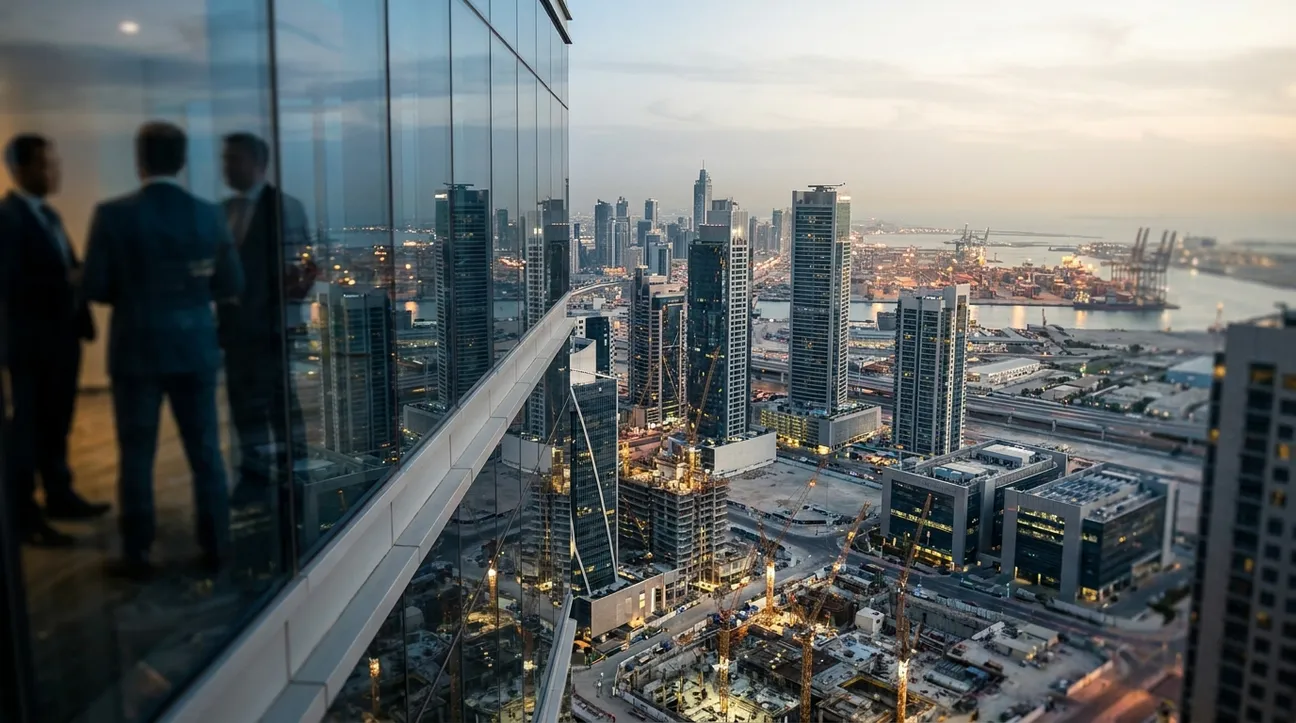
Branding economics of GCC sovereign wealth funds and the institutional signals reshaping real estate capital flows
With GCC sovereign funds projected to control $18 trillion by 2030, the strategic management of brand visibility is becoming a decisive factor in real estate dealmaking across the Gulf.
Executive Summary
Key Takeaways
- GCC sovereign wealth funds are projected to control $18 trillion by 2030, making their branding strategies a decisive factor in real estate capital flows.
- The Emirates Investment Authority ($102B AUM) uses deliberate opacity as a brand strategy to preserve negotiating leverage and signal selectivity.
- DAMAC Properties generated $3 billion in sales in just five hours, demonstrating how brand saturation converts recognition into transaction velocity.
- The GCC real estate market is projected to nearly double from $141.2B (2025) to $260.3B by 2034.
- Saudi Arabia's new foreign ownership law (effective January 2026) adds institutional transparency layers that interact with existing brand architectures.
A $141.2 billion market where institutional identity drives capital
The GCC real estate market reached a valuation of USD 141.2 billion in 2025, according to IMARC Group. Behind that figure sits a complex architecture of sovereign capital, private developers, and foreign investors whose interactions are increasingly shaped by something rarely discussed in real estate circles: institutional brand identity.
Sovereign wealth funds in the Gulf Cooperation Council are projected to control USD 18 trillion in assets by 2030, according to the Observer Research Foundation. Yet several of the most powerful capital allocators in the region, including the Emirates Investment Authority (EIA), maintain a degree of visual and communicative opacity that stands in sharp contrast to the branding intensity of the private developers they sometimes invest alongside.
This asymmetry is deliberate, structural, and increasingly relevant for real estate professionals seeking to understand how capital signals operate across the GCC.
How does the Emirates Investment Authority use opacity as a brand strategy?
The Emirates Investment Authority manages $102 billion in assets under management, according to the Sovereign Wealth Fund Institute (SWFI). Despite the scale of its portfolio, EIA maintains one of the lowest public-facing brand profiles among major sovereign wealth funds globally. Its website is minimal. Its public communications are infrequent. Its visual identity receives limited institutional promotion.
For researchers, journalists, and real estate professionals attempting to trace EIA's involvement in specific transactions, this creates a deliberate information gap. The fund's branding posture functions as a strategic filter, controlling the flow of inbound deal proposals and managing expectations around its investment appetite.
This approach contrasts with sovereign peers in Abu Dhabi and Saudi Arabia that have invested heavily in corporate identity infrastructure. The pattern reveals a spectrum of branding philosophies across GCC sovereign wealth funds, ranging from high-visibility platforms designed to attract international co-investment to low-visibility structures engineered to preserve negotiating leverage.
The absence of a robust public identity is itself a signal. It communicates selectivity, discretion, and a preference for bilateral relationships over open-market competition. For senior real estate executives operating in the GCC, understanding where a sovereign fund sits on this visibility spectrum provides meaningful intelligence about its likely transaction behavior.
The private-sector counterpoint: DAMAC and the economics of brand saturation
At the opposite end of the branding spectrum, private developers in the GCC have embraced aggressive identity construction as a core commercial strategy. DAMAC Properties achieved AED 36 billion, approximately $9.8 billion, in total sales in 2025, ranking as the number one private developer in the UAE, according to Arabian Business. Its DAMAC Islands 2 project generated AED 11 billion ($3 billion) in sales in just five hours in November 2025.
These results are inseparable from DAMAC's investment in brand architecture. The company's public identity, from its sales channels to its digital presence, is engineered to convert brand recognition into transaction velocity. The five-hour sales window for DAMAC Islands 2 would be structurally impossible without a pre-built reservoir of brand trust and buyer familiarity.
This divergence between sovereign opacity and private-sector brand saturation creates a distinctive market dynamic in GCC real estate. Projects backed by sovereign capital often rely on the developer's brand to carry public-facing credibility, while the sovereign fund operates as an invisible structural partner. The result is a layered identity architecture where multiple brands coexist within a single development, each serving a different audience: end buyers respond to the developer brand, while institutional co-investors respond to the sovereign signal.
Why does corporate identity transition matter for GCC real estate infrastructure?
The relevance of branding economics extends beyond residential development into logistics and infrastructure. Agility Logistics Parks operates more than 3.9 million square meters of Grade A warehousing and logistics infrastructure across Riyadh, Jeddah, and Dammam in Saudi Arabia, according to Agility Logistics Parks. The company's evolution from a traditional logistics operator to a branded real estate platform illustrates how corporate identity transitions can unlock new categories of institutional capital.
When a logistics company repositions itself as an infrastructure real estate platform, it changes the investor audience it can access. Pension funds, sovereign wealth vehicles, and real estate investment trusts respond to different identity signals than freight forwarding clients. The brand transition is a capital markets strategy as much as a marketing exercise.
This pattern is accelerating across the GCC as Saudi Arabia's regulatory environment evolves. The Law of Real Estate Ownership by Non-Saudis, in force as of January 21, 2026, allows foreign individuals and entities to own real estate within specially designated zones across the Kingdom, replacing the previous 2000 law. The legislation requires mandatory digital registration through the Saudi Real Estate Platform, creating a new layer of institutional transparency that will interact with existing brand architectures.
For foreign investors entering the Saudi market under this framework, the brand identity of local partners, developers, and logistics operators becomes a primary due diligence input. Institutional branding carries informational weight that compensates for the unfamiliarity of a new regulatory environment.
Dubai's transaction momentum and the role of brand trust
Dubai recorded AED 286.4 billion, approximately US$78 billion, in property sales during the first half of 2026, according to W Capital Real Estate Brokerage. This figure reflects a market where brand trust has been compounded over successive development cycles. Buyers and investors in Dubai operate within a brand ecosystem where developer reputation, sovereign backing, and regulatory credibility function as interdependent signals.
The concentration of transaction volume in Dubai underscores a broader principle: real estate markets with mature brand infrastructures attract disproportionate capital. Brand familiarity reduces perceived risk, shortens decision cycles, and enables the kind of rapid capital deployment visible in DAMAC's five-hour sales events.
Sovereign wealth funds that choose to remain below the brand visibility threshold are making a calculated trade-off. They sacrifice inbound deal flow in exchange for greater control over the terms and timing of their investments. The economic logic is sound for entities managing portfolios at EIA's scale, where selectivity is more valuable than volume.
The structural trajectory: from $141.2 billion to $260.3 billion
The GCC real estate market is projected to reach USD 260.3 billion by 2034, growing at a 7.03% CAGR, according to GRI Institute. This near-doubling of market value will intensify the branding dynamics already visible across the region.
As the market expands, the competition for institutional capital will drive more sophisticated approaches to brand architecture. Sovereign wealth funds will face increasing pressure to balance their preference for discretion against the transparency expectations of international co-investors and regulatory bodies. Private developers will continue to invest in brand infrastructure as a tool for accelerating sales velocity. Logistics and infrastructure operators will increasingly adopt real estate branding conventions to access new capital pools.
The executives shaping this landscape, from sovereign fund leadership to developer C-suites, recognize that brand identity in GCC real estate is a capital markets instrument. It determines which investors receive deal access, how quickly capital is deployed, and what risk premium the market assigns to a given project or platform.
What GCC brand architecture signals for global real estate capital
The GCC's approach to institutional branding offers a case study in how identity management shapes capital allocation at scale. The coexistence of highly opaque sovereign vehicles and aggressively branded private developers creates an information environment where brand signals carry outsized analytical value.
For international investors and real estate professionals engaging with the region, decoding these signals is a practical skill. The presence or absence of a sovereign fund's visual identity in a transaction is not a cosmetic detail. It is a structural indicator of deal governance, capital commitment horizons, and risk allocation.
GRI Institute members participating in GCC-focused gatherings consistently identify institutional transparency, including brand and communications infrastructure, as a factor influencing their capital deployment decisions. As the region's real estate market matures toward its projected 2034 valuation, the intersection of branding economics and sovereign capital strategy will become an increasingly central theme for senior leadership across the sector.
The funds, developers, and infrastructure platforms that calibrate their brand visibility to match their strategic objectives will hold a decisive advantage in attracting and deploying the capital required to build the next phase of GCC real estate.