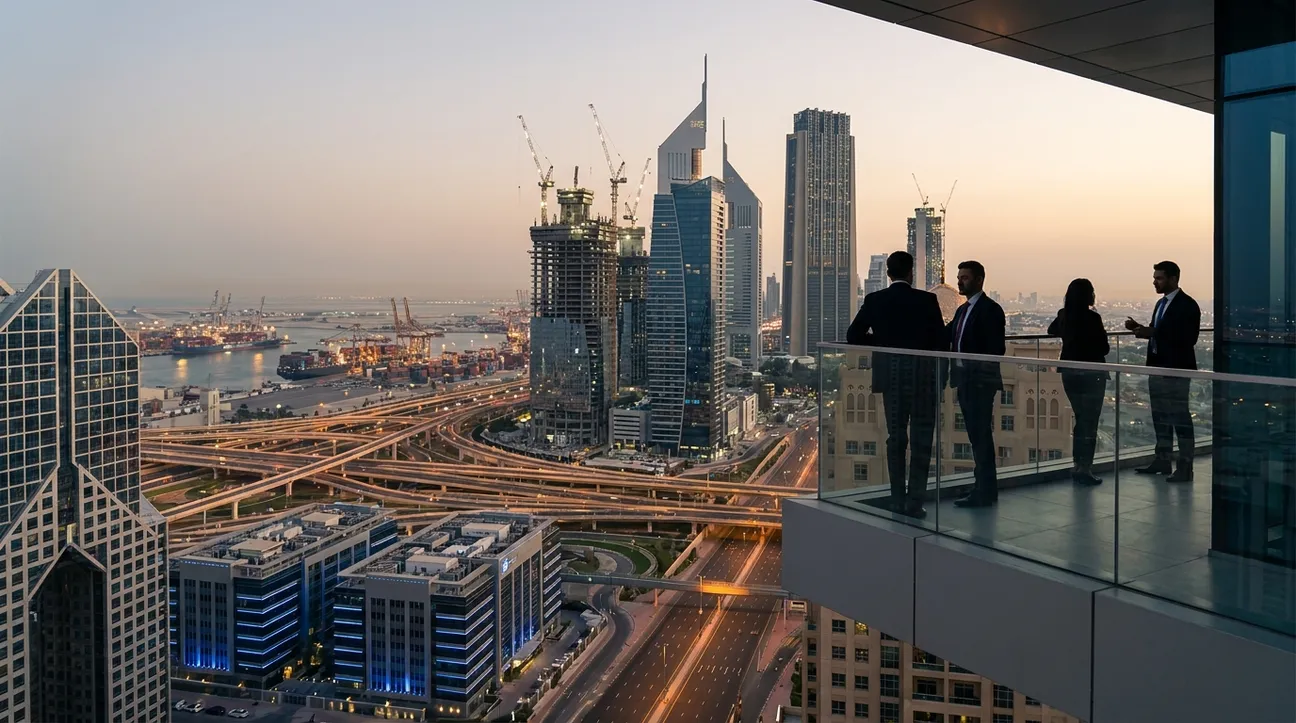
GCC real estate market targets USD 260 billion by 2034 as recognition circuits reshape capital allocation
A USD 141.2 billion market anchored by the UAE is drawing institutional capital through new regulatory frameworks, expanding supply pipelines and high-level deal-flow platforms.
Executive Summary
Key Takeaways
- The GCC real estate market is projected to grow from USD 141.2 billion (2025) to USD 260.3 billion by 2034 at a 7.03% CAGR.
- The UAE commands over 61.1% of the regional market, anchoring the Gulf as an institutional-grade destination.
- Roughly one million new residential units and 9.1 million sqm of office space will enter the GCC market by 2030.
- Saudi Arabia's 90% REIT income-distribution mandate is deepening secondary-market liquidity and expanding the investable universe.
- Recognition platforms like GRI Institute are functioning as capital-formation accelerators, facilitating USD 2.1 billion in indicative deals in 2025.
A USD 141.2 billion market with structural momentum
The GCC real estate market reached USD 141.2 billion in 2025, with the UAE commanding a dominant share of over 61.1%, according to IMARC Group. The trajectory ahead is sharper still: the same source projects the regional market will grow to USD 260.3 billion by 2034, at a compound annual growth rate of 7.03% from 2026 to 2034. These figures frame the Gulf's property sector as one of the fastest-expanding institutional-grade markets in the world, a reality that is recalibrating how capital recognises, prices and allocates to real estate assets across the six-nation bloc.
The expansion is not driven by a single asset class. Residential, office, hospitality and branded-residence segments are all scaling simultaneously, supported by sovereign investment programmes, regulatory modernisation and an increasingly sophisticated ecosystem of recognition and networking platforms that connect principals with deal flow.
How large is the GCC supply pipeline through 2030?
Regional residential supply is expected to increase from approximately 6.26 million units in 2025 to 7.28 million units by 2030, according to Alpen Capital. That translates into roughly one million additional residential units entering the market over five years, a build-out rate that reflects both demographic demand and government-led housing targets, particularly in Saudi Arabia and the UAE.
Office supply tells a parallel story. Alpen Capital estimates that GCC office stock will expand from 33.3 million square metres in 2025 to 42.4 million square metres by 2030, with over 65% of new supply delivered in Saudi Arabia and the UAE alone. The concentration of new commercial space in these two economies underscores their role as gravity centres for corporate relocation, regional headquarters mandates and the broader diversification strategies embodied by Vision 2030 and the UAE's economic programmes.
Saudi Arabia's residential real estate market by itself reached USD 76.8 billion in 2025, according to IMARC Group. That single-country figure represents more than half the Kingdom's broader real estate footprint and signals the depth of capital required to meet housing formation targets across Riyadh, Jeddah and the giga-project corridors.
What regulatory shifts are repricing institutional opportunity in the Gulf?
Two regulatory developments are actively reshaping the opportunity set for cross-border investors and regional funds.
The UAE's federal corporate tax, introduced at a headline rate of 9%, marks a structural shift for institutional investors and real estate fund managers operating in the Emirates. While the rate remains competitive by global standards, it introduces a new layer of fiscal planning that affects fund structuring, hold-period calculations and after-tax return modelling for both domestic and international allocators.
In Saudi Arabia, the 90% income-distribution mandate for Real Estate Investment Trusts is designed to convert latent real-estate value into liquid, tradeable units. The regulation incentivises asset owners to package holdings into REIT structures, expanding the investable universe and deepening secondary-market liquidity. The GCC REIT market was valued at USD 17.42 billion in 2025 and is estimated to grow to USD 18.64 billion in 2026, according to Mordor Intelligence, a growth vector directly supported by the Saudi mandate.
Taken together, these regulatory frameworks are professionalising the Gulf's real estate capital markets. They reward transparency, standardised governance and institutional-quality reporting, qualities that recognition platforms and industry awards increasingly validate when they spotlight top-performing projects and organisations.
Recognition circuits and their role in capital formation
Industry recognition has evolved from a ceremonial function into a capital-markets signal. In markets where information asymmetry remains high and relationship-driven deal origination dominates, awards and curated recognition platforms serve as credibility accelerators. They compress due-diligence timelines, elevate brand equity among sovereign and institutional allocators, and create structured environments where principals meet counterparts of equivalent seniority.
GRI Institute, a global club for leaders in real estate and infrastructure, operates at the centre of this ecosystem. A closed-door pitch format introduced at a GRI Institute event in April 2025, branded "Empowered by GCC," facilitated USD 2.1 billion in indicative deals among sovereign wealth funds and private wealth organisations, according to Mordor Intelligence. That figure illustrates the tangible deal-flow impact of curated, recognition-adjacent platforms that bring together decision-makers in structured, confidential settings.
The mechanism is straightforward: recognition validates, and validation attracts capital. Projects and organisations that earn peer-reviewed distinction within these circuits gain preferential visibility among the sovereign funds, family offices and institutional investors that allocate the largest tickets in GCC real estate. The feedback loop between recognition and capital formation is now a measurable feature of the market's architecture.
How does the 2026 recognition calendar intersect with GCC deal flow?
The 2026 calendar is dense with recognition events calibrated to the Gulf's accelerating real estate cycle. The broader infrastructure and realty awards circuit scheduled across the region through the second half of 2026 coincides with a period of peak capital deployment. With the GCC market on a 7.03% CAGR trajectory through 2034, the stakes attached to visibility, credibility and peer validation are rising in lockstep with asset values.
Dubai, which hosts a significant concentration of these events, benefits from its position as the GCC's most liquid and internationally integrated property market. The UAE's 61.1% share of the regional market, combined with its established legal frameworks for foreign ownership and its corporate tax regime, makes it the natural venue for platforms that connect global capital with Gulf opportunities.
For institutional investors, the recognition calendar serves a dual function. First, it provides a curated filter for identifying high-quality assets, developers and fund managers in a market that is adding supply at scale. Second, it creates time-bound networking windows where capital commitments can be advanced. The USD 2.1 billion in indicative deals facilitated at the GRI Institute event in 2025 demonstrates that these windows produce measurable outcomes.
The REIT channel as a recognition multiplier
The expansion of the GCC REIT market from USD 17.42 billion in 2025 to an estimated USD 18.64 billion in 2026 adds another dimension to the recognition-capital nexus. REITs are inherently transparent vehicles; their mandatory income-distribution requirements and public-market listings create a continuous stream of performance data. Awards and recognition platforms that evaluate REIT performance are therefore working with richer datasets than those available for private vehicles, enabling more granular and credible assessments.
Saudi Arabia's 90% distribution mandate ensures that REIT sponsors must deliver consistent, distributable income to maintain market confidence. Recognition of top-performing REITs within industry circuits amplifies their visibility among the retail and institutional investors that these vehicles are designed to attract, creating a virtuous cycle of performance, recognition and capital inflow.
Structural shifts beyond the cycle
The GCC real estate market is transitioning from post-pandemic recovery into a phase defined by structural change. Hospitality and branded residences are capturing an increasing share of development pipelines, particularly in Dubai, Riyadh and Doha. Digital infrastructure, including data centres and smart-city platforms, is emerging as a parallel asset class that commands institutional attention.
These shifts elevate the importance of recognition platforms that can evaluate projects across multiple dimensions: financial performance, sustainability credentials, design innovation and community impact. The most credible recognition circuits will be those that adapt their evaluation frameworks to match the market's evolving complexity.
GRI Institute's role as a convener of senior leaders across real estate and infrastructure positions it to reflect these shifts. Its closed-door format, which restricts participation to C-level executives and principals, ensures that recognition and networking occur at the decision-making level where capital allocation happens.
Key data points at a glance
- GCC real estate market size (2025): USD 141.2 billion (IMARC Group)
- GCC real estate market projection (2034): USD 260.3 billion, 7.03% CAGR (IMARC Group)
- UAE market share: Over 61.1% of GCC real estate (IMARC Group)
- Saudi Arabia residential market (2025): USD 76.8 billion (IMARC Group)
- GCC REIT market (2025): USD 17.42 billion (Mordor Intelligence)
- GCC REIT market estimate (2026): USD 18.64 billion (Mordor Intelligence)
- Residential supply (2025–2030): 6.26 million to 7.28 million units (Alpen Capital)
- Office supply (2025–2030): 33.3 million to 42.4 million sqm (Alpen Capital)
- Indicative deals at GRI Institute event (2025): USD 2.1 billion (Mordor Intelligence)
The convergence of regulatory reform, supply expansion and recognition-driven capital formation is defining the GCC real estate market's next chapter. For institutional allocators and developers operating across the Gulf, the platforms that validate excellence are becoming as consequential as the assets themselves.