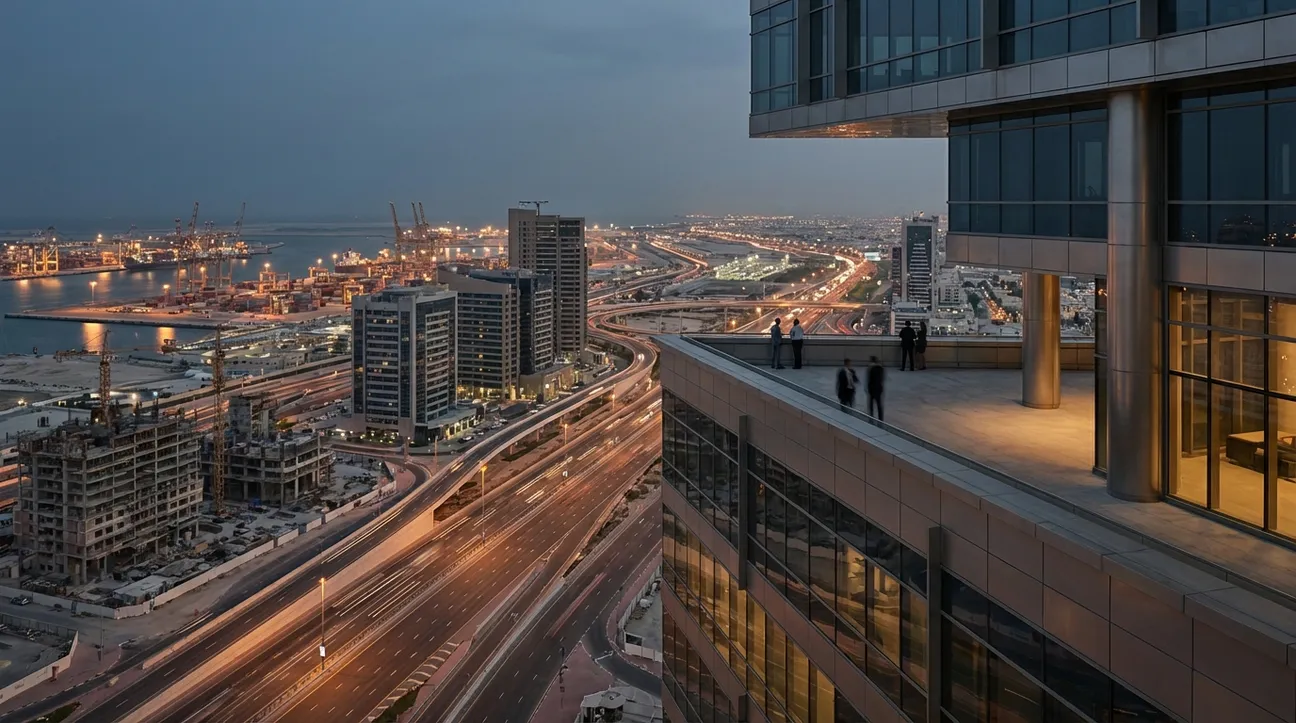
The quiet consolidation: how diversified holding companies are reshaping GCC mid-market real estate
Between sovereign wealth funds and family offices, a distinct institutional archetype is assembling real estate portfolios across the Gulf at scale.
Executive Summary
Key Takeaways
- Diversified holding companies—neither sovereign nor purely private—are quietly consolidating GCC mid-market real estate at scale.
- The GCC real estate market is projected to grow from $141.2B (2025) to $260.3B by 2034 at a 7.03% CAGR.
- These conglomerates are "sovereign-adjacent," accessing off-market deal flow and co-investment opportunities unavailable to purely private operators.
- Vision 2030 and similar national diversification agendas create a structural feedback loop that entrenches these operators' market position.
- Global analytical frameworks have an institutional blind spot, overlooking this critical capital layer between sovereign wealth funds and family offices.
A structural shift beneath the headline deals
The GCC real estate market, valued at $141.2 billion in 2025 according to IMARC Group, is projected to reach $260.3 billion by 2034 at a compound annual growth rate of 7.03%. Much of the commentary surrounding this expansion focuses on the familiar actors: sovereign wealth funds deploying generational capital, ultra-high-net-worth family offices, and global institutional investors chasing yield. Yet a quieter, arguably more consequential trend is unfolding in the middle market. Diversified holding companies, neither purely sovereign nor purely private, are consolidating real estate portfolios across the Gulf with a discipline and scale that warrants closer institutional attention.
These conglomerate-level operators occupy a specific niche. They combine industrial-era capital accumulation with modern portfolio diversification strategies, using real estate and hospitality as both yield generators and strategic hedges against commodity-cycle volatility. Their emergence as a distinct archetype in GCC real estate reflects a maturation of the region's capital markets and a deepening of the institutional layer that sits between the state and the family.
Who are the conglomerate operators reshaping GCC real estate from the middle?
The archetype is best understood through its representatives. AIMS Holding, a Saudi-based conglomerate founded by Sheikh Abdullah Ibrahim Al Subeaei, exemplifies the model. With dedicated divisions including AIMS Real Estate and AIMS Hospitality, the group has structured its portfolio to align directly with Saudi Vision 2030, the kingdom's sweeping economic diversification programme. The conglomerate's approach is characteristic of the broader trend: vertically integrated, multi-sector, and aligned with national development agendas rather than purely opportunistic investment theses.
In the UAE, MRBF Holding offers a parallel case. Led by Chairman Mohammed Alfalasi, the Emirati firm focuses on real estate and infrastructure, representing the locally rooted mid-market holding companies that bridge the gap between foreign institutional capital and the region's regulatory and commercial landscape. These entities are not household names in global real estate circles, but their cumulative market activity constitutes a significant share of mid-market transaction volume across the GCC.
The institutional significance of these groups lies in their operational character. Unlike passive allocators, they tend to develop, manage, and hold assets across cycles. Unlike sovereign funds, they operate with commercial agility and without the political visibility that constrains deployment timelines. Unlike family offices, they maintain formal corporate governance structures and diversified revenue streams that reduce concentration risk.
The UAE commands over 61.1% of the total GCC real estate market, according to IMARC Group. Within that dominant share, the competitive landscape is stratified. At the top sit government-related entities and global funds. At the base sit smaller developers and speculators. The middle, where diversified holding companies operate, has historically received less analytical coverage despite absorbing a meaningful portion of the market's growth. This analytical gap is itself a signal: the operators filling this space have done so without courting the institutional spotlight that sovereign funds and branded developers attract.
Why does the sovereign-adjacent capital layer matter for regional portfolio strategies?
The term "sovereign-adjacent" captures a critical nuance. Many of these holding companies maintain relationships with state-linked entities, pension funds, and development authorities without being direct extensions of government balance sheets. This positioning grants them access to deal flow, regulatory insight, and co-investment opportunities that purely private operators rarely obtain.
Consider the Abu Dhabi Pension Fund, which manages approximately $34 billion in assets according to the Sovereign Wealth Fund Institute. ADPF's strategic interest in real estate has been demonstrated through significant allocations, including its acquisition of a 31% stake in the Abu Dhabi Energy Real Estate Company for $900 million, part of a portfolio valued at $5.5 billion. While that transaction dates to 2021, it established an important benchmark for how pension capital in the Gulf interfaces with real estate through structured vehicles rather than direct development.
Diversified holding companies often serve as natural counterparties or co-investors alongside such pension and sovereign pools. Their operational capabilities, encompassing development expertise, asset management capacity, and local market knowledge, complement the capital scale of institutional allocators. This symbiotic relationship is accelerating the professionalisation of GCC mid-market real estate, gradually importing governance standards and underwriting discipline from more mature markets.
For international investors seeking GCC exposure, understanding this sovereign-adjacent layer is essential. These holding companies frequently control off-market deal flow and maintain relationships with landowners, regulators, and municipal authorities that determine project viability. Institutional capital entering the region without mapping this layer risks overpaying for access or misreading the competitive dynamics of specific submarkets.
How will Vision 2030 and national diversification agendas accelerate this trend?
Saudi Arabia's Vision 2030 is the most visible catalyst, but every GCC state maintains some variant of an economic diversification programme with real estate as a core pillar. These national agendas create structural demand for the type of operator that diversified holding companies represent: entities capable of executing across hospitality, residential, commercial, and mixed-use segments simultaneously, while aligning with government timelines and regulatory expectations.
AIMS Holding's alignment with Vision 2030 is instructive. The conglomerate's real estate and hospitality divisions are positioned to capture demand generated by the kingdom's tourism expansion, entertainment infrastructure build-out, and urban development programmes. This is a deliberate strategic posture, calibrating portfolio composition to national investment priorities rather than chasing global capital market trends.
The pattern extends beyond Saudi Arabia. Across the UAE, Qatar, Bahrain, Kuwait, and Oman, holding companies with diversified portfolios are positioning themselves as execution partners for national development visions. Their advantage lies in institutional memory and regulatory fluency. They understand permitting timelines, joint venture structures with government entities, and the specific procurement preferences of state-linked developers.
This alignment creates a feedback loop. As national agendas expand the addressable market for real estate and infrastructure, holding companies grow their portfolios. As their portfolios grow, they gain negotiating leverage and operational scale that further entrenches their position. The result is a gradual consolidation of mid-market real estate into the hands of a relatively small number of well-capitalised, diversified operators.
The analytical gap and what it signals
The relative obscurity of these operators in global real estate discourse is itself a data point. It suggests that international analytical frameworks, built around the binary of sovereign capital and private equity, have not adequately accounted for the institutional middle ground that defines much of the GCC's commercial landscape.
GRI Institute's ongoing engagement with GCC real estate leaders, through its events and research programmes, has consistently surfaced this theme. Conversations among members point to a growing recognition that the most consequential capital deployment in the region's mid-market is occurring through structures that defy conventional classification. These entities are too large and too formalised to be called family offices, yet too commercially driven and too operationally active to be considered sovereign vehicles.
The GCC real estate market's trajectory toward $260.3 billion by 2034 will not be driven solely by mega-projects and trophy assets. The compounding growth embedded in that IMARC Group projection requires sustained mid-market activity: residential communities, commercial parks, hospitality assets, and mixed-use developments that collectively constitute the bulk of built environment expansion. Diversified holding companies are the natural operators of this segment.
Institutional investors, asset managers, and development partners seeking to participate in the GCC's real estate growth cycle would benefit from mapping the conglomerate landscape with the same rigour currently applied to sovereign wealth funds and family offices. The operators assembling portfolios in the middle market today are building the institutional infrastructure that will define the region's real estate sector for the next decade.
As this trend deepens, GRI Institute will continue to provide its members with the analytical frameworks and convening platforms necessary to navigate the evolving GCC capital landscape. The quiet consolidation underway is, by design, difficult to track from a distance. It rewards proximity, relationships, and institutional depth, precisely the qualities that define effective engagement with the Gulf's real estate markets.